Introduction
Labor is the cost category that can make or break a construction project. For MEP and specialty contractors, labor routinely represents the majority of direct project costs—and unlike materials (which arrive with invoices) or equipment (which comes with receipts), labor requires workers to self-report. That makes it more vulnerable to inaccuracy than any other cost category.
The deeper problem is timing. When timesheets get filled out Friday for work done Monday through Thursday, cost overruns are already baked in before anyone sees them.
According to AGC's 2026 Construction Hiring and Business Outlook, 56% of construction firms identified rising direct labor costs—pay, benefits, and employer taxes—as a top financial concern. That's the baseline pressure on margins before a single timesheet error enters the system.
This guide covers everything a construction finance manager needs to close that gap:
- Calculating the fully burdened labor rate
- Building a tracking system that works in the field
- The KPIs that signal problems early
- Mistakes that silently destroy margins
- How technology replaces data lag with real-time visibility
Key Takeaways
- Labor cost tracking connects field hours to project profitability—it's not just payroll allocation
- The fully burdened rate—base wage plus taxes, benefits, and workers' comp—is the only number accurate enough for bidding and variance analysis
- Weekly cost-code-level variance reviews are the minimum standard for protecting active project margins
- Mixing change order labor with original scope labor is one of the costliest and most common tracking errors
- Overnight ERP-connected data refresh eliminates the 10–20 day WIP lag that leaves most labor data too stale to act on
What Is Construction Labor Cost Tracking?
Construction labor cost tracking is the systematic process of capturing, coding, and comparing actual labor hours and fully burdened costs against estimated budgets—at the project level and at the cost-code level. Unlike payroll processing, it connects every dollar spent to specific field activity.
Labor Tracking vs. Payroll Allocation
The distinction matters more than most finance teams realize.
| Approach | What It Does | The Question It Answers |
|---|---|---|
| Payroll allocation | Splits wages across departments or jobs based on time percentages | Where did the money go? |
| Labor cost tracking | Ties every hour to a specific job, phase, and cost code | Which project types and crews are actually producing margin? |
A construction CFO relying on payroll allocation can see that $200,000 went to the industrial division last month. A CFO with proper labor cost tracking knows that $47,000 of that was consumed by the electrical rough-in phase on Project 412, running 18% over budget because three rework cycles weren't captured in the original estimate.
Why Labor Is Harder to Track Than Materials
Materials arrive with invoices. Equipment generates receipts. Labor requires workers to:
- Self-report hours accurately
- Apply the correct cost codes
- Submit timesheets before memory degrades
- Have that data flow through payroll, job costing, and reporting systems without coding errors at each handoff
Each step introduces potential error. Those errors compound downstream into variance reports, WIP schedules, and ultimately, bids.
The Fully Burdened Labor Rate: The Number That Actually Matters
Most construction finance teams know their base wages. Far fewer use the fully burdened rate consistently in estimates and job cost reports—which is where systematic underbidding begins.
What Goes Into the Burdened Rate
The fully burdened rate includes everything beyond what shows on a timecard:
- Base wages (the hourly rate)
- Payroll taxes — FICA, Medicare, FUTA, state unemployment insurance
- Workers' compensation insurance
- Health and insurance benefits
- Retirement contributions
- Paid leave accruals — vacation, holiday, sick, and personal time
BLS data for December 2025 puts average private construction employer compensation at $50.93/hour, broken down as $35.47/hour in wages and $15.45/hour in total benefits—a benefits-to-wages ratio of 43.6%. That gap is what disappears when teams build estimates using base wage instead of burdened rate.
The Calculation Formula
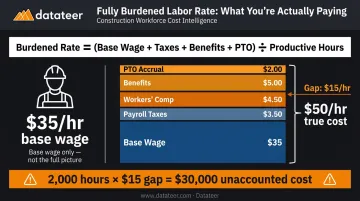
Fully Burdened Rate = (Base Wage + Payroll Taxes + Workers' Comp + Benefits + PTO Accrual) ÷ Productive Hours Worked
A tradesperson earning $35/hour in base wages doesn't cost $35/hour—they cost closer to $50/hour once burden is applied. On a project requiring 2,000 labor hours, that $15 gap represents $30,000 in unaccounted cost. Multiply that across a portfolio of fixed-price projects and the margin erosion becomes structural, not situational.
Why Burden Rates Must Vary by Classification
Applying a single blended company-wide burden rate is a common shortcut with real consequences. Burden varies significantly by:
- Trade — electrical versus ironwork versus HVAC
- Union status — union trades carry different fringe benefit structures
- Geography — prevailing wage requirements on public work add compliance-driven cost layers
- Employment classification — foremen and journeymen often carry different benefit structures
Finance teams need trade- and classification-specific burden tables maintained in the accounting system. When burden rates are wrong at the estimate stage, every downstream calculation (cost-per-unit benchmarks, productivity rates, variance reports, WIP revenue recognition) inherits that error.
Fixing that starts with knowing the actual burdened rate by craft — not a company-wide average. Datateer's Overhead & Burden Rate Analytics dashboard calculates actual fully burdened labor rates by craft, department, and division, and compares budgeted burden rates to actuals. That's how bid teams catch systematic mispricing before it compounds across projects.
How to Set Up a Construction Labor Cost Tracking System
Step 1 – Build a Cost Code Structure Field Workers Will Actually Use
Overly granular cost code structures fail in practice. When crews face 40+ codes, they default to catch-all codes—destroying the data quality the system was built to provide.
For most specialty contractors, 8–15 active cost codes per project phase is the practical ceiling. Codes should mirror how crews naturally describe the work: rough-in, trim-out, service and panel—not abstract CSI MasterFormat subdivisions that mean nothing to someone running wire at 7 AM.
Step 2 – Capture Labor at the Source, Not From Memory
The "reconstruction problem" is real: timesheets completed Friday for work done earlier in the week carry that delay as inherent variance—wrong hours, wrong codes, rounded entries.
Same-day digital time entry by cost code closes this window. Once crews enter time the same day against the correct code, memory degradation stops being a variable — and the data that feeds your job cost reports actually reflects what happened on the job.
Research published in Advanced Engineering Informatics (2025) confirms that manual data transmission creates time gaps, delays decision-making, and increases human error risk—validating what most construction finance managers already suspect from experience.
Step 3 – Separate and Allocate Indirect Labor
Direct labor is traceable to a specific job and phase. Indirect labor—superintendent time split across jobs, safety oversight, shop fabrication, QC inspection—is often absorbed as overhead without being allocated back to projects.
Failing to allocate indirect labor systematically understates true job-level costs and inflates apparent margin. Common allocation methods:
- By direct labor hours per project
- By project duration as a share of total active work
- By revenue percentage
Pick one method and apply it consistently — inconsistent allocation produces job margins that are incomparable across projects, which is its own problem when you're trying to evaluate PM performance or bid accuracy. That comparability becomes especially important in Step 4, where you're projecting costs forward.
Step 4 – Track Labor Committed Costs vs. Actuals vs. Remaining
Labor commitment tracking is the forward-looking component that turns cost tracking from a history report into a project management tool.
Formula: Estimated hours remaining × burdened rate = projected labor cost to complete
When this calculation runs continuously against live ERP data, a CFM can see projected final labor cost while the project is still active—and course-correction is still possible. Datateer's Job Costing & Cost-to-Complete analytics updates this figure automatically at the job, phase, and cost-code level, eliminating the monthly manual refresh.
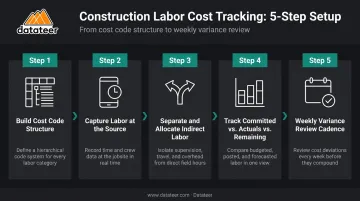
Step 5 – Establish a Weekly Variance Review Cadence
Monthly close labor reviews are too slow for active project management. By the time a monthly WIP report flags a 20% labor overrun, the project may be half-complete.
A practical weekly review process:
- Pull actual hours by cost code against budget for all active projects
- Flag anything trending 10%+ over — don't wait for confirmation
- Document the root cause: scope change, productivity shortfall, overtime, or estimate error
- Feed findings back into the estimating database — so future bids don't repeat the same mistake
Contractors running this cadence typically surface labor overruns 3–4 weeks earlier than those relying on monthly WIP reviews — which is often the difference between a recoverable situation and a margin loss that gets written off at closeout.
Key Labor Cost KPIs Every Construction Finance Manager Should Track
Labor cost as % of total project costs. A rising labor percentage on an active project relative to the original estimate is one of the earliest signals of productivity problems or scope creep—before invoices confirm what the trend already shows. Monitor this at both the project level and the cost-code level for maximum granularity.
Labor productivity rate (units installed per labor hour). This is the most forward-looking labor KPI because it measures output, not just cost input. If a crew is installing 15% fewer linear feet per hour than estimated, the cost overrun is already materializing—even if the numbers haven't surfaced in a variance report yet.
Output-per-labor-hour analysis is the standard method for identifying field performance deviations — it surfaces the problem before the budget report does.
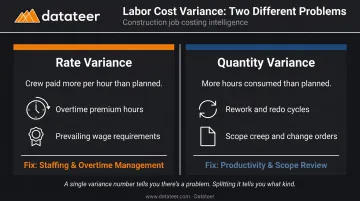
Labor cost variance: rate vs. quantity. These are different problems with different fixes:
| Variance Type | What It Means | Likely Fix |
|---|---|---|
| Rate variance | Crew was paid more per hour than planned | Staffing, overtime management, prevailing wage review |
| Quantity variance | More hours consumed than planned | Productivity, rework reduction, scope review |
Reporting labor variance as a single number tells you there's a problem. Splitting it tells you what kind.
Estimate accuracy ratio (bid labor hours vs. actual labor hours). This is the feedback-loop metric. Tracking bid vs. actual labor hours by project type and trade — consistently, across every job — tightens this ratio over time. The practical result: future bids carry less pricing risk, and the margin you estimated is closer to the margin you actually deliver.
Common Labor Cost Tracking Mistakes
Three patterns account for most of the margin surprises construction finance teams face at project closeout. Each one is fixable—but only if you know where to look.
Reporting Base Wages Instead of Burdened Rates
Projects look healthy during execution, then produce a margin shortfall at closeout. The gap usually traces back to job cost reports built on base wages rather than fully burdened rates.
Establish burdened rate tables by trade classification in the accounting system and require all labor cost reports to use them. No exceptions—not for quick estimates, not for project updates to ownership.
Mixing Change Order Labor with Original Scope Labor
When work driven by a client decision gets coded alongside original budget work, it becomes impossible to separate a contractor productivity problem from a billable scope addition.
CFMA's guidance on change order accounting explicitly requires separate documentation for change order costs that are identifiable and reasonable. In practice, that means dedicated change order cost codes (CO-01, CO-02, etc.) with each CO tracked against its own approved budget—completely separate from the original contract scope.
Reviewing Labor Costs Only at Month-End
By the time the WIP report lands, a project may be too far along to correct overruns without damaging the schedule or the client relationship. At that point, you're doing forensic accounting, not financial management.
Weekly cost-code-level variance reviews—with documented escalation thresholds—are the minimum standard for protecting margins on active work.
From Data Lag to Real-Time Labor Cost Visibility
The traditional WIP labor cost cycle has a hidden cost baked into its structure:
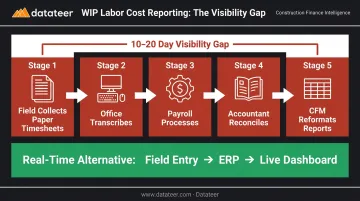
Field collects paper timesheets → office transcribes → payroll processes → accountant reconciles → CFM reformats into reports
This chain creates a 10–20 day window where labor slippage is invisible. The decisions that could have saved margin have already been made by the time the data arrives.
What Real-Time Labor Visibility Actually Looks Like
Genuine real-time visibility means:
- Labor hours captured at the source flow directly into the ERP with validated cost codes
- Burdened costs are calculated automatically using trade-specific rates
- The CFM sees live budget-vs.-actual variance by project and cost code without manual spreadsheet reformatting
- Projected cost to complete updates continuously—not just at month-end
The finance team stops explaining what went wrong last month and starts catching problems while there's still time to act.
According to AGC/Sage 2025 technology research, 54% of firms plan to use mobile software for employee time tracking and approval, and 50% plan to use mobile tools to access job cost reports from the field—reflecting broad industry recognition that the paper-to-payroll cycle is too slow.
How Datateer Closes the Gap
Datateer connects directly to major construction ERPs—Procore, Sage 100/300/Intacct, Viewpoint Vista, Viewpoint Spectrum, Acumatica Construction, Foundation Software, CMiC, Jonas Construction, and others. Labor cost dashboards update overnight as standard, with more frequent refresh intervals available when needed.
The platform's Labor & Materials Productivity dashboard flags labor budget variances at the cost-code level across all active projects simultaneously. When a firm runs Procore alongside Sage, Datateer's automated data cleaning reconciles both systems—standardizing cost codes and mapping data logic—so the finance team never touches a VLOOKUP or manually merges exports before a board meeting.
A Business Analyst from Double L Management captured what this looks like in practice: "The very first time we accessed our data through a Datateer analytics dashboard, that one click replaced two weeks worth of prior work."
Datateer's flat annual pricing covers unlimited users and the full dashboard suite—including Cost Variance, Job Costing & Cost-to-Complete, and Overhead & Burden Rate Analytics—starting at $10,000 per year per data source. Implementation typically takes 2–4 weeks, with the annual fee period beginning only once data is flowing.
Frequently Asked Questions
What is a good labor cost percentage for construction?
Labor typically runs 20–40% of total project costs for most trades, rising higher for MEP and specialty contractors. A single industry average matters less than the trend: a rising labor percentage on an active project relative to the original estimate is a more actionable signal than any benchmark comparison.
What is the average net profit margin for a contractor?
CFMA's 2025 Financial Benchmarker reports an average net income before tax margin of 6.7% for 2024, up from 6.3% in 2023. At margins this thin, a 5% labor cost overrun on a single major project can erase profit from several successful jobs. That's the real business case for precise labor tracking.
How accurate are construction cost estimates?
Estimate accuracy correlates directly with the quality of historical job cost data. Contractors who capture actual labor hours at the cost-code level on every completed project build a feedback loop that improves future bid precision. Those relying on memory or industry averages tend to repeat the same pricing errors on every project.
What is included in the fully burdened labor rate?
The fully burdened rate includes:
- Base wage
- Payroll taxes (FICA, FUTA, state unemployment)
- Workers' compensation insurance
- Health and other insurance benefits
- Retirement contributions
- PTO and holiday accruals
BLS December 2025 data shows construction benefits average 43.6% above wages. Use the burdened rate in every estimate and variance analysis.
How do you track labor costs across multiple projects simultaneously?
The key elements: a consistent cost code structure applied across all projects, daily labor data flowing from the field into the ERP, and a multi-project dashboard showing budget-vs.-actual by project and cost code in a single view. This lets the finance team identify which projects need attention without manually pulling individual reports.
What causes labor cost overruns in construction?
The most common causes:
- Using base wage instead of burdened rates in estimates
- Unplanned overtime accumulating across crews
- Productivity shortfalls from rework or poor job sequencing
- Scope additions coded to original budget lines instead of dedicated CO codes
- Delayed visibility that prevents early corrective action
Separating rate variance from quantity variance pinpoints which cause is driving a specific overrun, and which corrective action will actually fix it.