Introduction
A single clause buried in a construction contract can shift hundreds of thousands of dollars in cost exposure from the owner to the contractor. Contract terms dictate when money moves, who absorbs cost overruns, and how disputes get resolved. Get them wrong, and the consequences surface in your WIP schedule, your cash flow, and your margin.
The challenge for construction finance managers and CFOs is that they often inherit contracts they didn't draft. Yet they're held accountable for billing accuracy, WIP reporting, and protecting margin — all of which hinge on specific contract language buried in documents that rarely get re-read after signing.
This article covers what you need to know: the five primary contract types, the key clauses with the biggest financial implications, how contract structure shapes reporting and cash flow, and the dispute triggers that consistently erode profitability.
Key Takeaways
- A construction contract defines scope, payment terms, risk allocation, and dispute resolution — errors here have direct financial consequences
- Each contract type — lump sum, cost-plus, T&M, unit price, and GMP — shifts financial risk differently
- Clauses like retainage, schedule of values, change orders, and liquidated damages directly affect cash flow and margin
- How WIP is calculated and billed depends on contract type — contract literacy is non-negotiable for finance teams
- Proactive review and disciplined documentation prevent most disputes before they escalate
What Is a Construction Contract?
A construction contract is a legally binding agreement between an owner and one or more contractors establishing the scope of work, timeline, payment structure, and legal obligations of each party. The same framework governs relationships between general contractors and subcontractors.
For a contract to be legally enforceable, Cornell Law School's Legal Information Institute identifies the core requirements as mutual assent (offer and acceptance), adequate consideration, capacity, and legality. In practical terms, this maps to the "3 C's" — consideration, capacity, and consent.
What makes construction contracts different from standard commercial agreements:
- Duration: AIA's 2023 change-order dataset found completed building projects averaged 8 to 33 months depending on project size
- Stakeholder complexity: Owners, GCs, subcontractors, designers, and lenders all interact under overlapping contractual relationships
- Cost uncertainty: Scope, labor, and material costs can shift dramatically over a multi-year project
- Specialized mechanisms: Progress billing, retainage, and schedule of values requirements must be addressed directly — none of these appear in standard commercial contract templates
For finance managers and CFOs, that means zeroing in on payment terms, change order rights, and retainage provisions — the clauses that directly affect cash flow and project profitability.
The 5 Main Types of Construction Contracts
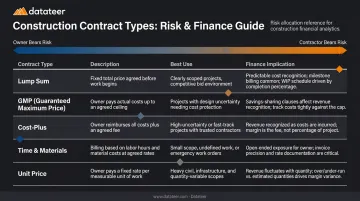
Each contract type shifts financial risk differently between owner and contractor. Choosing the wrong structure — or misunderstanding the one you've inherited — creates billing and reporting problems that compound over the project lifecycle.
Lump Sum (Fixed-Price)
The contractor agrees to complete the full scope for a predetermined price and carries the financial risk of cost overruns. AIA identifies stipulated sum contracts as the most common owner-contractor agreement form — they work well for well-defined scopes and create predictable billing schedules for owners.
Best for: Well-defined scope with minimal expected changes. Finance implication: Billing tracks against a schedule of values; margin is protected when scope is controlled.
Cost-Plus
The owner reimburses actual project costs (labor, materials, equipment, subcontractors) plus an agreed fee or percentage for contractor overhead and profit. Risk shifts to the owner, but the trade-off is flexibility when scope isn't fully defined at contract signing.
Best for: Fast-track projects or work that must begin before design is complete. Finance implication: Demands rigorous cost documentation — every invoice must be defensible.
Time and Materials (T&M)
Payment is based on labor hours and materials consumed. Flexible for undefined or rapidly evolving scopes, but without a spending cap, T&M contracts create significant budget exposure for owners and cash flow unpredictability for contractors.
Best for: Emergency work, small projects, or highly variable scopes. Billing consideration: Without real-time labor and material tracking, billing disputes are difficult to resolve and costs become impossible to defend.
Unit Price
Payment is tied to measurable quantities of completed work — cubic yards of concrete, linear feet of pipe, square feet of paving. AIA notes unit price contracts are common in public infrastructure work including highways, bridges, and sewer systems where exact quantities can't be fixed at signing.
Best for: Civil and infrastructure work with quantity uncertainty. Finance implication: Billing accuracy depends on field quantity verification; over/under-measurement directly affects revenue.
Guaranteed Maximum Price (GMP)
The owner's total cost exposure is capped while maintaining flexibility. The contractor recovers actual costs plus a fee, but absorbs overruns beyond the GMP unless the owner formally approves a cap adjustment for directed scope changes. Savings below the cap are often shared between owner and contractor.
Best for: Projects requiring cost transparency with an owner ceiling. Finance implication: Requires the most detailed financial tracking of any contract type — cost documentation, change order management, and savings reconciliation all need real-time visibility.
Key Terms Every Construction Finance Manager Should Know
Scope of Work and Change Orders
The scope of work defines exactly what the contractor is obligated to deliver. Any deviation — added work, deleted work, or design changes — should trigger a formal change order.
The problem is that change orders frequently don't get processed before the work happens. AIA's analysis of over 11 million construction contracts found average project cost change across the lifetime of a project runs approximately 4%, with larger projects ($50M+) averaging 11.29 change orders. Work performed outside the original contract without a signed change order is the single most reliable path to a payment dispute.
Schedule of Values (SOV)
The SOV is the line-item breakdown of contract value tied to project milestones or phases. It's the foundation of every pay application: it controls when cash flows into the project and in what amounts. An SOV that's poorly structured at contract execution creates billing friction for the entire project duration.
Finance teams should scrutinize the SOV at contract signing, not after the first pay application dispute.
Retainage
Retainage is a percentage of each progress payment withheld by the owner until substantial or final completion. ConsensusDocs states retainage typically ranges from 5% to 10%, though several states have enacted statutory caps — California, Texas (for public works over $5M), Oklahoma, and Massachusetts each cap public or covered private retainage at 5%.
The cash flow impact is substantial. CFMA notes that retainage strains cash flow and that final payment often arrives months after project completion — tying up working capital that could be deployed on new work.
Liquidated Damages
Liquidated damages (LD) are pre-agreed financial penalties triggered when the contractor fails to meet contractual milestones, most commonly the substantial completion date. AIA defines them as predetermined sums owed when specific milestones are missed, and FAR 52.211-12 requires them on federal construction contracts that run late.
Unlike actual damages, which require proof of loss, LDs are a fixed, contractual liability. Any schedule slippage must be monitored against LD exposure from day one.
Substantial Completion and Final Completion
These two milestones carry very different payment implications:
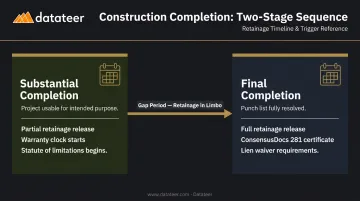
- Substantial completion: The project is usable for its intended purpose. Per AIA, this triggers partial retainage release and starts warranty and statute of limitations clocks
- Final completion: All punch list items are resolved. ConsensusDocs 281 (Certificate of Final Completion) formally authorizes release of retainage held since substantial completion
The gap between these two milestones — sometimes months — is where retainage sits in limbo. Finance teams should document the specific release conditions at contract signing: punch list approval authority, lien waiver requirements, and any owner-specified certificate forms that must accompany the final payment request.
Dispute Resolution Clauses
Most construction contracts specify a mandatory dispute resolution sequence. The three common pathways each carry distinct implications for finance teams:
- Mediation: Required first step in most AIA contracts; informal, non-binding, preserves the relationship
- Arbitration: Binding resolution without a jury; limits discovery rights and can compress timelines — affecting how aggressively a payment dispute can be documented and pursued
- Litigation: Full court process; broader discovery but slower and more expensive
Understanding which process applies before a dispute arises determines how finance teams should document payment problems and at what point to escalate to legal counsel.
How Contract Type Affects Financial Management and Reporting
Contract structure doesn't just affect how you build — it determines how you bill, how you report, and how you manage cash.
Billing Rhythm and WIP Profile
Each contract type creates a distinct financial reporting dynamic:
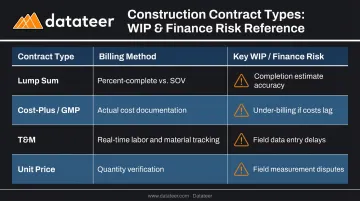
- Lump sum: Percent-complete billing against an SOV; WIP accuracy depends on reliable completion estimates
- Cost-plus / GMP: Actual cost documentation and reconciliation required for every pay application; under-billing risk increases if costs aren't captured promptly
- T&M: Real-time labor and material tracking drives billing; delays in field data entry translate directly to billing delays
- Unit price: Quantity verification drives revenue recognition; field measurement disputes are a common trigger for billing discrepancies
Managing a portfolio with mixed contract types compounds reporting complexity. NASBP notes that underbillings and overbillings directly intersect with cash flow, earned profit, working capital, and bonding capacity — meaning WIP accuracy is not just an accounting concern, it affects the firm's ability to bond new work. The CFMA 2025 Benchmarker reported underbillings to equity at 8.1% across all companies surveyed — a metric that moves materially based on how accurately WIP is calculated.
Cash Flow Timing Risk
Three contract-level factors consistently delay cash receipts:
- Retainage withholding: 5–10% of every progress payment held until completion
- Pay application schedules: Fixed billing windows mean late submissions cost an entire payment cycle
- Change order approval timelines: Approved COs convert to billable revenue; pending COs do not
Finance managers need a real-time view of what's billed, what's retained, and what's pending approval. Without that visibility, liquidity forecasting is built on incomplete data.
Where Datateer Fits
Manual WIP reporting — exporting from Sage or Vista, reconciling in Excel, cleaning cost codes — typically creates a 10–20 day reporting lag. By that point, the data is stale and margin problems have had weeks to compound.
Datateer's automated reporting platform pulls live data directly from 12+ construction ERPs (Procore, Sage, Viewpoint Vista, Acumatica, CMiC, Foundation Software, and others) to give finance teams a unified view across all active contracts. Three modules address the specific risks each contract type creates:
- WIP & Financial Truth dashboard: Surfaces billed vs. earned positions, over/under-billings, and margin per job overnight — no manual intervention required
- Retainage Tracking module: Tracks A/R retainage (held by owners) and A/P retainage (held on subcontractors), flags overdue releases, and feeds directly into 13-week cash flow forecasting
- Change Order Aging dashboard: Shows unapproved COs by days outstanding, so stalled change orders where work is complete but payment hasn't followed don't fall through the cracks
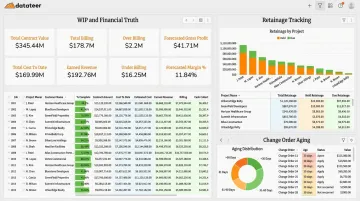
For firms where this data currently lives across spreadsheets and ERP exports, the platform brings it into a single real-time view.
Common Construction Contract Disputes and How to Prevent Them
Arcadis's 2025 Construction Disputes Report found that average construction dispute value increased 40% in 2024 versus the prior year and had nearly doubled since 2021. The recurring causes are predictable: contractual compliance failures, contract administration problems, poorly drafted claims, design errors, and owner-directed changes.
Most of these are preventable.
Scope Creep and Undocumented Changes
Performing work outside the original contract without a signed change order is the most reliable way to create a payment dispute. A strict change order protocol — documented in the contract, enforced in the field, and tracked by finance from the moment a CO is submitted — closes this exposure before it compounds.
The Datateer Change Order Aging module tracks every CO across its lifecycle (pending, approved, denied, executed) and flags aging unapproved COs as a leading indicator of billing dispute risk before the exposure compounds.
Payment Delays and Retainage Disputes
Unclear pay application procedures, missing lien waivers, or ambiguous retainage release conditions create cash flow crises that are disproportionate to the actual dispute. Finance teams should:
- Document contractual retainage release conditions at contract execution
- Track every open retainage balance by project and counterparty
- Monitor pay application submission deadlines and approval timing
Delays and Liquidated Damage Claims
Schedule slippage triggers LD clauses, turning a delay into a direct financial liability. Proactive schedule monitoring and documented force majeure or owner-caused delay events are the primary defenses. Finance teams need current visibility into three things — not at month-end, but continuously:
- The LD rate and the project milestone it's tied to
- Documented force majeure or owner-caused delay events
- Current schedule position relative to LD trigger dates
Frequently Asked Questions
What are the 5 types of construction contracts?
The five main types are lump sum (fixed-price), cost-plus, time and materials (T&M), unit price, and guaranteed maximum price (GMP). Each allocates financial risk differently — lump sum puts overrun risk on the contractor, while cost-plus and T&M transfer most cost exposure to the owner.
What are the 3 C's of a contract?
The 3 C's refer to the core legal requirements of a valid contract: consideration (something of value exchanged by both parties), capacity (parties must be legally competent to enter a contract), and consent (mutual, voluntary agreement to the terms).
Does a construction contract have to be notarized?
No. FindLaw confirms that most business contracts do not require notarization to be legally binding — enforceability depends on offer, acceptance, and consideration. Notarization may be required for specific related documents like lien waivers or bond agreements in certain states, but not the contract itself.
What is retainage in a construction contract?
Retainage is a percentage of each progress payment — typically 5–10% — withheld by the owner until project completion. It incentivizes quality and timely completion, but creates real cash flow pressure for contractors and subcontractors waiting on final payment.
What is the most common type of construction contract?
Lump sum (fixed-price) contracts are the most widely used, particularly for projects with well-defined scopes. AIA identifies the stipulated sum as the most common owner-contractor agreement form — it offers budget certainty and straightforward billing.