Introduction
Construction is a thin-margin business. According to CFMA's 2025 Financial Benchmarker, pre-tax net income margins for Industrial and Nonresidential contractors averaged just 4.4% in fiscal 2024. Heavy Construction firms fared better at 8.3%, Specialty Trades at 7.7% — but none of these numbers leave much room for error.
At a 4.4% margin, absorbing a single unrecovered overhead point shrinks profit by roughly 23%. Two points cuts it nearly in half. That math is why overhead management matters more in construction than in almost any other industry.
The problem rarely announces itself. Overhead creep is gradual — a new hire here, a software subscription there, a lease signed during a strong quarter. Each decision makes sense in isolation. Collectively, they build a cost floor that persists even when project volume drops.
Understanding how that floor gets built — and how to lower it without gutting operational capacity — is what separates firms that hold margin from those that watch it erode quarter by quarter. This article covers both: where overhead accumulates and how to allocate it accurately across active projects.
Key Takeaways
- Overhead vs. direct cost: Direct costs (labor, materials) are tied to specific jobs; overhead covers firm-wide operating costs shared across all projects
- Margin math is unforgiving: At a 4.4% pre-tax margin, one unrecovered overhead point destroys nearly a quarter of profit
- The biggest overhead drivers: Administrative headcount, equipment and facility carrying costs, and software/vendor fragmentation account for most of the problem
- Cutting overhead requires: Better upfront hiring and vendor decisions, tighter active cost management, and scaling capacity to match actual project volume
- Allocation methodology matters as much as the total: Misallocated overhead distorts job cost reports and hides true project profitability
How Construction Overhead Costs Typically Build Up
Overhead rarely spikes — it accumulates. Office leases, insurance premiums, software subscriptions, and administrative salaries each carry individual justification at the time of commitment. The problem is compounding: by the time the cost structure is reviewed, it far exceeds what was originally planned.
The Visibility Problem
During growth phases, rising revenue masks a worsening overhead percentage. A firm billing $50M may have the same overhead ratio as when it billed $30M — or a worse one — and never notice because absolute revenue is climbing. The ratio only becomes visible during a slow project cycle, a margin review, or an economic downturn.
By the time overhead creep registers as a problem, the cost floor is already set — and cutting it takes far longer than it took to build.
The Ratchet Effect
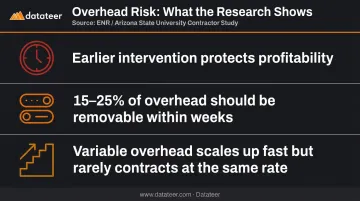
Fixed commitments added during growth phases create cost floors that don't shrink proportionally when volume drops. A 2015 ENR/Arizona State study of approximately 500 US contractors found that 92% cut overhead during the 2008–2013 downturn — but most did so too late. The researchers drew three conclusions worth building into any overhead strategy:
- Earlier intervention would have protected profitability in the majority of cases
- Approximately 15–25% of overhead should be structured as removable within weeks, not quarters
- Variable overhead scales up quickly during busy periods but rarely contracts at the same rate — leaving the firm structurally more expensive at each successive growth stage
Key Cost Drivers for Construction Overhead
Three categories account for most overhead bloat in mid-size construction firms.
Administrative and Operational Headcount
Staff added during growth — including benefits and payroll taxes — becomes a structural fixed commitment regardless of project workload. For Industrial and Nonresidential contractors, CFMA reports base payroll at 3.6% of revenue and SG&A at 7.3% of revenue in fiscal 2024.
Administrative headcount is the largest and stickiest category because it's the hardest to reduce quickly without operational disruption.
Equipment and Facility Footprint
Owned equipment and leased space generate ongoing costs — depreciation, insurance, registration, maintenance — whether or not they're being used. Firms that size their facilities and fleet for peak capacity pay full carrying costs during slow periods. The U.S. Army Corps of Engineers' equipment costing methodology separates ownership cost (depreciation plus capital cost of money per hour) from operating expenses — a clear reminder that carrying costs accrue with or without utilization.
Software and Vendor Fragmentation
Subscriptions acquired piecemeal over multiple years create a compounding fixed cost layer that rarely gets audited. Common findings during any deliberate review include:
- Overlapping tools solving nearly identical problems
- Unused licenses paid for across multiple billing cycles
- Redundant vendor relationships with no consolidation plan
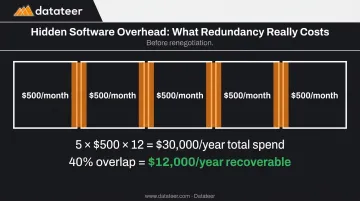
Five $500/month subscriptions with 40% overlap represent $12,000/year in recoverable overhead — before any renegotiation.
Financial Visibility Gaps
When finance teams work from data that's weeks old, gradual overhead growth goes undetected. Construction firms operating on manual ERP exports and spreadsheet reconciliation can experience reporting lags of 10–20 days for WIP reports, according to Datateer's documented client experience. By the time the numbers surface, overhead drift has already become a structural problem — not a correctable variance.
Cost-Reduction Strategies for Construction Overhead
Overhead reduction operates at three distinct levels: decisions made before overhead is committed, management practices applied while it's active, and the operational context that makes overhead efficient or wasteful. Addressing only one level rarely solves the problem.
Strategies That Reduce Costs by Changing Decisions
These decisions set the cost baseline before a dollar of overhead is ever committed — which is why they carry the most weight.
Set an overhead rate ceiling before making fixed commitments. Research your segment benchmark — CFMA reports SG&A at 7.3% for Industrial and Nonresidential contractors — and set a firm internal target. Use that ceiling as a filter: any new hire, lease, or fleet addition that would push overhead above the ceiling requires a corresponding revenue justification before approval.
Make deliberate buy vs. rent vs. outsource decisions. Non-core functions like bookkeeping, HR, legal, and marketing can be outsourced, creating costs that scale with project volume rather than fixed commitments that persist regardless. Ownership and employment create floors; outsourcing creates flexibility.
Conduct a deliberate software and vendor audit. Identify overlapping subscriptions, consolidate where possible, and eliminate tools that don't reduce labor time or improve output quality. A structured audit — not an ad-hoc review — surfaces more savings than most firms expect.
Embed overhead recovery into every bid. Overhead not priced into project bids is absorbed by the firm's margin. Calculate a consistent absorption rate and apply it to every estimate — calibrated to your actual forward-looking work mix, not historical averages.
An FMI analysis found that a shift toward more subcontracting and less direct labor caused one contractor to under-recover $451,950 in overhead because their markup rates were built for a different cost mix. Recovery rates must track where the work is actually going.
Strategies That Reduce Costs by Changing How Overhead Is Managed
Once overhead is committed, active management determines how much of it compounds into a problem versus gets caught early.
Conduct quarterly overhead audits. Comparing actual spending against the budgeted overhead rate at quarter-end — rather than year-end — creates time to correct before the next project cycle is priced. Include both fixed and variable categories in each review.
Adopt a profit-first or ring-fenced overhead budget. Separating overhead funds structurally from project revenue enforces spending discipline through account structure rather than ad-hoc judgment. This is especially important during profitable periods when the temptation to expand is highest.
Implement real-time financial dashboards. Monthly reporting means overhead overruns are often three weeks old before anyone sees them — past the point where corrective action changes the outcome. Daily or overnight visibility changes what's still fixable.
Datateer's Overhead, G&A & Burden Rate Analytics module connects directly to construction ERPs — including Sage, Procore, Viewpoint Vista, Acumatica, and Foundation Software — delivering overhead absorption per project, budgeted vs. actual burden rates, and under-allocated overhead flags on an overnight refresh cycle.
- Tighten AR and AP processes. Late payment fees, interest charges, and strained subcontractor relationships inflate the real cost of carrying overhead. Proactive collections, automated invoice processing, and early payment discipline reduce these hidden costs without touching a single headcount line.
Strategies That Reduce Costs by Changing the Operational Context
Business structure determines whether overhead works for the firm or against it — independent of any individual spending decision.
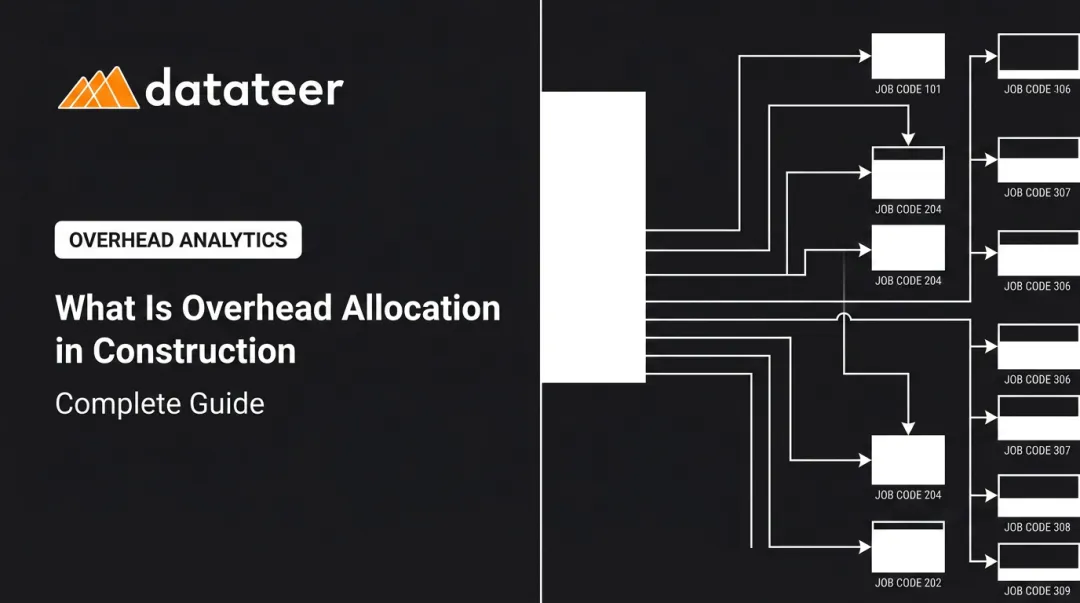
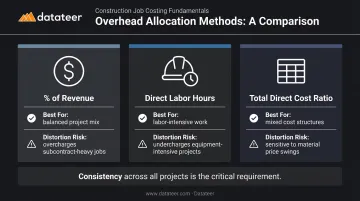
Adopt a consistent overhead allocation methodology. The three most common approaches are: allocation as a percentage of revenue, by direct labor hours, or by total direct cost ratio. Each has different distortion risks — revenue-based allocation overcharges subcontract-heavy jobs; labor-hour allocation undercharges equipment-intensive work. What matters most is consistency. Without a defined method, some projects absorb disproportionate overhead, distorting job cost reports and hiding the true profitability of individual project types.
Scale overhead commitments to contracted backlog, not pipeline. Firms that expand headcount or lease space based on forecasted revenue frequently find themselves carrying fixed overhead through slow periods. Link expansion decisions to signed contracts only.
Renegotiate supplier and vendor contracts on a defined cycle. Insurance premiums, SaaS pricing, equipment lease rates, and professional service retainers all shift with market conditions. Firms that don't review these on a regular schedule pay above-market rates that could be reduced without operational impact.
Eliminate manual data workflows from finance and accounting. Time spent extracting, cleaning, and formatting data from ERP and project management systems is overhead-intensive labor with a direct automation substitute.
Datateer's documented client experience shows manual WIP report preparation alone can consume two weeks of staff time per cycle. When ERP data flows directly into dashboards via automated sync, that capacity either reduces personnel overhead or shifts finance teams from data gathering to analysis that actually affects outcomes.
Conclusion
Reducing construction overhead rarely requires a single dramatic cut. It requires identifying where overhead originates — across decisions, management gaps, and operational context — and addressing each root cause rather than targeting visible expense lines. Firms that treat overhead as a number to cut rather than a signal to investigate often cut the wrong things, and the underlying problem resurfaces within a year.
Effective overhead management operates on three levels:
- Strategic — embedded in bid pricing and budget design from the start, not retrofitted after the fact
- Contextual — calibrated to current business scale and project mix, not locked to historical commitments
- Continuous — built on regular audits, consistent allocation discipline, and financial visibility that reflects what's happening now
Platforms like Datateer's Overhead & Burden Rate analytics give construction finance teams the real-time visibility to monitor these dynamics across projects and time periods — without waiting weeks for reports that are already stale.
Frequently Asked Questions
What is the average overhead rate for construction?
There is no single authoritative all-sector average. CFMA's most current sector-specific figure is 7.3% SG&A for Industrial and Nonresidential contractors in fiscal 2024. Rates vary meaningfully by firm size, project type, and geography — track your own rate over time rather than benchmarking against a generic industry average.
What are the most effective ways to decrease overhead costs in construction?
The highest-impact levers are better upfront decisions about fixed commitments (staffing, fleet, space), tighter active management with real-time financial visibility, and operations sized to actual project volume through backlog-linked expansion and regular contract renegotiation. Consistent overhead allocation underpins all three — you can't reduce what you can't accurately measure.
What is the biggest expense in construction?
Direct costs (labor and materials) represent the largest share of project cost. Within overhead, administrative headcount and equipment or facility carrying costs are typically the largest categories. Composition varies considerably by firm size and type.
Can overhead costs be fixed?
Some overhead is inherently fixed — office rent, salaried staff, insurance — and remains constant regardless of project volume. Variable overhead fluctuates with activity. The goal is not to eliminate fixed overhead but to size it appropriately to sustainable revenue levels, and to ensure a meaningful portion remains removable if volume drops suddenly.
What is the difference between direct and indirect overhead in construction?
Direct (job) overhead covers costs tied to a specific project: site supervision, temporary facilities, project-specific equipment, and job-site insurance. Indirect (general) overhead covers firm-wide operating costs — office rent, administrative staff, corporate insurance — shared across all projects. Mixing the two distorts both job costing and G&A reporting.
How do construction companies allocate overhead to projects?
The three most common methods are: as a percentage of revenue, as a percentage of direct labor hours, or as a percentage of total direct costs. Each method produces different allocations depending on a project's labor, material, and subcontract mix. Choosing a method and applying it consistently is essential — inconsistent allocation produces job cost reports that misrepresent which project types are actually profitable.