Introduction
Construction contractors routinely complete work and submit invoices — then wait. Not because their client is slow to pay, but because a portion of every payment is deliberately held back by design. That's retainage, and it's one of the most consequential financial mechanisms in the construction industry.
Retainage (also called retention or holdback) is the practice of withholding a percentage — typically 5% to 10% — of each progress payment until a project reaches defined completion milestones. For a $10 million project, that's potentially $500,000 to $1 million sitting in someone else's account while your crews are still on site.
This article covers the full picture: what retainage is, how it works through the payment chain, its impact on each party, the legal framework governing it, and how to account for it correctly. For CFOs, controllers, and project accountants, retainage touches cash flow, balance sheet classification, and revenue recognition — making it essential knowledge for anyone managing construction finances.
Key Takeaways
- Retainage is standard across U.S. construction, typically 5–10% of each progress payment
- It flows down the entire payment chain — owner to GC to subcontractor to sub-subcontractor
- While owners benefit from financial leverage, contractors and subs absorb real cash flow strain
- State and federal laws increasingly cap retainage at 5% and define mandatory release conditions
- Tracking retainage receivable and payable separately, with precision, is critical to financial health
What Is Retainage in Construction?
Retainage is the deliberate withholding of a percentage of each progress payment owed to a contractor or subcontractor, held as financial security until the project reaches a defined completion milestone.
In the U.S., the terms retainage, retention, and holdback are used interchangeably — though "retainage" dominates American construction contracts, while "retention" is more common in the UK and Australia.
Where the Practice Came From
The practice traces back to 1840s Britain during the Railway Mania boom. Railway companies, overwhelmed by inexperienced contractors entering a suddenly booming market, began withholding a minimum of 20% of contractor payments as security against default and incomplete work. That 20% rate looks extreme by modern standards — but the core logic (withhold until performance is proven) spread globally and eventually became standard in U.S. construction contracts.
What Rate to Expect
The industry standard sits at 5–10% of each progress payment. Historically, 10% was the norm, but legislative pressure has pushed many states toward 5% caps — particularly on public projects. Common rate structures include:
- 10% flat — still used on many private contracts and older public project templates
- 5% cap — required on public projects in many states; California's SB 61 (effective January 1, 2026) extends this to private projects; New York enacted similar legislation in 2023
- Step-down — contracts starting at 10% that reduce to 5% once the project reaches 50% completion
How It Flows Through the Payment Chain
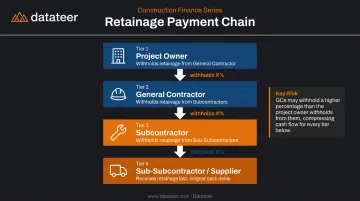
Retainage applies at every level of the project hierarchy:
- Owner withholds from the general contractor (GC)
- GC withholds from subcontractors
- Subcontractors may withhold from sub-subcontractors or suppliers
GCs sometimes withhold a higher percentage from subs than the owner withholds from them — stacking the cash flow burden at the lower tiers. State prompt payment laws are increasingly targeting this practice, but it remains common on projects where the GC contract and subcontract terms aren't aligned.
How Retainage Works: A Practical Example
The Numbers in Action
Consider a $5 million commercial project with a 5% retainage clause. Each month, the GC submits a $500,000 progress invoice. Here's what actually gets paid:
| Invoice Amount | Retainage (5%) | Net Payment |
|---|---|---|
| $500,000 | $25,000 withheld | $475,000 paid |
Repeated across 10 billing periods, the owner holds $250,000 by project end. On a 10% retainage contract, that doubles to $500,000, all legitimately withheld under the contract terms.
The GC mirrors this downstream. When the plumbing sub invoices $100,000 for completed rough-in work, the GC withholds $5,000 (5%) and pays $95,000. That sub finishes its scope in month 3 of a 20-month project and then waits nearly two years to collect the remainder.
When Retainage Gets Released
Release isn't automatic. Standard conditions include:
- Substantial completion — the project is sufficiently complete for its intended use
- All punch list items resolved
- Final acceptance signed off by the owner or architect
- Lien waivers submitted from the GC and all subcontractors
- Subcontractor payments confirmed as settled
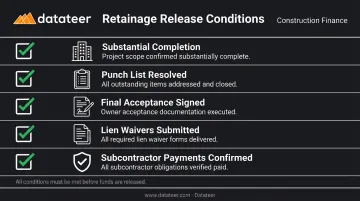
Disputes over what actually constitutes substantial completion are among the most common causes of retainage delays. One party says the project is done; the other points to outstanding items. Without clear contract language, these disputes can hold retainage for months.
Tiered and Variable Retainage Structures
Not all retainage clauses are static. Common variations include:
- Step-down provisions: Start at 10%, reduce to 5% at 50% completion
- Line-item release: Subcontractors who finish their scope early can receive retainage release even while the broader project continues
- Zero retainage after milestones: Some contracts eliminate retainage entirely once the project achieves substantial completion
These structures ease working capital pressure for subs and GCs while preserving the owner's ability to enforce completion. Negotiating the right structure upfront — before a dispute surfaces — is where contract language pays for itself.
The Purpose and Benefits of Retainage
Retainage has persisted for over 180 years because it solves a real problem: owners paying in full before work is verified complete have little recourse if something goes wrong. It gives owners three concrete protections:
- Quality assurance — withheld funds keep contractors financially accountable through punch-list completion, not just framing or rough-in
- Defect correction leverage — owners can fund remediation work directly from retained funds rather than filing suit to recover costs
- Default protection — if a contractor walks off the job, retained funds cover the cost of a replacement contractor or direct payments to unpaid subs
There's also an indirect benefit for contractors. Agreeing to retainage upfront can eliminate the need for a performance bond — a guarantee that typically costs 1–3% of the contract value on larger projects. For contractors with a strong track record, negotiating lower retainage in place of bonding can reduce total project overhead meaningfully.
The Cash Flow Challenge: How Retainage Affects Each Party
Owner's Perspective
Owners are the clear beneficiaries. They maintain financial leverage without laying out additional capital and gain a funded mechanism to address disputes or incomplete work — at the cost of a more complex payment administration process.
General Contractor's Perspective
GCs face a direct squeeze. CFMA's 2024 Financial Benchmarker reports that general contractors often earn net margins of just 1.4% to 3.5%. A standard 5% retainage withholding can exceed the entire project profit margin — so the GC's entire profit may sit unreleased until the project closes.
Meanwhile, the GC continues funding full payroll, materials, equipment costs, and subcontractor payments at 100 cents on the dollar. On long-duration projects, this working capital gap creates real pressure to draw on credit lines or reserves.
The cash flow impact typically shows up as:
- Margin compression: Retainage withheld can exceed total project profit on thin-margin jobs
- Working capital strain: Full costs flow out while 5-10% of billings stay locked
- Credit dependency: Extended projects force GCs to carry lines of credit longer than planned
Subcontractor's Perspective
Subcontractors often bear the most disproportionate burden. A mechanical sub who completes all work in month 2 of a 24-month project may wait nearly two years to collect retained funds — all while operating at full cost. Modern prompt payment laws in many states now provide for line-item release to partially address this, but enforcement varies.
Material Supplier's Perspective
Suppliers typically hold the weakest position. They deliver materials early, carry full production and delivery costs, and often have no direct retainage recovery mechanism. In some states, material-only suppliers are exempt from retainage by statute — verify this before signing any contract.
The Risk of Retainage Abuse
Some GCs withhold more from subs than owners withhold from them — using retainage as a cash management tool rather than a quality safeguard. Others use retainage as leverage in bad-faith disputes. The California Supreme Court addressed this directly in United Riggers & Erectors v. Coast Iron & Steel (2018), ruling that a "good faith dispute" justifying retainage withholding must relate specifically to the retention payment itself — not to unrelated claims between parties. Subcontractors in California now have stronger legal footing to demand timely release.
Retainage Laws and Release Conditions
Federal Framework
The Federal Acquisition Regulation (FAR 32.103) governs direct federal construction contracts. Key provisions:
- Maximum retainage is 10%, but only when the Contracting Officer documents unsatisfactory progress
- If satisfactory progress is achieved, the contractor is paid in full with no retainage
- Retained amounts must be paid promptly upon contract completion
The federal government's position has been clear since 1983: the Office of Federal Procurement Policy directed agencies to eliminate retainage as a default practice. The DOD, GSA, and DOT all adopted zero-retainage policies as a result.
State Law Landscape
More than 30 states have enacted retainage statutes for private projects. The variation is significant:
| State | Key Rule |
|---|---|
| California | 5% cap on private projects (SB 61, effective Jan. 1, 2026) |
| New York | 5% cap on private contracts of $150,000+ (2023, tightened 2025) |
| New Mexico | Retainage prohibited on most public and private projects |
| Illinois | 10% first half of project, reduces to 5% at 50% completion |
| Connecticut | Retainage must be held in interest-bearing escrow accounts |
| Louisiana | Retainage on contracts over $50,000 must be held in interest-bearing escrow |
| Ohio | Release required within 30 days of substantial completion |
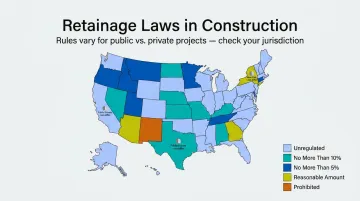
Operating across multiple states without jurisdiction-specific contract templates creates real legal and financial exposure — the rules are simply too different to manage with a one-size-fits-all approach.
Contract Language Governs
Regardless of what state law permits, the construction contract is the primary governing document. If retainage terms aren't explicitly written into the contract, there's no retainage. More importantly, retainage is negotiable in most U.S. jurisdictions — percentage, release trigger, step-down provisions, and escrow requirements are all open to negotiation. Contractors with strong track records regularly negotiate down from 10% to 5%, add step-down clauses at 50% completion, or secure earlier release triggers — all of which directly reduce the cash tied up on any given project.
Retainage in Construction Accounting
How to Record It
Two entries, two sides of the balance sheet:
- Retainage Receivable (asset): Amounts withheld from your firm by the owner — money you've earned but haven't collected yet
- Retainage Payable (liability): Amounts your firm withholds from subcontractors — obligations you'll eventually need to pay out
Under ASC 606, revenue is recognized as performance obligations are satisfied — not when retainage cash is received. This means a contractor who has earned $2 million in retainage receivable has already recognized that revenue, but the cash hasn't arrived. If retainage isn't tracked separately from total recognized revenue, it distorts cash flow analysis and can mask liquidity problems.
The FASB's own guidance draws a further distinction: retainage is a receivable if the only condition remaining before payment is the passage of time (substantial completion has occurred). It's a contract asset if payment is still conditioned on completing additional performance obligations. That classification matters for balance sheet presentation and financial statement accuracy.
The Multi-Project Tracking Problem
Tracking retainage across 10, 20, or 50 active projects — each with different rates, release conditions, subcontractor tiers, and state-specific rules — is where spreadsheets break down. Firms relying on manual processes typically discover retainage discrepancies late: after release windows have passed, after subcontractors file disputes, or during year-end reconciliation when nothing can be done in real time.
The problem compounds at the subcontractor level. A GC managing 15 subs across 8 projects needs to know, at any given moment, which retainage amounts are overdue, which are approaching release milestones, and what the net retainage position is across the entire portfolio. Spreadsheets don't answer those questions proactively.
How Automated Analytics Address the Gap
Datateer's construction intelligence platform pulls retainage receivable and payable data directly from connected ERPs — including Procore, Sage, Viewpoint Vista, Acumatica, Foundation Software, and others — through automated overnight data syncs. The result is retainage visibility that surfaces problems before they become disputes or write-offs.
The platform tracks both sides of the retainage equation across the full project portfolio:
- A/R retainage: Amounts held by owners against your billings
- A/P retainage: Amounts your firm holds on subcontractors
- Release schedule timelines: Upcoming milestones by project
- Overdue releases: Retainage that should have been released but hasn't, tying up working capital
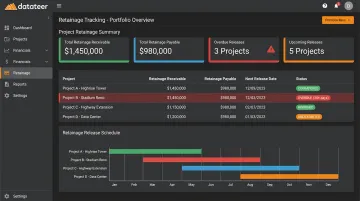
Retainage schedules feed directly into 13-week cash flow forecasting, so upcoming releases are modeled into forward-looking liquidity projections rather than tracked as static balance sheet items.
For construction CFOs and controllers managing multiple active projects across jurisdictions, daily visibility into retainage aging — without manual spreadsheet reconciliation — replaces end-of-month discovery.
Frequently Asked Questions
What does retainage mean in construction and how is it paid?
Retainage is a percentage (typically 5–10%) of each progress payment withheld by the project owner until substantial completion or other contract-defined milestones are met. Once conditions are satisfied, the owner releases the held funds to the GC, who then pays withheld amounts to their subcontractors.
What is the difference between retainage and retention in construction?
In U.S. construction, "retainage" refers to the withheld amount; "retention" can describe the act of withholding — but the two terms are widely used interchangeably. International markets, particularly the UK and Australia, predominantly use "retention" to describe the same practice.
What is a typical retainage percentage on a construction project?
The standard range is 5–10%. Ten percent was historically common, but many states now cap public project retainage at 5%, with California and New York extending similar caps to private projects. Contracts often start at 10% and step down to 5% at the 50% completion mark.
Who holds the retainage funds during a construction project?
The project owner typically holds retainage withheld from the GC; the GC holds retainage withheld from subcontractors. In some states — Connecticut, Louisiana, and Ohio among them — retainage must be held in a separate interest-bearing escrow account rather than commingled with general operating funds.
Can retainage be negotiated in a construction contract?
In most U.S. jurisdictions, retainage terms are negotiable: the percentage, release trigger, and step-down schedule can all be modified by agreement. Subject to applicable statutory caps, contractors with strong performance histories regularly negotiate more favorable terms than contract defaults allow.
How is retainage recorded in construction accounting?
Retainage owed to a contractor is recorded as Retainage Receivable (an asset); retainage withheld from subcontractors is recorded as Retainage Payable (a liability). Under ASC 606, revenue is recognized as work progresses — not when retainage cash is actually received — so retainage balances must be tracked separately for accurate financial reporting.