

Introduction
Every construction project generates change orders. The question is whether your team manages them or reacts to them.
A construction change order is a formal, written amendment to an existing contract — modifying scope, price, or schedule with the signatures of all parties. The process is the governed sequence of steps that produces that amendment. Miss a step, and you risk unpaid work, schedule disputes, and legal exposure.
This article is written for GCs, subcontractors, project managers, and construction finance professionals. According to AIA's analysis of 18,229 completed U.S. projects, projects valued between $10M and $50M average nearly 8 change orders each — with cost increases averaging 4–5% of the original contract value.
On a $20M project, that's roughly $900,000 moving through a process that most teams execute informally.
What follows covers each step in sequence, the failure points at every stage, and what the finance team needs to track throughout.
Key Takeaways
- A signed change order is the only contractual basis for payment on extra work — verbal directives don't qualify.
- The process follows a defined sequence: identify, notice, assess, draft, negotiate, execute, record.
- Unposted change orders distort WIP reports and hide margin fade before you have a chance to act.
- Every step must produce written documentation — field logs, cost breakdowns, signatures.
- Post approved change orders immediately — not at month-end close.
What Is the Construction Change Order Process?
A change order is a formal, written amendment to an existing construction contract. It modifies one or more of three elements: scope of work, contract price, or project schedule. The "process" is the governed sequence of steps that produces this amendment — from the moment a change event is identified through final incorporation into the contract and financial records.
That sequence exists to protect all parties. Without it, contractors perform work with no legal basis for payment, owners face undocumented cost additions, and disputes escalate into claims.
Key Terms to Distinguish
These terms are frequently confused in the field:
| Term | What It Is | What It Isn't |
|---|---|---|
| Change Order (CO) | Signed, three-party agreement modifying scope, price, or schedule | Not a unilateral directive |
| Change Order Request (COR) | Formal written proposal before approval — initiates the review process | Not yet a binding amendment |
| Request for Information (RFI) | A question alerting the design team or owner to a field condition or ambiguity | Does not change the contract |
| Construction Change Directive (CCD) | Owner/architect-directed instruction issued before price is agreed — contractor must proceed | Not a substitute for a negotiated CO |
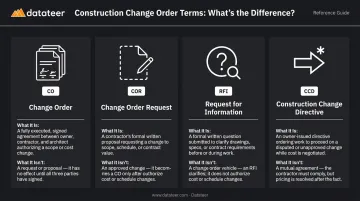
Understanding these distinctions matters legally. An RFI opens the paper trail; a CCD compels the work to proceed. Only a signed change order establishes the contractor's legal right to payment.
Why a Formal Change Order Process Matters
Construction contracts are fixed-price agreements. Any work performed outside the original scope without a signed change order leaves the contractor with no contractual basis for payment — no matter how justified the extra work was in the field.
The consequences compound quickly when the process is skipped:
- Schedule overruns go uncompensated — without a signed CO modifying contract time, the owner has no obligation to adjust the completion date
- Costs accumulate without authorization — labor and materials spent on unapproved work hit the job cost system with no corresponding revenue offset
- WIP schedules become inaccurate — unapproved or unrecorded COs leave contract values understated, distorting percent-complete calculations and over/underbilling positions
- Disputes surface at closeout — when no paper trail exists, "who owes what" conversations become expensive claims
The process is also legally non-optional. Under AIA A201-2017 Section 7.4, if a contractor believes a proposed minor change will affect the Contract Sum or Contract Time and proceeds without notifying the architect, that right to adjustment is waived. Notice provisions are enforceable forfeiture clauses, not administrative formalities. Miss the window, and the right to recover is gone.
How the Construction Change Order Process Works, Step by Step
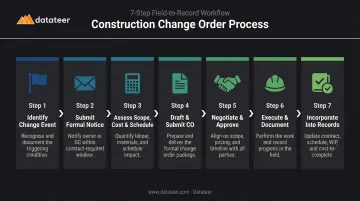
Here's the end-to-end sequence: a change event triggers notice, notice initiates a cost and schedule assessment, a formal document is drafted and submitted, parties negotiate and approve, work proceeds under authorization, and the signed CO is incorporated into the contract and financial records.
Step 1: Identify the Change Event
Change orders flow from two directions:
- Top-down: Owner or architect requests additions, deletions, or substitutions
- Bottom-up: Contractor or sub identifies a field condition that warrants additional compensation
Common triggers include design errors or omissions discovered in the field, unforeseen site conditions, owner-requested scope additions, material substitution requirements, and post-contract regulatory changes.
The moment a potential change is identified, the clock starts. Most contracts impose notice deadlines from this point — missing them can forfeit the right to recovery.
Step 2: Submit Formal Notice
Most contracts require written notice within a defined window after discovering the change event. Under AIA A201-2017, concealed or unknown conditions require notice within 14 days of first observation (Section 3.7.4), while Claims must be initiated within 21 days of the event or first recognition (Section 15.1.3.1).
At this stage, an RFI typically serves as the first formal document — alerting the GC or architect that a condition requires clarification. It is not a change order and does not authorize work or payment, but it starts the paper trail.
Critical: Check your specific contract language. Notice periods, approved formats, and escalation procedures vary by contract type, owner, and project. Division 1 specifications often have requirements that override AIA defaults.
Step 3: Assess Scope, Cost, and Schedule Impact
Once notice is submitted, the affected party prepares a detailed analysis. This should include:
- Direct labor and material costs
- Subcontractor pricing with backup
- Equipment costs
- Overhead and profit markups per contract terms
- Schedule impact in calendar days, particularly if the change falls on the critical path
Three pricing methods are available under AIA A201-2017 Section 7.3.3:
| Method | Best For | Key Requirement |
|---|---|---|
| Lump sum | Clearly defined scope | Itemized breakdown supporting the number |
| Unit pricing | Repetitive or quantity-based work | Unit rates established in contract or by agreement |
| Cost-plus/T&M | Uncertain scope | Daily documentation of labor, materials, and equipment |
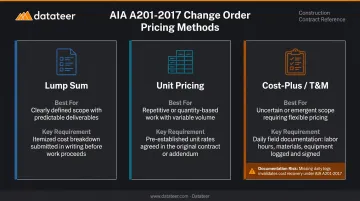
Time and materials is the riskiest method for both parties. It requires tight daily field documentation — without it, disputes over quantities and rates are nearly guaranteed.
Step 4: Draft and Submit the Change Order
A complete change order form must contain:
- Change order number and project/contract reference
- Description of the changed scope
- Itemized cost breakdown
- Schedule impact in days and revised substantial completion date
- Authorized signatures from all three parties (Owner, Contractor, Architect)
- Effective date
AIA's G701-2017 is the recognized standard form. It provides fields for original contract sum, net prior change orders, adjusted sum, contract time impact, and revised completion date. Using a consistent internal format across all projects reduces administrative errors and simplifies dispute resolution if a claim becomes necessary.
Step 5: Negotiate and Obtain Written Approval
Owners routinely push back on price and schedule impact. Contractors must defend costs with documentation — material invoices, labor rate sheets, equipment logs, subcontractor quotes — not estimates.
No work begins on changed scope until written authorization is obtained from someone specifically empowered in the contract to approve it. Verbal directives from project managers, owner's reps, or even architects are not sufficient.
If the owner wants work to proceed before pricing is agreed, the appropriate mechanism is a Construction Change Directive — which the contractor must proceed with, but which preserves the right to negotiate the price. Proceeding on a verbal "go ahead" preserves nothing.
Step 6: Execute the Work and Document in the Field
With authorization in hand, crews execute the changed scope. The site team maintains contemporaneous documentation:
- Daily logs noting labor hours, materials installed, and equipment used specifically on the CO work
- Site photographs before, during, and after
- Records of any schedule impacts encountered during execution
These records are the evidentiary foundation that protects the contractor if the change order is later disputed, adjusted at final billing, or challenged in a mechanics lien proceeding. Documentation created months after the fact — once a dispute has already surfaced — carries far less credibility than contemporaneous field logs.
Step 7: Incorporate Into Contract and Financial Records
The signed change order is now a legal part of the contract. It must be attached to the contract document set and included with payment applications and lien waivers covering that work.
The finance team's responsibility at this step is immediate — not month-end. Once a CO is approved and posted in the ERP, the job cost budget, revised contract value, and WIP schedule all need to update.
A 10–20 day lag between approval and posting — common in manual, spreadsheet-based workflows — creates WIP distortion that finance teams won't catch until the damage is done. Datateer's Change Order Impact & Aging Analytics pulls directly from the native change order modules in Procore, Sage, Vista, Spectrum, and Acumatica. Once a CO is posted in the ERP, it flows through to the WIP dashboard, Job Costing & Cost-to-Complete, and Margin Protection analytics on the next overnight sync — giving finance teams a current view of approved values, pending exposure, and margin impact by job without the manual reconciliation cycle.
Key Factors That Affect the Change Order Process
How well a project team manages change orders comes down to six variables. Understanding them up front prevents the disputes and cost surprises that derail closeout:
- Contract language — Notice periods, authorized signatories, approved formats, and CO procedures in Division 1 govern everything. Ambiguities here should be resolved before execution, not mid-project when money is at stake.
- Pricing method and scope clarity — The more loosely defined the changed scope, the longer negotiation takes. Lump sum resolutions move faster than open-ended T&M negotiations.
- Relationship dynamics — Projects with high trust and established processes resolve change orders faster. Adversarial relationships slow approvals and increase the probability of unresolved claims at closeout.
- Volume and tracking discipline — Frequent small change orders demand a systematic tracking log — without one, pending authorizations stack up and cumulative cost exposure becomes invisible to finance teams.
- Timing in the project lifecycle — AIA research shows timing can matter more than volume — changes approved early cost far less than those surfaced mid-phase when crews are already committed.
- Regulatory and compliance requirements — Changes affecting life safety systems, code compliance, or public agency oversight may require permit amendments or inspector sign-offs before proceeding, adding unplanned time to the process.
Common Change Order Mistakes and Misconceptions
The Verbal Directive Problem
The most damaging misconception in practice: that a verbal "go ahead" from an owner, architect, or project manager constitutes authorization. It doesn't. Proceeding on a verbal directive puts the contractor at full legal and financial risk for the work performed.
Confirm every verbal instruction in writing immediately — even a brief email stating "Per our conversation today, I understand you've directed us to proceed with [X]. Please confirm written authorization per the contract." Push for formal authorization before committing crew and materials.
The Month-End Accounting Problem
Finance teams that learn about approved change orders only at month-end close cannot accurately update WIP, catch budget variances, or flag margin fade while the project is still correctable. By the time a stalled or denied CO surfaces in a manual process, the work is done, the costs are locked in, and recovery options are limited.
Datateer's Change Order Impact & Aging module addresses this directly. Rather than discovering exposure at close, finance teams get continuous visibility into:
- Which COs are aging in the approval chain and how many days they've stalled
- Dollar exposure accumulating from work performed without formal approval
- Where in the office-to-field-to-owner chain the delay is occurring
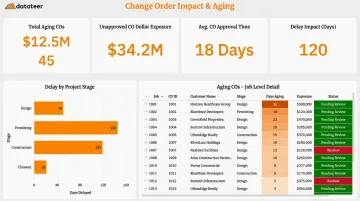
No waiting for month-end. No surprises on the WIP schedule.
The Scope Creep Trap
Teams that allow a "just do it" culture — processing change orders informally or skipping them entirely for small additions — end up at project close with dozens of undocumented work additions, no paper trail for payment, and a claims process that costs more to pursue than the work was worth. Each informal addition seems manageable in isolation. Collectively, they can quietly erase 5–10% of project margin before anyone notices.
Frequently Asked Questions
What is a change order request?
A change order request (COR) is the formal written proposal to modify a contract's scope, price, or schedule before the change order itself is issued. It initiates the review and negotiation process between parties and establishes the documentation trail that supports the final signed CO.
What is the purpose of a change order?
A change order legally amends the construction contract so that changed work is formally authorized. It gives the contractor a contractual basis for payment and documents agreed-upon scope, price, and schedule adjustments in writing, protecting all parties if a dispute arises.
What's the difference between a PO and a change order?
A purchase order is a procurement document authorizing the purchase of materials or services from a vendor. A change order is a contractual amendment between parties to a construction agreement. They serve different legal and operational functions and should never be substituted for one another.
What's the difference between an RFI and a change order?
An RFI alerts the design team or owner to a field ambiguity or condition — it asks a question but does not change the contract. A change order is the formal signed amendment that results if the answer to the RFI reveals work outside the original scope.
What happens if work is done without an approved change order?
The contractor has no contractual basis for payment on that work. It also creates exposure to liquidated damages if the unauthorized work causes schedule impacts. Verbal instructions and field directives do not substitute for written authorization.
How do change orders affect a project's WIP report?
Approved change orders increase the revised contract value, which directly affects the over/underbilling calculation. An unposted or pending CO leaves contract value understated, suppressing earned revenue and distorting percent-complete until the CO is formally posted in the ERP and WIP schedule.