
AIA billing solves this. It gives every party on a project — general contractors, subcontractors, owners, architects — a single, standardized process for requesting and certifying payment at defined intervals throughout a project's lifecycle.
This article covers what AIA billing is, the core documents and terminology that drive it, how the process works step by step, and what it means for construction finance teams managing payment applications across active projects.
This guide is written for: construction finance managers, CFOs, controllers, contractors, and CPA firms serving construction clients who need a clear, working understanding of AIA billing.
Key Takeaways
- AIA billing is the construction industry's standardized payment application process, built around two forms: the G702 and G703.
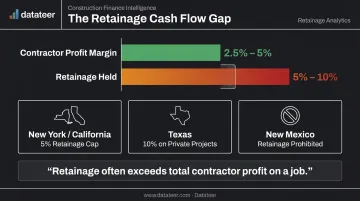
- Retainage withheld at 5–10% per payment routinely exceeds typical contractor profit margins of 2.5–5%, making it the top cash flow risk in AIA billing.
- Change orders average a ~4% cost increase per project — mismanage them and your payment application gets rejected.
- North American construction disputes average $43 million and 14.4 months to resolve; standardized AIA billing is the first line of defense.
- AIA billing data feeds directly into retainage tracking, cash flow forecasting, and WIP reporting.
What Is AIA Billing?
AIA billing is a standardized process for submitting and processing payment applications in the construction industry. It was developed by AIA Contract Documents — the documents division of the American Institute of Architects — to replace the inconsistency of every contractor using a different custom billing format.
The current billing forms — the G702 and G703 — are 1992 editions still in active use today, part of a library of over 200 AIA forms and contracts.
The core purpose of AIA billing is simple: contractors formally request payment for work completed at defined intervals during a project, rather than billing as a lump sum at completion. This gives owners documented, milestone-based financial control. It gives contractors a predictable, accepted framework for getting paid.
You'll also hear it called AIA progress billing or AIA payment applications. These terms are interchangeable.
Who Uses AIA Billing?
AIA billing is used primarily on commercial and industrial construction projects. The parties involved include:
- General contractors
- Subcontractors
- Project owners
- Architects (who certify payment applications)
- Construction managers
While it originated in the architecture world, it has become the de facto standard for large-scale construction contracts across the United States. As AIA New York notes, AIA contracts are now "the most widely used standard form contracts in the building industry."
Key AIA Billing Documents: The G702 and G703 Forms
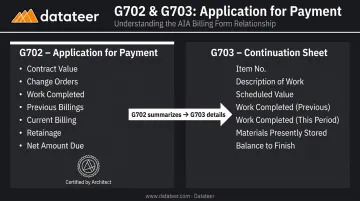
AIA billing centers on two documents used together. The G702 gives owners a high-level summary of what's being billed. The G703 provides the line-by-line proof behind that summary. Both are required.
G702 — Application and Certificate for Payment
The G702 is the official one-page payment application submitted by the contractor to request payment for a defined billing period. It captures:
- Original contract value
- Net changes from approved change orders
- Total work completed to date
- Previous amounts billed
- Current billing amount
- Retainage withheld
- Net amount due this period
At the bottom of the form is the Architect's Certificate for Payment block — the section where the architect or project owner certifies the amount they agree is owed.
Under AIA A201-2017, Section 9.4, the architect must act within seven days of receiving the application: certifying the full amount, certifying a reduced amount with written reasons, or withholding certification entirely. The contract or applicable jurisdiction may also require notarization.
G703 — Continuation Sheet
The G703 is the detailed companion to the G702. It breaks the contract sum into individual line items tied to the Schedule of Values, showing for each item:
- Scheduled value
- Work completed in prior periods
- Work completed this period
- Stored materials
- Total completed and stored to date
- Balance to finish
- Retainage amount
The G702 is the cover sheet; the G703 is the evidence behind it — what AIA Contract Documents calls "a necessary component in a contractor completing a G702."
Supporting Documentation
Beyond the two forms, complete payment applications typically include:
- Stored material invoices and delivery slips
- Change order logs with approval status
- Lien waivers (conditional and unconditional)
- Insurance certificates
- Progress photos
These documents reduce approval delays by substantiating the amounts requested. A missing lien waiver or invoice can hold up payment for 30 days or more.
Essential AIA Billing Terminology
Everyone on a project touches AIA billing data — from field managers completing progress percentages to CFOs reviewing payment applications across a portfolio. These four terms are the ones that matter most.
Retainage
Retainage (also called retention or holdback) is a percentage of each progress payment withheld by the project owner until the project reaches satisfactory completion. The standard range is 5% to 10%, though state law sets specific limits:
- New York and California cap retainage at 5%
- Texas requires 10% on private projects
- New Mexico prohibits retainage entirely
Retainage protects owners from incomplete or substandard work while giving contractors a financial incentive to see projects through to completion.
The cash flow problem is real. Construction firms typically operate on profit margins of 2.5% to 5% — meaning a 10% retainage hold often exceeds the contractor's total projected profit on a job. Subcontractors can wait months or years for retained funds to be released, sometimes long after their portion of the work is complete.
Schedule of Values (SOV)
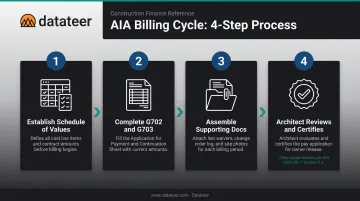
The Schedule of Values is an itemized list that breaks the total contract value into individual work components, each with an assigned dollar amount. Per AIA A201-2017, Section 9.2, the contractor must submit the SOV before the first payment application, and it must be acceptable to the architect.
Every G703 submission is measured against the SOV. It's the financial roadmap for the entire project — and it must be agreed upon before billing begins.
Front-loading is a common risk — contractors may inflate early-phase line item values to improve early cash flow. Architects can reject front-loaded schedules and require cost substantiation data.
Change Orders
A change order (CO) is a formal document that modifies the scope, cost, or timeline of a contract line item. On the G702, change orders appear in a dedicated section showing the net change to the contract sum.
Key rule: only approved change orders for the current billing period should be included. Billing pending or unapproved change orders as if they were approved is one of the most common triggers for payment application rejection and disputes.
AIA's analysis of 11 million+ construction contracts found that change orders average approximately 4% in cost increases across all project sizes, with larger projects averaging more individual change orders.
Stored Materials
Stored materials are building components purchased and held on-site or off-site that haven't been installed yet. They can be included in AIA billing when supported by proof of purchase — invoices or delivery slips. On the G703, stored materials appear as a separate column, clearly distinguished from completed work.
The AIA Billing Process: Step by Step
Step 1 — Establishing the Schedule of Values
Before the first billing cycle, the contractor and owner agree on the Schedule of Values. This document becomes the financial reference point for every future payment application. A poorly constructed SOV — with vague line items or front-loaded values — creates problems that compound through the entire project lifecycle.
Step 2 — Preparing and Submitting the Payment Application
Each billing period, the contractor:
- Completes the G702 with current period billing details and contract summary figures
- Completes the G703 with line-item progress percentages and stored material amounts
- Assembles supporting documentation: stored material invoices, change order log, lien waivers, and progress photos
- Submits the full package by the agreed billing deadline
A common practice: submitting a pencil requisition — an informal draft — before the formal submission deadline. This gives the owner or architect a chance to raise format questions early, reducing the risk of rejection after formal submission.
Step 3 — Review, Certification, and Payment
The owner or architect reviews the application by:
- Verifying progress percentages against field observations
- Checking supporting documentation against amounts claimed
- Reviewing change order status and approvals
- Certifying the application (for the requested amount or a reduced amount)
Payment is then issued based on the certified figure, minus any applicable retainage held for the period.
Benefits of AIA Billing for Construction Finance Teams
Finance teams working in U.S. construction get three concrete advantages from AIA billing:
- Fewer disputes. G702 and G703 are universally recognized formats, so all parties start from the same baseline. The 2024 Arcadis Construction Disputes Report found North American disputes averaged $43 million in value and 14.4 months to resolve — with errors and omissions in contract documents as the top cause.
- Predictable cash flow. The SOV-based structure lets contractors plan payroll and materials procurement around expected payment cycles. Owners can tie capital release to verified, documented milestones.
- A complete audit trail. Every billing cycle, change order, and retainage deduction is captured in a standardized document — critical for dispute resolution, lien management, and project closeout. With subcontractor payment cycles averaging 96 days in U.S. construction (per Billd's 2023 Construction Cash Flow Report), that paper trail is often what resolves payment timing conflicts before they become formal disputes.
Common Challenges in AIA Billing
Change Order Complexity
Unapproved change orders billed as approved are among the most frequent causes of payment application rejection. The practical fix: maintain a change order log with status tracking (pending, approved, denied, executed) and bill only for changes that have received written authorization. For work authorized by Construction Change Directives but not yet formalized as change orders, AIA A201 Section 9.3.1.1 provides a contractual mechanism to include those amounts — use it explicitly rather than estimating.
Cost Code Inconsistencies
AIA billing forms are standardized; cost code structures are not. Different contractors use NAHB codes, CSI MasterFormat, or fully custom structures — and when those codes don't align across the G703 and the owner's cost tracking system, reviews stall.
Best practice: align cost code structures with the project owner's requirements before submitting the first SOV. Getting this right at project kickoff prevents billing cycle friction for the entire project.
Manual Data Management and Financial Visibility Gaps
Tracking retainage balances, billing-to-date percentages, and projected cash flow across a portfolio of active projects creates a significant bottleneck for most construction finance teams. When AIA billing data lives in spreadsheets — manual G703 reconciliations, retainage aging schedules built in Excel, Procore exports hand-reconciled to Sage invoices — finance managers face a 10–20 day lag before they have accurate financial positions.
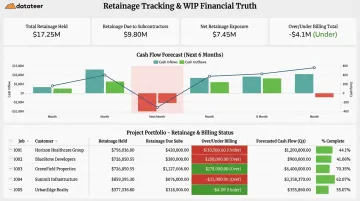
Datateer's construction analytics platform tackles this directly. It integrates with 12+ construction ERPs — Procore, Sage 100/300/Intacct, Viewpoint Vista, Acumatica, Foundation Software, CMiC, and others — and syncs data overnight without CSV exports or VLOOKUP formulas. The WIP & Financial Truth dashboard automatically calculates:
- Billed versus earned revenue per job
- Over-billings and under-billings
- Percentage complete across the project portfolio
The Retainage Tracking module surfaces both A/R retainage (what owners are holding from you) and A/P retainage (what you're holding from subs), flags overdue releases, and feeds retainage schedules directly into a 13-week cash flow forecast. As Double L Management put it: "The very first time we accessed our data through a Datateer analytics dashboard, that one click replaced two weeks worth of prior work."
Frequently Asked Questions
What does AIA stand for in billing?
AIA stands for the American Institute of Architects. In billing, it refers to the standardized payment application process and forms (primarily the G702 and G703) that the AIA developed to bring consistency to construction payment requests across the industry.
What is the AIA billing process and how does it work?
The AIA billing process is a structured method for contractors to request payment at regular intervals during a project. Contractors complete the G702 (payment application summary) and G703 (line-item continuation sheet) against an agreed-upon Schedule of Values, then submit with supporting documentation. An architect reviews and certifies the application before payment is released.
What is the difference between the G702 and G703 forms?
The G702 is a one-page summary cover sheet showing total contract value, amount billed to date, retainage, and the net payment requested. The G703 is the detailed continuation sheet that itemizes each line of work from the Schedule of Values with individual progress percentages, stored materials, and retainage per line item.
What is retainage in AIA billing?
Retainage is a percentage of each progress payment (typically 5–10%) withheld by the project owner until the project is satisfactorily completed. It protects owners from incomplete work, but given that contractor profit margins average 2.5–5%, retainage often exceeds the contractor's projected profit on a job.
Who is required to use AIA billing?
AIA billing is not legally mandated by any U.S. statute — it becomes binding when parties adopt it contractually. When parties adopt AIA A201 General Conditions, contractors are expected to use G702 and G703 forms for payment applications. It's the accepted standard on most U.S. commercial construction projects.
Can CPA firms use AIA billing data for construction client audits?
Yes. CPA firms with construction client portfolios can use AIA billing submissions as the foundation for auditing WIP schedules, retainage positions, and revenue recognition under ASC 606. Platforms like Datateer automate access to this billing data across multiple construction clients, pulling directly from their ERPs so CPA advisory practices can scale construction engagements without building or maintaining custom integrations per client.