
Introduction
A construction company can close its best revenue year on record and still scramble to make payroll the following week. That scramble isn't mismanagement. It's a structural problem baked into how construction businesses operate — and it's far more common than most owners admit.
The core issue: profitability and cash flow are not the same thing. A company can post strong margins on paper while its bank account runs dry. The gap between earned revenue and collected cash is where most financial stress in construction actually lives.
According to CFMA's 2024 Construction Financial Benchmarker, contractors carried an average of 56.6 days in accounts receivable in FY2023 — nearly two full billing cycles before cash actually arrives. For a firm funding weekly payroll and daily material deliveries, that lag is brutal.
This guide is written for construction CFOs, finance managers, and CPA advisors working with construction clients — particularly firms in the $10M–$1B revenue range where multi-project portfolios, retainage obligations, and WIP complexity tend to compound the timing gap between work performed and cash received.
Key Takeaways
- Strong margins don't prevent a cash crisis — cash flow and profitability measure entirely different things
- Underbilling, retainage, and unapproved change orders rarely appear on the P&L until the damage is already done
- Billing speed and billing accuracy are the fastest near-term levers available
- A rolling cash flow forecast, reviewed weekly, separates proactive firms from reactive ones
- Real-time visibility into WIP, receivables, and project costs sharpens every other strategy on this list
Why Profitable Construction Companies Still Struggle with Cash
The Profit-Cash Disconnect
Under percentage-of-completion accounting, revenue is recognized as work is performed — not when payment is received. A company can record $400K in revenue during a given month while collecting nothing, yet payroll, materials, and overhead still need funding.
FASB Topic 606 formalizes this gap: when performance precedes an unconditional right to consideration, the company records a contract asset — not cash. What's recognized and what's collected are two different numbers, and the gap between them has to be funded somehow.
WIP: The Mechanism That Reveals the Gap
The WIP (Work in Progress) schedule is where that disconnect becomes measurable. At any point in a project, WIP reports show whether a company is:
- Overbilled — collected more than earned (a positive cash position)
- Underbilled — earned more than collected (effectively financing the project out of pocket)
The problem is timing. Most firms review WIP monthly, meaning cash decisions are made on data that's already weeks old. By the time underbilling shows up in a manual WIP report, the corrective window has often closed.
The Growth Trap
Revenue growth consumes working capital. NASBP reported in 2025 that working capital as a percentage of revenue for $10M–$50M commercial GCs rose from 7.6% to 12.1% between 2016 and 2025.
A firm growing from $3M to $5M in revenue with a 60-day collection cycle needs to fund hundreds of thousands more in outstanding receivables at any given time. Growth without capital planning is one of the most reliable ways a profitable firm runs out of cash.
The Silent Drains Most Owners Miss
Two additional cash drains that rarely get tracked:
- Firms that distribute most profits during strong periods often end up borrowing back money they already paid out when work slows down
- Accounting method choice — cash vs. accrual, percentage-of-completion vs. completed contract — determines when taxable income appears relative to available cash. The wrong choice creates tax bills that arrive before the cash to pay them does
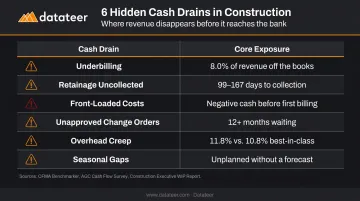
The Six Hidden Cash Drains in Construction Businesses
1. Underbilling on Active Jobs
When project managers delay pay applications or miss completed work items, the company has already spent cash on labor and materials but hasn't requested payment. The earned revenue sits off the books.
CFMA's 2024 Benchmarker reported average underbillings/equity of 8.0% for FY2023. Across a multi-project portfolio, that translates to hundreds of thousands in uncollected, earned revenue sitting on the balance sheet at any given time.
2. Retainage Sitting Uncollected
Standard contracts withhold 5–10% of each payment until project completion. That retainage accumulates untracked. A company with $5M in active contracts could have $250K–$500K in earned revenue locked in retainage at any time.
The problem compounds when no one is actively tracking retainage balances or initiating release requests after punch list completion. Levelset's research found that 66% of contractors waited more than 30 days to collect retained funds — with historical averages of 99 days for GCs and 167 days for subcontractors from project completion to collection.
3. Front-Loading Costs, Back-Loading Collections
Every new project opens with an immediate cash deficit. Mobilization labor, materials, permits, and equipment hit the books weeks before the first pay application is submitted or approved. When multiple projects kick off simultaneously, these deficits stack — even as the overall backlog looks healthy on paper.
4. Unbilled and Unapproved Change Orders
Change order work frequently gets performed before pricing is finalized. Every day of work under an unapproved change order is cash spent with no corresponding billing. AGC has documented that some contractors waited more than one year for payment on change order work — an exposure that compounds daily while field crews keep executing.
5. Overhead Growing Faster Than Revenue
CFMA's 2024 Benchmarker reported SG&A expense of 11.8% of total revenue for all respondents, compared to 10.8% for Best in Class firms. When overhead isn't tracked as a percentage of revenue monthly, it creeps upward during growth phases and only surfaces as a visible problem at year-end.
6. Seasonal Cash Flow Gaps
Construction revenue is seasonal in most markets; overhead is not. Without reserves built during peak periods, firms hit predictable winter slowdowns without a buffer. A rolling 13-week forecast makes this gap visible months in advance. Most firms still don't see it coming.
| Cash Drain | Core Exposure |
|---|---|
| Underbilling on active jobs | 8.0% of revenue sitting off the books (CFMA 2024) |
| Retainage uncollected | 99–167 days from completion to collection |
| Front-loaded project costs | Negative cash from day one before first billing |
| Unapproved change orders | 12+ months waiting for payment documented by AGC |
| Overhead creep | 11.8% vs. 10.8% for Best in Class firms (CFMA 2024) |
| Seasonal cash gaps | Predictable but routinely unplanned without a forecast |
Proven Strategies to Improve Construction Cash Flow
Bill Faster and With More Discipline
Billing speed is the single highest-impact near-term improvement available. Practical steps:
- Assign billing accountability to a named person, not a department
- Set a fixed pay application schedule tied to contract terms — treat it as operational, not administrative
- Track Days Sales Outstanding (DSO) monthly; CFMA reported a 56.6-day average for FY2023 — every day reduced on a mid-sized firm frees working capital that's otherwise sitting in receivables
DSO improvements compound quickly across a portfolio. Closing that gap starts with treating billing as a revenue event — not a back-office task.
Aggressively Track and Pursue Retainage
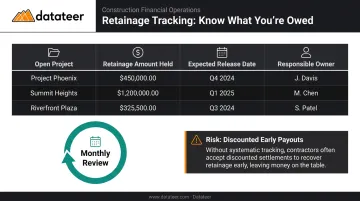
Build a retainage tracker showing:
- Every open project
- Retainage amount held
- Expected release date
- Person responsible for initiating release
Review it monthly. Cash-constrained firms often accept discounted early retainage payouts rather than waiting for full release — sacrificing margin unnecessarily. A structured tracker with named owners and scheduled reviews is what prevents that trade from happening quietly.
Require Deposits and Milestone-Based Payments
For projects above a threshold size, require a mobilization deposit before work begins. Structure payment schedules so inflows align with actual project expenditure phases — this reduces the front-loading problem that creates a cash deficit at every project start.
Contract language matters here. Clear payment schedules, defined due dates, and late payment penalties are what make all other billing strategies enforceable.
Price and Bill Change Orders Before Work Begins
Establish a firm policy: no change order work starts without written pricing acknowledgment. Even partial compliance — getting the majority of change orders priced upfront — dramatically reduces the gap between work performed and cash collected. This is both a cash flow practice and a margin protection practice.
Build and Maintain a Rolling 13-Week Cash Flow Forecast
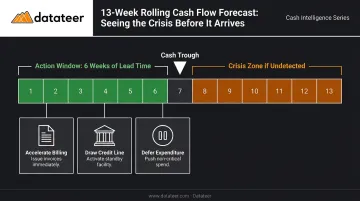
A 13-week rolling forecast maps every expected receipt and payment across 90 days, updated weekly. This is an operational tool, not a planning document.
When a cash trough is visible six weeks out, there is time to:
- Accelerate a billing cycle
- Draw on a line of credit
- Defer a non-essential expenditure
Six weeks of lead time turns a potential cash crisis into a managed decision. That lead time only exists if the forecast is current.
Build a Cash Reserve During Peak Revenue Periods
Intentionally set aside cash during high-revenue months into a dedicated reserve account. CFMA's 2024 Benchmarker reported 23.5 average days of cash for FY2023 — a useful baseline for gauging where your firm stands.
A commonly cited target is two to three months of operating expenses held as liquid reserve. Firms in growth phases or carrying heavy retainage concentrations typically need more. Setting this aside systematically — not just when cash happens to be flush — is what separates intentional reserves from accidental ones.
How Real-Time Data Visibility Transforms Cash Flow Management
The Problem With Data Lag
When WIP reports take 10–20 days to compile manually from ERP data, leadership is making cash decisions against a snapshot of the past. By the time underbilling or margin fade appears in a manually built WIP report, the window for corrective action has often already closed.
The decisions made in that gap (about billing, collections, subcontractor payments, and overhead spending) are all built on stale information.
What Automated Visibility Changes
Datateer's construction intelligence platform connects directly to 12+ construction ERPs — including Procore, Sage, Vista, and Acumatica — and replaces the manual 10–20 day WIP reporting cycle with an automated overnight refresh. Double L Management's Business Analyst put it directly: "the very first time we accessed our data through a Datateer analytics dashboard, that one click replaced two weeks worth of prior work."
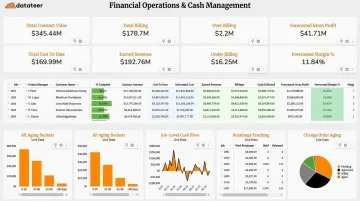
The platform's Financial Operations & Cash Management suite provides:
- WIP & Financial Truth dashboard — automated over/under-billing calculations per job, surfacing the underbilling exposure that typically stays hidden between manual reporting cycles
- AR & AP Health dashboard — real-time receivables and payables aging across 0–30, 31–60, and 61–90 day windows
- Job-Level Cash Flow dashboard — identifying which projects are generating cash and which are consuming it
- Retainage tracking — A/R retainage, A/P retainage, release schedules, and overdue releases feeding directly into the 13-week cash flow forecast
- Change Order Impact & Aging — flagging stalled change orders by days outstanding and quantifying the unbilled dollar exposure
From Forensic Accounting to Strategic Partnership
Implementation runs 2–4 weeks, with data flowing before the annual subscription period begins — which means finance teams aren't waiting months to start making better decisions.
When finance managers have a live view of every project's cash position, the role shifts. Instead of compiling historical reports, they're advising leadership on forward-looking decisions: which jobs to accelerate billing on, where retainage is ready to pursue, which projects are trending toward a cash problem before the damage is done.
That shift is what separates construction firms that react to cash problems from those that prevent them.
Frequently Asked Questions
What is cash flow in construction?
Construction cash flow refers to the movement of money into and out of a business across project phases — covering when cash is actually received from clients versus when it is paid out for labor, materials, subcontractors, and overhead. The timing of these movements, not just the total amounts, determines financial stability.
What happens if cash flow is negative?
Negative cash flow means a company is spending more than it's collecting in a given period. If sustained, this leads to missed payroll, late payments to vendors and subs, potential credit line defaults, and serious financial distress — even for firms that are profitable on paper.
What is an example of negative cash flow in construction?
A contractor mobilizes a crew, purchases materials, and pays weekly wages for four weeks before submitting a first pay application. During that period, the company is cash-flow negative even if the contract is profitable overall — outflows have started while inflows have not yet begun.
What is the difference between profit and cash flow in construction?
Profit is an accounting concept reflecting revenue minus expenses on the income statement — often recognized as work is performed under percentage-of-completion accounting. Cash flow reflects actual money in the bank. A company can be profitable on paper while cash-negative in practice if collections lag behind costs.
How do you forecast cash flow for a construction company?
Map expected inflows (progress payments, retainage releases, deposits) and outflows (labor, materials, subcontractors, overhead) by week or month across all active projects. Calculate the net cash position for each period to identify future shortfalls while there's still time to act.
What is a healthy cash reserve for a construction company?
Two to three months of operating expenses is a commonly cited benchmark for a liquid reserve. The right target varies by project size, collection cycles, and seasonal patterns — firms in growth phases or carrying heavy retainage typically need to hold more.