Cost tracking gets mentioned in nearly every conversation about project controls, yet it's frequently treated as a bookkeeping exercise done after the fact. That's the wrong model. The real value isn't in documenting what happened — it's in seeing what's happening while there's still time to act.
This article breaks down the specific advantages of proactive construction cost tracking and how each one directly protects and improves project profitability.
Key Takeaways
- Construction cost tracking monitors labor, materials, equipment, and subcontractor spend against budgets throughout the entire project lifecycle
- Its primary value is early detection: catching budget drift before it compounds into unrecoverable margin loss
- Accurate job costing at the cost code level is what separates project-level profitability analysis from company-level guesswork
- Delayed data turns financial reviews into post-mortems — firms without real-time tracking manage by looking backward
- Consistent cost tracking builds historical data that sharpens every future bid and estimate
What Is Construction Cost Tracking?
Construction cost tracking is the ongoing process of recording, categorizing, and comparing all project expenses against a pre-approved budget throughout the project lifecycle. Tracked cost categories include:
- Labor (direct and indirect)
- Materials and equipment
- Subcontractor costs
- Overhead and burden
It applies across every active project, from preconstruction through final closeout, and at the portfolio level when managing multiple concurrent jobs.
The framing matters: cost tracking is not an accounting exercise. It exists to give project managers and finance teams the visibility needed to protect margin. Satisfying reporting requirements is a byproduct, not the goal.
Key Advantages of Construction Cost Tracking
The advantages below map directly to metrics that construction finance teams are already responsible for managing. These aren't theoretical benefits — they're operational and financial outcomes with real dollar implications.
Real-Time Budget Visibility
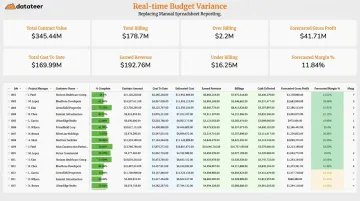
Real-time visibility means having an accurate, current picture of where money is being spent on each project — not a snapshot compiled from spreadsheets two weeks after the fact.
Cost tracking creates this by connecting project spend data from field reports, purchase orders, subcontractor invoices, and payroll to a live budget view. Finance teams can identify variances as they develop rather than discovering them at month-end close.
Why this matters:
In construction, cost overruns compound. A 5% labor overage in week three that goes undetected often becomes a 15% margin problem by project completion. Early visibility is the only real intervention window. According to KPMG's 2023 Global Construction Survey, 37% of respondents missed budget and/or schedule targets by 20% or more in the prior year — a figure that reflects how common late detection really is.
When a project manager sees that concrete costs are running 12% over budget mid-project, they can renegotiate supplier terms, adjust crew scheduling, or submit a change order. None of those options exist if the data arrives after the fact.
KPIs directly impacted:
- Budget variance by cost code
- Cost Performance Index (CPI)
- Percent complete vs. percent spent
- Project-level gross margin
When it matters most: Real-time visibility has the highest impact on long-timeline projects, multi-phase jobs, and work with concurrent subcontractor scopes — where delayed financial data creates the largest gap between field activity and what finance teams are reporting.
For firms still relying on manual processes, that gap is substantial. The typical WIP report compiled from spreadsheets and ERP exports can run 10–20 days behind reality. Datateer's platform eliminates that lag by pulling data directly from 12+ construction ERPs — including Procore, Sage, Viewpoint Vista, Acumatica, and Foundation Software — and refreshing dashboards overnight. One customer, a business analyst at Double L Management, put it plainly: "That one click replaced two weeks worth of prior work."
Accurate Job Costing
Job costing is the practice of assigning every cost — labor hours, material deliveries, equipment usage, subcontractor invoices — to the specific project and cost code that generated it. The goal is precise comparison of actual costs against the budgeted cost for each line item.
Doing this accurately requires clean data at the source: correct cost codes, verified labor hours, matched invoices. It also requires a system that aggregates that data at the job level without manual consolidation.
Why this matters:
Without accurate job costing, profitability gets assessed at the company level rather than the project level. A few strong jobs can mask a pattern of underperformers until the overall margin trend becomes undeniable. By then, the pattern is already established.
Dodge research found that 93% of general and heavy highway contractors rank job costing and WIP data as the most important information they collect — yet 78% still use a mix of software and spreadsheets to produce it. That combination creates data quality risk at every reconciliation point.
Firms with accurate historical job cost data have a concrete competitive advantage in bidding: they can price more precisely, neither leaving money on the table nor eroding margin through underestimation.
KPIs directly impacted:
- Profit per project
- Labor cost variance by cost code
- Subcontractor cost vs. contract value
- Historical unit cost benchmarks used in estimating
Highest impact scenarios: Accurate job costing is especially critical on T&M contracts (where billable hours must be defensible), GMP contracts (where overruns come directly out of the contractor's pocket), and multi-year projects where early cost code errors compound into significant reporting distortions.
One practical challenge: cost codes applied inconsistently across ERPs, field reports, and payroll systems produce job cost reports that can't be trusted. Datateer's data cleaning and standardization layer automatically maps cost codes across systems and reconciles Procore project commits to Sage invoices — removing the manual VLOOKUP work that typically precedes every reporting cycle.
Proactive Margin Protection
Margin fade — the gradual erosion of project profitability from small cost overruns, untracked rework, billing delays, and scope creep — typically goes unnoticed until closeout reveals a far weaker margin than projected.
Consistent cost tracking prevents this by establishing a clear budget baseline and continuously comparing actuals against it. Finance teams can identify the specific cost codes or phases where margin is slipping and act while corrective options still exist.
Why this matters:
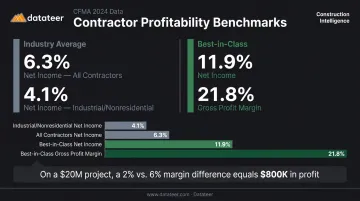
The difference between a 6% and a 2% net margin on a $20M project is $800,000. That's often the difference between a profitable year and a flat one.
CFMA's 2024 Construction Financial Benchmarker puts average contractor net income before tax at 6.3% — and just 4.1% for industrial and nonresidential contractors. Best-in-class performers report 11.9% net income and 21.8% gross profit margins. The gap between average and top-quartile performance is not explained by revenue volume alone; it's explained by financial discipline, of which margin protection is a central component.
Proactive cost tracking also shifts the finance team's role. Rather than assembling reports after the fact, finance teams become advisors — giving leadership the data to make decisions about staffing, procurement, and scope while the margin can still be defended.
KPIs directly impacted:
- Gross margin by project
- WIP report accuracy
- Revenue recognition timing
- Cash flow forecast reliability
- Over/underbilling exposure
Most critical on: Competitively bid jobs with thin initial margins, projects experiencing scope changes, and firms running 10+ concurrent jobs where portfolio-level margin trends are difficult to monitor without consolidated data.
Datateer's Margin Protection module monitors original estimated margin versus current projected margin per job and flags specific negative variance drivers — labor overrun, material price escalation, subcontractor cost increases, change order denial — surfacing the exact cost codes where deterioration is occurring.
The result is continuous in-project monitoring that replaces the monthly forensic scramble with real-time visibility that still has room to act on.
What Happens When Construction Cost Tracking Is Missing
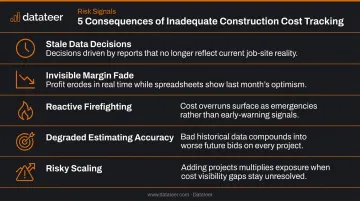
The consequences of inadequate cost tracking are concrete and recognizable to anyone who's worked in construction finance:
- Decisions run on stale data. WIP reports compiled manually from spreadsheets can be 10–20 days behind reality. Leadership approves resource commitments based on last month's actuals.
- Margin fade goes invisible. Without regular actual-vs-budget comparison by cost code, small overruns accumulate undetected — surfacing only at project closeout when nothing can be done.
- Reactive firefighting replaces strategic management. Finance managers spend their weeks formatting reports rather than analyzing trends, escalating concerns, or advising on decisions.
- Estimating accuracy degrades. Without reliable historical job cost data, future bids are built on assumptions — making it harder to win profitably in competitive markets.
- Scaling becomes financially risky. A firm that can't accurately track costs on 10 projects cannot safely manage 20. The financial blind spots multiply faster than revenue does.
Each of these failures shares a common root: degraded data. An Autodesk/FMI study found that bad data may have cost global construction $1.848 trillion in 2020, with one-third of poor decisions attributed directly to bad data. Firms still running manual reconciliation aren't just slow — they're operating on the exact data quality that drives those losses.
How to Get the Most Value from Construction Cost Tracking
Cost tracking produces its best outcomes when three conditions are met:
- Data is captured consistently at the source — correct cost codes, verified hours, matched invoices
- Reports are reviewed frequently enough to act on — weekly at minimum for active projects, not just at month-end
- Insights trigger decisions — not just documentation
The biggest barrier for mid-to-large construction firms isn't awareness — it's the manual effort required to compile data from ERPs, spreadsheets, and field reports into a coherent picture. That process typically takes days and produces information that's already outdated by the time it reaches decision-makers.
Automated financial platforms like Datateer address this directly. The platform connects to 12+ construction ERPs and replaces days of manual data assembly with financial visibility that refreshes overnight. Pre-built dashboards are available on day one — with a 2–4 week implementation timeline — covering:
- Cost variance by cost code
- CPI and over/underbilling position
- Gross margin by project
- 13-week cash flow forecasting
Technology accelerates what good process already does — it doesn't replace it. The firms that get the most from cost tracking pair automated data infrastructure with consistent review cadences and clear KPI ownership, so the finance team can raise issues before they become losses.
Conclusion
Construction cost tracking protects margin because it closes the gap between when problems form and when finance teams find out. Real-time visibility, accurate job costing, and proactive margin protection aren't isolated wins — they reinforce each other. Firms that apply them consistently, project by project, build a financial operating discipline that's hard to replicate from the outside.
Cost tracking should be treated as an ongoing operational practice, not a reporting task. Finance teams that make it part of how they run — not just how they report — are the ones who stop margin fade early, price future work more accurately, and grow without the financial surprises that stall less disciplined firms.
Frequently Asked Questions
How do you track and control construction project costs to improve profitability?
Effective cost tracking starts with a detailed budget baseline and consistent cost code assignment for every expense category. It requires regular actual-vs-budget review, with integrated financial systems minimizing the lag between field activity and reporting so teams can intervene while corrective options still exist.
How does a construction project's cost structure affect profitability?
A project's cost structure — the mix of labor, materials, equipment, and subcontractor spend — determines where margin is most at risk. Labor and subcontractor costs are the most variable, so firms with tighter tracking on those two categories have the most leverage over final project profitability.
What is margin fade in construction and how is it prevented?
Margin fade is the gradual erosion of project profitability caused by untracked overruns, rework, and scope creep accumulating over time. It's prevented by comparing actuals to budget by cost code frequently enough to intervene before overruns compound — continuous monitoring catches problems that month-end snapshots miss.
What are the most important KPIs to track for construction cost management?
Key metrics include cost performance index (CPI), budget variance by cost code, over/underbilling position, WIP report accuracy, and gross margin by project. Labor cost variance is one of the most useful leading indicators — it tends to surface broader project financial problems before they show up elsewhere.
What is the difference between construction cost tracking and cost control?
Cost tracking is the process of capturing and organizing what has been spent. Cost control is the decision-making layer that uses that data to prevent future overruns. Tracking provides the visibility; control is what teams do with it.