Introduction
Contractors routinely purchase materials weeks or months before installation — structural steel with 12–16 week lead times, hollow-metal doors running 16–26 weeks, elevator equipment stretching half a year. That upfront cost sits on your books, unrecovered, until AIA billing gives you a mechanism to address it.
AIA billing for stored materials lets contractors bill owners for purchased materials delivered to the site — or an approved off-site location — but not yet incorporated into the project. The mechanism lives in Column F of the AIA G703 Continuation Sheet, and knowing how to use it correctly is where most teams either recover cash faster or create costly disputes.
This guide is written for construction finance managers, CFOs, project accountants, and advisors to commercial contractors who need to understand the stored materials billing process at an operational level — how the columns actually work, what documentation is required, and where most teams go wrong.
Key Takeaways
- Column F of the AIA G703 is a running balance of materials purchased, stored, and not yet installed — updated each period, not a one-time entry.
- Materials transfer from Column F to Column E only when physically incorporated into the work, regardless of when payment is received.
- Off-site stored materials require explicit owner approval plus documentation beyond the standard on-site threshold.
- Invoices, delivery confirmations, and photos are required to substantiate every stored materials billing entry.
- Multi-period carry-forward errors are the most common operational failure in stored materials billing.
What Is AIA Billing for Stored Materials, and Why Does It Matter?
Stored materials in the AIA billing context are raw materials, prefabricated components, or construction consumables that have been purchased and delivered to the site (or a pre-approved off-site location) but have not yet been physically installed into the project. Physical incorporation is what separates stored materials from completed work — not payment, not delivery, and not scheduling intent.
The Cash Flow Problem It Solves
According to the CFMA, contractors bear the front-money burden of financing project costs before receiving payment. On commercial projects, that burden can be substantial. Pike Construction's Q1 2024 market report shows lead times for common materials ranging from 4 weeks (EPDM roofing) to 26 weeks (hollow-metal doors and elevators). Purchasing materials that far in advance, without a billing mechanism to recover those costs, creates real cash flow strain.
The AIA billing framework addresses this directly: contractors can submit stored materials as part of a progress payment application rather than waiting until installation.
Why It's Frequently Misapplied
That mechanism is straightforward in theory. In practice, stored materials billing generates more disputes than almost any other component of the G703 — because of:
- Confusion about when values should move between columns
- Incorrect handling of multi-period carry-forward balances
- Missing or insufficient documentation
- Billing for materials that haven't been delivered yet
The sections below work through each of these issues in detail.
How Stored Materials Work on the AIA G703
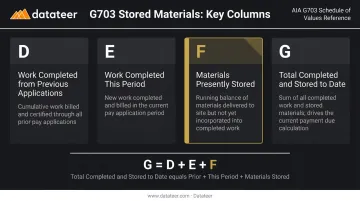
The G703 Continuation Sheet tracks progress billing line by line. Four columns govern stored materials:
| Column | Name | What It Tracks |
|---|---|---|
| D | Work Completed from Previous Applications | Cumulative completed work from prior periods |
| E | Work Completed This Period | New work completed in the current billing period |
| F | Materials Presently Stored | Running balance of stored, uninstalled materials |
| G | Total Completed and Stored to Date | D + E + F |
Column F: Running Balance, Not a Period Entry
Per AIA G703 instructions, Column F must be recalculated at the end of every pay period to reflect the total value of materials currently stored and not yet incorporated. Don't record only what's new this period — the balance carries forward until materials are installed.
One common misconception: owner payment does not reduce the Column F balance. If the owner paid for stored steel in Period 2 and that steel hasn't been installed by Period 3, the steel's value stays in Column F for Period 3.
The Column F to Column E Transition
Stored material value moves out of Column F and into Column E only when the material has been physically incorporated into the project. This is recorded in the pay period when installation actually occurs:
- Enter a negative value in the Stored Materials field equal to the installed portion
- Enter a corresponding positive value in the Work Completed field
The material never jumps directly from Column F to Column D. It must pass through Column E in the period of installation.
How It Plays Out Across Pay Periods
Pay Period 1 — Newly Stored Materials: Materials are delivered but not installed. Enter the invoiced value in Column F. Column G increases accordingly. The owner pays, subject to retainage.
Pay Period 2 — Partial Installation: Some materials have been installed. Enter a negative value in Stored Materials equal to the installed portion and a positive value in Work Completed. The uninstalled balance stays in Column F.
Pay Period 3 — Full Incorporation: All remaining stored materials are installed. The Column F balance transfers to Column E via the same negative/positive adjustment. Column F returns to zero for that line item.
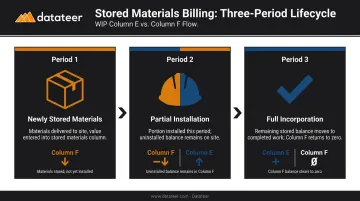
By final completion, Column F should read zero across every line item — if it doesn't, uninstalled materials are still sitting on your balance sheet.
Retainage on Stored Materials
Stored materials appear in Column G (Total Completed and Stored to Date), and AIA G702 Line 4 pulls directly from Column G. That means stored materials are included in the retainage base — so a portion of every stored materials payment is withheld until project completion, at whatever rate your contract specifies.
- Retainage applies to stored materials the same way it applies to completed work
- The withheld amount accumulates until the contract's retainage release conditions are met
- Tracking this separately from standard retainage matters for cash flow forecasting
Documentation Required to Bill for Stored Materials
The AIA A201-2017 General Conditions (Section 9.3.2) conditions stored materials payment on "procedures satisfactory to the Owner to establish the Owner's title or otherwise protect the Owner's interest." In practice, that translates to a documentation package — and the specifics vary by contract.
Standard Documentation Components
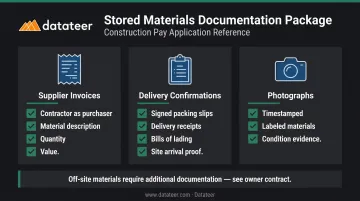
Most contracts require three core documents:
- Supplier invoices showing the contractor as purchaser, the material description, quantity, and value — missing invoices are the most common reason stored materials billing gets rejected
- Delivery confirmations: signed packing slips, delivery receipts, or bills of lading showing materials arrived at the site, paired with dated site photographs
- Photographs, preferably timestamped with materials labeled — even when not contractually required, photos are your strongest defense if a dispute arises over material condition or presence
When a Bill of Sale Is Required
For higher-value materials or off-site storage, many owners require a formal bill of sale or stored materials affidavit. This document transfers ownership of the stored materials to the owner upon payment, protecting the owner if the contractor defaults before installation.
University of Michigan's construction manager payment forms and Kutztown University's FPS040 form are two examples of owner-side bill of sale requirements — both require the contractor to warrant title and assign storage/insurance obligations accordingly.
Review Your Contract's General Conditions First
Bills of sale requirements are just one example of how contracts vary. The G703 instructions set a baseline, but individual contracts often go further — requiring:
- Certificates of insurance naming the owner as an additional insured
- Specific approval forms for off-site storage locations
- Bonded warehouse receipts for materials stored away from the site
Before submitting a first stored materials billing, review the general conditions and any supplementary conditions. What's acceptable documentation under one contract may be insufficient under another.
On-Site vs. Off-Site Stored Materials
The handling differs significantly depending on where materials are stored.
On-Site Stored Materials
Materials delivered to the physical project site are the standard scenario. Under base AIA language, they don't require separate advance owner approval beyond proof of purchase and delivery confirmation — though title and insurance requirements still apply.
Off-Site Stored Materials
AIA A201 Section 9.3.2 allows payment for off-site stored materials only if the owner approves in advance and the storage location is agreed upon in writing. Beyond that, off-site billing typically requires:
- Proof of insurance covering the off-site location
- Bonded warehouse receipt or storage agreement
- Clear identification system (tagging, labeling) tying materials to the specific project
- Insurance, storage, and transportation costs covered by the contractor
Contractors who skip the advance approval step risk having the stored materials line of a pay application rejected. The AIA's modular construction guidance explicitly notes that off-site payments require owner pre-approval — this isn't a technicality that can be addressed after the fact.
Why Off-Site Materials Carry Higher Owner Risk
Those documentation requirements exist because off-site materials present a meaningfully higher ownership and recovery risk. If a contractor defaults, materials sitting at a fabricator's facility or warehouse are far harder to recover than materials on the job site. The approval and documentation requirements are risk protection mechanisms — for the owner and, ultimately, for the contractor who wants their pay application to hold up.
Common Mistakes in Stored Materials Billing
Zeroing Out Column F When the Owner Pays
This is the most common error. Payment alone does not trigger the Column F to Column E transition — only physical incorporation does. Previously paid stored materials must continue to appear in Column F until they're installed. AIA G703 instructions explicitly require Column F to be recalculated each period to include stored materials not yet incorporated, regardless of payment status.
Moving Column F Directly to Column D
Stored materials must transition through Column E — Work Completed This Period — in the pay period they are installed. They cannot jump directly to Column D. Doing so skips the period of installation from the billing record entirely, which creates reconciliation errors downstream.
Billing Undelivered or Unapproved Materials
Column F should only reflect materials that are physically present and verifiable. Billing for ordered-but-not-received materials, or for off-site materials without owner approval, creates billing disputes and can constitute a breach of the pay application process.
Using Column F as a Labor/Material Split
Column F is only for physically stored, uninstalled materials. It's not a mechanism for breaking out material costs from labor within a line item. If that breakdown is needed, create a separate line item in the schedule of values.
Manual Tracking Across Multiple Pay Periods
On projects with many line items or extended schedules, tracking stored material values manually in spreadsheets creates real reconciliation risk. The carry-forward calculation needs to be right every period — and one incorrect entry compounds across subsequent applications.
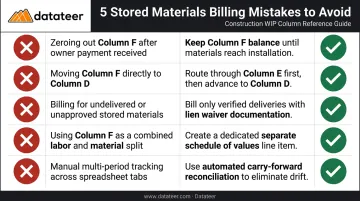
Automated financial platforms address this directly. Datateer's WIP reporting and job costing analytics pull from connected ERPs — Procore, Sage, Vista, Acumatica, and others — to eliminate manual cross-period recalculation and maintain data integrity across active pay applications. Double L Management reported that automated data access through Datateer replaced two weeks of prior manual work.
For teams managing stored materials across many projects simultaneously, that efficiency compounds fast. Reach out to Datateer at hello@datateer.com or book a free 15-Minute Workflow Audit to discuss your specific pay application workflow.
Frequently Asked Questions
How do you bill for stored materials on an AIA pay application?
Enter the invoiced value of purchased, uninstalled materials in Column F of the AIA G703 Continuation Sheet, supported by supplier invoices and delivery confirmations. Submit this with the standard G702/G703 pay application package. Column F must reflect the running balance of all stored materials, not just new additions in the current period.
What is a bill of sale for stored materials?
A bill of sale formally transfers ownership of stored materials to the owner upon payment. It's commonly required for high-value or off-site materials to protect the owner's interest if the contractor defaults before installation. Many public owners and large GCs have their own standard bill of sale forms.
When do stored materials move from Column F to Column E?
Only when materials are physically incorporated into the project, not when the owner pays for them. Record the transition in the pay period when installation occurs: a negative entry in Column F and a corresponding positive entry in Column E.
Can contractors bill for off-site stored materials?
Yes, if the contract permits it and the owner approves the off-site location in writing beforehand. Additional documentation is required: proof of insurance, bonded warehouse receipts, and material identification tags. Failing to secure pre-approval is the most common reason off-site billing gets rejected.
What happens to stored materials in Column F after the owner has already paid for them?
They stay in Column F. Payment has no effect on how stored materials are tracked; only installation moves them to Column E. Removing paid but uninstalled materials from Column F misrepresents completion status and creates reconciliation problems down the line.
Conclusion
Stored materials billing through Column F of the AIA G703 is a legitimate and important cash flow tool for contractors. It works correctly only when three things are in place: the Column F carry-forward rules are followed consistently across every pay period, the transition from Column F to Column E is tied to actual physical installation, and the supporting documentation is complete before the application is submitted.
Contractors whose pay applications move through approval quickly are simply applying the mechanics correctly and consistently. That requires internal procedures around documentation collection, column management, and multi-period reconciliation that treat stored materials billing as a defined process rather than a judgment call each billing cycle.
For construction finance teams managing this across multiple active projects, building those procedures is what separates clean billings from contested ones. Platforms like Datateer can support that process by syncing stored materials and billing data directly from your ERP, giving finance teams a consistent, reconcilable record across every pay period and every project.