
Introduction
The contract type you sign before breaking ground determines far more than your legal obligations. It sets your revenue recognition method, defines when cash flows into your business, shapes how WIP is calculated, and decides who absorbs cost overruns before a single crew mobilizes.
Most contractors focus on winning work and executing it well. That's understandable. But the contract structure they agree to — often negotiated quickly, rarely scrutinized financially — creates the risk profile they'll live with for the project duration.
This guide breaks down the four major U.S. construction contract types, the most common payment structures, and the scope and clause provisions that finance managers and CFOs need to understand cold — with the financial consequences of each decision spelled out directly.
Key Takeaways:
- Contract type — lump sum, cost-plus, GMP, or unit price — determines who absorbs cost overruns
- Payment structure drives cash flow timing and working capital requirements
- Vague scope language triggers change orders and erodes margin faster than any other contract failure
- Contract structure directly determines WIP calculation method and reporting complexity
- Pay-when-paid and pay-if-paid clauses transfer serious cash flow risk down to subcontractors
What Makes Up a Construction Contract: The Three Core Elements
Every construction contract is built on three interconnected pillars, each carrying distinct financial consequences:
- Scope of work — what is included, what is excluded, and what happens when something falls in between
- Payment structure — how and when the contractor gets compensated for completed work
- Contract form — the legal and procedural framework governing the entire relationship
Standard form contracts from AIA, EJCDC, ConsensusDocs, and DBIA exist to provide a vetted legal framework for these three pillars. AIA contracts are widely used in U.S. commercial building, while EJCDC forms have governed infrastructure contracts since 1975. ConsensusDocs, developed by a coalition of 40+ industry associations, offers more than 100 contract forms.
Standard forms provide the legal scaffolding — but the financial terms inside them require deliberate negotiation on every project. Price, scope definition, retainage percentage, billing cycle, and change order thresholds must be tailored to each project's specific risk profile. Those choices determine how much cash is tied up in retainage, how quickly billing disputes escalate, and whether margin erosion gets caught early or discovered at closeout.
Construction Contract Types and Their Financial Risk Profiles
The four contract types most common in U.S. commercial construction each allocate cost risk differently. Understanding that allocation is the starting point for every financial conversation.
Lump Sum (Fixed Price) Contracts
Under a lump sum agreement, the contractor names a price and owns the outcome. If costs run over, margin shrinks. If costs come in under, margin expands. AIA describes this as a fixed-price arrangement where the parties agree the project will be performed for a stated amount.
The financial implications are clear-cut but unforgiving:
- Accurate pre-construction estimating is non-negotiable — there's no mechanism to recover cost overruns from the owner
- Scope definition must be airtight before signing; ambiguity becomes the contractor's financial problem
- WIP accounting is cleaner on paper (percentage-of-completion against a fixed contract value), but margin fade can accelerate rapidly if job costs aren't tracked in real time
- Unanticipated cost growth goes undetected without continuous job cost visibility — by the time a monthly WIP report surfaces the problem, the opportunity to course-correct may be gone
Cost-Plus Contracts
Cost-plus shifts cost risk to the owner, who reimburses actual labor, materials, and subcontractor costs plus a contractor fee. AIA's A103-2017 is the standard cost-plus form without a price ceiling.
Cost-plus contracts place a much heavier financial management burden on the contractor:
- Every expenditure must be documented and defensible — invoices, timesheets, and receipts form the backbone of every billing cycle
- Without rigorous cost tracking, reconciling final project cost against billings becomes a significant challenge
- Forecasting final cost is harder because actual costs are the variable, not the estimate
- Cash flow is generally more predictable (costs are reimbursed), but billing disputes arise quickly when documentation is incomplete
GMP and Unit Price Contracts
A Guaranteed Maximum Price (GMP) contract is cost-plus with a contractual spending ceiling — think of it as cost-plus with a safety net for the owner. AIA A102-2017 governs this structure. The contractor has cost-plus flexibility up to the maximum; above that ceiling, cost overruns become the contractor's problem unless a change order is approved.
The structure carries real financial advantages. A peer-reviewed analysis in the ASCE database found that design-build projects using GMP were less likely to experience cost overruns than lump sum projects.
Unit price contracts work differently — payment is made per measurable unit of completed work (cubic yards of excavation, linear feet of pipe). They're standard in civil and infrastructure work where quantities can't be precisely known at signing. Financial exposure comes from quantity estimate errors: bid too many units and revenue falls short; bid too few and cost tracking becomes chaotic.
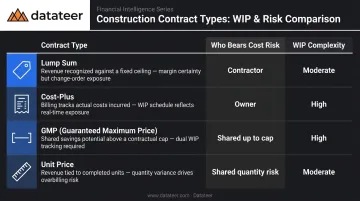
| Contract Type | Who Bears Cost Risk | WIP Complexity |
|---|---|---|
| Lump Sum | Contractor | Moderate |
| Cost-Plus | Owner | High |
| GMP | Shared (up to cap) | High |
| Unit Price | Shared (quantity risk) | Moderate |
Construction Contract Payment Structures: How You Get Paid Matters
Payment structure is separate from contract type. A lump sum contract can use milestone billing or monthly progress billing. A cost-plus contract can have payment tied to defined cost thresholds. The structure chosen directly affects cash flow, working capital, and the contractor's ability to fund ongoing work without external financing.
Progress Billing and Retainage
Progress billing — sometimes called schedule of values billing — is the most common payment structure in commercial construction. The contractor invoices monthly based on percentage of work completed against a pre-agreed breakdown of contract value.
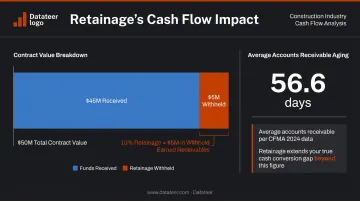
Layered on top is retainage: a percentage withheld from each progress payment until project completion or a defined milestone. ConsensusDocs confirms retainage is typically 5–10% of each payment. The American Subcontractors Association notes that high retainage limits a contractor's ability to accept new work, hire, purchase equipment, and maintain cash flow — often forcing borrowing for operating costs.
Across a portfolio, retainage compounds fast. A contractor holding $50M in active contract value at 10% retainage has $5M in earned but unpaid receivables sitting in escrow. CFMA's 2024 Financial Benchmarker reported 56.6 days in accounts receivable for fiscal year 2023 — a figure that understates the true cash conversion gap once retainage is factored in separately.
Milestone and Stored Materials Payments
Milestone-based payment structures trigger payment when defined project phases are complete — foundation, structural steel, mechanical rough-in. The financial risk centers on the milestone definition. Vague completion criteria create disputes over whether a phase qualifies, which delays payment and strains cash flow.
Stored materials billing allows payment for materials delivered to site but not yet installed. Stored materials billing can improve cash flow, but the documentation requirements are significant:
- Certified invoices showing material cost
- Proof of insurance covering stored materials
- Sometimes a bill of sale or joint check agreement
Missing any of these requirements stalls payment. Contractors who don't anticipate these documentation needs in the contract often end up funding materials out of pocket longer than necessary.
Pay-When-Paid and Pay-If-Paid Clauses
For subcontractors, these two clauses carry very different financial weight.
Pay-when-paid delays the GC's payment obligation to the sub until the owner pays the GC. Payment is eventually owed — the clause adjusts timing, not entitlement.
Pay-if-paid is more aggressive. When enforceable, it makes owner payment to the GC a condition precedent to the sub's right to payment at all. If the owner defaults, the sub may absorb the loss entirely.
Enforceability varies significantly by state. California courts have voided pay-if-paid clauses as conflicting with mechanics lien protections. Wisconsin, North Carolina, Massachusetts, and New York have statutes that restrict or eliminate pay-if-paid enforcement. Subcontractors operating across multiple states need to know their jurisdiction's position before signing contracts containing these clauses.
Scope of Work: Why Precision Protects Margins
Scope of work is where contracts are won or lost financially. A well-negotiated price means nothing if the scope that price covers is ambiguous enough to absorb additional work without compensation.
What a Well-Defined Scope Requires
A financially protective scope section should include:
- Detailed specifications and drawings incorporated by reference (not vague descriptions)
- Explicitly stated inclusions — and equally explicit exclusions
- Allowances for undefined items with stated dollar limits
- A clear, written change order process with defined timelines for owner response
Change Orders and Margin Risk
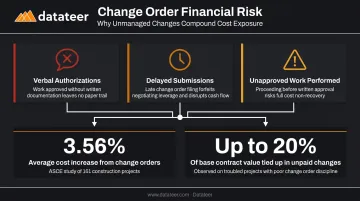
A peer-reviewed ASCE study of 161 school renovation projects found that change orders increased final project cost by an average of 3.56% of contract value, with unforeseen conditions accounting for 1.45% and design-related changes 1.36%. On projects that experienced schedule overruns, the change order percentage jumped to 5.26% — more than double the rate on on-schedule projects.
The financial risk compounds when change orders aren't processed correctly:
- Verbal authorizations create unbilled work with no contractual basis for payment
- Delayed change order submissions allow disputes to develop after the fact
- Unapproved change orders where work has already been performed represent margin consumed without recovery
The exposure compounds quickly. FMI has observed that on troubled projects, as much as 20% of base contract value can be tied up in unpaid changes or unresolved financial disputes, effectively gutting profitability on any job where it occurs.
Scope Gaps Under Lump Sum Contracts
Scope gaps — work that neither party explicitly included or excluded — become contractor-absorbed costs under lump sum agreements. The contractor took the cost risk; ambiguous scope defaults to their obligation. Exhaustive scope definition before signing any fixed-price contract is the direct defense against that outcome.
Under cost-plus arrangements, scope gaps are less catastrophic because the owner reimburses actual costs. Even so, disputes over what qualifies as a reimbursable cost can create billing delays that strain cash flow.
How Contract Structure Affects WIP Reporting and Financial Visibility
Different contract types create fundamentally different WIP accounting pictures. The mechanics matter because they determine how quickly finance teams can detect financial problems — and whether there's still time to fix them.
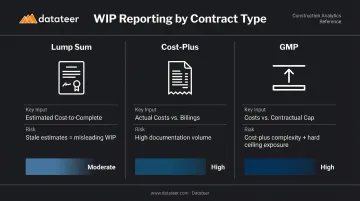
- Lump sum projects use estimated cost-to-complete to calculate over/underbilling. Accuracy depends on field-level cost reporting and updated completion estimates. Stale estimates produce misleading WIP schedules.
- Cost-plus projects require reconciliation of actual costs against billings. The WIP picture is simpler on paper, but documentation volume is much higher.
- GMP projects add tracking costs against the contractual cap — cost-plus complexity combined with the hard exposure of a ceiling that actual costs cannot exceed.
Under ASC 606, revenue is recognized as performance obligations are satisfied, with the cost-to-cost input method being the most common approach in construction. Contract assets (under-billings) and liabilities (over-billings) are determined at the individual contract level. The AICPA confirms that WIP schedules support revenue recognition and identify contract asset or liability positions by comparing recognized revenue with billings.
That recognition timing is precisely where reporting lag becomes a compliance risk, not just an operational nuisance. Finance teams relying on spreadsheet-based WIP often don't know a project is overbilled, underbilled, or burning through contingency until 10–20 days after month-end — by which point the window to intervene has closed.
Datateer's construction financial dashboards close that gap. By syncing directly with ERPs including Procore, Sage, Viewpoint Vista, and Acumatica, the platform automates WIP calculations — percentage complete, earned revenue, billed revenue, costs in excess of billings, and projected margin — replacing the 10–20 day reporting lag with a dashboard refresh that reflects current ERP data.
The platform also generates per-job, per-contract revenue recognition schedules for ASC 606 compliance. For CFOs and CPA firms managing construction client portfolios, that means audit-ready documentation without the monthly manual assembly.
Critical Contract Clauses Finance Teams Must Know
Several contract provisions carry direct financial consequences that extend well beyond legal fees. Finance teams should flag four clauses in particular during every significant contract review:
- Liquidated damages (LDs)
- Consequential damages waivers
- Indemnification
- Dispute resolution
Liquidated damages (LDs): Pre-set penalties for schedule overruns that reduce realized revenue dollar-for-dollar. Courts enforce LDs when the amount represents a reasonable estimate of anticipated loss rather than a penalty. One Connecticut case resulted in a $315,000 award at $400 per day for 789 days of delay, with a net owner judgment exceeding $150,000 after offsetting unpaid contractor work. Treat LDs as a potential revenue reduction — not just a legal risk — during contract review.
Consequential damages waivers: AIA A201-2017 includes a mutual waiver of consequential damages. Without it, a contractor could face claims for lost profits, financing costs, and business losses well beyond direct project damages. Reviewing whether this waiver is present — and whether it's mutual — should be standard on every significant contract.
Indemnification: AIA A201-2017 ties contractor indemnification to third-party claims caused by the contractor's negligent acts or omissions. Broad language that extends beyond this can create unexpected financial liability. Many states have anti-indemnity statutes that cap how far these provisions can reach.
Dispute resolution: How disputes are resolved carries financial consequences well beyond legal fees. Unresolved disputes can freeze retainage, delay final billing, and tie up working capital for months or years. The choice between arbitration, mediation, and litigation affects both cost and timeline.
On high-value contracts, involving legal counsel and financial advisors during dispute resolution clause negotiation is money well spent. A poorly structured clause can produce cash flow disruptions that far exceed the cost of the review itself.
Frequently Asked Questions
What is a standard construction contract?
A standard construction contract is a formal agreement that defines scope of work, payment terms, project schedule, risk allocation, and party responsibilities. Commercial projects typically use standard forms from AIA, EJCDC, ConsensusDocs, or DBIA as a baseline, then negotiate project-specific terms from there.
What are the 7 requirements of a valid contract?
The essential legal elements are offer, acceptance, consideration, mutual assent, capacity, legality, and written form. For construction contracts to be practically enforceable, they must also define scope, price, and schedule clearly enough to resolve disputes without litigation.
What are the most common payment structures in construction contracts?
Progress billing against a schedule of values is the most common structure in commercial construction. Milestone-based billing, stored materials billing, and lump sum payment at completion are also used, with most commercial projects combining progress billing and retainage.
What is the difference between a lump sum and a cost-plus contract?
A lump sum fixes the contractor's price regardless of actual costs — the contractor bears cost risk. A cost-plus contract reimburses actual costs plus a fee — the owner bears cost risk. The right choice depends on how well the scope is defined at the time of contracting.
How do change orders affect a construction contract?
Change orders formally modify the original contract scope, schedule, or price. Unauthorized or poorly documented changes are a leading cause of payment disputes, cost overruns, and margin erosion — the work is complete, but no enforceable payment basis was established before it started.
How does contract type affect WIP reporting?
Each contract type creates different WIP complexity. Lump sum projects rely on accurate cost-to-complete estimates, while cost-plus and GMP projects require detailed cost tracking and reconciliation. The specific structure determines which inputs drive revenue recognition and where estimate errors compound fastest.