Introduction
Most construction progress report templates solve for one audience. The field PM gets a familiar 15-section document. The finance manager gets a financial summary that's already two weeks stale by the time it reaches the owner's desk, when it arrives at all.
That gap matters. Lenders don't release draws on good intentions. Sureties don't overlook billing inconsistencies. Owners who discover schedule slippage from their inspector rather than your report will second-guess every number you submit afterward.
This article covers the standard construction progress report format — all eight core sections — plus a realistic filled-in example and a closer look at the financial sections that owners, lenders, and CFOs actually scrutinize. The financial sections are where draw timelines and margins are won or lost — and where slow payments contribute to reduced profit for 41% of construction businesses, according to Levelset's 2022 survey.
Key Takeaways
- A construction progress report documents work completed, schedule status, budget performance, safety, and risks for a defined reporting period.
- Standard formats include 8 core sections — WIP, cost-to-complete, and change orders are the sections that drive payment approvals and lender draws.
- Reports align with pay application cycles: weekly for active oversight, monthly for draw submissions.
- Consistent format across every reporting period is non-negotiable — lenders and owners stop trusting numbers when the structure shifts.
- Financial sections are only as credible as the ERP data behind them — stale or manually adjusted inputs invite rejected draws and audit scrutiny.
What Is a Construction Progress Report?
A construction progress report is a structured, periodic document that captures how a project is performing against its baseline plan. It covers work completed, schedule variance, budget consumption, safety events, and upcoming activities. It functions as both a management tool and a contractual record: courts have treated it as admissible evidence in disputes.
Who Reads It and What They're Looking For
Write for the skeptical reader, not the cooperative one:
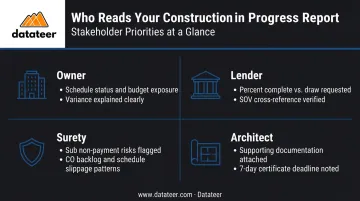
- Owner — schedule status and budget exposure; wants variance explained, not buried
- Lender — verifies percent complete justifies the draw being requested; cross-references SOV line items against billing amounts
- Surety — reads cover to cover, watching for sub non-payment, CO backlog, and schedule slippage patterns
- Architect — under AIA A201, must issue or withhold a Certificate for Payment within 7 days of receiving the application; needs supporting documentation to act
Reporting Cadence
Most contracts specify weekly or monthly reporting, with monthly cadence tied directly to pay application cycles. AIA A201-2017 requires payment applications to be submitted at least 10 days before the established payment date, so your progress report must be ready before that deadline, not after.
Establish the reporting schedule at kick-off and hold to it. Irregular submission gaps complicate draw timelines and signal disorganization to lenders.
Construction Progress Report Template: The 8 Core Sections
These eight sections appear in virtually every defensible, stakeholder-ready progress report. They work for commercial, civil, and industrial projects. Adapt field labels to your contract — don't change the structure.
Section 1: Project Identification & Executive Summary
Project identification header — use identical fields every period:
| Field | Example |
|---|---|
| Project Name | Westfield Medical Office Building |
| Contract No. | C-2024-047 |
| Owner | Westfield Health Systems |
| GC | Summit Construction Group |
| Reporting Period | June 2–8, 2025 |
| Report No. | 14 |
Executive summary — 3 to 4 sentences maximum. Lead with bad news and pair it immediately with a plan. The difference between a weak summary and a credible one:
- ❌ "Project is progressing as planned. Work continues on schedule and within budget."
- ✅ "Structural steel erection is 8 days behind the baseline schedule due to a fabricator delivery delay on Level 3 columns, received June 4 instead of May 27. A recovery schedule has been submitted to the owner adding one weekend shift during June 15–16; projected substantial completion remains November 14. The open risk is MEP rough-in on Level 2, which cannot begin until steel erection is complete — owner action required on the RFI for plenum height clearance by June 11."
Section 2: Work Completed, In Progress, and Look-Ahead
Specificity is credibility. "Work continued on building" is indefensible under scrutiny. Quantities and stationing are not — "installed 240 LF of 8-inch storm drain between Sta. 12+00 and Sta. 14+40" is.
Structure this section across three time frames:
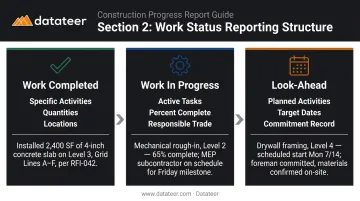
- Work completed — specific activities finished this period, with quantities and locations
- Work in progress — active tasks, current percent complete, and responsible trade
- Look-ahead (next 2 weeks) — planned activities with target dates; this creates a commitment record. If Tuesday's deck pour doesn't happen, next week's report must say why.
Section 3: Schedule Status
| Activity | Planned % Complete | Actual % Complete | Variance | Status |
|---|---|---|---|---|
| Foundation | 100% | 100% | — | Complete |
| Structural Steel | 85% | 74% | -11% | Behind — delivery delay |
| Level 1 MEP Rough-In | 40% | 48% | +8% | Ahead |
Always follow the table with a one-paragraph narrative. Owners and sureties need the cause behind each variance, not just the number.
Section 4: Manpower, Equipment, and Materials
These three sub-fields show whether your resourcing matches your schedule commitments:
- Manpower — trade headcounts per day, total hours this period
- Equipment — assets on site with active/idle status (idle equipment is a red flag for owners and sureties)
- Materials — received this period, pending deliveries, and any items at risk of slipping
Section 5: Safety, Quality, and Photos
- Safety — recordable incidents, near-misses, toolbox talks completed, cumulative man-hours without a recordable. Report zero incidents explicitly — sureties and insurance carriers track this.
- Quality — inspections completed, test results, non-conformance reports, corrective action status
- Photos — every photo needs a date, location, and one sentence describing what it shows. Unlabeled photos at the back of a PDF are not documentation.
Section 6: Issues, Risks, and Change Orders
Keep issues and risks in separate buckets:
- Issues — active problems currently impacting the project (with mitigation plan or owner action required)
- Risks — items that haven't materialized but need monitoring (risks without recommended actions read as blame-shifting)
Change order log — include pending, approved, and total impact:
| CO # | Description | Submitted | Status | Cost Impact | Sched. Impact |
|---|---|---|---|---|---|
| CO-007 | Structural steel upcharge | May 14 | Pending — 25 days | +$48,200 | +3 days |
| CO-008 | MEP coordination revision | May 29 | Pending — 10 days | +$12,400 | 0 days |
Flag how long pending COs have been sitting without owner action. Stalled approvals are a margin risk hiding in plain sight.
Construction Progress Report Example
Here's a completed example based on a mid-size commercial project in active construction — use it as a benchmark for format, language, and financial detail.
Project: Westfield Medical Office Building | Location: Denver, CO | Period: June 2–8, 2025 | Phase: Structural / MEP Rough-In | Prepared by: J. Harrington, PM
Executive Summary: Structural steel erection is 8 days behind baseline due to a fabricator delivery delay on Level 3 columns. A recovery schedule adding one weekend shift on June 15–16 has been submitted to the owner; projected substantial completion of November 14 is maintained. Level 1 MEP rough-in is running 8% ahead of plan. The open risk requiring owner action is the plenum height RFI on Level 2 — response needed by June 11 to protect the MEP start date.
Work Completed, Schedule Status, and Look-Ahead:
| Trade/Activity | Planned Completion | Forecast Completion | Variance | Notes |
|---|---|---|---|---|
| Foundation & Slab-on-Grade | April 18 | April 18 | 0 days | Complete |
| Structural Steel — Levels 1–2 | May 30 | May 30 | 0 days | Complete |
| Structural Steel — Level 3 | June 3 | June 11 | +8 days | Delivery delay |
| Level 1 MEP Rough-In | July 12 | July 4 | -8 days | Ahead — crews accelerated |
| Exterior Framing | June 28 | June 28 | 0 days | On track |
Financial Summary:
| Field | Amount |
|---|---|
| Original Contract Value | $8,400,000 |
| Approved Change Orders | $214,000 |
| Adjusted Contract Value | $8,614,000 |
| Billings to Date | $3,965,440 (46%) |
| Cost-to-Complete Estimate | $4,750,000 |
| Retainage Held | $440,604 (10%) |
This table is what lenders and owners cross-reference against the draw request. If the percent billed doesn't reconcile with the Schedule of Values in the pay application, the draw gets held — not questioned, held. Get the numbers right before submitting.
The Financial Sections Construction Finance Teams Often Undervalue
Most progress report templates treat the financial summary as a single table at the back. That's a mistake. It's the section that drives payment approvals, lender draw releases, and surety confidence.
WIP: The Lender's Core Test
Percent complete versus percent billed is what lenders are actually reading:
- Billing at 65% while reporting 75% complete → signals underbilling; lender may question whether work is actually done
- Billing at 65% while 62% complete → signals overbilling; shifts financing burden to the owner
According to CMAA, WIP analysis should be performed monthly, at minimum, and should scrutinize underbillings, overbillings, cash flow, and gross profit. NASBP notes that underbillings tie up cash in work not yet billed, reducing liquidity and potentially forcing short-term borrowing — a pattern sureties track closely through trend analysis.
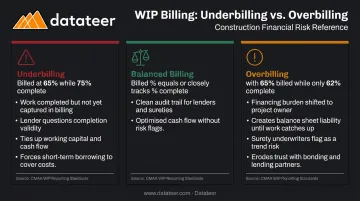
Inconsistency between the WIP schedule and the progress report doesn't just raise questions. It creates disputes.
Budget Performance Fields That Belong in Every Report
Every progress report financial summary should include:
- Committed costs — POs and subcontracts executed to date
- Actual expenditures — costs incurred through the period end
- Estimate at Completion (EAC) — projected final cost based on current performance
- Cost-to-Complete (CTC) — remaining work to spend
- Budget variance — with a one-sentence explanation of the driver
Owners and lenders want early warning of overruns while contingency is still available — not a surprise at 90% completion.
The Data Lag Problem
When the financial sections of a progress report depend on manually pulling data from ERP systems and reformatting spreadsheets, finance teams face a 10 to 20 day lag between project activity and the numbers that land in the report. By the time the financial summary is assembled, the margin fade has already happened.
Datateer's direct ERP sync connects to Procore, Sage, Viewpoint Vista, Acumatica, Foundation, and 12+ other systems — refreshing data overnight without manual intervention. The WIP dashboard calculates percentage complete, earned revenue, billed revenue, over/under-billings, and projected margin per job, flagging margin fade before the monthly close locks it in. For CFOs preparing draw submissions, that means catching a problem while there's still time to act on it.
Common Mistakes to Avoid
Format Inconsistency
When sections move between periods, readers stop trusting the document. The lender goes straight to the financial summary. The owner goes straight to the executive summary. The surety reads cover to cover. Changing the format forces everyone to hunt — and a reader who has to hunt is a reader who starts doubting.
Use the same template every reporting period, same section order, same header labels.
Vague Work Descriptions and Buried Bad News
"Work continued" tells no one anything and is indefensible under scrutiny. CMAA states that contractors lose cases not because they are wrong, but because they cannot prove what happened — and the party with the best contemporaneous documentation wins.
The same principle applies to bad news. Softening schedule variance in paragraph four of a rarely-read section is worse than leading with it. When the owner finds out from their inspector, every future number in every future report gets second-guessed.
Disconnected Financial Data
Three specific failure patterns:
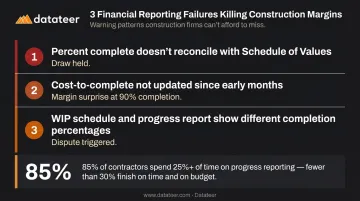
- Percent complete in the progress report doesn't reconcile with the Schedule of Values in the pay application
- Cost-to-complete estimate hasn't been updated since month two
- WIP schedule and progress report show different completion percentages for the same job
Any one of these triggers a hold. All three trigger a dispute. Levelset's 2020 data found that 85% of contractors spent more than a quarter of their time tracking and reporting project progress, yet fewer than 30% consistently finished projects on time and within budget. Reporting volume doesn't guarantee reporting accuracy.
The root cause is usually manual reconciliation across disconnected systems. Tools like Datateer's Job Costing & Cost-to-Complete dashboard address this by pulling actual costs, committed costs, pending change orders, and projected final cost directly from the ERP — updating continuously rather than refreshing once a month at close.
Frequently Asked Questions
What is a WIP report template?
A WIP (Work in Progress) report template is a structured financial document used to track costs incurred, percentage of completion, billed amounts, and over/under-billing status across active projects. It's the financial counterpart to the operational progress report and is used by finance teams to support draw requests and monitor margin.
What should be included in a construction progress report?
A complete progress report covers eight core sections:
- Project identification and executive summary
- Work completed and work in progress
- Look-ahead schedule
- Schedule status
- Manpower, equipment, and materials
- Safety and quality
- Issues and change orders
- Financial summary — including WIP data, cost-to-complete, and retainage
How often should construction progress reports be submitted?
Most contracts specify weekly or monthly cadence — weekly for active phases requiring close oversight, monthly tied to pay application cycles. AIA A201 ties submission to the payment date in the contract. Consistency matters more than frequency; irregular gaps complicate draw timelines.
What is the difference between a daily report and a progress report?
A daily report is the real-time field record — crew counts, work performed, weather, equipment, photos. A progress report is the weekly or monthly summary that aggregates daily data for owners, lenders, and sureties. The progress report is only as reliable as the daily logs feeding it.
Who is responsible for creating a construction progress report?
The project manager or superintendent typically owns the operational sections. The finance manager or CFO owns the financial summary, WIP reconciliation, and change order impact. On mid-size to large projects, it's a collaborative document — field and office both sign off before it goes out.