For construction finance leaders, the consequences are tangible: eroded margins, strained cash flow, and contract renegotiations on projects that were never priced to absorb mid-build cost spikes.
What's often missed is that most overruns aren't purely bad luck. They stem from a combination of external market forces and internal process failures — both of which can be addressed. This guide breaks down where commercial construction costs actually originate and what levers work at each stage.
Key Takeaways
- Delayed financial visibility amplifies every cost driver — material volatility, labor shortages, and scope creep included
- Most overruns begin accumulating in pre-construction and only become visible weeks into execution
- Real-time job cost monitoring is the single highest-leverage internal control available
- Effective cost control spans three stages: pre-construction planning, execution oversight, and external market management
- Firms that catch margin fade early retain the most room to course-correct before losses compound
How Commercial Construction Costs Typically Build Up
Cost problems in commercial construction rarely announce themselves. They build across phases — each one adding a little more pressure — until a WIP report finally surfaces what the job has been absorbing for weeks.
Estimating assumptions made under bid pressure get carried into the schedule. Procurement happens reactively rather than strategically. Change orders get processed informally. By the time finance leadership pulls a cost-to-complete, the margin has already faded.
The Pre-Construction Origin Problem
A 2025 study published in the Lean Construction Journal identified risk identification and design interdisciplinary reviews as the two most critical pre-construction processes tied to cost overruns — not execution failures, but decisions made before the first shovel enters the ground.
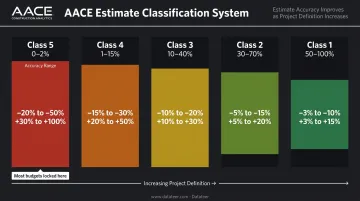
AACE's estimate classification system reinforces this point. A Class 5 estimate — built on just 0–2% project definition — carries an accuracy range of -20% to -50% on the low side and +30% to +100% on the high side. Most commercial project budgets are locked in before the design is anywhere near complete. When a budget gets committed at Class 5 accuracy, the project starts behind — and detection speed determines how much ground it loses.
Why Detection Lags Matter
The compounding effect is what makes timing so damaging. A labor inefficiency surfaced in week four costs a fraction of what it costs when caught at month-end close three weeks later. By then, the same problem has driven additional overruns, disrupted crew deployment, and left fewer options for recovery.
Firms using manual, spreadsheet-based WIP processes typically operate with a 10–20 day reporting lag between when cost events occur and when finance teams can see them. By that point, the margin has moved on without them.
Key Cost Drivers for Commercial Construction
Material Price Volatility
Steel, concrete, lumber, copper, and mechanical/electrical components are all subject to meaningful price swings between bid and build. The AGC reported that materials and services used in nonresidential construction rose 2.6% year over year as of July 2025, with acceleration driven by tariff impacts on steel and aluminum.
For projects bid months before procurement, this gap between estimated and actual input cost creates direct margin exposure — unless contracts include escalation clauses.
Skilled Labor Shortages
The labor constraint is severe and persistent. According to AGC's 2024 Workforce Survey:
- 94% of respondents reported open craft-worker positions
- 94% of those firms said those roles were hard to fill
- 54% reported project delays directly caused by worker shortages
Wage pressure follows from scarcity, and reduced crew productivity compounds the cost. Unlike material costs, you rarely see labor inefficiency in real time. It shows up in payroll after the fact.
Regulatory and Compliance Complexity
Stricter building codes, permitting timelines, and compliance requirements — especially in high-growth urban markets — add both direct costs (additional systems, materials, or documentation) and indirect costs through schedule extensions. Delayed permits push project starts, which push procurement into different market conditions than those used in the original estimate.
Scope Changes and Change Order Mismanagement
An ASCE analysis of 125 design-build building projects confirmed what most project managers already know: change orders are directly tied to cost and schedule performance. The Construction Industry Institute notes that poorly managed changes interrupt workflow, create delays, inflate costs, and generate claims.
Every undocumented or unpriced scope revision is a direct margin leak. The cumulative impact of multiple change orders across a project — for electrical and mechanical contractors especially — can be substantial even when individual orders appear minor.
Financial Visibility Lag
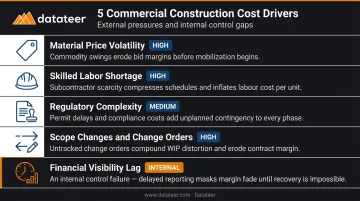
Unlike the cost drivers above, financial visibility lag is an internal control failure — one that amplifies every other risk on this list.
When finance teams operate on 10–20 day WIP refresh cycles, cost problems compound in the dark between reporting periods. Labor overruns, material waste, and billing misalignments go unaddressed not because the data doesn't exist, but because no one has seen it yet.
Datateer's automated construction finance dashboards eliminate this lag, delivering WIP and job cost data on a near-real-time basis. As one Double L Management client put it: "That one click replaced two weeks worth of prior work."
The platform's Margin Protection and Job Costing dashboards flag negative variance drivers at the cost-code level while intervention is still possible: labor overruns, material escalation, subcontractor cost increases, and stalled change orders.
Cost-Reduction Strategies for Commercial Construction
No single strategy works across all projects or firms. Effective cost control depends on identifying which driver is causing the problem and applying the right lever at the right stage.
Strategies That Change Pre-Construction Decisions
The decisions made before construction begins lock in a disproportionate share of total project cost. These strategies address that front-loaded risk.
Lock in material pricing early. Procurement decisions made at bid time often reflect optimistic pricing assumptions. Committing to supplier agreements or early-buy arrangements for high-volatility materials (steel, copper, concrete) before construction begins reduces exposure to mid-project price spikes. With tariff-driven acceleration in steel and aluminum costs through 2025, this is not optional risk management.
Apply value engineering before design is finalized. Value engineering yields the greatest savings during pre-construction, before specifications are committed. Substituting engineered wood systems in appropriate structural contexts, simplifying facade details without compromising performance, or revisiting mechanical system layouts can reduce cost without reducing function. Post-commitment, the same changes cost more and take longer to implement.
Build inflation-adjusted contingencies. AACE's estimate classification framework shows that early-stage estimates carry accuracy ranges of +30% to +100% on the high side. Contingency funds sized to historical averages routinely fall short when material prices are rising. Tie contingency sizing to current material price indices — not rule-of-thumb percentages — and build in review triggers at procurement milestones.
Defer non-critical scope elements. Features that don't affect structural integrity, code compliance, or core business function can be phased into a later project stage. Reducing the cost exposure of the initial build preserves optionality without sacrificing the core project.
Strategies That Improve Execution-Phase Control
Most overruns materialize during active construction, even when their roots are in pre-construction. These strategies address the execution gap.
Track job costs against budget continuously, not monthly. Manual WIP reporting creates a 10–20 day lag where labor inefficiencies, material waste, and billing misalignments compound unchecked. Firms that move to continuous or near-real-time job cost monitoring can identify where a project is going off-track while there's still time to adjust crew deployment, renegotiate purchase orders, or accelerate billing. Datateer's Job Costing & Cost-to-Complete dashboard covers this directly, tracking actual costs incurred, committed costs, pending change orders, and projected final cost at job, phase, and cost-code level, with data updated nightly.
Implement disciplined change order management. Every unpriced scope change is a direct margin leak. A formal change order process — written approval, pricing, and schedule impact assessment before any out-of-scope work begins — is one of the highest-leverage controls available. Datateer's Change Order Impact & Aging module tracks pending, approved, denied, and executed change orders with aging by days since submission, specifically flagging work performed without approved change orders.
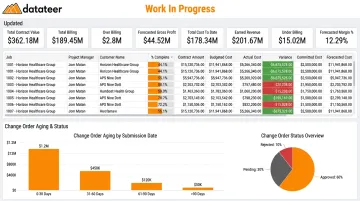
Conduct weekly project-level margin reviews. Margin fade (the gradual erosion of projected profit as small overruns accumulate) is most damaging when it goes unreviewed until month-end. Weekly or bi-weekly project financial reviews, supported by live data, shift finance managers from forensic accounting to proactive risk management.
Two dashboards serve different roles here: Cost Variance shows where costs are deviating at the transaction level, while Margin Protection shows where the project's final profitability is heading.
Strategies That Address External Factors
Some cost drivers can't be eliminated — but they can be distributed and timed more intelligently.
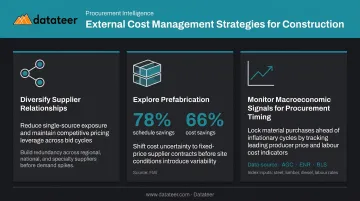
Diversify supplier relationships. Over-reliance on a single supplier creates concentrated risk. When that source experiences a shortage or price spike, the project absorbs the full impact. Building a multi-supplier network, including regional alternatives, distributes this risk and creates negotiating leverage at procurement.
Explore prefabrication for eligible project elements. FMI's 2024 Labor Productivity Study found that 78% of surveyed contractors saw schedule savings from prefabrication and 66% saw cost savings. For commercial projects with repetitive structural or mechanical elements, moving portions offsite reduces material waste, limits on-site labor variability, and compresses timelines.
Monitor macroeconomic signals to time procurement. AGC's reporting on tariff-driven material acceleration, ENR's cost indexes, and BLS Producer Price Index data provide enough signal for firms willing to track them. Knowing when steel prices are moving before a procurement decision, or when shipping costs are spiking ahead of a major equipment purchase, converts market awareness into direct cost savings.
Conclusion
Rising commercial construction costs are not simply a condition to absorb. They're driven by where cost originates and how quickly it surfaces. Firms that address cost at the decision stage, manage it with real-time visibility during execution, and adapt to external conditions strategically will outperform those that react after the damage is done.
Cost control is a continuous discipline, not a project-by-project intervention. The firms most resilient to escalation are those with financial infrastructure that surfaces variances while there's still time to course-correct — not after the close, and not after the margin has already moved.
That infrastructure starts with data: automated ERP feeds, real-time job costing, and dashboards that give CFOs and project teams a shared view of where each project actually stands. Datateer's construction analytics platform connects directly to your ERP to deliver exactly that — with pre-built dashboards live in 2–4 weeks and no per-seat fees. If you're not sure where your data maturity stands today, the free 60-second Construction Data Maturity Audit is a good starting point.
Frequently Asked Questions
How can I reduce commercial construction costs?
Reducing costs requires addressing where they originate, not just cutting line items. Focus on three stages: pre-construction decisions (scope, procurement, contingency planning), execution controls (real-time job cost tracking, change order discipline), and supply chain factors like supplier diversification and procurement timing.
What are the key rules of cost control in construction?
Build accurate budgets with inflation-adjusted contingencies, track job costs in near-real-time instead of waiting for monthly reports, and enforce written change order approval before work begins. A shared data source that keeps field and finance aligned ties all three together.
What are the biggest causes of cost overruns in commercial construction?
The primary drivers are material price volatility, skilled labor shortages, scope changes, poor change order management, and delayed financial reporting. That last one is often underestimated — when finance teams are working on 10–20 day old data, every other cost driver compounds undetected between reporting cycles.
How does inflation affect commercial construction projects?
Inflation widens the gap between estimated and actual costs for materials, labor, and equipment — firms without inflation-adjusted contingencies or early price locks absorb that difference as direct margin exposure. AGC reported nonresidential construction input costs rose 2.6% year over year as of July 2025, with tariff-driven acceleration in steel and aluminum.
What is value engineering in commercial construction?
Value engineering reviews project designs to find lower-cost alternatives that meet the same functional and structural requirements. Apply it during pre-construction, before specs are locked — post-commitment value engineering is slower, costlier to implement, and delivers fewer savings.
How can real-time financial data help control construction costs?
Real-time job cost visibility lets finance managers catch labor slippage, budget overruns, and margin fade as they happen rather than at month-end close. That timing difference determines whether corrective action is still possible. Adjusting crew deployment, renegotiating purchase orders, or accelerating billing only works before the overrun becomes permanent.