Introduction
Construction AP teams face a problem most industries don't: invoices don't arrive with simple price tags. A subcontractor's pay application may reference a Schedule of Values line item at 67% complete, with retainage withheld, a pending change order, and labor hours that need field verification. Multiply that complexity across dozens of active projects and hundreds of monthly invoices, and the margin for error translates directly into lost margin.
According to Rabbet's 2024 Construction Payments Report, 82% of contractors experienced payment delays longer than 30 days, with slow payments estimated to cost the U.S. construction industry $280 billion in 2024. Invoice approval isn't the only driver, but it's where the problem is either caught early or compounded into something far more expensive.
Getting that process right starts with understanding what construction invoice approval actually involves — how 3-way matching works in a construction context, and where it breaks down in practice. That's what this guide covers.
Key Takeaways
- Construction invoice approval confirms an invoice is legitimate, correctly job-coded, and aligned with contract terms before payment is released.
- 3-way matching reconciles the PO/subcontract, field confirmation, and invoice to catch overbilling and coding errors before they hit job costs.
- In construction, the "receipt" is often a certified percent complete or superintendent sign-off, not a standard goods receipt.
- A failed match triggers an exception and resolution workflow — not approval.
- PO discipline and field documentation quality determine whether the process works at scale.
What Is Construction Invoice Approval and 3-Way Matching?
Invoice Approval Defined
Invoice approval is the structured review and authorization process a construction firm runs before recording a payable and scheduling payment. It confirms four things:
- Legitimacy — is this a real invoice from a real vendor?
- Accuracy — are quantities and amounts correct?
- Job-cost coding — is this assigned to the right project and cost code?
- Contract compliance — does this align with what was agreed?
That last point is where construction diverges from standard AP. A generic AP team verifies the invoice matches the PO. A construction AP team must also verify the approved billing period, the Schedule of Values, any executed change orders, and the retainage rate in the subcontract. All of that must clear before a match can pass.
3-Way Matching Defined
Sage defines 3-way matching as the reconciliation of three documents:
- The Purchase Order or subcontract — what was agreed upon
- The receiving report or field confirmation — what was actually delivered or completed
- The vendor invoice — what the vendor is billing for
All three must agree on vendor identity, quantities, pricing, and terms before the invoice can be approved.
Why Construction Is Different
In construction, all three documents carry layers that standard AP doesn't encounter:
- Progress billing requires matching against a certified percent complete and Schedule of Values line items (AIA G702/G703 documents), not a physical goods receipt.
- Retainage means the payable amount will always differ from the invoice face value by a contractually defined percentage — most often 5% or 10%, per CFMA — which must be tracked separately.
- Change orders alter PO values mid-project, creating temporary mismatches until the system reflects authorized changes.
- Multiple billing types (T&M, lump sum, milestone, unit price) each require different match logic.
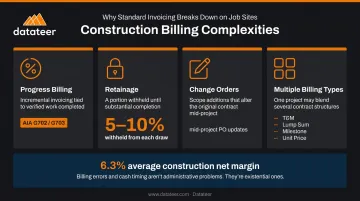
CFMA's FY2023 data puts average net income before taxes at 6.3% across 1,290 construction companies. With margins that thin, high subcontractor invoice volumes, and complex billing structures, a single approval failure can erase the profit on an entire job phase.
What goes wrong without it:
- Overpayments to subcontractors for work not yet completed
- Costs posted to the wrong job, distorting WIP reports and over/under-billing calculations
- Cash flow disruption from paying ahead of verified field completion
- Lien and dispute exposure from payments that can't be substantiated
How the 3-Way Matching Process Works in Construction
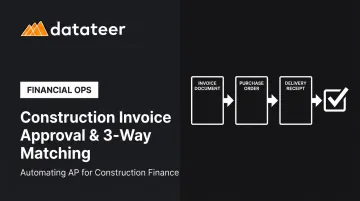
The end-to-end flow: invoice enters the system → gets coded to a job and cost code → gets matched against the PO/subcontract and the field confirmation → passes to approval routing if the match succeeds → gets flagged as an exception if it fails.
Here's what each step involves.
Step 1: Invoice Capture and Job-Cost Coding
Invoices arrive in multiple formats — email attachments, supplier portals, scanned paper, or direct ERP feeds. The first task is extracting key fields: vendor name, invoice number, billing period, line items, and total amount.
Cost coding happens here: assigning the invoice to the correct job number and cost code. This step is foundational.
If an invoice gets coded to the wrong job or cost code at capture, the 3-way match can pass cleanly while the job-cost data is wrong. Accurate match results and accurate cost data are not the same thing — errors introduced at coding don't get caught downstream.
Step 2: The 3-Way Match
The match logic checks:
- Vendor alignment — the vendor on the invoice matches the vendor on the PO
- Quantity and amount tolerance — billed amounts fall within acceptable variance of what was ordered
- Receipt confirmation — the work or materials billed are verified as received or completed
In construction, the receipt document varies by contract type:
| Billing Type | Receipt Equivalent |
|---|---|
| Progress billing | Certified percent complete against Schedule of Values (AIA G702/G703) |
| T&M contracts | Labor time records + material delivery confirmations |
| Lump sum / milestone | Site superintendent sign-off or architect certification |
| Material supply | Signed delivery slips with field verification |
One point that causes confusion: when a subcontractor bills for work tied to an unapproved change order, the match will fail. That's the process working correctly. The invoice should be held until the change order is formally executed and the PO updated. Approving it before that step creates an undocumented payable.
Step 3: Approval Routing and Authorization
After a successful match, the invoice routes through a defined approval chain:
- Project manager or site superintendent — confirms the work happened as billed
- AP or finance team — verifies financial accuracy, contract compliance, and coding
- Controller or CFO — authorizes invoices above a defined dollar threshold
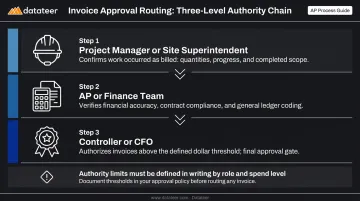
Approval authority should be defined by role and spend limit in writing — not determined ad hoc per invoice. Without a defined structure, approval decisions vary by person and project — a problem that becomes harder to audit and correct as the firm takes on more work.
Outcome of approval:
- Invoice posts to the ERP as an approved payable
- Payment gets scheduled per contract terms
- Retainage is withheld at the contractually agreed rate and tracked separately for release at project completion
Key Factors That Affect Invoice Approval and 3-Way Matching
Several operational variables determine whether the process works reliably or becomes a source of exceptions and delays.
PO discipline. Matching only works if purchase orders or subcontracts are raised in the system before work begins. Invoices that arrive without a corresponding PO force manual review and break any automation. The fix is process enforcement at project kickoff, not a technology upgrade.
Field documentation quality. The receipt leg of the match depends on field teams producing timely, accurate delivery confirmations, site sign-offs, or certified progress reports. Weak field documentation culture creates a bottleneck that delays payment cycles and strains subcontractor relationships. The field-to-finance handoff requires a defined SLA.
ERP integration and data completeness. All three documents must exist in a connected system for matching to work. When POs live in one system, receiving records sit on paper, and invoices arrive by email, the match must be assembled manually — slow and error-prone. Platforms like Datateer connect to construction ERPs (Procore, Sage, Vista, Acumatica, and others), pulling committed costs, invoice data, and change order status into a unified financial view so finance teams have real-time visibility into cost-to-budget variance and AP aging across all active projects.
Scale and invoice volume. As project count grows, invoice volume grows faster. A.M. Ortega Construction, a utility and paving contractor, processes approximately 4,000 AP invoices per month. At that volume, matching tolerance rules, exception thresholds, and approval delegation must be calibrated deliberately, or AP becomes a cash flow bottleneck.
Retainage and change order tracking. Both create systematic apparent mismatches. Retainage means the payable will always be less than the invoice face value. Change orders alter PO values mid-project. Systems that don't account for both will flag valid invoices as exceptions, which erodes confidence in the process and slows approvals.
Common Issues and Where 3-Way Matching Falls Short
The Job-Cost Coding Misconception
The most common mistake: assuming that passing a 3-way match confirms an invoice is correctly job-costed. It doesn't. The match only confirms that the invoice aligns with the PO. If the PO was coded to the wrong job or cost code at creation, the match passes with bad data intact. Cost coding accuracy must be enforced at PO creation — it cannot be treated as something the matching process will catch.
Datateer's Job Costing and Cost Variance dashboards help here — not by catching miscoding at entry, but by surfacing anomalies in real time once data flows from the ERP. An unexpected variance on a specific cost code signals that something may have been miscoded, and the drill-down-to-source-transaction feature lets a CFM investigate without leaving the dashboard.
2-Way Matching Is a Hidden Risk
Many construction AP teams run 2-way matching — comparing only the PO and invoice, skipping receipt verification — because field confirmation is slow or hard to obtain. This removes the primary control that prevents payment for undelivered materials or work not yet performed. On multi-subcontractor projects, this creates real overbilling exposure.
The fix is operational, not procedural. Mobile-enabled approval workflows and a defined field-to-finance confirmation SLA close the documentation gap. Dropping the control doesn't.
When 3-Way Matching Isn't the Right Tool
Three-way matching is not appropriate for every invoice type. Firms that apply it universally create unnecessary friction:
- Non-PO invoices (utilities, professional fees, emergency purchases) have no PO to match against — use 2-way matching or threshold-based approval instead
- Very low-value invoices where the administrative cost of a full match exceeds the financial risk — blanket POs or auto-approval thresholds are more appropriate
- T&M invoices with fluid quantities — the match needs to account for timesheets and delivery confirmations rather than a static PO quantity
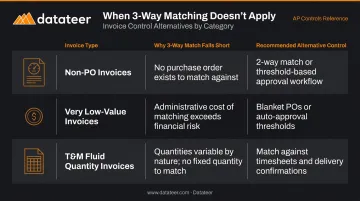
Calibrating which invoices require full 3-way matching versus alternative controls depends on your firm's actual invoice mix. That calibration needs to be deliberate, not inherited from a generic AP policy.
The Field-Office Bottleneck
The most common systemic failure point is the gap between field verification and finance recording. A project manager knows the work happened. But if there's no fast, structured way to record that in the AP system, invoices sit waiting for sign-off, payment terms get missed, and early payment discounts evaporate.
Resolving this requires a workflow fix in the source system: a mobile-enabled approval process in your ERP or project management platform, or a defined SLA for how quickly field confirmation must be recorded after work is verified. Datateer surfaces the downstream consequences of the gap in real time — stalled change orders, under-billings, budget variances — but the confirmation workflow itself has to live where the data originates.
Conclusion
Construction invoice approval with 3-way matching is the control that ensures no payment leaves without confirmed authorization (PO), confirmed delivery or completion (field receipt), and confirmed billing accuracy (invoice). When all three align, job-cost data stays trustworthy, margins hold, and subcontractor relationships don't erode over disputed payments.
The discipline is what's hard — enforcing PO creation before work starts, closing the field documentation loop consistently, and configuring matching rules that account for progress billing, retainage, and change orders. A generic AP model applied to a construction environment will generate exceptions by design. The fix isn't tighter approvals; it's matching logic built for how construction actually bills.
Datateer's AP and change order analytics give finance teams real-time visibility into where exceptions are stacking up — by job, subcontractor, or cost code — so the matching process stops being a reactive bottleneck and starts informing how the next project is structured. If that kind of visibility is missing from your current workflow, the 15-Minute Workflow Audit is a practical starting point.
Frequently Asked Questions
What is an invoice approval?
Invoice approval is the formal review and authorization step confirming that an invoice is accurate, legitimate, and compliant before it's recorded in the accounting system and scheduled for payment. In construction, this includes verifying job-cost coding, retainage, and contract compliance — not just the dollar amount.
Do invoices need to be approved?
Yes — all invoices should go through an approval process. In construction, this is especially critical given the risk of overbilling, duplicate payments, and incorrect job costing that directly affect project profitability and WIP accuracy.
Who is responsible for approving invoices for payment?
Approval involves multiple roles:
- Project manager or superintendent — confirms field accuracy
- AP or finance team — verifies financial and compliance details
- Controller or CFO — authorizes invoices above a defined dollar threshold
How do you approve an invoice?
- Verify the invoice against the PO and receipt document (3-way match)
- Confirm job-cost coding is correct
- Check for exceptions such as retainage or unapproved change orders
- Route through the defined approval workflow before posting to the ERP for payment
What is 3-way matching in construction invoicing?
3-way matching reconciles three documents — the Purchase Order or subcontract, the receipt or field-verified completion record, and the invoice — to confirm all three agree on vendor, quantities, price, and terms before payment is authorized.
What happens when a construction invoice fails 3-way matching?
A failed match flags an exception and routes the invoice for resolution — which may involve correcting the invoice with the vendor, issuing a formal change order to update the PO, or obtaining missing field documentation. The invoice is not approved or paid until the discrepancy is resolved.