Introduction
A construction firm can have a full project backlog, crews on every site, and strong revenue on paper — and still struggle to make payroll. That's not mismanagement. It's the structural reality of construction cash flow, where the gap between completing work and collecting payment can stretch for months.
Rabbet's 2024 Construction Payments Report estimated that slow payments added $280 billion in costs to the construction industry in 2024 — up from $208 billion just two years prior. The same report found that 82% of contractors waited more than 30 days for payment in 2024, compared to 49% in 2022. Meanwhile, cross-industry B2B payment terms average around 45 days. Construction routinely runs well past that.
The reasons are structural: project-based billing cycles, multi-tier payment chains from owner to GC to sub, retainage withholds, and lien rights that require active management. Generic AR advice doesn't map to this environment — this guide covers practices built specifically for how construction billing and collections actually work.
Key Takeaways
- Vet customer creditworthiness and get signed payment terms in writing before any work begins
- Invoice the same day milestones are hit; use progress billing on large jobs to surface cash flow problems early
- Review your AR aging report weekly and track DSO, AR Turnover Ratio, and CEI as core performance metrics
- Follow a structured, tiered collections cadence so follow-up happens on schedule, every time
- Treat retainage as a managed receivable with its own release schedule, not an afterthought
Lay the Foundation: Contracts, Creditworthiness, and Payment Terms
Poor AR outcomes rarely start with collections. They start weeks or months earlier — with vague contract language, unvetted clients, and payment terms the customer never actually reviewed before signing. By the time a invoice goes unpaid, the damage was usually done at contract execution.
Assess Customer Creditworthiness Before You Commit
On large commercial projects, a collection failure isn't a cash flow inconvenience — it can be catastrophic. Before committing resources, run a proper credit vetting process:
- Pull a business credit report and review payment history with other trade creditors
- Request financial statements for larger contracts — look at debt load relative to income and current liquidity
- Check trade references with suppliers and GCs they've worked with previously; ask specifically about payment timeliness
- Establish tiered credit limits based on risk profile — not every client gets the same exposure
For larger projects, requiring an upfront deposit shifts some of the carrying cost burden to the client and serves as an early signal of their intent and ability to pay. Most experienced GCs expect it.
What Your Construction Payment Terms Must Include
Five elements belong in every construction payment contract — without exception:
- Explicit due dates tied to milestones or calendar dates, not vague "upon completion" language
- Defined retainage percentage and the specific conditions required for release
- Late payment fee structure — state this clearly and reference it on every invoice
- Accepted payment methods with instructions so payment isn't delayed by process confusion
- Dispute resolution timeline that prevents invoices from sitting in limbo while a disagreement festers
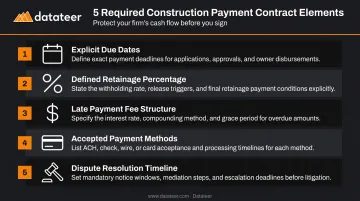
Walking a client through these terms before signing takes five minutes and surfaces any objections before they become disputes. Clients who push back hard on standard language at this stage are telling you something worth knowing.
Beyond the core contract terms, change order billing discipline matters just as much. Bill change orders when they occur — not at project closeout. Require PM approval as part of the billing workflow so nothing slips through without documentation. Bundling scope changes into the final invoice invites owner pushback and delays payment on work completed months earlier.
Invoice Faster and Smarter: Progress Billing and Documentation
Every day between completing work and sending the invoice is a day added to the collection clock. CFMA notes that slow billing cycles lead directly to slow collections and bad debt — a straightforward cause-and-effect that gets overlooked when billing is treated as an administrative task rather than a cash flow driver.
Invoice on the Same Day Work Is Completed
The standard should be simple: milestone achieved, invoice sent — same day. Not end-of-week. Not end-of-month.
Operationally, this requires that field teams have the ability to document completion and trigger billing from the job site. A dispute-proof construction invoice includes:
- Project name and contract number
- Specific work completed with dates
- Line items matching the contract or schedule of values
- Supporting documentation: photos, signed change orders, inspection reports
- Clear due date and late fee language referencing the contract
- Multiple payment options with instructions
When invoices arrive complete and well-documented, administrative rejection reasons disappear. Late invoices simply delay the payment clock — regardless of when the work was actually done.
Use Progress Billing to Reduce Your Exposure
On projects lasting more than a few weeks, progress billing is the standard best practice. Smaller, more frequent invoices are easier for clients to approve and pay. More importantly, they surface payment problems early — before you've completed six months of work with nothing collected.
Structuring a schedule of values correctly matters:
- Break project scope into logical, defensible payment milestones
- Tie each billing period to documented completion percentages
- Use AIA G702/G703 format on commercial work — these are the authoritative payment application forms for the industry and include the Continuation Sheet backup that prevents administrative rejection
Watch for underbilling. NASBP has documented that underbillings tie up cash and can inflate working capital on paper — in one analysis, they inflated working capital by nearly $3 million. Sureties and lenders scrutinize this closely, and late-stage underbillings may be excluded from working capital calculations entirely if collection is uncertain.
The problem is that most firms don't catch underbilling positions until month-end reporting. Datateer's over/under-billing dashboards flag these positions at the project level daily, pulling directly from ERP data so the billed-versus-earned gap is visible while there's still time to act.
Track What Matters: AR Aging Reports and Key Performance Metrics
Sending invoices is half of AR management. The other half is knowing exactly where every dollar stands. Without a disciplined tracking system, overdue invoices get buried in day-to-day operations — and by the time the problem is visible, collection probability has already dropped significantly.
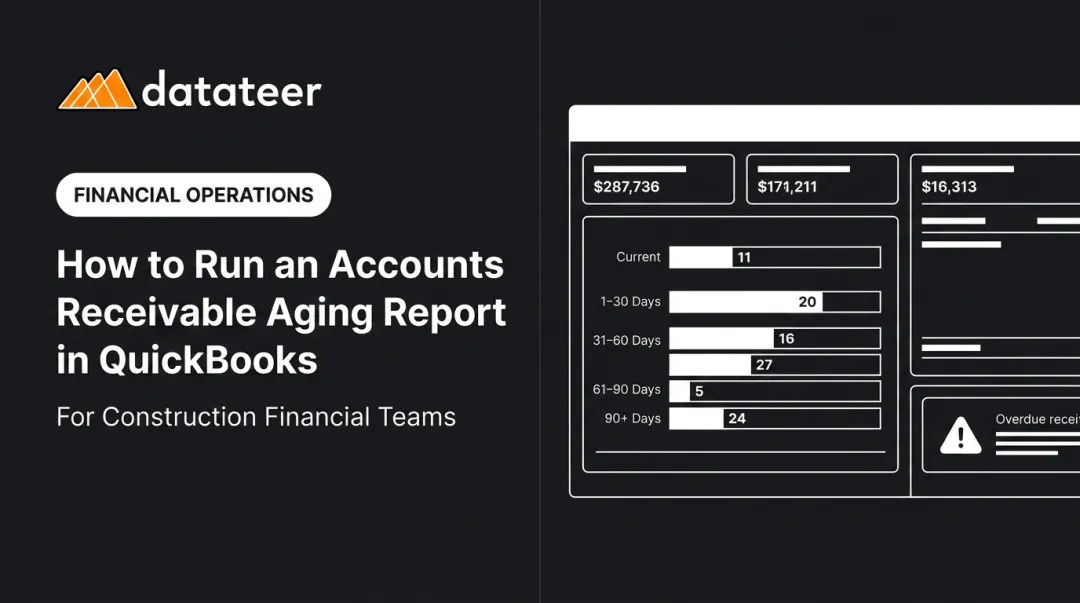
The AR Aging Report: Your Weekly Compass
The AR aging report is not a quarterly finance document. It's a weekly operational tool. Each aging bucket should trigger a specific response:
| Aging Bucket | Status | Required Action |
|---|---|---|
| 0–30 days | Current | Monitor — no action needed |
| 31–60 days | Yellow flag | Check-in email; confirm invoice was received |
| 61–90 days | Red flag | Direct phone call; confirm approval status |
| 90+ days | Critical | Formal demand; escalation decision required |
The 90+ day threshold matters. NACM uses the example that a receivable valued over 90 days may be worth 50 cents on the dollar — meaning a $10,000 invoice effectively becomes a $5,000 asset. That math alone justifies early follow-up discipline.
Key AR Metrics Every Construction Finance Team Should Track
Three metrics form the core AR performance framework for construction:
- Days Sales Outstanding (DSO): (AR balance ÷ net credit sales) × number of days. Track monthly against your own baseline — industry benchmarks vary widely by firm size and sector.
- AR Turnover Ratio: Net credit sales ÷ average AR. Higher means faster collection cycles. CFMA flags this as a key subcontractor performance metric.
- Collection Effectiveness Index (CEI): Percentage of collectible AR actually collected in the period. Below 80% signals a billing, follow-up, or client-mix problem that needs diagnosis.
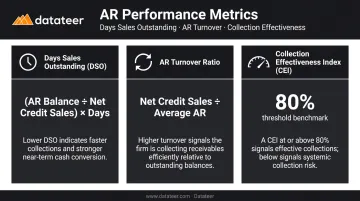
A fourth metric worth adding: Average Days Delinquent (ADD). Unlike DSO, which includes current receivables, ADD isolates only overdue invoices — helping you pinpoint whether aging problems stem from slow billing, weak follow-up, or a specific client subset.
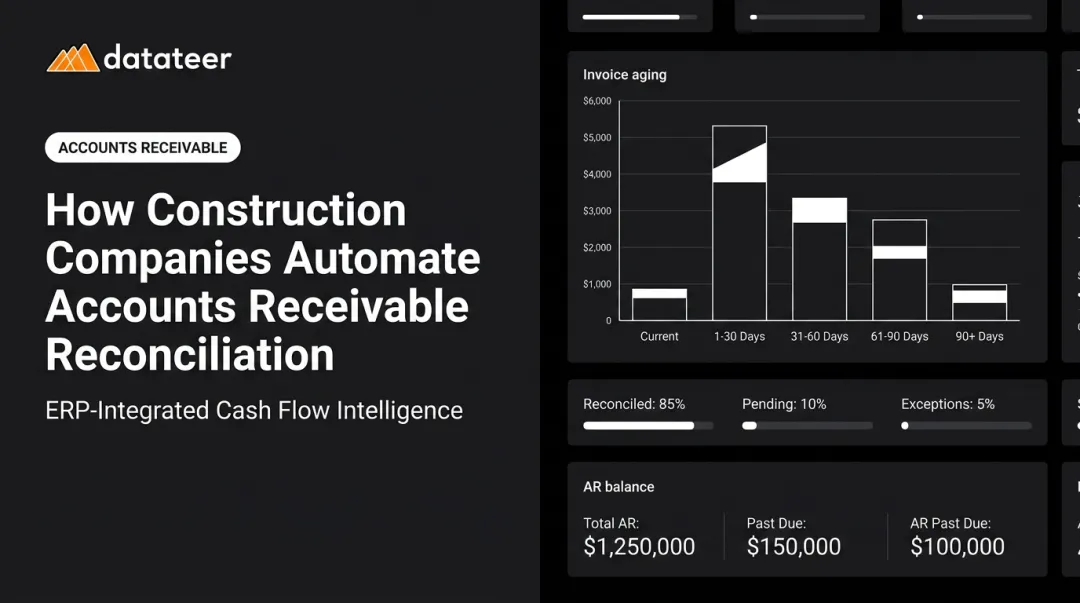
The challenge for most construction finance teams isn't understanding these metrics — it's getting them fast enough to act. Datateer's AR/AP Health dashboards sync directly from 12+ construction ERPs including Procore, Sage, Viewpoint Vista, and Acumatica, updating overnight so aging data reflects yesterday's position rather than last month's spreadsheet export. DSO, CEI, and ADD are pre-built in the KPI Library alongside 50+ other construction-specific metrics — no manual calculation required.
The Collections Playbook: From Friendly Reminder to Formal Demand
When follow-up depends on someone remembering to send an email, invoices age past the point of easy recovery. A tiered collections cadence removes that dependency — and makes the process repeatable regardless of who's managing it.
The Standard Collections Cadence
| Timing | Action | Channel |
|---|---|---|
| Day of invoicing | Confirm receipt | |
| 3 days before due | Friendly reminder | |
| 3 days after due | Check-in: confirm approval status | |
| 10 days after due | Follow-up: request payment timeline | Email + phone |
| 30 days after due | Formal demand letter citing contract terms | Written |
| 60 days after due | Escalation decision point | Phone + attorney/lien |
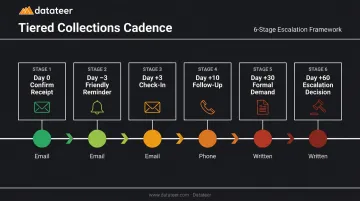
The escalation tools each have a place:
- Email works for early-stage follow-up where the relationship is intact
- Direct phone calls matter at 60+ days, where relationship context and negotiation are required
- Formal demand letters at 30 days should cite contract terms explicitly — late fees, dispute timelines, and next steps
- Mechanics liens are the construction-specific escalation tool most others don't have. Levelset notes that lien rules, deadlines, and requirements vary by state — and Rabbet found that 90% of GCs filed a lien due to slow payments in a 12-month period. Lien rights must be tracked from day one, not only when a payment goes sideways.
When a Payment Plan Makes Sense
When a client has genuine cash flow problems, escalating to formal collections can damage a working relationship and ultimately recover less than a structured plan would. A reasonable payment plan includes:
- A written agreement with defined installment amounts and dates
- Continued accrual of late fees per the original contract
- A clear trigger for resuming escalation if installments are missed
Payment plans don't make sense when there's reason to believe the client is using "cash flow issues" as a delay tactic, or when the relationship has no future value. The distinction usually becomes clear by the 30-day mark.
Not all delayed payments trace back to client behavior — some stall at the invoice level itself. Datateer's Change Order Impact & Aging analytics can surface this hidden problem: if the team completed the work but the change order hasn't cleared the approval chain, the invoice isn't collectible until it does. Tracking stalled change orders by aging days helps finance teams fix the bottleneck rather than chasing payment on an invoice that was never going to clear.
Managing Retainage and Resolving Disputes Without Stalling Cash Flow
Retainage represents a pool of cash that is legally earned but deliberately delayed. ConsensusDocs confirms that retainage typically ranges from 5% to 10% of each progress billing, withheld until the project reaches substantial or final completion. On a large commercial project, that accumulates into a significant receivable — one that many firms track loosely rather than managing as a distinct AR category with its own release schedule.
Retainage Release Management
Waiting for the owner to initiate retainage payment is a passive strategy that costs time and cash. Best practice is proactive:
- Track release dates by project and build a forward-looking release calendar
- Prepare documentation in advance: final lien waivers, certificate of substantial completion, and warranty documentation. Having these ready when release conditions are met eliminates delays on your side
- Issue retainage billing immediately when release conditions are met, not when it's convenient or when the owner reaches out
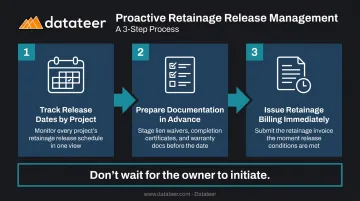
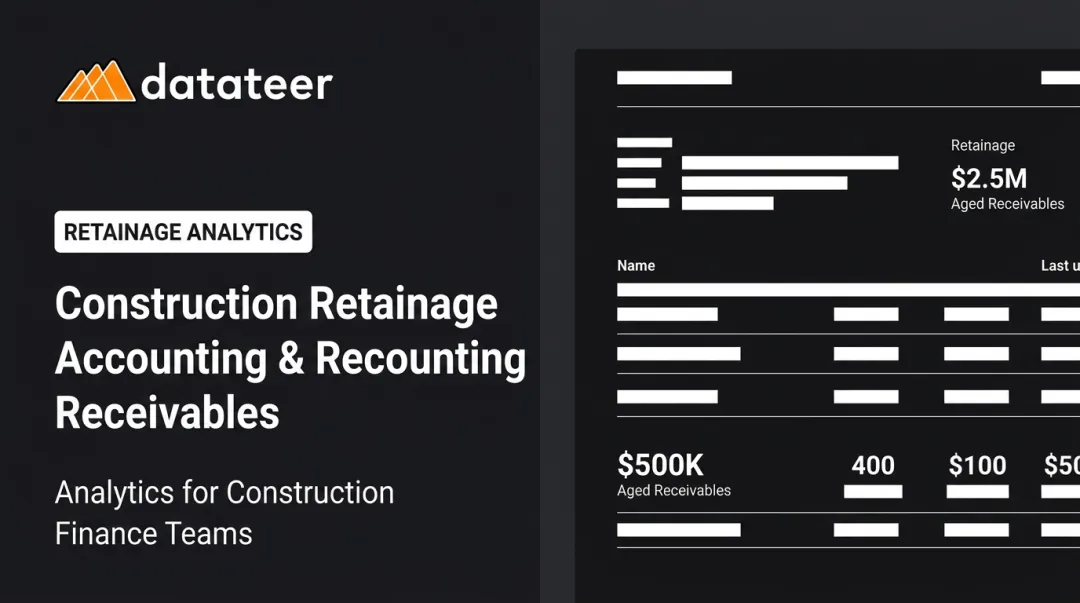
Datateer's Retainage Tracking module tracks both AR retainage (held by owners) and AP retainage (held on subs) at the project level, including overdue release identification and integration with 13-week cash flow forecasting so retainage release timing feeds directly into liquidity planning.
Handling Disputes Without Freezing Collections
Invoice disputes should not pause collections on the entire billing. A structured dispute response:
- Investigate immediately: check for misapplied payments and review original scope against what was billed
- Respond within 10 business days with a documented position
- Separate disputed from undisputed amounts — collect the undisputed portion on the normal schedule while the dispute is resolved
A line-item disagreement on 15% of an invoice should not stall payment on the other 85%. Allowing that to happen is a negotiating concession that costs real cash flow.
Frequently Asked Questions
What are some best practices for managing accounts receivable?
Vet customers before extending credit, establish written payment terms with explicit due dates and late fees, invoice immediately upon milestone completion, review aging reports weekly, and follow a structured tiered collections cadence. These five disciplines, applied consistently, prevent most AR problems from escalating to collections.
What is the best KPI for accounts receivable?
Days Sales Outstanding (DSO) is the primary metric for most construction firms: it measures average collection speed and directly reflects billing and collections process health. CEI and AR Turnover Ratio are important companion metrics — CEI shows what percentage of collectible AR was actually collected, while AR Turnover captures how efficiently receivables are being converted to cash.
What are the 5 C's of accounts receivable management?
The 5 C's — Character, Capacity, Capital, Conditions, and Collateral — form the credit assessment framework used when vetting new clients. In construction, this applies most critically when evaluating a new GC or developer before committing to a large project where a payment failure could be financially devastating.
What is the 10% rule for accounts receivable?
When more than 10% of total AR has aged past 90 days, it signals a systemic problem — either in the billing process, the collections cadence, or the client mix. That threshold should trigger a diagnostic review, not just escalation on individual invoices.
How do construction companies manage retainage in accounts receivable?
Best practice is to track retainage as a separate AR bucket by project, maintain a forward-looking release schedule, prepare required documentation before the release date arrives, and bill retainage immediately upon meeting contractual release conditions. Don't wait for the owner to initiate — billing retainage the moment release conditions are met consistently accelerates collection by weeks.