Introduction
Construction projects routinely exceed their original budgets. KPMG's 2023 Global Construction Survey found that 37% of respondents missed budget or schedule targets by 20% or more due to inadequate risk oversight. For an industry where net profit margins typically run 4%–7% — the CFMA's 2024 benchmarks show industrial and nonresidential contractors averaging just 4.4% — a 20% overrun doesn't just hurt. It eliminates profit entirely and often requires subsidizing the loss from other work.
The instinct when overruns happen is to ask what went wrong at the end. The more useful question is where cost control broke down — during planning, during execution, or at the system level — in the tools that were supposed to flag problems early. Overruns rarely announce themselves. They compound through small scope additions, labor productivity shortfalls, and invoice discrepancies that go untracked for weeks. The seven strategies below address all three stages where overruns originate: before construction starts, while it's underway, and after projects close.
Key Takeaways
- Most cost overruns trace back to decisions made before ground breaks, not unforeseeable field surprises.
- The most dangerous margin fade happens silently, weeks before anyone with budget authority sees it.
- Labor and subcontractor costs need dedicated, frequent tracking — month-end reconciliation catches problems too late.
- Unmanaged change orders are one of the most reliable paths to blown margins.
- Annual cost audits close the learning loop — skip them and every new estimate starts from guesswork.
How Construction Cost Overruns Typically Build Up
Overruns rarely appear as a single line-item explosion. They accumulate across weeks through a predictable pattern:
- Labor productivity slippage — hours run over on specific phases while the crew keeps moving
- Informal scope additions — small field requests that never go through formal pricing or approval
- Invoice discrepancies — vendor bills that don't match purchase orders, absorbed quietly
- Delayed cost recognition — costs incurred in one period not appearing in reports until the next
By the time these variances surface in a monthly report, they're often large enough that the remaining project budget can't absorb them.
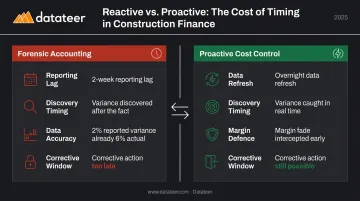
The reporting cycle is the real problem. When WIP reports take two or more weeks to compile from ERP data, project managers are making real-time decisions with stale information. What looks like a 2% variance at reporting time may already be at 6% before anyone acts.
That gap defines the difference between forensic accounting (discovering what went wrong after the fact) and proactive cost control (catching margin fade while there's still time to act). Each strategy below is designed to close that gap.
Key Cost Drivers in Construction Projects
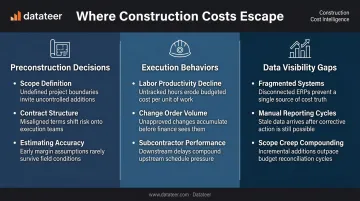
Understanding where costs escape helps prioritize where to intervene. Cost drivers fall into three categories:
Preconstruction Decisions
Scope definition, contract structure, and the accuracy of early estimates set the ceiling on everything that follows. KPMG's 2023 survey found that 83% of organizations identify improving estimating accuracy as their single biggest priority — which signals how often estimates are the origin point of overruns, not the field execution that follows.
Execution Behaviors
Once construction is underway, three variables move costs more than anything else:
- Labor productivity — BLS data shows output declined every year from 2021 through 2024, while compensation rose 3%–4.8% annually across the same period
- Change order volume — unresolved or underprice changes accumulate into significant margin erosion
- Subcontractor performance — delays and rework from subs rarely stay isolated to one line item
Falling output against rising labor costs puts constant pressure on project margins. There's no single fix; it requires visibility into all three simultaneously.
Data Visibility Gaps
Fragmented systems and manual reporting cycles mean problems compound before anyone sees them. By the time the weekly report surfaces a variance, the underlying issue is two weeks old.
Scope creep compounds this. It's rarely one large, visible change — it's dozens of small ones that were never formally priced, each individually manageable, collectively catastrophic.
7 Cost-Reduction Strategies for Construction Projects
These strategies are organized by where they intervene: some prevent overruns from forming, some catch them mid-project, and one closes the learning loop so firms don't repeat the same mistakes.
Strategies That Change Decisions Made Before Construction Begins
The most powerful cost reductions happen before a shovel hits the ground. Once construction starts, the ability to change cost outcomes narrows fast. Decisions about scope, budget structure, contract terms, and team composition set what's recoverable during execution.
Strategy 1 — Conduct Rigorous Preconstruction Planning
The project or financial manager should be involved during estimating — not handed a finalized budget afterward. Construction Industry Institute research found that well-performed pre-project planning can reduce total design and construction costs by as much as 20% and compress schedules by up to 39%. That figure comes from alignment: when the operations plan (staffing needs, phasing, specialty trade requirements) is built alongside the estimate, the budget reflects field reality rather than abstract assumptions.
Finance managers who arrive after the estimate is locked inherit someone else's assumptions. Involvement during preconstruction means the budget is buildable, not just plausible.
Strategy 2 — Build Estimates Using Standardized Cost Codes and Historical Data
Estimate accuracy improves when firms use consistent cost code structures across projects. AACE's estimate classification system illustrates the stakes: a Class 5 estimate with minimal project definition carries a range of -20% to -50% low and +30% to +100% high. A Class 3 estimate narrows that to ±10%–30%. The difference is definition quality, and historical data is what improves definition.
Firms operating with inconsistent or manually remapped cost codes start every estimate partially blind. Without a common code structure, there's no reliable baseline to reference.
Datateer automates cost code standardization across ERP data sources, enabling apples-to-apples comparison between estimated and actual costs — even for firms whose divisions or acquisitions use different native code structures.
Strategy 3 — Lock in Pricing Through a Disciplined Subcontractor Buyout
Subcontractor buyout is where preconstruction cost control becomes concrete. Effective buyout has four components:
- Solicit multiple bids — competition is the single most reliable cost lever
- Level bids for scope comparability — an apples-to-apples comparison, not just the lowest number
- Move quickly — construction input prices for nonresidential projects rose 15.7% in 2022 alone; locking prices before escalation protects the budget
- Use fixed-price contracts where possible — eliminate downstream variability at the contract structure level
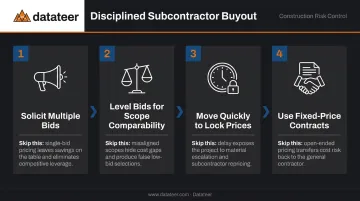
Firms that skip bid leveling often discover mid-project that the low bidder's scope excluded items the next-highest bidder included. The savings evaporate in change orders.
Strategies That Change How Projects Are Managed During Execution
Once construction is underway, cost control depends on how frequently — and accurately — financial data reaches the people who can act on it. Weekly reviews with current data allow intervention; monthly Excel reports mean you're always reacting to the past.
Strategy 4 — Establish a Structured Forecast Cadence
A line-by-line budget forecast should be updated and reviewed regularly — at minimum monthly, ideally more frequently on active projects. FMI recommends reviewing monthly quantity-based cost-to-complete forecasts for every job. These forecasts are forward-looking by design — projecting what will happen, not cataloging what already has.
Every forecast review should answer three questions:
- Do current projections hold through project completion, or has something shifted?
- Are there upcoming cost events — material deliveries, trade mobilizations, equipment rentals — that aren't yet reflected in the budget?
- Are there invoice discrepancies or unexpected cost drivers that need to be addressed now?
Datateer's Job Costing & Cost-to-Complete module replaces the manual month-end refresh with continuous automated forecasting. It pulls actual costs, committed costs, pending change orders, and projected final cost directly from the ERP — at the job, phase, and cost-code level — updated overnight as standard.
Strategy 5 — Monitor Labor Productivity in Near Real Time
Labor is the highest-risk cost category in construction, not just because of its size but because productivity shortfalls compound quickly without detection. BLS data shows construction labor productivity declined every year from 2021 through 2024, while wages rose 3%–5% annually over the same period. The structural pressure is real.
The monitoring problem compounds it. When WIP reports take 10–20 days to produce from ERP data, last week's labor slippage won't surface until next month. A variance caught in week two is recoverable; the same variance compounded across three weeks often isn't.
Datateer's Labor & Materials Productivity dashboard addresses this directly. The platform syncs from construction ERPs — including Sage 100/300, Viewpoint Vista, Procore, and Acumatica — and refreshes overnight as standard.
A Double L Management user put it plainly: "That one click replaced two weeks worth of prior work." Finance managers can review cost-code-level labor variances mid-month, catching budget blowouts on Tuesday instead of three weeks after payroll is cut.
Strategy 6 — Govern Change Orders With Disciplined Approval and Cost Recovery
AIA's 2023 analysis of 892,457 change orders across 18,229 completed US construction projects found an average cost increase of approximately 4% attributable to change orders. That's the average — projects with weak change order governance routinely exceed it by multiples.
Effective change order management requires three disciplines:
- Require formal pricing and written approval before any work proceeds — verbal go-aheads are where most change order disputes start
- Track aging from submission date — stalled approvals quietly absorb cost without corresponding revenue recovery
- Pursue 1:1 cost recovery for every change order the GC absorbs, whether the responsible party is the owner or a sub
Datateer's Change Order Impact & Aging Analytics module tracks change orders across their full lifecycle — pending, approved, denied, and executed — with aging by days since submission. It ties each change order to revenue and margin impact at the cost-code and project-phase level, and surfaces where change orders are stalled in the approval chain.
Strategy That Changes the Systemic Context Around Cost Control
Strategy 7 — Conduct Annual Cost Audits to Close the Learning Loop
For some firms, the real cost problem isn't a specific project decision or management gap. It's that there's no institutional memory of what went wrong and why. Every estimate is built from partial recollection rather than verified data.
An annual cost audit — comparing monthly forecasts against actual outcomes across each phase of completed projects — surfaces patterns that ad hoc project reviews miss:
- Which cost codes consistently overrun, and by how much
- Which trade bids consistently under-represent true cost
- Which project types or contract structures produce the most variance
- Where estimates diverge from actuals most frequently across project phases
These insights should feed directly into future estimates and procurement decisions. Without this feedback loop, firms recalibrate on intuition. CII's research on lessons-learned programs confirms that construction firms improve outcomes by learning from past experience and applying it forward — not treating each project as if it exists in isolation.
Conclusion
Cost overruns in construction originate at identifiable points: preconstruction decisions that build in unrealistic expectations, monitoring gaps that allow margin fade to compound undetected, and structural data gaps that prevent firms from learning what went wrong.
Cutting spend arbitrarily rarely solves any of these. The most effective cost control operates at all three levels: before the project starts, during execution, and after closeout. That requires disciplined process and data infrastructure that gives every decision-maker a timely, accurate view of where the project stands.
For firms still compiling WIP reports manually or waiting until month-end to review job cost performance, the gap between what they know and what's actually happening on their projects is costing real margin. That lag is the problem Datateer is built to eliminate: the platform connects directly to construction ERPs and surfaces labor variances, change order aging, and cost-to-complete forecasts in dashboards that update overnight — no manual assembly required.
Frequently Asked Questions
How do you control costs in the construction industry?
Effective cost control requires action before, during, and after a project. It starts with accurate preconstruction budgeting and locked subcontractor pricing, continues with regular forecast reviews and real-time labor monitoring during execution, and closes with structured change order management throughout. No single tactic works in isolation.
What is the cost control process in construction?
The process involves setting a detailed budget baseline during preconstruction, then tracking actual costs against that baseline through regular forecasting cycles. Changes are managed through a formal approval process, and project outcomes are reviewed post-completion to improve future estimates — making it a continuous discipline, not a month-end task.
What are the three main areas of cost control in construction?
The three areas are preconstruction planning and estimation, active monitoring and change management during execution, and post-project review for continuous improvement.
What causes cost overruns in construction projects?
The most common causes are inaccurate estimates at the outset, scope creep through unmanaged changes, labor productivity shortfalls, and reporting lags that prevent timely intervention. Most overruns involve more than one of these — they compound each other.
How does technology help with cost control in construction?
Technology closes the reporting lag that turns small variances into unrecoverable losses — platforms that sync ERP data overnight give finance managers visibility to catch margin fade while corrective action is still possible. Dodge Construction Network's 2023 research found that 86% of GCs with higher digital engagement experienced notable value from their technology stack, compared with 58% of lower-engagement firms.