This guide is written for construction finance managers, CFOs, and CPA advisors working with construction clients. It covers what progress billing is, why the industry depends on it, exactly how the process and calculation work, and what breaks down operationally when the setup isn't precise.
Key Takeaways
- Progress billing invoices clients in stages tied to verified work completion, not at project end
- The billing amount equals percentage complete × total contract value, minus prior billings
- A schedule of values (SOV) is the financial backbone of every progress billing arrangement
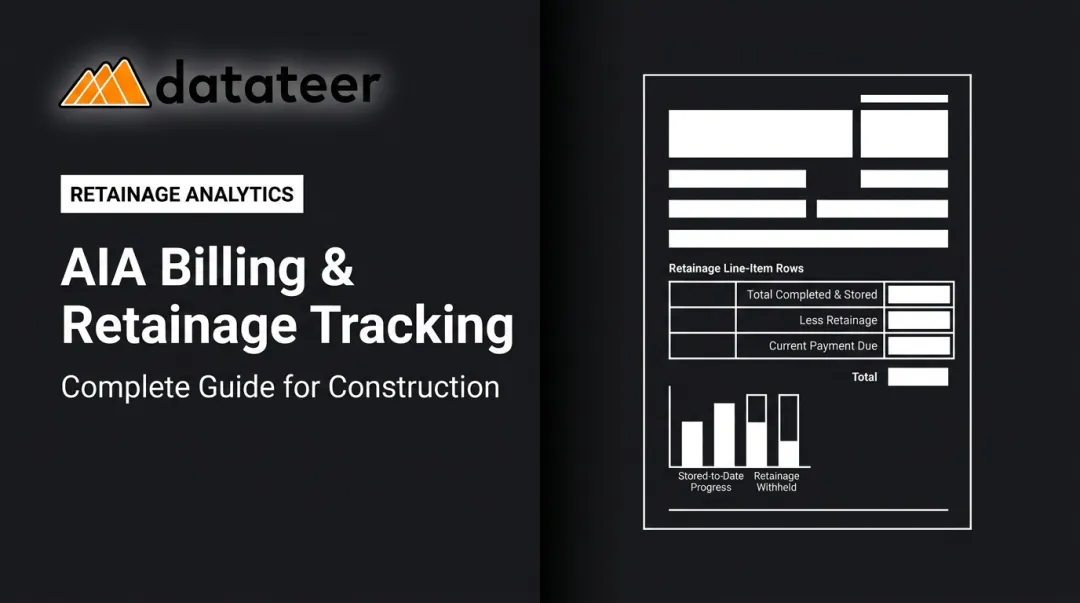
- Retainage — typically 5–10% — is withheld from each payment and released at project close
- Billing disputes almost always come down to one question: how much work is actually complete
What Is Progress Billing in Construction?
Progress billing is an invoicing structure where a contractor submits multiple payment applications throughout a project. Each one reflects the portion of work completed to date, drawing down against a predefined contract value until 100% has been billed and collected.
Contractors benefit because they can fund ongoing labor, materials, subcontractors, and equipment costs without self-financing months of work. Owners benefit because they pay for work that has actually been completed — not a lump sum written upfront and taken on faith.
Two other structures are often confused with it:
- A single advance paid before any work begins, with no tie to verified completion
- One invoice issued after all work is finished, with the contractor absorbing every interim cost
Progress billing differs from both: invoices are issued repeatedly, tied to incremental verified work, and distributed across the full project timeline.
The distinction matters because progress billing requires contractual infrastructure — a schedule of values, defined milestones, and a retainage mechanism — that neither of the other two structures requires.
Why Construction Projects Depend on Progress Billing
Construction is structurally different from most industries. A commercial office building takes an average of 16.2 months from start to completion; healthcare facilities average 14.8 months. These timelines mean continuous cash outflows — labor, materials, subcontractor draws, equipment — with no final deliverable to invoice against for well over a year.
Without periodic billing, contractors face two bad options:
- Self-finance the entire project — absorbing months of costs through working capital or debt, creating real insolvency risk
- Demand large upfront deposits — shifting financial risk to owners, reducing competitiveness at bid time, and eliminating the owner's financial checkpoints
Neither option serves the project. Progress billing solves this by creating a regular payment cycle that matches cash inflows to the ongoing cost of construction.
Progress billing is codified in the standard contract forms used across U.S. commercial and institutional construction. The AIA G702 (Application and Certificate for Payment) and G703 (Continuation Sheet) provide the standardized framework for submitting and certifying progress payments. ConsensusDocs 710 offers the equivalent for subcontractor payment applications. These forms exist because, on any project where scope, duration, and cost run deep, a single-invoice structure simply doesn't hold — and the industry has built its documentation infrastructure around that reality.
How Progress Billing Works: End-to-End Process
The full cycle runs from contract execution through final payment. Here's how each stage works.
Step 1: Develop a Schedule of Values
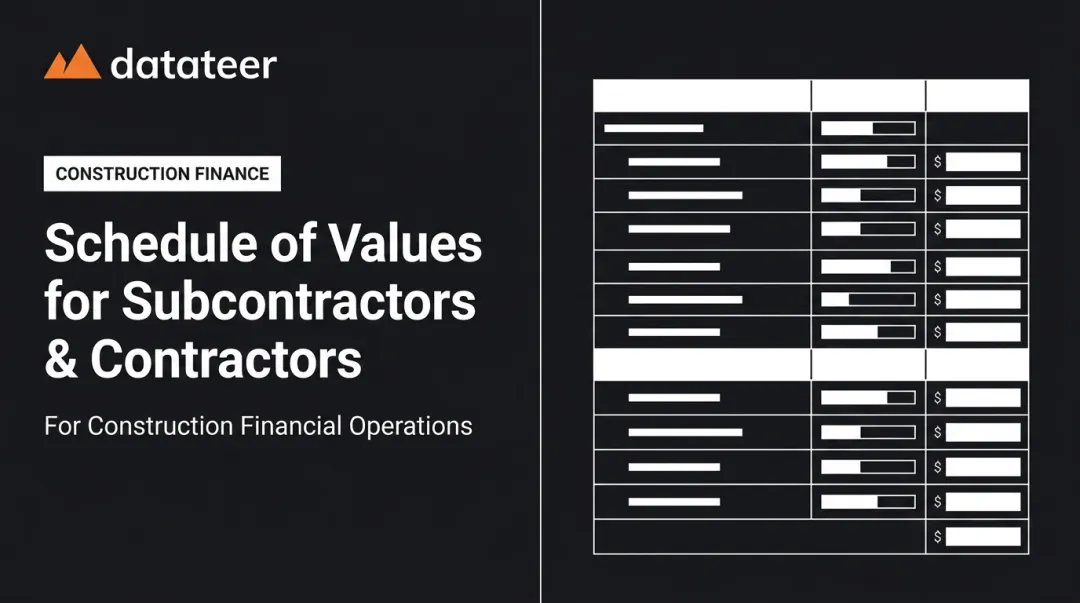
Before the first invoice can be submitted, the contractor and owner establish a Schedule of Values (SOV) — a line-item breakdown of every work scope element and its assigned dollar value, together totaling the full contract price.
The SOV becomes the financial backbone of every future billing. Each progress invoice draws down against the values assigned to completed line items. Many SOVs are organized according to CSI MasterFormat divisions, which provides a standardized structure that owners, architects, and lenders recognize.
Step 2: Define Milestones and the Payment Schedule
The contract must specify what triggers each billing cycle:
- Time-based — monthly billing on a set date
- Percentage-based — billing at 25%, 50%, 75% completion thresholds
- Phase-based — billing when foundation is complete, framing is complete, etc.
Alongside the trigger structure, the contract should define payment due dates, retainage terms, and the process for handling disputed invoices. Vague milestone definitions are a leading driver of payment disputes. The more precisely the contract defines completion criteria, the fewer costly arguments arise later.
Step 3: Submit, Review, and Pay Progress Invoices
This is the repeating cycle for each billing period:
- Contractor calculates the percentage of each SOV line item completed to date
- Applies that percentage to the line item value to determine the amount earned
- Subtracts previous billings and retainage to arrive at the net amount due
- Submits a payment application (typically on AIA G702/G703 or equivalent form)
- Owner or architect reviews the application and verifies completion in the field
- Approves or adjusts the amount and issues payment (minus retainage) by the contract due date
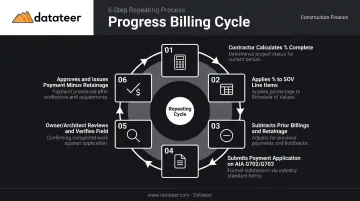
At final project completion, the contractor submits a last invoice that includes all withheld retainage.
How to Calculate Progress Billing: Formula and Example
The Core Formula
Progress Billing Amount = (% Complete × Total Contract Value) − Amount Previously Billed
The percentage of completion is measured using one of two methods — and the contract should specify which governs:
- Cost-to-cost method — Costs incurred to date ÷ total estimated costs. Common under ASC 606 as an input method; frequently used because cost data is readily available from the accounting system
- Physical completion method — Verified percentage of work physically in place, assessed through field observation or milestone confirmation
Worked Example
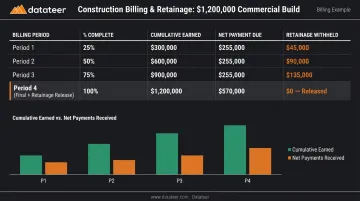
Consider a $1,200,000 commercial build with the following SOV summary:
| Billing Period | % Complete | Cumulative Earned | Prior Billings | Amount Billed | 10% Retainage | Net Payment Due |
|---|---|---|---|---|---|---|
| Month 3 | 25% | $300,000 | $0 | $300,000 | $30,000 | $270,000 |
| Month 6 | 55% | $660,000 | $300,000 | $360,000 | $36,000 | $324,000 |
| Month 9 | 80% | $960,000 | $660,000 | $300,000 | $30,000 | $270,000 |
| Final | 100% | $1,200,000 | $960,000 | $240,000 + $96,000 retainage | — | $336,000 |
By month 9, the contractor has received $864,000 in net payments while $96,000 sits in retainage (earned but withheld until project close). That accumulated retainage is released with the final invoice. On a firm managing five or ten concurrent jobs, retainage balances across projects can represent a material portion of working capital tied up with no clear visibility into when it releases.
How Change Orders Affect Calculations
The worked example above assumes a fixed contract value. In practice, that denominator rarely holds.
AIA's 2023 change order research found that change orders affect virtually every commercial project, with average cost impacts ranging from 3.2% to 5.04% of project value. Each approved change order modifies the total contract value, so the SOV must be updated before the next billing cycle.
Skipping that update creates immediate billing inaccuracies. The percentage-complete calculation runs off the wrong denominator, and the resulting invoice either overbills or underbills actual contract scope. Specific risks include:
- Overbilling exposure — invoicing against an unapproved change inflates billed amounts and creates dispute risk
- Underbilling losses — missing an approved change means leaving earned revenue out of the invoice
- Audit flags — mismatched SOV and contract value draws scrutiny during bonding reviews or lender audits
Tracking which change orders are approved, pending, or unsigned is a billing control, not a bookkeeping afterthought.
Key Factors That Affect Progress Billing Outcomes
Completion Percentage Accuracy
The accuracy of percentage-complete estimates is what determines whether a progress billing invoice is defensible or disputed. If field teams and project accountants are working from different data — or data that's weeks old — the billing snapshot is stale before it's even submitted.
Firms relying on manual monthly spreadsheet processes face a structural lag. By the time cost data is exported from the ERP, reconciled, and formatted into a WIP schedule, 10–20 days may have elapsed. Costs and completion percentages can shift significantly within that window.
Datateer solves the lag problem at its source: the platform syncs overnight from 20+ construction ERPs (including Procore, Sage 100/300/Intacct, Viewpoint Vista, Viewpoint Spectrum, Acumatica, Foundation, CMiC, Jonas, QuickBooks, and NetSuite) so finance teams see the prior day's ERP data rather than a three-week-old spreadsheet export. Double L Management described the difference plainly: "That one click replaced two weeks worth of prior work."
The WIP & Financial Truth dashboard automates the over/underbilling calculation across the entire job portfolio. It flags billings in excess of costs and costs in excess of billings at the project level — so problems surface before the billing period closes, not during a month-end forensic review.
Contract and Documentation Quality
Vague milestone definitions, thin SOV line items, and poorly drafted change order clauses compound every billing challenge. A well-structured contract with granular SOV line items makes each invoice faster to verify, faster to approve, and harder to dispute.
The stakes are real: the Arcadis 2025 North America Construction Disputes Report found that average dispute values in North America increased 40% in 2024 and have nearly doubled since 2021. Documentation quality at contract formation is the cheapest dispute prevention available.
Retainage Policy and State Law
Retainage terms vary by contract and jurisdiction:
- Standard range: 5–10% withheld per payment
- New York's Prompt Payment Act now voids retainage above 5% on private contracts over $150,000
- Federal contracts cap retainage at 10% under the FAR
- California mandated a 5% retention cap for private construction contracts effective 2026
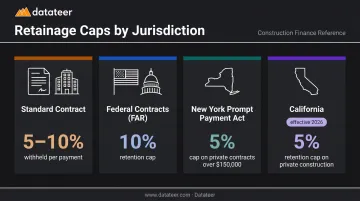
Finance teams managing multiple projects across different states need to know which retainage rules apply to each contract. Both compliance and working capital exposure hinge on getting this right.
Common Issues and When Progress Billing Falls Short
The Front-Loading Problem
The most damaging misconception is that progress billing automatically equals fair billing. Contractors sometimes assign disproportionate value to early-phase SOV items — mobilization, insurance, site preparation — to accelerate early cash receipts.
The result: payments arrive ahead of actual earned value, creating a "billings in excess of costs" position that signals financial risk to owners, lenders, and auditors.
Owners actively monitor for front-loading and restrict SOV structures where early-phase line items carry disproportionate value. Finance teams should flag these patterns during SOV review — before they trigger owner disputes or audit scrutiny.
Operational Failure Points
Front-loading is a structural risk, but day-to-day execution introduces its own failure points. The most frequent breakdowns in the progress billing cycle:
- Completion percentage disputes — field and office using different data sources
- Slow owner reviews — payment delayed past contractual due dates, compounding cash flow pressure
- Unsigned change order documentation — work performed under a pending CO that hasn't been approved, creating SOV gaps
- Retainage disputes at close — delayed releases that quietly tie up working capital months past project completion
- Separate billing and cost systems — no shared source of truth between field and office
When Progress Billing Isn't the Right Structure
Beyond execution failures, some projects simply aren't structured for progress billing at all:
- Short, low-value projects (under 30 days, under $50,000) — a simple deposit-plus-final structure is easier to administer with less paperwork overhead
- Undefined or highly variable scope — milestones can't be reliably defined upfront, so the SOV becomes speculative
- Government or public contracts — alternative billing structures may be mandated by procurement regulations
The right question isn't whether progress billing is standard practice — it's whether the project's duration, scope definition, and contract value justify the administrative overhead. Contractors scaling from residential into commercial work often discover this mismatch the hard way.
Conclusion
Progress billing aligns cash flow with the physical reality of construction — protecting contractors from liquidity risk while giving owners financial checkpoints throughout the project. That alignment only holds when the contract, schedule of values, and completion tracking are all set up with precision.
For finance teams, understanding the formula, the SOV structure, retainage mechanics, and accounting treatment isn't academic — it's operational. The difference shows up in real terms:
- Chasing invoices vs. submitting on schedule
- Discovering overbilling positions at audit vs. catching them at the billing review
- Releasing retainage months late vs. tracking it against contractual milestones in real time
Every billing period should be grounded in accurate, current data. Platforms like Datateer automate that data flow — pulling directly from your ERP to keep WIP, retainage, and billing positions current without the spreadsheet grind — so finance teams spend less time reconstructing numbers and more time acting on them.
Frequently Asked Questions
What is progress billing in construction?
Progress billing is an invoicing method where contractors submit multiple invoices throughout a project, each tied to the verified percentage of work completed to date. Rather than billing the full contract amount at the end, payments are distributed across the project timeline to fund ongoing labor and material costs.
How do you calculate progress billing in construction?
The billing amount for each period equals the percentage of the project completed (measured by cost-to-cost or physical completion) multiplied by the total contract value, minus any amounts previously billed. Retainage (typically 5–10%) is then withheld from the resulting figure by the owner.
Can you give an example of progress billing in construction?
On a $1,000,000 contract, if 30% of work is complete in month three and $200,000 was billed previously, the contractor bills $100,000 this period ($300,000 cumulative earned minus $200,000 previously billed), less applicable retainage withheld by the owner.
What is the difference between construction in progress and progress billings?
Construction in progress (CIP) is the accumulated costs incurred on a job, recorded as an asset on the balance sheet. Progress billings is the amount invoiced to the client. When CIP exceeds billings, the difference is a current asset; when billings exceed CIP, it is a current liability.
What is retainage and how does it affect progress billing?
Retainage is a percentage (typically 5–10%) withheld from each approved progress payment as a performance reserve. It reduces the net cash received on every invoice and is released in full only at final project completion.