
Introduction
Purchase orders live in one system. Cost codes in another. Subcontractor invoices tracked in a spreadsheet someone built three years ago. For construction finance teams, this fragmentation isn't unusual — it's the norm.
When procurement data is inconsistent across those systems, the consequences aren't administrative. They show up directly on job margins and cash flow.
The downstream effects are familiar: WIP reports that lag by two to three weeks, budget overruns that surface too late to recover from, and change orders that accounting never sees until month-end reconciliation turns into a multi-day fire drill.
According to a 2021 study by Autodesk and FMI, bad data — defined as inaccurate, incomplete, inaccessible, inconsistent, or untimely — may have cost the global construction industry $1.85 trillion in 2020 alone. For a contractor with $1B in annual revenue, that translated to an estimated $165M exposure.
The exposure is large enough to justify a structured response. What follows breaks down the five pillars of procurement data integrity, the warning signs that data is degrading, practical fixes to address them, and how to build an audit cadence that holds.
Key Takeaways
- Procurement data integrity means cost codes, POs, subcontractor records, and change orders stay accurate and consistent across every system that touches them
- Each of the five data integrity pillars (accuracy, consistency, completeness, timeliness, security) has direct consequences for WIP and job cost reporting
- Manual data entry and disconnected field-to-office systems are the leading causes of procurement data failure — and the first place committed costs go missing
- Best practices: standardize cost codes, automate ERP data flows, enforce approval workflows, and audit on a regular cadence
- Firms that catch committed cost errors while a project is active protect margins; firms that catch them post-job absorb the loss
Why Procurement Data Integrity Is Critical in Construction
Construction procurement touches more moving parts than almost any other industry function. Subcontract agreements, material purchase orders, change orders, lien waivers, and progress billings all feed directly into job cost and WIP reporting. A single data error here distorts the financial picture of a live project.
The downstream effects compound quickly:
- Project managers making scope decisions based on overstated or understated committed costs
- CFOs approving draw requests based on inaccurate percentage-of-completion figures
- Bonding agents and lenders receiving WIP schedules that don't reflect actual project health
Construction margins don't leave much room for error. CFMA's 2025 Financial Benchmarker reports that Industrial and Nonresidential contractors averaged 4.4% net income before taxes in FY2024, with the pre-2020 five-year industry average sitting at 4.7%. A two-point variance in committed costs isn't a rounding error at those margins — it's the difference between a profitable project and a loss.
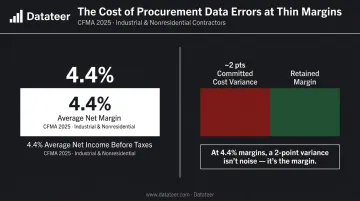
What makes procurement data errors especially damaging in construction is their compounding nature. Projects span months or years. A bad cost code entry or an unmatched subcontractor invoice in month two distorts every report that follows.
By the time the error surfaces, it may have already shaped a bad bid estimate, masked a margin fade trend, or triggered a lender dispute.
The 5 Pillars of Procurement Data Integrity in Construction
These five properties aren't abstract data governance principles. In construction, each one has a direct financial consequence.
Accuracy
Accuracy means procurement data correctly reflects what was actually ordered, committed, and received. In practice: PO values match subcontract scopes, change orders are logged with the right cost codes, and vendor invoices are matched to the correct job and phase.
A single inaccurate committed cost entry is enough to produce a false margin on a WIP report. That false margin then shapes decisions — on re-scoping, on draws, on whether to flag a risk to ownership — that are based on numbers that never reflected reality.
Consistency
For a procurement record to be useful, it has to tell the same story across every system — the ERP, the project management platform, and the accounting ledger. That's what consistency means in practice.
This breaks down most visibly in firms running Procore alongside Sage or Vista without a clean integration layer. A subcontractor invoice processed in the field may not appear in accounting for weeks. Cost codes mapped differently across systems make cross-system reporting unreliable. When the PM's numbers and the controller's numbers don't match, the immediate problem isn't the discrepancy — it's that no one knows which version to trust.
Common consistency fixes include:
- Standardizing cost code mappings across Procore and your ERP
- Automating reconciliation between project commits and accounting invoices
- Eliminating the manual VLOOKUP cycles that typically precede every board meeting
Completeness
Completeness means every required data point is captured — no missing records, no gaps in the procurement trail.
In construction, incomplete data looks like:
- A change order approved in the field but never formally logged in the system
- A purchase order issued verbally and never entered
- A subcontractor overpayment not tied back to an approved schedule of values
Missing records create phantom costs or untracked commitments that silently distort projected margins.
Timeliness
Project decisions in construction happen constantly: whether to authorize more work, re-scope a subcontract, or flag a risk to ownership. Procurement data that is two to three weeks stale cannot support any of those decisions.
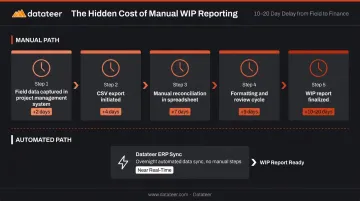
Firms relying on manual processes typically experience a 10–20 day lag for WIP reports — the result of CSV exports, manual reconciliation, and spreadsheet formatting cycles. Finance teams end up reporting on a past that no longer reflects current project status, while project managers make present-day calls without current cost visibility.
Security
Security means controlling who can create, edit, or delete purchase orders, subcontractor records, and cost entries. Unauthorized or unaudited changes to committed costs can go undetected in manual environments, creating fraud risk, compliance exposure, and unreliable audit trails.
Platforms like Datateer address this through direct ERP sync — meaning cost data flows from the source system automatically, with no manual entry layer where edits can slip through undetected.
Common Warning Signs Your Procurement Data Is Compromised
These are the diagnostic signals that tell a CFO or finance manager that procurement data integrity is degrading — often before a major financial discrepancy surfaces.
Reporting Conflicts and Reconciliation Delays
The clearest warning sign: project managers and accounting presenting different job cost figures for the same project.
Other indicators include:
- WIP reports that require days of manual reconciliation before anyone will sign off on them
- Change orders that appear in the field log but not in the committed cost report
- Finance staff spending 20–40 hours each month reconciling data rather than analyzing it
When reconciliation consumes that much time, it's a structural integrity problem — not a workload problem. Datateer's direct ERP integration replaces that manual cycle with automated overnight data sync, making discrepancies visible immediately rather than buried in competing spreadsheet versions.
Cost Code Errors and Misclassification
Watch for:
- Costs consistently landing in the wrong cost codes, making job cost reports unreliable for comparison or forecasting
- Duplicate vendor entries that inflate committed totals
- Purchase orders coded to the wrong job or phase
These errors compound over a project's life because teams rarely correct them once initial reports go out. JBKnowledge's construction technology research found that when apps don't integrate, 49% of construction respondents manually transfer data and 44% rely on spreadsheets — both of which are primary vectors for cost code misclassification.
Unexplained Margin Erosion
When project margins are declining and the procurement data can't clearly explain why — untracked scope increases, unapproved change orders, vendor overbilling — that's a data integrity failure, not a project management one.
Margin fade caught late is rarely recoverable. At 4–5% net margins, unexplained erosion of even one or two points on a major project wipes out profit for the year. The inability to trace committed costs back to original approved budgets in real time is one of the clearest signs the procurement data environment needs structural improvement.
Best Practices for Maintaining Procurement Data Integrity in Construction
Standardize Cost Codes Across All Systems
Inconsistent cost code structures are the single most common source of procurement data integrity failure in construction firms.
Best practice is a master cost code list that maps identically in the ERP, the project management system, and any procurement portal. The CSI MasterFormat standard provides a recognized organizing framework — Division 00 covers Procurement and Contracting Requirements, Division 01 covers General Requirements — and can serve as the foundation for a firm's internal cost code hierarchy.
Two rules that matter most:
- Standardization must happen before project kickoff, not mid-project
- Any subcode that exists in one system but not another creates a break in data continuity that will compound over the project's life
Datateer's implementation process includes automated cost code standardization as part of standard setup — mapping the firm's unique data logic across Procore, Sage, Vista, Acumatica, and other integrated ERPs so that cross-system inconsistencies are caught at the data layer rather than discovered at month-end.
Automate ERP Data Flows and Eliminate Manual Transfer Steps
Every manual handoff between systems is a potential point of data corruption. Exporting from Procore and importing into Sage. Copy-pasting PO data into a spreadsheet. Manually re-entering committed costs for a reporting deck.
The goal is to eliminate those steps through direct ERP integration. When procurement data flows automatically from source systems to reporting, the risk of transcription errors, formula breaks, and version conflicts drops to near zero.
Datateer supports automated overnight sync with 12+ construction ERPs, including:
- Procore, Sage 100/300/Intacct, Viewpoint Vista, Viewpoint Spectrum
- Acumatica Construction, Foundation Software, CMiC, Jonas Construction, NetSuite
Cost code standardization is included as part of standard implementation. One client noted that their first interaction with a Datateer dashboard replaced two weeks of prior manual work.
Implement Approval Workflows for POs and Change Orders
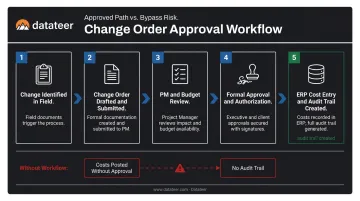
Formal approval workflows create a validation checkpoint before any cost entry affects committed cost totals. They ensure every purchase order and change order is reviewed against the approved budget before it posts, and they create an audit trail showing who approved what and when.
Without these workflows, verbal approvals and informal field decisions create costs that are never properly logged. The Arcadis 2024 Construction Disputes report found that the average North American construction dispute value rose to $43.0M in 2023, with resolution times averaging 14.4 months. Owner-directed changes ranked among the leading dispute causes, and unapproved or informally documented change orders are a primary driver of those disputes.
Assign Data Ownership and Define Clear Roles
Procurement data quality degrades when no single person is accountable for it. Best practice is to assign a named data owner for each procurement data domain:
- Who is responsible for cost code integrity?
- Who owns vendor master data?
- Who reviews PO-to-invoice matching?
Data ownership doesn't mean one person does all the work. It means one person is accountable for the quality standard of that data type — and has the authority to enforce corrections when violations occur.
Establish Validation Rules at the Point of Entry
Validation rules catch errors at the moment they're created, not weeks later during reconciliation. Configure these rules in the ERP and procurement system:
- Cost code required — no PO saves without a valid cost code assigned
- Invoice-to-PO matching — flags invoices exceeding PO values before payment releases
- Job assignment validation — rejects entries missing a confirmed job and phase
- Vendor master controls — blocks new vendor entries without a tax ID
Enforcing these rules in spreadsheets doesn't work. They need to live in the systems where data originates.
Conduct Regular Reconciliation Between Field and Office Data
Even with automation and validation in place, periodic manual reconciliation remains a best practice. At minimum, this happens at month-end close and should verify:
- All approved change orders are reflected in the committed budget
- All subcontractor invoices have matching commitments
- PO balances agree between the project management system and the ERP
Document exceptions. Require sign-off before reports are finalized. A clean reconciliation sign-off is the last line of defense before financial data reaches leadership.
How to Build a Procurement Data Audit Schedule in Construction
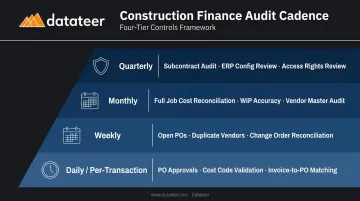
Use this cadence to catch procurement data errors before they compound between reporting cycles. Adjust frequency based on project volume, team size, and how deeply your ERP is integrated.
| Frequency | Checks |
|---|---|
| Daily / per-transaction | PO approvals confirmed; cost code assignments validated at entry; invoice-to-PO matching reviewed before payment release |
| Weekly | Open POs without matching invoices; duplicate vendor entries; field-to-office change order log reconciliation |
| Monthly | Full job cost reconciliation; cost code variance review against budget; WIP schedule accuracy check; vendor master data audit for inactive or duplicate records |
| Quarterly / project milestone | Comprehensive subcontract commitment audit; data governance policy review; ERP configuration audit; access rights review to confirm only authorized users have edit permissions |
Wipfli recommends weekly budget-to-actual comparisons to flag unusual costs quickly, with monthly project team reviews covering original contract price, signed and unsigned change orders, estimated cost to date, and percent complete. Monthly internal control reviews should also reconcile job schedules to year-to-date revenue and cost, with over/under billings tying back to the balance sheet.
Firms with direct ERP integration can run many of these checks continuously rather than on a fixed schedule. Datateer's Cost Variance, Job Costing & Cost-to-Complete, Change Order Impact & Aging, and WIP Reporting dashboards provide in-month visibility that replaces periodic audits with ongoing monitoring — cutting manual work for finance staff and surfacing anomalies days earlier than a scheduled review would.
Conclusion
Procurement data integrity in construction isn't a one-time setup. It's an ongoing operational discipline. The firms that protect their margins most effectively catch errors in committed costs, cost codes, and subcontractor data while a project is still active — not during a post-job autopsy when there's nothing left to do about it.
Construction operates on margins that don't absorb much error. Industrial and Nonresidential contractors averaged 4.4% net income before taxes in FY2024. At that level, a sustained two-point variance in a major project's committed costs isn't noise — it's the margin.
A structured approach to data integrity — built on standardized cost codes, automated ERP data flows, clear ownership, and a layered audit cadence — turns procurement data from a liability into a decision-making asset. Platforms like Datateer automate that data flow directly from your ERP, so cost variances surface in dashboards during the project — when there's still time to act — rather than in a post-close reconciliation that changes nothing. The firms that build this discipline don't just close the books faster. They catch the problems that would have closed them.
Frequently Asked Questions
What are the best practices for maintaining procurement data integrity in construction?
The core practices are: standardize cost codes before projects kick off, automate ERP data flows to eliminate manual transfer steps, implement formal approval workflows for POs and change orders, assign named data owners for each procurement domain, and maintain a layered audit cadence from daily transaction validation to quarterly governance reviews.
What are the 5 pillars of data integrity in construction procurement?
The five pillars are accuracy, consistency, completeness, timeliness, and security — meaning data reflects real commitments, tells the same story across systems, has no gaps, is current enough to act on, and only changes with authorization. Each pillar directly affects the reliability of WIP reports and job cost data.
What is the most common cause of procurement data errors in construction?
Manual data entry and the absence of direct integration between field project management systems and accounting ERPs. Each manual handoff — CSV exports, copy-paste transfers, spreadsheet re-entry — introduces the risk of transcription errors, version conflicts, and broken formulas. JBKnowledge found that 49% of construction firms manually transfer data between disconnected systems.
How does poor procurement data integrity affect WIP reports?
Inaccurate or incomplete committed cost data directly distorts percentage-of-completion calculations, producing WIP schedules that overstate or understate project margins. Those distorted WIP reports then affect bonding capacity, lender draw approvals, and strategic decisions made by leadership based on numbers that were never correct.
How often should construction firms audit their procurement data?
Use a layered cadence: daily transaction validation, weekly open-PO and change order reconciliation, monthly job cost and WIP checks, and quarterly access rights reviews. Firms with direct ERP integration can automate most of this cadence, cutting the manual time required at each interval.