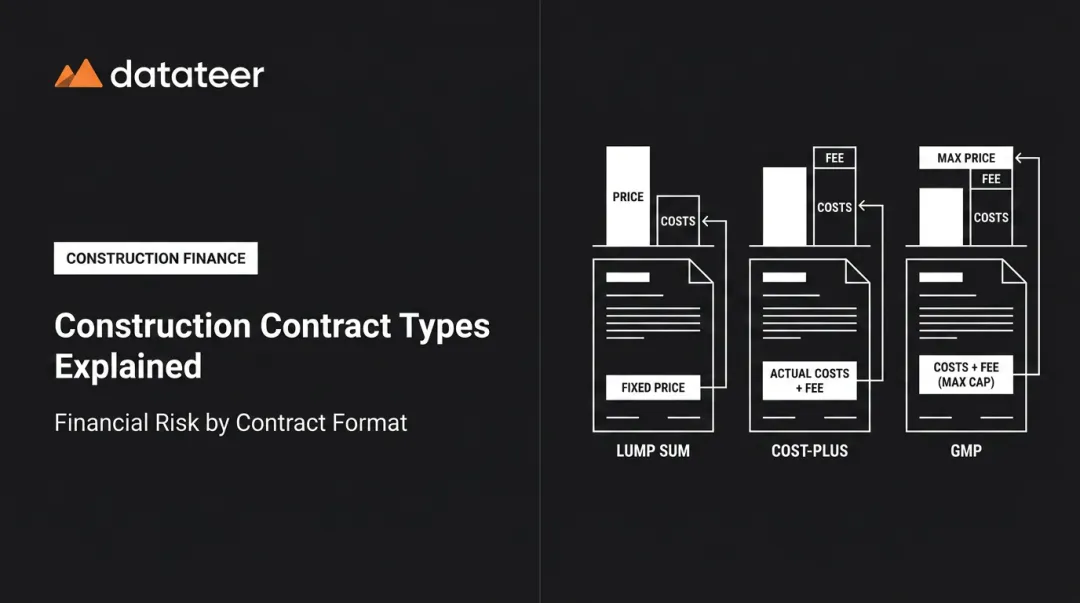

Understanding the types of change orders matters beyond just paperwork. Each type carries distinct financial, schedule, and documentation implications that affect project profitability, billing accuracy, and cash flow. Get the classification wrong or skip the documentation, and you're setting up disputes, budget drift, and WIP inaccuracies that compound over months.
This article breaks down what a construction change order is, the core types and secondary classifications, what every CO must include to be enforceable, and what finance teams need to know to stay ahead of the financial risks change orders create.
Key Takeaways
- A change order is a legally binding contract amendment that modifies scope, cost, or schedule and requires all-party signatures before taking effect.
- The three core types are additive (adds contract value), deductive (reduces it), and zero-cost (documents changes with no financial impact).
- Secondary classifications — scope, time, design, value engineering, and field — describe what is changing, not the financial direction.
- Every CO requires a cost breakdown, schedule impact assessment, and proper signatures before work begins.
- Unmanaged change order volume is a leading driver of WIP inaccuracies and margin fade on active projects.
What Is a Construction Change Order?
A construction change order is a formal, written amendment to an existing contract that modifies scope, cost, schedule, or some combination of all three. Under AIA A201-2017 Section 7.2.1, a change order is a written instrument prepared by the Architect and signed by the Owner, Contractor, and Architect — recording agreement on the change, the adjusted Contract Sum, and the adjusted Contract Time. Until all three parties sign, the document isn't a change order; it's a proposal.
Change orders arise after contract execution in response to:
- Unforeseen site conditions (soil, utilities, existing structure)
- Owner-requested design revisions
- Design errors or omissions in the original drawings
- Regulatory updates or inspection requirements
- Coordination failures between trades
An approved change order updates the contract sum and schedule, creating a paper trail that protects payment rights, supports accurate billing, and provides the foundation for dispute resolution. That documentation matters regardless of project size — it's what separates a managed scope change from an uncompensated one. The sections below break down the specific types of change orders and when each applies.
The Three Core Types of Construction Change Orders
Before looking at what is changing, it's important to understand how a change affects the contract's financial value. Every change order falls into one of three categories.
Additive Change Orders
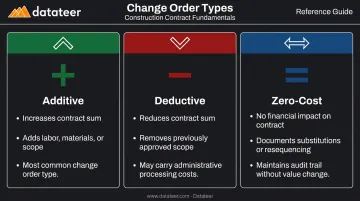
An additive change order increases the contract sum by adding labor, materials, equipment, or subcontracted work not included in the original scope. It's the most common type — hitting unexpected rock, rerouting conduit around existing utilities, or discovering concealed conditions can all trigger one mid-project.
Pricing an additive CO typically requires the contractor to submit a cost breakdown covering:
- Direct labor hours and rates
- Material quantities and unit costs
- Equipment charges
- Subcontractor costs
- Applicable overhead and profit markups
AIA A201 identifies four pricing methods for change order work: mutual acceptance of a lump sum, stated unit prices, cost plus a mutually acceptable fee, or an Architect's determination when agreement can't be reached. There is no universal overhead-and-profit percentage mandated by AIA or ConsensusDocs — the applicable rate and any cap come from the specific contract.
The key risk: additive COs issued without a clear approval workflow lead to unauthorized work, billing disputes, and budget drift. Multiple small additive orders that accumulate without anyone tracking cumulative impact can erode margin before finance teams notice.
Deductive Change Orders
A deductive change order removes scope and reduces the contract sum — typically issued when owners cut costs mid-project, eliminate features, or scale back finishes or square footage.
One important distinction: deductive change orders are not the same as value engineering, even though both reduce cost. Value engineering is typically a pre-award activity. A deductive CO happens after construction is underway, and it may still carry administrative or demobilization costs that partially offset the savings.
AIA A201 Section 7.3.8 uses "actual net cost" as the basis for the owner's credit when a directed change produces a net decrease and the parties haven't agreed otherwise.
There's also a legal boundary to be aware of: under ConsensusDocs guidance, deleting work to award it to a different contractor may constitute breach and expose the owner to anticipated-profit damages, depending on the contract and governing law.
Deductive COs can also disrupt already-scheduled subcontractor work, create scope gaps, and complicate pay applications. The financial savings are real, but operational costs routinely offset more of those savings than owners expect.
Zero-Cost Change Orders
A zero-cost (or no-cost) change order documents a modification to the original scope without changing the contract sum. Common examples include:
- Material substitutions where the cost difference is negligible
- Resequencing work that doesn't affect the schedule
AIA addresses this through G710-2017, the Architect's Supplemental Instructions form, which documents minor changes that don't adjust Contract Sum or Contract Time — providing a formal written record without requiring a full G701 three-party signature process.
These still require documentation. Without a signed record, disputes over what was included in the original scope become very hard to resolve.
Watch for this specific oversight: a material substitution that costs the same but adds three weeks of lead time still requires a change to the Contract Time, even if the dollar amount is zero. Skipping that documentation is a common source of claims later.
Other Change Order Classifications to Know
The three core types describe a change order's financial direction. A second layer of classification describes what is actually changing — these categories often overlap with additive, deductive, or zero-cost types and help teams route COs to the right reviewers.
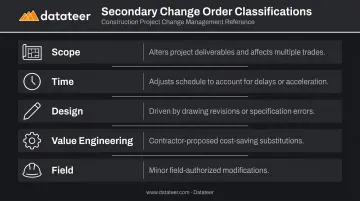
Five categories appear most often in commercial and civil construction practice:
Scope change orders alter what the project delivers — new features, layout revisions, or expanded footprint. They're the most complex to price because they typically affect multiple trades simultaneously and require resequencing of work already underway.
Time change orders adjust the construction schedule in response to weather events, inspection delays, regulatory holds, or owner-driven acceleration requests. Schedule impacts carry real downstream costs that must be documented in the CO:
- Extended equipment rentals
- Rescheduled crew mobilizations
- Delayed milestone payments tied to project completion dates
Design change orders arise from updated drawings or engineering revisions issued during construction — the result of errors, omissions, or owner-driven design evolution. These ripple into procurement lead times, inspection sequencing, and trade coordination.
Value engineering change orders are contractor-proposed substitutions or method changes that reduce cost without sacrificing quality. The FHWA defines a Value Engineering Change Proposal as a post-award contractor proposal made during construction under a VE clause — meaning VE isn't exclusively a pre-contract activity. When documented as a formal CO, it protects the contractor's right to share in savings and gives the owner a clear record of what changed from the original specification.
Field change orders (FCOs) authorize minor modifications directly in the field — typically changes that don't affect the contract price or timeline. EJCDC publishes a Field Order form (CMAR-942-2023) for this purpose. Speed is the advantage. But even minor FCOs must be documented and signed; unsigned field changes are one of the fastest paths to scope creep and payment disputes.
What Every Change Order Should Include
For a change order to be enforceable and useful for financial tracking, it needs specific components. The AIA G701-2017 form provides the standard structure.
Required identification and description:
- Project name and CO reference number
- Clear description of the change and the reason for it
- References to affected drawings or specification sections
Required cost documentation:
- Labor hours and rates
- Material quantities and unit costs
- Equipment charges
- Subcontractor costs
- Overhead and profit markups
Lump sum change orders assign a fixed total. Itemized change orders break down every cost component. Itemized format provides stronger audit protection: when a dispute arises, line-item detail is far easier to defend.
Additional required fields:
- Schedule impact (added or reduced workdays)
- Resulting Substantial Completion date
- Required signatures from all approving parties (Owner, Architect, Contractor under AIA)
- Approval due date
- Supporting attachments: photos, RFI responses, marked-up drawings
Work must not begin until the change order is fully executed. Acting on an unapproved CO removes the contractor's leverage to recover costs if the owner disputes the price later.
How Change Orders Impact Construction Finances
Individual change orders may seem manageable in isolation. The problem is cumulative volume.
Research on 185 Texas highway projects over $10M found that change-order count correlated positively with both cost growth and schedule growth — with significantly worse outcomes appearing above 20 change orders on a project. Each CO may be small; together, they reshape the financial picture of a job entirely.
The WIP Problem
Approved change orders increase the contract value and affect every downstream WIP calculation: percent complete, earned revenue, and over/underbilling positions. According to CFMA, an approved change adjusts both the contract price and total estimated costs on the WIP schedule. That single update can shift margin, percent complete, and billing status simultaneously.
When change orders are logged in spreadsheets and reconciled manually at month-end, finance teams are working with data that's already weeks old. The Double L Management business analyst who implemented Datateer put it directly: "The very first time we accessed our data through a Datateer analytics dashboard, that one click replaced two weeks worth of prior work."
Financial Controls That Reduce Exposure
Managing change order risk requires consistent systems at every stage of the process:
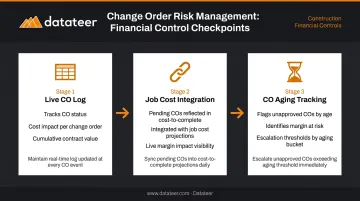
- Maintain a live CO log that tracks number, status, cost impact, and cumulative contract value
- Integrate CO approvals with job cost tracking so pending COs show up in cost-to-complete projections, not just after approval
- Track change order aging — work performed against an unapproved CO is margin at risk
Those controls are only as good as the data behind them. Datateer's Change Order Impact & Aging analytics module pulls directly from Procore, Sage, Vista, Spectrum, and Acumatica to track change orders across their full lifecycle — pending, approved, denied, executed — including aging by days since submission.
The platform surfaces stalled COs before they compound into margin problems. With an overnight automated sync across all connected ERPs, finance teams see updated CO status and WIP positions each morning rather than discovering drift weeks after the fact.
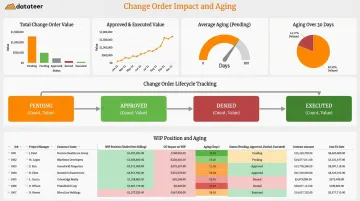
Daily visibility into CO status gives finance teams time to act — not just time to report.
Frequently Asked Questions
What should be included in a change order?
A change order needs the project reference, a clear description of the change and its reason, a detailed cost breakdown (labor, materials, equipment, markups), schedule impact, and signatures from all required parties. No work should begin until the document is fully executed by all parties.
What is a field change order?
A field change order (FCO) is a written authorization for minor modifications issued directly in the field — typically for changes that don't affect the contract price or timeline. Even minor FCOs must be documented and signed to prevent scope creep and protect payment rights.
What is the difference between an RFI and a change order?
An RFI is a question submitted to the architect or engineer to resolve an ambiguity in the drawings — it does not change the contract. A change order is the formal document that modifies the contract's scope, cost, or schedule once all parties agree to the change.
What is a Construction Change Directive (CCD)?
A CCD allows the owner and architect to direct the contractor to proceed with work before cost and schedule impacts are fully negotiated. It requires only the owner's and architect's signatures, not the contractor's agreement. Once pricing is resolved, the owner and contractor convert it into a formal change order.
Who approves a change order in construction?
Under standard AIA contracts, a change order requires signatures from all three parties: the owner, the contractor, and the architect. The architect prepares the formal document using the AIA G701 form, and the owner provides final authorization.
How do change orders affect WIP reports?
Approved change orders increase contract value and alter percent-complete calculations, which directly shifts earned revenue and over/underbilling positions. If change orders aren't updated promptly, WIP reports will misstate billing positions, leaving finance teams with inaccurate data for cash flow forecasting and margin protection.