
This article walks construction managers and finance leaders through a structured process for evaluating subcontractor performance: defining measurable KPIs, building a step-by-step review process, scoring results consistently, and turning evaluation data into actionable decisions.
Key Takeaways
- Define KPIs across quality, schedule, financials, and safety before work begins — not retroactively
- Evaluate continuously throughout the project, not only at closeout
- Use a 5-tier scoring scale (Exceptional to Unsatisfactory) for consistency and defensibility
- Financial KPIs (budget adherence, change order frequency, billing accuracy) are the most undertracked dimension
- Evaluation data should drive future bidding and selection decisions, not just file away after closeout
Why Subcontractor Performance Evaluation Matters
According to the 2024 AGC/FMI Subcontractor Default Survey, nearly 50% of respondents experienced project cancellations or delays due to subcontractor defaults, and 70% saw increased subcontractor distress or defaults compared to the prior year.
When a sub's work fails inspection, the costs stack fast: you pay for rework, absorb the schedule slip, and often cover idled downstream crews. The Construction Industry Institute puts rework costs at 2% to 20% of contract value — enough to erase the margin on an otherwise healthy job.
Without a tracking system, these cost bleeds often don't surface until the WIP report at month-end, by which point the damage is done.
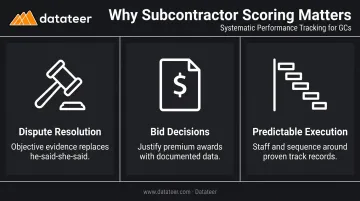
Beyond risk containment, a scored subcontractor base is a competitive asset. GCs who track performance systematically execute more predictably and carry better documentation when disputes arise. That record serves three practical purposes:
- Dispute resolution: Replaces he-said-she-said with objective evidence when owners, bonding companies, or legal counsel get involved
- Bid decisions: Justifies awarding a proven sub at a slight premium over a cheaper unknown — with numbers to back it up
- Predictable execution: Allows teams to staff and sequence projects around subs with documented track records
Key Performance Indicators for Evaluating Subcontractors
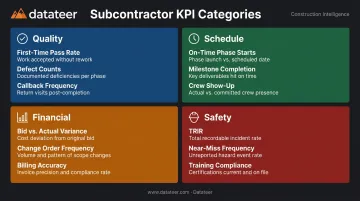
KPIs must be defined per trade activity before work begins. Setting them retroactively creates ambiguity, weakens enforceability, and leaves room for subcontractors to argue they weren't held to a standard they didn't agree to.
Quality and Schedule KPIs
Quality indicators:
- First-time quality rate (work passing inspection without rework)
- Defect and punch list item counts per phase
- Callback frequency post-completion
Each should be scored against documented acceptance criteria written into the subcontract — not against a vague standard like "acceptable quality."
Schedule indicators:
- On-time phase starts
- Milestone completion rates against the master schedule
- Crew show-up reliability
Schedule KPIs carry the broadest downstream impact. A framing crew two days late delays MEP rough-in, insulation, and drywall — and can burn the weather window entirely. Scheduling data is also visible to both field and purchasing teams, making it one of the easier categories to track consistently.
Financial and Cost Performance KPIs
Most ERP and project management systems hold substantial financial data on subcontractor performance. Yet it rarely gets analyzed at the cost-code level where subcontractor variance actually shows up.
Key financial indicators:
- Bid vs. actual cost adherence by cost code
- Change order frequency and dollar value initiated by the subcontractor
- Billing accuracy (overbilling patterns, duplicate submissions, unsupported quantities)
The AIA's analysis of 18,229 completed projects found average cost change due to change orders of 4% to slightly more than 5% — and projects over $50M averaged 11 change orders. Not all change orders are subcontractor-driven, but a sub who consistently generates scope disputes or billing exceptions is a margin risk worth quantifying.
Datateer's Cost Variance and Change Order Impact & Aging dashboards pull directly from ERPs like Procore, Sage, Vista, and Acumatica to flag subcontractor-related cost variances by cost code as they occur. Rather than waiting for the month-end WIP cycle, project teams can see whether a subcontractor's committed costs are tracking to budget and investigate at the source transaction level without switching systems.
Safety and Compliance KPIs
Key safety indicators:
- Total Recordable Incident Rate (TRIR), calculated using the OSHA standard formula: (injuries and illnesses × 200,000) / employee hours worked
- Near-miss reporting frequency (a leading indicator of safety culture)
- Safety training compliance percentage
- Jobsite cleanliness and housekeeping standards
For context, the BLS reported a 2024 construction industry TRIR of 2.2 per 100 full-time workers. A subcontractor significantly above that benchmark warrants scrutiny — both for liability exposure and the effect on your firm's Experience Modification Rate.
How to Build a Subcontractor Evaluation Process Step-by-Step
Having the right KPIs is only half the equation. The process itself must be structured, consistently applied, and built with input from every department that touches subcontractor performance.
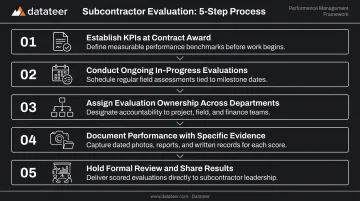
Step 1: Establish KPIs and Criteria at Contract Award
Embed performance criteria in or append them to the subcontract before mobilization. The subcontractor should know exactly what they'll be evaluated against — specific inspection pass standards, billing submission requirements, milestone dates — before the first crew shows up. This eliminates ambiguity and makes enforcement cleaner if the relationship deteriorates.
Step 2: Conduct Ongoing In-Progress Evaluations
Don't wait for closeout. Build structured checkpoints at each phase gate or on a monthly cadence for longer projects. Mid-project reviews serve a purpose that closeout reviews can't: they create a window for corrective action while there's still time to recover.
The DC Department of General Services schedules contractor evaluations at 15%, 30%, 50%, 75%, and final completion for projects over 12 months — a useful framework even for private GCs adapting it to their own project cadences.
Step 3: Assign Evaluation Ownership Across Departments
Subcontractor performance affects more than the field superintendent. Each department holds a piece of the picture:
- Field/Project Management — quality observations, schedule compliance, crew reliability
- Purchasing — material delivery performance, billing exceptions, change order disputes
- Finance — budget vs. actual by cost code, overbilling flags, margin impact
- Warranty — callback frequency, response time, resolution quality
Collecting input from each function before scoring creates a more accurate picture. It also avoids the common problem of a field super who likes a sub personally overriding a financial record showing consistent cost overruns.
Step 4: Document Performance with Specific Evidence
Narrative opinions don't hold up. Document with:
- Inspection records and photo logs
- Corrective action notices
- Delivery receipts and billing submissions
- Schedule deviation records
Thorough documentation protects the GC legally and provides the defensible grounds needed for contract decisions, particularly if a subcontractor relationship eventually needs to be terminated.
Step 5: Hold a Formal Review and Share Results
At closeout, schedule a formal evaluation meeting with the subcontractor. Share scores, cite the supporting evidence, acknowledge strong performance, and walk through improvement areas directly. This isn't a formality. Subcontractors who receive specific, evidence-backed feedback improve faster — and the ones who don't respond to it give you a documented basis for bid decisions on the next project.
How to Score and Interpret Subcontractor Performance Results
The five-tier scale used in federal contracting under FAR 42.1503 translates cleanly to private construction:
| Rating | Definition |
|---|---|
| Exceptional | Exceeded requirements across most categories; minimal issues |
| Very Good | Met requirements; exceeded some to the GC's benefit |
| Satisfactory | Met requirements; minor problems or major problems addressed through corrective action |
| Marginal | Did not meet some requirements; problems not yet corrected |
| Unsatisfactory | Did not meet most requirements; recovery is unlikely |
Each KPI category receives its own rating backed by documented evidence — not a single rolled-up score that buries the detail.
Once ratings are assigned, the response follows the tier:
- Satisfactory to Exceptional: Recognize the sub formally, prioritize them for future bids, and consider performance-based incentives in future contracts.
- Marginal: Issue a formal corrective action plan with specific remediation steps, a timeline, and a follow-up checkpoint. Document this carefully — it's critical if the relationship eventually needs to be terminated and you need to show a pattern of escalation.
- Unsatisfactory: When failures span multiple categories and corrective actions haven't worked, the GC must choose between restructuring remaining scope and termination. Under ConsensusDocs 755, a notice and cure process is required before acting. A thorough evaluation record is what holds up that decision with ownership, legal counsel, and bonding companies.
Common Mistakes to Avoid When Evaluating Subcontractors
Waiting until closeout to document problems. End-of-project reviews are forensic, not corrective. By the time a pattern of poor performance is formally documented, the rework has happened, the schedule has slipped, and the margin is gone. CII puts rework costs at 2–20% of contract value — a range that can eliminate profit on a job entirely, and it compounds before anyone writes it down.
Letting scoring vary by supervisor. When evaluations depend on individual intuition rather than structured criteria, the data becomes useless for cross-project comparisons or vendor database decisions. Without a centralized system, scores stay siloed in individual project files and never inform future bid decisions.
Spreadsheets make this worse. Scores tracked in separate Excel files across projects can't be aggregated or compared without significant manual effort — which means the data rarely gets used at all.
Failing to close the feedback loop. Evaluations that stay internal provide no opportunity for the subcontractor to improve. Sharing results — including both what went well and what needs to change — is also a relationship investment. Many performance issues resolve once a subcontractor knows they're being scored against specific criteria and that those scores affect future awards.
Frequently Asked Questions
How do you evaluate a subcontractor?
Define measurable KPIs upfront across quality, schedule, cost, and safety. Conduct ongoing in-project reviews against those criteria, document performance with specific evidence (photos, inspection records, corrective action logs), score using a consistent rating scale, and share results directly with the subcontractor at closeout.
What are some examples of subcontractor performance evaluations?
Common examples: a framing crew rated on inspection pass rate and phase completion; an MEP sub scored on change order frequency and billing accuracy; a concrete sub evaluated on schedule adherence and safety incidents. Each trade's evaluation is tailored to the work type and contract obligations.
What KPIs should I use to evaluate subcontractor performance?
The four core categories: quality (defect rate, inspection pass rate), schedule (on-time milestone completion, crew attendance), financial (budget vs. actual, change order frequency, billing accuracy), and safety (incident rate, training compliance). Define these before mobilization, not after problems appear.
How often should subcontractor performance reviews be conducted?
At minimum, at each project phase gate and at closeout. For projects over 12 months, monthly structured check-ins are recommended. Ongoing informal monitoring should happen continuously between formal reviews so issues are caught early enough to correct.
What should a subcontractor performance evaluation form include?
Project and subcontractor identification, scored KPI categories (quality, schedule, cost, safety) with space for specific documented examples, an overall rating using a consistent scale, and a signature line confirming the subcontractor has received and reviewed the evaluation.
What happens when a subcontractor consistently underperforms?
Issue a formal corrective action plan with documented follow-up. If performance doesn't improve, restrict the sub from future bid lists. For active contracts with critical failures, termination may be warranted — proper notice and cure steps under the contract are required, and your evaluation records provide the legal basis for that decision.