
The stakes are clear. What's less clear, for many construction finance professionals, is exactly where their estimating process is breaking down.
This guide covers 8 actionable tips across the full estimating lifecycle: pre-estimate preparation, cost calculation, subcontractor bid management, risk and contingency, and the post-award feedback loop. No estimate will ever be perfect, but the goal isn't perfection — it's narrowing the margin of error enough to protect project margins and win profitable work consistently.
Key Takeaways
- Standardized templates and historical job cost data are the foundation of every reliable estimate
- Fully loaded labor rates and rigorous quantity take-offs drive more estimate errors than any other factor
- Level bids by comparing inclusions and exclusions across sub proposals before selecting the low bidder
- Contingency and indirect costs need to be calculated line items, not gut-feel percentages
- The feedback loop between estimated and actual costs is what separates improving estimators from those who repeat the same mistakes
Build a Strong Estimating Foundation (Tips 1 & 2)
Tip 1: Start with a Standardized Estimating Template
A construction estimating template does one critical job: it prevents line items from falling through the cracks when deadline pressure is high and time is short.
For GCs, a complete template covers all applicable CSI divisions, general conditions, temporary facilities, permits, bond costs, insurance, and administrative overhead. For specialty contractors, it means capturing fixture types, controls, equipment, and transmission — not just material and labor. The CSI MasterFormat provides a 50-division structure that serves as a reliable starting framework.
Two principles make templates effective:
- They function as checklists. Every estimator, regardless of experience level, works through the same structure. Nothing gets skipped because it "seemed obvious."
- They evolve after every project. When a cost category is missed or underestimated, the master template gets updated. Over time, it encodes the firm's hard-won institutional knowledge.
Templates are not rigid. Each project requires customization — adding or removing line items based on scope. The master template is simply the starting point that ensures nothing is forgotten before customization begins.
Tip 2: Mine Your Historical Job Cost Data
Before building a new estimate, pull three to five comparable past projects — similar size, type, and scope — and compare your proposed line-item numbers against what those jobs actually cost at the cost-code level.
If HVAC came in at $100K on a similar project but the current estimate shows $150K, that delta needs a clear, documented justification. If there isn't one, the number needs a second look.
The approach depends entirely on accurate job cost tracking at the code level. Without cost-code-level actuals, estimators are building numbers on assumptions rather than evidence. Job cost tracking is a non-negotiable operational practice — not a finance team luxury that gets cut when things get busy.
The practical challenge with spreadsheet-based lookups:
- Speed: Pulling comparable project data manually can take days
- Consistency: Different formats make apples-to-apples comparisons unreliable
Datateer eliminates that lag by syncing job cost actuals directly from 12+ construction ERPs — including Procore, Sage, Viewpoint Vista, Acumatica, and Foundation Software. The sync covers actual costs incurred, committed costs, projected final cost, and variance to budget at the job, phase, and cost-code level. Data refreshes overnight as standard, so historical cost comparisons are ready without the multi-day manual exercise.
Calculate Costs with Precision (Tips 3 & 4)
Tip 3: Perform Rigorous Quantity Take-offs
A take-off error compounds through the entire estimate. Get the quantities wrong and every downstream calculation — material costs, labor hours, equipment time — inherits that error.
For material-heavy scopes and specialty subcontractors, a traditional material take-off quantifies every major material component. For GCs managing complex scopes, a Work Breakdown Structure (WBS) approach organizes the project into discrete, priceable elements that can each be estimated independently.
Digital take-off tools like Bluebeam, PlanSwift, and On-Screen Takeoff eliminate the measurement errors that come with scale rulers and manual counting — and they cut hours off the process.
Two failure modes are worth watching for:
- Going too granular (counting every fastener on a complex mechanical project) wastes time without improving accuracy
- Going too high-level (lumping dissimilar scopes into one line item) creates pricing gaps that show up as change orders
The target is sufficient breakdown to price each meaningful scope element — detailed enough to catch major cost components, not so detailed that the process becomes the bottleneck.
Tip 4: Calculate Fully Loaded Labor Rates and Crew Productivity
Labor is often the most profitable self-performed scope for a GC or specialty contractor. It's also the most common source of estimate error.
What "fully loaded" actually means:
A fully loaded labor rate goes well beyond the hourly wage. It must include:
- Employer payroll taxes (6.2% Social Security, 1.45% Medicare per IRS Publication 15-A)
- FUTA/SUTA contributions
- Health benefits, retirement contributions, and paid leave
- Union dues where applicable
- Company-provided vehicles, cell phones, tools, and small equipment allocations
According to BLS data from December 2025, total employer compensation in construction averaged $50.93/hour — with wages at $35.47/hour and benefits adding another $15.45/hour. That's a 30.3% benefits burden on top of wages. Estimators who price labor using wage rates alone are leaving a significant gap.
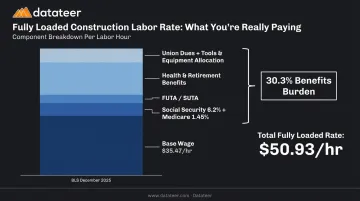
To calculate your fully loaded rate, sum all labor-related costs for a defined period (quarter or year), then divide by total hours worked in that same period.
Crew productivity requires the same rigor. Divide total labor hours spent on a past project task by the quantity of work completed — that gives you a unit production rate (manhours per linear foot of pipe, per square foot of concrete, etc.). Averaging across multiple past jobs and crews is worth the effort; productivity can swing 15-25% across crews on similar work, and a single project data point won't capture that range.
Datateer's Overhead & Burden Rate Analytics dashboard calculates actual fully-burdened labor rates by craft, department, and division — and compares budgeted burden rates to actuals. For bid teams, this means the rates going into the estimate are grounded in real cost data, not last year's assumptions.
Scrutinize Subcontractor Bids and Level Scope (Tip 5)
The low subcontractor bid almost never tells the whole story. Before selecting a sub based on price, the estimator needs to understand exactly what that price includes — and what it doesn't.
Bid leveling means lining up all sub proposals side by side and mapping inclusions and exclusions against the full project scope. Subcontractors routinely:
- Exclude problem scopes they can't self-perform
- Price against a different (often earlier) plan revision
- Omit items where responsibility is ambiguous in the bid documents
Before leveling bids, run through these verification steps:
- Call every sub to confirm coverage of the complete scope before leveling
- Request revised proposals with missing items explicitly priced
- When time allows, perform an independent take-off of the sub's scope as a spot-check against their number
- Document what each sub explicitly includes and excludes before the bid is submitted
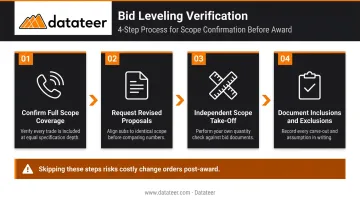
Accepting the lowest sub number without this verification is a direct path to margin erosion. The gap in coverage doesn't disappear — it surfaces later as a costly change order. Arcadis's 2024 Construction Disputes Report identified errors and omissions in contract documents as one of the top two dispute causes in North America — a direct consequence of scope gaps that weren't caught before award.
Catching these gaps at bid time is a data problem as much as a process one. Datateer's Subcontractor Performance dashboard pulls actual performance data from your ERP, giving estimators and project teams visibility into which subs consistently deliver on their numbers and which ones show a pattern of cost overruns or change order activity — before the next bid cycle starts.
Account for Indirect Costs, Escalation, and Risk (Tips 6 & 7)
Tip 6: Account for Indirect Costs and Material Escalation
Indirect costs are the category most likely to be underestimated or absorbed into a vague overhead line. Jobsite supervision, temporary facilities, permits, safety programs, insurance, and bonding all need explicit calculation — not a rough guess at the end.
RSMeans benchmarks general conditions for a general contractor at 5% to 15% of total project cost, with 10% as the most common allowance. That's a wide range. The right number for any specific project depends on duration, complexity, and the firm's direct cost structure — which is why it must be calculated, not assumed.
On material escalation, the current environment demands attention:
- AGC reported the PPI for materials used in nonresidential construction rose 2.5% year over year as of August 2025
- Steel mill products rose 13.1% and aluminum mill shapes rose 22.8% over the same period
- 43% of contractors reported projects canceled or delayed due to rising material costs
Practical steps to protect against escalation:
- Get written vendor quotes with firm expiration dates
- Build escalation clauses into contracts for projects lasting more than a few months (ConsensusDocs provides standard escalation clause language)
- Use published indices like ENR's Construction Cost Index or the BLS PPI to benchmark material trends
- Update equipment rates to reflect current replacement costs, not historical averages
Datateer's Material Price Escalation Analytics tracks actual purchased cost per unit for key materials (lumber, steel, concrete, copper, and others), trended over time and compared against bid-estimate unit prices and external indices including the PPI and ENR Material Cost Index. The system calculates escalation impact rolled up to project margin, giving finance teams a quantified view of exposure — not just a directional warning.
Tip 7: Build in Structured Risk and Contingency Allowances
Contingency added as a single gut-feel percentage at the end of an estimate is not risk management. It's an unexamined assumption that can unravel a project budget.
A structured approach ties contingency to specific identified risks:
| Risk Category | Examples |
|---|---|
| Design uncertainty | Incomplete drawings, pending engineering decisions |
| Subsurface conditions | Geotechnical unknowns, existing utility conflicts |
| Supply chain | Long-lead equipment, single-source materials |
| Labor availability | Tight labor markets, specialty craft shortages |
| Schedule risk | Weather windows, permitting delays |
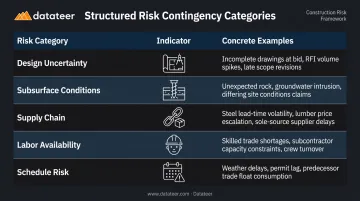
Each risk gets its own contingency line with a calculated allowance based on probability and potential impact.
For early-stage estimates where scope isn't fully defined, AACE 56R-08 provides a useful framework: a Class 5 estimate (0-2% project definition) carries accuracy ranges of -20% to -30% / +30% to +50%. That's the honest conversation to have with decision-makers at concept stage.
Range estimating (presenting a low/likely/high rather than a single number) gives stakeholders a clearer picture of the financial risk envelope. It also reduces the pressure to commit to false precision before the project scope is actually defined.
Document all assumptions, exclusions, and identified risks in a formal estimate narrative. That documentation protects the estimating team when scope change disputes arise after award.
Close the Loop: Track Estimates Against Actuals (Tip 8)
The single most powerful way to improve future estimates is also the most consistently neglected: comparing estimated costs to actual costs at the cost-code level throughout project execution.
When labor productivity runs behind estimate on a current job, two things should happen: corrective action on that project, and a flag to revisit the productivity assumption in future bids. Most firms only capture the first lesson when the overrun is large enough to trigger a conversation. The second lesson — updating the estimating model — rarely happens at all.
The reason this feedback loop breaks down is timing. By the time a traditional monthly job cost report reaches the estimating team, it reflects data that's two to four weeks old. KPMG's 2021 survey found only 16% of construction firms had fully integrated systems and tools to manage project data, and 60% cited a critical need for more integration and visibility.
Datateer's Cost Variance dashboard is built to close this gap. Instead of waiting for month-end reports, estimators and finance teams work from the same live data. Key capabilities include:
- Overnight data refresh replacing the traditional 10–20 day WIP lag
- Variance reporting at the job, phase, cost code, and resource type level (labor, materials, equipment, subcontractor, overhead)
- Drill-down to source transactions in the ERP without leaving the dashboard
- Automatic cost code standardization across projects and divisions, keeping estimated-vs.-actual comparisons consistent even when teams use different coding conventions
- Unlimited user access so estimators and CFMs work from the same data simultaneously, with no seat licensing and no spreadsheet silos
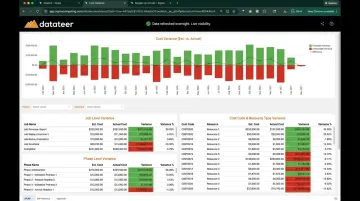
Without this feedback loop, the first seven tips remain one-time improvements. With it, every completed project feeds the next bid — building institutional knowledge that compounds across every estimate the firm produces.
Frequently Asked Questions
Frequently Asked Questions
How can I improve estimate accuracy for large construction jobs?
Large jobs require a detailed WBS, cost-code-level historical data from comparable projects, bid leveling across multiple subcontractors, and formal risk contingency — revisited at each design milestone as scope definition matures. Early-stage accuracy ranges are wide by nature; the estimate should tighten as project definition improves.
What is the 50-90 estimation technique?
The 50/90 method (formalized in AACE 119R-21) produces two numbers: the P50, which you're 50% confident the project stays under, and the P90, the 90%-confidence ceiling. Presenting both gives decision-makers a realistic cost range instead of a single-point estimate that implies false precision.
What are the most common causes of inaccurate construction estimates?
The most frequent causes are underestimating indirect costs, using outdated labor rates or productivity factors, failing to verify subcontractor bid scope coverage, ignoring material price escalation, and having no formal process for comparing estimated to actual job costs on completed projects. Most estimate failures trace back to at least two of these simultaneously.
How do you calculate a fully loaded labor rate for construction?
Sum all labor-related costs for a defined period — wages, payroll taxes, benefits, union dues, tools, and vehicles — then divide by total hours worked. Apply your overhead and markup percentage on top to produce the billing rate used in the estimate.
What contingency percentage should I include in a construction estimate?
There is no universal number. AACE 56R-08 ties contingency to estimate class: a Class 5 (minimal scope definition) carries accuracy ranges of -20% to +50%, while a Class 1 (fully defined scope) narrows to -3% to +10%. Calculate contingency against specific identified risks rather than applying a blanket percentage.
How does job cost tracking improve future construction estimates?
Tracking actuals by cost code against the estimate reveals patterns over time — labor categories that are consistently underpriced, material types that routinely run over — allowing estimators to correct their models with real performance data. Firms that close this loop turn completed projects into a compounding asset for every future bid.