Introduction
Construction finance leaders are operating in an environment where the margin for error has essentially disappeared. Material costs swing unpredictably, labor productivity erodes quietly, and the difference between a profitable job and a recorded loss often comes down to when a problem gets caught — not whether it exists.
The data reflects how widespread this challenge is. According to KPMG's 2023 Global Construction Survey, 37% of construction firms missed budget or schedule performance targets. That's not a fringe problem — it's a systemic one.
Construction forecasting software exists to close that timing gap. It catches a slipping job before closeout, prevents a payroll crunch on an otherwise profitable project, and gives leadership a financial picture that reflects current conditions — not what the numbers looked like three weeks ago.
What follows covers the specific use cases forecasting software is built for, the measurable benefits each one delivers, and the real cost of going without it.
Key Takeaways
- Construction forecasting software converts live ERP data into forward-looking projections — cost-to-complete, cash flow, and WIP position — updated continuously, not assembled manually at month-end
- The three highest-impact use cases are real-time cost forecasting, cash flow visibility and liquidity planning, and automated WIP reporting
- Without it, finance teams work on data that's 2–4 weeks stale, discovering budget overruns after the fact rather than in time to act
- Direct ERP integration is what separates genuinely useful forecasting from a more sophisticated spreadsheet
- Forecasting compounds in value when updated on a rolling basis and acted on, not merely documented
What Is Construction Forecasting Software
Construction forecasting software is a system that pulls live project cost, labor, billing, and schedule data from a firm's ERP and translates it into forward-looking projections: cost-to-complete, cash flow timing, revenue backlog, and WIP position.
It sits downstream of the ERP — not replacing it, but consuming the financial data it holds and presenting it in dashboards that refresh continuously rather than requiring manual assembly. The ERP remains the system of record; the forecasting platform is the analytics layer on top of it.
Platforms like Datateer connect directly to 20+ construction ERPs — Procore, Sage, Viewpoint Vista, Acumatica, Foundation Software, CMiC, Jonas Construction, and others — pulling job cost actuals, billing data, committed costs, and retainage schedules automatically. The point is lead time: enough visibility to protect margins, manage liquidity, and act before each reporting cycle closes.
Key Use Cases and Benefits of Construction Forecasting Software
The use cases below aren't abstract capabilities. Each one addresses a specific failure point that construction finance teams encounter when relying on spreadsheets or static ERP reports alone.
Real-Time Cost Forecasting
Real-time cost forecasting compares budgeted cost against actual spend and cost-to-complete — at the job and cost-code level — so finance leaders can see where margin is heading before the project closes.
Forecasting software automates this by ingesting job cost actuals from the ERP, comparing them to original estimates, and surfacing variance at the line-item level. What used to require a multi-day manual reconciliation becomes a continuously updated view.
Why this matters:
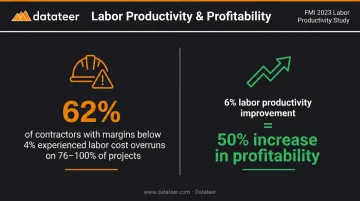
Margin fade is one of the most common ways construction firms lose money. A job that looked profitable at kickoff can erode below budget without warning, and finding that at monthly close is too late. FMI's 2023 Labor Productivity Study found that among contractors with operating margins below 4%, 62% experienced labor cost overruns on 76–100% of their projects. The same study found a 6% labor productivity improvement was associated with a 50% increase in profitability — a number that only moves when you catch problems early enough to act.
When the cost forecast refreshes daily rather than monthly, project managers and finance leaders share the same picture. That alignment creates options: reassigning crews, accelerating change orders, adjusting procurement while those levers still work.
The benefit extends to estimating, too. When actual cost-code performance is captured systematically across completed jobs, estimators have real data to anchor future bids rather than relying on memory or generic benchmarks.
KPIs this use case moves:
- Job gross margin %
- Cost variance by cost code
- Cost-at-completion accuracy
- Budget overrun frequency
- Estimating accuracy on repeat project types
When it matters most: Multi-project portfolios where finance leaders can't personally monitor every job; fixed-price contracts where cost overruns come directly out of the contractor's margin; labor-intensive projects where productivity variance compounds quickly.
Cash Flow Visibility and Liquidity Planning
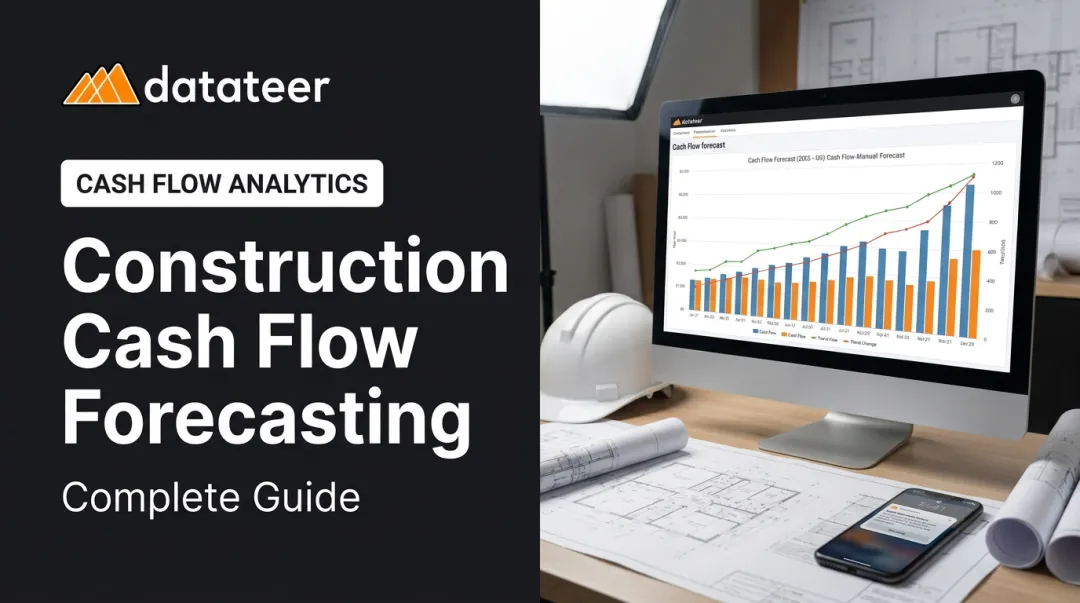
Cash flow forecasting in construction maps the timing gap between when costs are incurred (payroll, subcontractor invoices, materials) and when money is actually collected from billing milestones, draw schedules, and retainage releases.
Forecasting software creates this visibility by integrating billing schedules, contract payment terms, subcontractor obligations, and project progress into a projected net cash position by period. Datateer's platform builds a 13-week cash flow forecast from real-time burn rates and retainage schedules, and extends visibility further with a Forecasted Liquidity dashboard that projects bank balance six months out.
Why this matters:
A job can be on budget and still create a cash crisis. Retainage is typically 5–10% of total project cost, held until substantial completion. Net-60 owner payment terms and net-30 subcontractor invoices can create months of negative cash flow on otherwise profitable projects.
According to Travelers Bond & Specialty Insurance, inadequate internal cost controls or failure to use accounting systems are factors in nearly 50% of contractor failures — and tight cash flow is one of the earliest warning signs that surety underwriters flag. Proactive cash flow forecasting gives controllers lead time to sequence procurement, time subcontractor payment runs, and plan credit line usage before a crunch hits rather than after.
Sureties and lenders notice the difference, too. Contractors who can produce a live, rolling cash flow forecast on demand build credibility that static quarterly reports simply can't replicate.
KPIs this use case moves:
- Days Sales Outstanding (DSO)
- Cash flow gap by project
- Retainage balance outstanding
- Working capital availability
- Credit line utilization
When it matters most: Firms managing multiple concurrent projects with back-loaded payment structures; specialty contractors with high subcontractor payment volume; periods of rapid growth when new project starts consume cash before old projects close.
WIP Reporting and Financial Accuracy
WIP (work-in-progress) reporting is the financial process of recognizing revenue and costs accurately across partially completed projects: calculating overbilling and underbilling positions, cost-to-complete estimates, and percent-complete by job.
It's the schedule that auditors, bonding companies, and lenders rely on to evaluate a contractor's financial health.
Forecasting software transforms this process. Instead of a finance team spending 10–20 days manually pulling job cost data, reconciling spreadsheets, and formatting reports, the software syncs directly with the ERP and refreshes the WIP schedule automatically. Datateer, for example, delivers a 2-minute WIP refresh after ERP sync — replacing what Double L Management's Business Analyst described as "two weeks worth of prior work" with a single click.
Why this matters:
WIP accuracy directly affects financial credibility. According to EisnerAmper, continual profit fade identified through WIP causes sureties to lose confidence in management and can severely affect bonding capacity.
Overbilling masks cash flow problems; underbilling means the firm has done work it hasn't collected on. Both create audit surprises that damage relationships with surety companies and lenders, and stale WIP data can't catch these positions in time to correct them.
Once WIP prep no longer consumes the finance team's month-end bandwidth, CFOs and controllers can shift from assembling data to analyzing it: reviewing job performance trends, flagging at-risk projects, and advising on bidding strategy instead of chasing down numbers.
KPIs this use case moves:
- WIP schedule preparation time
- Overbilling/underbilling balance accuracy
- Percent-complete variance from field reality
- Monthly close cycle time
- Audit adjustment frequency
When it matters most: Firms preparing monthly WIP schedules for bonding or bank reporting; firms with more than five to ten active jobs where manual consolidation becomes unmanageable; finance teams spending more than a week each month on report preparation.
What Happens When Construction Forecasting Software Is Missing
For firms relying on spreadsheets and manual ERP exports, financial data is typically 2–4 weeks old by the time it reaches leadership. That lag turns budget overruns from recoverable situations into recorded losses.
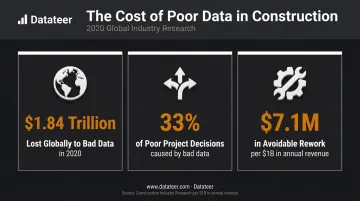
An Autodesk and FMI study found that bad data cost the global construction industry an estimated $1.84 trillion in 2020 — and that 33% of poor project decisions result directly from bad data. For a contractor with $1 billion in annual revenue, bad data affects approximately $165 million of revenue and causes $7.1 million in avoidable rework.
Without real-time financial visibility, the downstream effects stack up fast:
- Margin fade goes undetected until closeout — by then it's a recorded loss, not a recoverable situation
- Cash crunches arrive without warning, forcing delayed vendor payments, emergency credit draws, and stalled project starts
- WIP reports take weeks to prepare, limiting their usefulness and creating audit exposure
- Finance leaders spend most of their time gathering data rather than analyzing it
- Spreadsheet-based forecasting collapses at scale — version control failures, broken formulas, and siloed assumptions make portfolio-level visibility impossible
JBKnowledge's Construction Technology Report found that 62% of construction companies still relied on spreadsheets for estimating workflows and 49% used manual entry to transfer data between non-integrated applications. When those figures compound across a $200M project portfolio, the exposure isn't operational friction — it's material financial risk.
How to Get the Most Value from Construction Forecasting Software
Forecasting software delivers its full value only when connected directly to the systems where construction financial data actually lives. Manual data entry into a forecasting tool reintroduces the same errors and delays the software is supposed to eliminate.
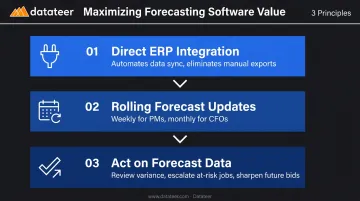
Three principles matter most:
1. Direct ERP integration is essential. Platforms that sync automatically with your existing ERP — pulling job cost actuals, billing data, and contract information without manual export — ensure what appears in the forecast reflects actual field and financial reality. Datateer's zero-lift connection model handles this automatically — standardizing cost codes, reconciling Procore commits to Sage invoices, and eliminating VLOOKUP work entirely.
Implementation takes 2–4 weeks, with dashboards live on day one.
2. Forecasts must be updated on a rolling basis. A forecast updated only at project milestones or month-end provides the illusion of visibility without the early-warning function that justifies the investment. CFMA guidance recommends rolling forecasts updated monthly or quarterly at minimum for executive reporting — and weekly for active project management in fast-moving environments.
Datateer's standard overnight refresh supports both cycles, with more frequent updates available for firms that need them.
3. Act on what the forecast shows. Review variance reports, escalate at-risk jobs before closeout, and use forecast data to sharpen future bids. Firms that build this review into their regular financial cadence — weekly for PMs, monthly for CFOs — consistently catch margin fade earlier and close projects closer to the original bid.
Conclusion
The real value of construction forecasting software is seeing where each job is heading before the damage is done — catching margin fade in time to act, managing cash flow against what's actually moving, and keeping leadership out of the dark between monthly closes.
The three use cases covered here — real-time cost forecasting, cash flow visibility, and automated WIP reporting — reinforce each other over time. Each month of rolling forecast data sharpens the next. Over project cycles, that history becomes a benchmark that improves future bids and resource planning in ways that one-off reports never could.
The firms that separate from the competition aren't the ones with the most sophisticated tools. They're the ones that build forecasting into their standard financial workflow and actually change behavior based on what it shows them.
Frequently Asked Questions
How do you forecast construction costs?
Construction cost forecasting compares original estimates against actual job cost data — pulled from the ERP at the cost-code level — and projects cost-to-complete based on current progress and burn rates. Forecasting software automates this by syncing live job cost data continuously rather than requiring manual spreadsheet updates each month.
What is the difference between construction budgeting and forecasting?
A budget is set once at project kickoff and defines the approved cost baseline. Forecasting is an ongoing process that updates that baseline against actual performance. Budgeting answers "what did we plan to spend?" — forecasting answers "what will we actually spend, and does that leave us profitable?"
What are the main use cases for construction forecasting software?
The three core use cases are real-time cost forecasting (tracking job margin as work progresses), cash flow forecasting (projecting when money moves in and out), and WIP reporting (producing accurate overbilling/underbilling positions for bonding, audits, and lender reporting).
How does construction forecasting software improve cash flow management?
The software maps billing milestones, retainage release schedules, and subcontractor payment obligations together so controllers can see projected cash position weeks in advance. That lead time allows them to adjust billing cadence, sequence payments, or plan credit line usage before a cash crunch develops.
What causes construction projects to go over budget?
The most common causes are untracked scope changes, labor productivity below estimate, material cost volatility, and financial data too stale to catch variance early. Most overruns build gradually from small, undetected variances that live cost data would have surfaced in time to correct.
How does construction forecasting software integrate with ERP systems?
Purpose-built platforms connect directly to construction ERPs such as Procore, Sage, Vista, and Acumatica via automated data syncs, pulling job cost actuals, billing data, and contract information without manual export or re-entry. This keeps forecast data aligned with current field and financial reality rather than a weeks-old manual snapshot.