
That approach is expensive. According to Arcadis's 2025 Construction Disputes Report, the average North American construction dispute reached $60.1 million in 2024 — a 40% increase from the prior year — with resolution taking an average of 12.5 months. Most of those disputes trace back to contract terms that were poorly negotiated, vaguely written, or never monitored during execution.
This guide is written for construction CFOs, finance managers, and firm leaders. It covers the four primary contract types and their financial risk profiles, the clauses that most frequently destroy margins, proven negotiation tactics, and how to monitor contract risk throughout project execution — not just at signing.
Key Takeaways
- Contract type — fixed-price, cost-plus, T&M, or unit price — determines who absorbs financial risk, and the wrong choice erodes margins before a shovel hits the ground
- The most dangerous clauses — liquidated damages, indemnification, pay-if-paid — are often buried in standard boilerplate
- Effective negotiation means understanding the other party's priorities, not just defending your own terms
- Contract risk materializes during execution — real-time financial monitoring lets you catch margin drift while there's still time to course-correct
Construction Contract Types and Their Financial Risk Profiles
Every construction contract distributes financial risk between owner and contractor. The structure you choose — or accept — determines who absorbs cost overruns, schedule delays, and scope uncertainty.
The Four Primary Contract Types
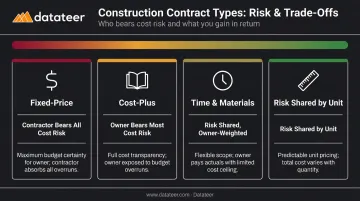
| Contract Type | Who Bears Cost Risk | Key Trade-Off |
|---|---|---|
| Fixed-Price (Lump Sum) | Contractor | Cost certainty for owner; full scope risk for contractor |
| Cost-Plus (with or without GMP) | Owner (unless GMP applies) | Flexibility for contractor; budget uncertainty for owner |
| Time & Materials (T&M) | Owner | Maximum contractor protection; no owner cost ceiling |
| Unit Price | Shared | Works well when quantities are uncertain but unit costs are predictable |
Fixed-Price Contracts: Where Contractor Risk Concentrates
Under a fixed-price structure, the contractor assumes scope and cost risk entirely. If material costs spike, labor runs long, or scope is ambiguous, the contractor absorbs the difference. KPMG data shows that only 31% of projects came within 10% of planned budget over a three-year survey period — across all contract types. That gap hits contractors hardest under fixed-price arrangements, where pre-bid estimate errors translate directly into margin erosion with no mechanism for recovery.
Cost-Plus and T&M: Shifting Risk Toward Owners
Where fixed-price contracts concentrate risk on contractors, cost-plus and T&M structures flip that exposure toward owners. Two provisions determine whether that exposure stays manageable:
- Guaranteed Maximum Price (GMP): Under AIA A133-2019, costs exceeding the GMP are the construction manager's responsibility — the owner is protected once a ceiling is set
- Audit rights: AIA A133 requires record preservation for three years after final payment and grants owners access to supporting cost records — contractors should understand this obligation before signing
Negotiating both provisions together — a firm GMP plus defined audit rights — gives owners budget control without eliminating the scheduling flexibility that makes these structures attractive in the first place.
Key Contract Elements to Negotiate Before You Sign
Contract Sum and Payment Schedule
The negotiated price must account for more than current material costs. Build in protection for:
- Price escalation clauses tied to material cost indices (PPI, ENR Material Cost Index) for projects extending beyond 12 months
- Statutory fee and permit cost contingencies that aren't always visible during bid preparation
- Retainage terms: According to CFMA, retainage typically sits at 5% or 10% and can be withheld for weeks, months, or years. At 10%, retainage can exceed a contractor's actual profit margin, requiring working capital financing
Negotiate retainage reduction provisions tied to milestone completion rather than accepting standard holdback terms without pushback.
Scope of Work and Change Order Process
A vague scope of work is a margin leak waiting to happen. A precisely written scope:
- Defines what is and isn't included in the contract price
- Establishes which party is responsible for design-related ambiguities
- Sets the baseline for change order pricing
The change order process deserves equal attention. According to a 2026 Dodge Construction Network/Clearstory survey of nearly 200 US contractors, the average cycle from changed work to authorized change order runs nearly seven weeks — and 83% of specialty contractors reported negative cash flow effects from that delay.
Negotiate these terms before signing:
- Markup rates for labor, materials, equipment, and overhead on change order work
- Owner approval timelines (ideally 14 days or fewer for routine changes)
- Conditions under which a contractor can proceed without written approval
- Pricing methods for time-sensitive changes
Risk Allocation
Owners push maximum risk to contractors. Contractors push it to subcontractors. The result is often a risk allocation that has nothing to do with who actually controls each risk factor.
Effective risk allocation negotiation asks: Who can best control or mitigate this risk? The answer usually points in three directions:
- Weather and force majeure events — neither party controls these; treat them as shared risk with defined float provisions
- Scope gaps from incomplete owner drawings — that risk belongs with the owner who furnished them
- Subcontractor performance — that risk belongs with the GC who selected and contracted them
Milestone and Payment Schedule Alignment
Payment terms directly affect liquidity. Watch for:
- Net-30 vs. net-60 payment terms and how they interact with your subcontractor payment obligations
- Retainage release triggers — "substantial completion" is vague; push for defined milestone-based release schedules
- Payment application timing that misaligns with your actual cost burn rate
Dispute Resolution
Include a tiered dispute resolution process in every contract: negotiation first, then mediation, then arbitration. Without a defined process, disputes default to litigation. The average North American construction dispute takes 12.5 months to resolve even when a process exists — meaning an undefined path will cost more time and money than most firms budget for.
High-Risk Contract Clauses That Can Destroy Project Margins
Liquidated Damages
LD clauses impose pre-set daily financial penalties for schedule delays. Before signing, scrutinize:
- The daily rate and whether it reflects actual owner damages or functions as a penalty
- The cap on total LD exposure — uncapped LDs can exceed contract value on long projects
- What events start the clock — and whether owner-caused delays are carved out
- Force majeure exclusions that stop LD accrual during qualifying events
ENR notes that public-project contracts commonly fix daily delay amounts in bid documents. Contractors should always push for delay analysis provisions that pause LD accrual when owner actions contribute to schedule slippage.
Indemnification and Hold Harmless Clauses
Three indemnity forms exist, and the differences can cost millions depending on fault allocation:
- Limited form: Covers only losses caused by the indemnitor's own fault
- Intermediate form: Applies unless the indemnitee is solely at fault — meaning a contractor can be required to cover losses even when partially caused by the owner
- Broad form: Covers losses even when the indemnitee is solely at fault
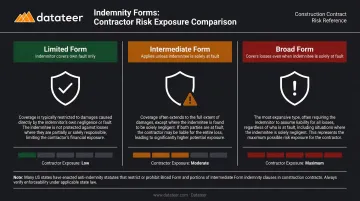
Contractors should resist intermediate and broad indemnity forms. State anti-indemnity statutes invalidate broad language in some jurisdictions, but you cannot rely on statute to fix a clause that should have been negotiated out before signing.
Pay-If-Paid vs. Pay-When-Paid
Pay-if-paid clauses make a subcontractor's right to payment contingent on the GC first receiving payment from the owner — transferring owner credit risk entirely downstream.
Verify current state law before signing. Virginia prohibited pay-if-paid clauses effective January 1, 2023. California, Illinois, Massachusetts, New York, North Carolina, and South Carolina have also prohibited or restricted these provisions. New Jersey enforced a properly drafted clause in 2022. Confirm your state's current statute before finalizing any subcontract.
Limitation of Liability and Force Majeure
Limitation of liability clauses cap a contractor's total financial exposure for defects or delays. Finance managers should push for mutual caps — provisions that protect both parties equally — rather than one-sided limitations that protect only the owner.
Force majeure provisions must be specific. Vague language leaves contractors absorbing costs from supply chain disruptions, material price spikes, or subsurface surprises with no relief. Post-COVID drafting improved in many standard forms — but owner-drafted contracts often still use narrow event lists.
Negotiate for:
- Specific qualifying events (supply chain disruptions, labor shortages, government-mandated shutdowns)
- Both time extension and cost relief — many clauses grant time but no money
- Broad "catch-all" language beyond the enumerated list
Proven Construction Contract Negotiation Strategies
Know Your Numbers Before the Table
This is non-negotiable. Before any negotiation session, finance managers should establish:
- Cost floor: The absolute minimum price at which the project is financially viable
- Target margin: Your required return after overhead, risk contingency, and cost of capital
- Acceptable risk threshold: Which clauses (and at what exposure levels) you can live with vs. which are dealbreakers
Entering negotiations without these figures means you're making decisions based on gut feel under pressure. That's how contractors concede margin they can't recover.
Listen to Understand the Other Party's Priorities
Skilled negotiators spend more time listening than talking. Understanding what the owner values most — deadline certainty, cost certainty, quality, or limiting their own liability — reveals exactly where they'll flex and where they won't.
An owner fixated on delivery dates may accept a liquidated damages cap in exchange for a contractual acceleration provision. An owner worried about cost certainty may accept a cost-plus structure with a GMP rather than insisting on lump sum.
These trade-off opportunities don't surface when you're talking through your own terms. They surface when you're listening carefully to theirs.
Note: The "70/30 rule" (70% listening, 30% speaking) is a practitioner heuristic, not a research-backed standard. The underlying principle — meaning that listening reveals trade-off opportunities — is sound regardless of the specific ratio.
Offer Alternatives, Not Flat Refusals
When a contract term is unacceptable, the instinct is to refuse it. The better move is to propose a modified alternative that achieves the owner's underlying goal through a different mechanism.
Examples:
- Replace an uncapped LD clause with a daily LD rate plus a cap at 5–10% of contract value
- Replace broad indemnity language with limited indemnity plus a requirement for adequate insurance coverage
- Replace a pay-if-paid clause with a pay-when-paid clause with a defined outside payment deadline
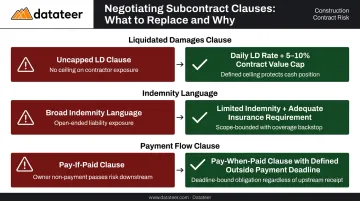
This approach turns potential impasses into collaborative problem-solving. Contracts negotiated this way tend to hold up better under project pressure because both parties understood the trade-offs before signing.
Use Professional Advisors Strategically
Legal counsel should review every contract before signing. But a construction CFO or finance manager who can quantify the financial exposure of specific clauses (in dollars, not just legal concepts) strengthens the legal team's negotiating position significantly.
Bring these items to legal review:
- Detailed cost estimates and schedule risk analysis
- Subcontractor terms that will flow down from the prime contract
- Specific clause exposure calculations (e.g., maximum LD exposure at the proposed daily rate against your schedule risk assessment)
- Cash flow projections under different retainage scenarios
Monitoring and Managing Contract Risk During Project Execution
Signing a well-negotiated contract is step one. The financial risk doesn't disappear — it just shifts from the negotiating table to the project itself.
What Contract Risk Looks Like During Execution
Contract risk materializes through:
- Labor slippage that pushes costs past the budgeted line items
- Scope creep driven by owner-directed changes without formal change orders
- Delayed change order approvals — work performed but revenue not yet contractually secured
- Budget overruns that compound quietly across multiple cost codes before becoming visible
The Dodge/Clearstory survey found that 77% of specialty contractors reported writing off unapproved or negotiated-down change orders, and 97% started change work before receiving written approval. These aren't edge cases — they're the norm.
What Finance Teams Should Track in Real Time
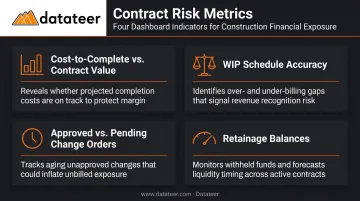
Four metrics provide the earliest warning signals for contract risk:
- Cost-to-complete vs. contract value — Is the projected final cost trending above the original contract price? If yes, by how much, and at which cost codes?
- WIP schedule accuracy — Are over-billings or under-billings building up in ways that don't match the project's actual progress?
- Approved vs. pending change orders — How much revenue is in "pending" status, and how long has it been outstanding?
- Retainage balances — Is retainage being released on schedule, and does the firm's net retainage position (A/R vs. A/P) create liquidity pressure?
Construction firms relying on monthly manual WIP reports typically discover margin problems 10–20 days after the data would have allowed intervention. That lag is often the difference between a correctable problem and an unrecoverable loss.
Where Real-Time Visibility Changes the Outcome
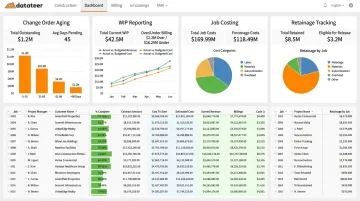
Datateer's construction financial dashboards close that gap. The platform connects to 12+ construction ERPs — including Procore, Sage, Viewpoint Vista, Acumatica, and Foundation — replacing the 10–20 day reporting lag with overnight automated data refresh. Finance teams get a current view of cost-to-complete, change order aging, retainage balances, and margin variance every morning.
Specific modules relevant to contract risk include:
- Change Order Impact & Aging Analytics — tracks pending, approved, and denied change orders by days outstanding, with margin impact quantified per change order and tied to specific cost codes
- WIP Reporting & Financial Truth — automates percentage-complete, over/under-billings, and margin fade detection in real time
- Job Costing & Cost-to-Complete — surfaces actual vs. committed costs and projected final cost at the job, phase, and cost-code level
- Retainage Tracking — monitors A/R retainage, A/P retainage, release schedules, and integration with 13-week cash flow forecasting
- Margin Protection Analytics — flags negative variance drivers (labor overruns, material escalation, change order denials) while there's still time to intervene
Double L Management described the impact this way: "That one click replaced two weeks worth of prior work."
That time savings has a second benefit beyond reporting speed. When a change order dispute arises mid-project, documented cost data sourced directly from the ERP is far more persuasive than estimates reconstructed after the fact from memory and spreadsheets.
Datateer offers a free 60-second Construction Data Maturity Audit to benchmark your current reporting capabilities, plus a no-pitch 15-Minute Workflow Audit that reviews your reporting process against your ERP environment.
Frequently Asked Questions
How do you negotiate a construction contract?
Effective negotiation starts before the meeting: establish your cost floor, target margin, and risk thresholds in advance. At the table, prioritize understanding the owner's real priorities through active listening, then systematically address high-risk clauses — scope, payment terms, change orders, LDs, indemnification, and dispute resolution — before signing.
What is the 70/30 rule in negotiation?
The 70/30 rule is a practitioner heuristic suggesting negotiators spend roughly 70% of their time listening and 30% speaking. The goal is identifying the other party's underlying priorities — not just their stated positions — which reveals where trade-offs are possible rather than where you'll hit a wall.
What are the 5 C's of negotiation?
The 5 C's — Clarity, Compromise, Collaboration, Communication, and Commitment — are a practitioner framework (not a research-backed standard) emphasizing mutual understanding over one-sided wins. In construction, where owner-contractor relationships span multiple projects, the emphasis on ongoing collaboration makes this framing more practical than purely adversarial approaches.
What are the most important clauses in a construction contract?
The financially consequential clauses are scope of work, payment and retainage terms, change order procedures, liquidated damages, indemnification, and dispute resolution. Each can significantly affect project profitability if left unexamined. Most appear in boilerplate language that looks standard until you calculate the actual exposure.
What is a change order in construction contracts?
A change order is a formal modification to the original contract's scope, price, or schedule. Negotiating a clear, pre-approved change order process — including markup rates and owner approval timelines — before project start is one of the most effective ways to protect contractor margins on large projects.
How do you manage risk after a construction contract is signed?
Post-signing risk management requires ongoing monitoring of cost-to-complete, WIP accuracy, change order status, and budget variances. Construction firms with automated, real-time financial reporting — like the dashboards Datateer provides — catch margin drift and cash flow problems while they're still correctable. Firms relying on monthly manual processes typically discover problems too late to course-correct.