
Introduction
When a change order stalls — owner won't approve the cost, the scope is disputed, or the schedule impact goes unacknowledged — the financial consequences compound fast. Change order dispute management is how contractors and owners formally work through those disagreements: identifying the scope change, documenting its cost and time impact, negotiating a resolution, and closing it before it metastasizes into a claim.
For construction CFOs, finance managers, and project leads, unresolved disputes are among the most direct sources of margin fade and cash flow disruption. A single stalled change order can idle crews, distort WIP reports, and compress the remaining schedule — while costs accumulate against work that hasn't been billed.
According to Arcadis's 2025 Construction Disputes Report, the average North American construction dispute in 2024 carried a value of $60.1 million and lasted 12.5 months to resolve — a 40% increase in dispute value from the prior year.
This article covers how the dispute process works, what causes change orders to escalate into schedule crises, the factors that shape outcomes, and the documentation mistakes that turn manageable disagreements into costly legal battles.
Key Takeaways
- Disputes arise when scope, cost, or schedule impact goes undocumented or processed too slowly — documentation gaps cause as many disputes as genuine disagreements
- Every unresolved change order carries a hidden schedule cost: idled crews, disrupted deliveries, compressed downstream work
- Timely written notice is the single most important step in preserving rights to compensation and time extensions
- Excusable vs. compensable delay classification determines whether you recover time only, or time plus money
- Real-time WIP and change order aging visibility lets teams catch problems early — before they become forensic accounting exercises
What Is Change Order Dispute Management in Construction?
Change order dispute management is the structured approach to identifying when a proposed scope change is contested, documenting its cost and schedule impact, escalating through contract-defined channels, and reaching formal resolution before work or payments stall.
The goal is to protect both parties' contractual rights while keeping the project moving. Resolution adjusts the contract sum, timeline, or both — it doesn't halt construction.
The distinction from routine processing comes down to agreement. Routine change orders involve a signed document both parties accepted. Disputes arise when one party contests the entitlement, pricing, or schedule impact — often with work already underway and the clock running. That pressure is exactly why a defined process matters more than an improvised negotiation.
The contrast between the two scenarios:
- Routine processing: Scope agreed, document signed, change executed
- Dispute management: Entitlement, pricing, or schedule impact is contested — requires documented escalation through contract-defined channels
Why Change Orders Cause Schedule Delays and Financial Damage
The Core Mechanism
Change orders introduce uncertainty into a planned work sequence. When that uncertainty goes unresolved, it creates a decision vacuum: crews pause, materials aren't ordered, subcontractors can't be scheduled, and the critical path shifts. The longer the vacuum, the worse the damage.
A contested change order that takes 30–60 days to resolve doesn't simply lose those days. It compresses the remaining schedule, forces overtime, and may push the project into weather windows or permit expiration periods that extend delays further. ASCE research on cumulative change impact found that once changes exceed 10% of the original labor budget, individual change order payments typically don't cover the full productivity cost. The financial damage runs deeper than the change order value itself.
The Financial Cascade
Delayed resolution means delayed billings. Work completed but not yet covered by a signed change order often cannot be invoiced, creating a gap between costs incurred and revenue recognized. That gap shows up as underbilling distortion in WIP reports — and drains cash precisely when the project needs it most. ASC 606 compounds this: unapproved changes and claims must be treated as variable consideration, which further constrains what can be recognized until resolution is reached.
Excusable vs. Compensable Delays
Not all delays are equal under the contract:
- Excusable, non-compensable delays (weather, force majeure, unforeseen conditions) — typically entitle the contractor to a time extension only, no additional payment
- Excusable, compensable delays (owner-directed changes, late design approvals, differing site conditions) — entitle the contractor to both a time extension and additional cost recovery
Misclassifying the type of delay is a frequent source of disputes. A contractor who accepts a time extension without claiming compensable costs may forfeit the right to recover extended general conditions and overhead that the contract would have supported.
Notice Deadlines Are Strict
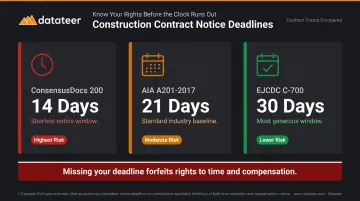
Most contracts require written notice within a defined window after identifying a delay impact. The governing form matters:
| Contract Form | Notice Deadline |
|---|---|
| ConsensusDocs 200 | 14 days |
| AIA A201-2017 | 21 days |
| EJCDC C-700 | 30 days |
Missing the applicable window can forfeit the right to both time and compensation, even when the underlying claim is valid. In Cascade Civil Construction v. Jackson Dean Construction (Washington, 2023), a $1,561,818.66 and 133-day claim failed entirely because the contractor did not satisfy pre-work notice requirements — the court affirmed summary judgment against Cascade.
How to Manage Change Order Disputes: Step by Step
Effective dispute management follows a defined sequence — and the earlier each step is executed, the lower the cost of the dispute:
- Written notice
- Cost and schedule documentation
- Impact analysis
- Negotiation
- Formal resolution (if necessary)
Identify and Issue Timely Written Notice
Written notice is the contractual trigger that preserves all downstream rights. It must state that a change in conditions has been identified, that a claim for additional time or cost may follow, and it must be submitted within the contractually specified window.
Courts and arbitrators rarely grant leniency for missed notice requirements, even when the underlying claim is legitimate. The Cascade Civil case is a clear example: the contract treated the claim procedure as an absolute condition precedent, and failure to comply was dispositive regardless of the merits.
Document Cost and Schedule Impact Contemporaneously
Documentation must be built in real time:
- Daily logs signed in the field
- Crew timesheets tied to the affected scope
- Material receipts with dates
- Timestamped photos of site conditions
- All written correspondence with the owner or architect
Retrospective reconstruction of impact is the weakest form of claim support. Opposing counsel knows this, and will exploit every gap. The change order request (COR) should include a separate schedule impact analysis showing how the change affects the critical path, not just a cost breakdown. Pricing the cost without claiming the time extension leaves the contractor exposed to liquidated damages for a delay they were entitled to avoid.
Negotiate, Escalate, or Invoke Dispute Resolution
Escalation follows a clear sequence:
- Direct negotiation: document all offers and counteroffers in writing
- Mediation, arbitration, or dispute review boards: the specific path depends on your contract form
- Litigation or mechanics' liens: last resort, and the most expensive outcome for both parties
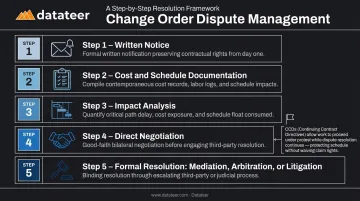
Construction change directives (CCDs) let work proceed under protest while cost negotiations continue. This preserves project momentum without surrendering the claim — the right move when an owner demands progress but the contractor contests pricing or scope.
Key Factors That Determine Dispute Outcomes and Schedule Impact
How a change order dispute resolves — and how much schedule damage it causes — depends on factors that are largely within the contracting parties' control before and during the project.
Contract language clarity: Contracts that precisely define what constitutes a change, the notice timeline, the pricing methodology, and the dispute resolution mechanism produce far fewer escalated disputes than vague boilerplate agreements. AIA A201 routes unresolved disputes through an Initial Decision Maker; ConsensusDocs uses tiered negotiation through senior management before binding resolution.
Quality and timeliness of documentation: Parties with contemporaneous records — signed daily logs, timestamped photos, original schedules with update history — consistently outperform those relying on memory or reconstructed records in negotiations and arbitration. The evidentiary advantage is decisive.
Financial reporting lag: When WIP reports arrive weeks after the fact, finance teams can't see how unresolved disputes are eroding job margins until intervention is no longer practical.
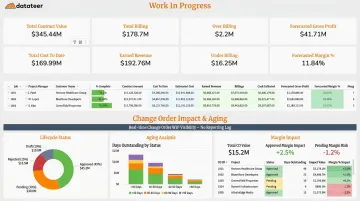
Datateer's construction analytics platform eliminates that blind spot. It syncs directly with ERPs including Procore, Sage, Viewpoint Vista, and Acumatica, replacing the typical 10–20 day WIP reporting lag with near-real-time visibility. The Change Order Impact & Aging module tracks every CO by lifecycle status, days outstanding, and margin impact — so CFOs see financial exposure before it compounds. Double L Management's business analyst put it plainly: "That one click replaced two weeks worth of prior work."
Number of stakeholders in the approval chain: The more parties required to sign off, the longer resolution takes. Firms without a defined escalation structure for stalled approvals routinely see disputes outlast their original schedule buffer.
Regulatory and contractual constraints: State statutes set hard deadlines for owner responses and payment — and impose interest penalties for violations. Contractors and owners who know which statute governs have a measurable advantage at the negotiating table. Key US examples:
- California SB 440 / Civil Code §8850 (private works): 30-day response, 60-day payment of undisputed amounts, 2% monthly interest on late payments
- California PCC §9204 (public works): 45-day response window
- Washington RCW 39.04.360: 30-day change order issuance requirement, 1% monthly interest for violations
Common Mistakes That Turn Change Orders Into Legal Disputes
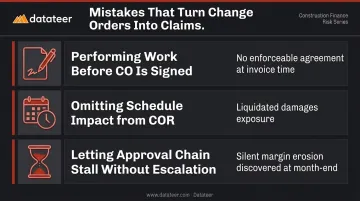
Three avoidable mistakes account for a significant share of disputes that escalate unnecessarily:
Performing work before the change order is signed. Verbal authorization creates no enforceable agreement. A submitted but unsigned COR is a proposal — it becomes a change order only when all parties sign. Proceeding to invoice or schedule work based on an unsigned COR routinely triggers disputes at payment time.
Treating schedule impact as an afterthought. Many CORs are priced for cost but fail to formally claim a time extension, leaving the contractor exposed to liquidated damages for delays they were entitled to avoid. Critical path impact analysis belongs in every COR — not as an optional add-on pursued only when the owner pushes back.
Letting the approval chain stall without escalation. A change order sitting in "pending" status for weeks while field crews continue working is a slow-motion margin erosion. Without visibility into aging change orders and their financial exposure, finance teams discover the damage at month-end — after the project has already absorbed costs against work that may never be billed.
Frequently Asked Questions
Who pays for change orders in construction?
It depends on who caused the change. Owner-requested changes are typically paid by the owner; contractor errors are absorbed by the contractor. Design errors typically fall to the architect or be negotiated, depending on the contract terms and the nature of the error.
How long can a builder delay construction?
There is no universal limit — the project contract and applicable law govern acceptable delay windows. Unexcused delays expose the contractor to liquidated damages, while excused delays under the contract terms typically earn a time extension without financial penalty.
What kinds of contractor delays are excusable?
Two categories apply. Excusable non-compensable delays — acts of God, weather, force majeure — earn a time extension only. Excusable compensable delays — owner-caused interference, late design approvals, differing site conditions — earn both a time extension and additional cost recovery.
What happens if a change order is disputed in construction?
The party contesting the change should follow the contract's dispute resolution process, starting with direct negotiation and escalating to mediation or arbitration if needed. A construction change directive (CCD) can keep work moving while cost negotiations continue.
How do change orders affect a project's schedule?
Change orders can extend the schedule directly by adding scope, or indirectly by creating decision delays that idle crews and disrupt sequencing. The schedule impact must be analyzed against the critical path to determine whether a formal time extension is warranted — a cost-only COR without a schedule analysis is an incomplete claim.
What is the difference between a time extension and a compensable delay?
A time extension simply pushes the project completion date without additional payment. A compensable delay also entitles the contractor to recover extended general conditions, overhead, and other documented costs caused by the owner's actions.