According to Billd's 2024 National Subcontractor Market Report, the average time from pay application submission to actual payment is 57 days — and 71% of subcontractors report that GCs routinely slow-pay them. That's not just a vendor relations problem. It's a cash flow, lien, and compliance problem that starts inside your AP workflow.
This article explains how construction AP works end-to-end, what separates it from standard AP, and where firms most commonly break down.
Key Takeaways
- Every construction invoice must be matched to a specific job, phase, and cost code — not just a vendor account
- Mastering the six-step AP workflow — from invoice receipt through GL posting — gives finance teams control over cost accuracy and payment timing on every active job
- Retainage creates a split payable that must be tracked separately from standard AP balances
- Paying before collecting a conditional lien waiver exposes the firm to double-payment risk, no matter how trusted the vendor
- Manual AP processes create a data lag that corrupts cost-to-complete and cash flow visibility across all active projects
What Is the Construction Accounts Payable Process?
Construction AP is the structured internal process by which a construction firm validates, approves, and disburses payments owed to subcontractors, material suppliers, equipment vendors, and other project-related creditors. The goal is straightforward: only correctly documented, properly authorized, and contractually compliant invoices get paid — at the right amount, to the right party, at the right time.
Standard AP handles vendor invoices. Construction AP handles payment applications — formal document packages that include:
- Schedule of values and percentage completion per line item
- Stored materials documentation
- Prior payment history
- Supporting lien waivers
Add retainage holdbacks, project cost codes, state-level prompt payment laws, and multi-tier lien exposure, and a generic AP process quickly breaks down — producing duplicate payments, missed lien deadlines, or compliance violations.
Why Construction AP Is More Complex Than Standard AP
Project-Based Coding Multiplies Validation Requirements
Every payable must be coded to a specific job, phase, and cost category. A firm managing 15 active projects may have hundreds of open payables, each requiring individual validation against a subcontract or purchase order. A mismatch anywhere — wrong job, wrong phase, wrong cost code — corrupts job costing data and WIP reporting across the board.
The Multi-Tier Payment Chain Creates Cascade Risk
General contractors receive payment from the owner and are responsible for paying subcontractors, who in turn pay their own suppliers. Any delay or error in the GC's AP process cascades downstream.
Levelset's 2021 Construction Cash Flow & Payment Report found that GCs are twice as likely as subcontractors to be paid within 30 days. The gap between what the GC receives and what reaches subs and suppliers is where cash flow stress, work stoppages, and lien filings originate.
The downstream cost is measurable. Cash flow problems from payment chain dysfunction:
- Reduced profit for 47% of construction professionals
- Delayed projects for 33%
- Forced 30% to borrow to cover shortfalls
The Legal and Compliance Layer Is Unforgiving
State prompt payment laws set mandatory downstream payment windows after the GC receives funds. Verified current examples include:
| State | Downstream Payment Window | Penalty for Late Payment |
|---|---|---|
| California | 7 days | 2% per month |
| Texas | 7 days | 1.5% per month |
| New York | 7 days | 1% per month |
| Connecticut | 25 days | 1% per month |
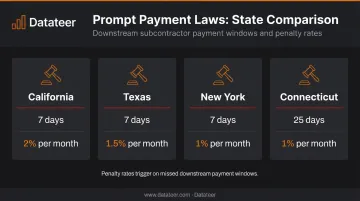
Missing these windows isn't just a vendor relations issue — it triggers statutory interest, penalty fees, and in some jurisdictions, bad-faith damages. No amount of goodwill with a subcontractor neutralizes statutory liability.
How the Construction AP Workflow Works Step by Step
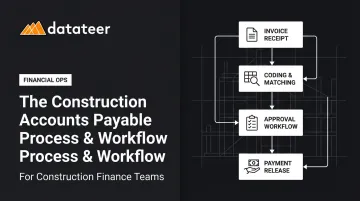
Construction AP is a sequential, document-intensive workflow. Each stage functions as a control gate — preventing overpayment, fraud, and lien exposure before the next step begins. Here's how it operates end-to-end.
Step 1: Invoice and Payment Application Receipt
The workflow begins when the firm receives a payment application or invoice. This distinction matters: a standard supplier invoice is a simple payment request. A formal pay application includes a schedule of values, percentage completion per line item, stored materials billing, prior payment history, and applicable lien waivers.
Both document types are logged into the ERP or AP system and assigned to the correct project. Errors at intake — wrong project assignment, missing documentation — delay every downstream step that follows.
Step 2: Document Verification and Three-Way Match
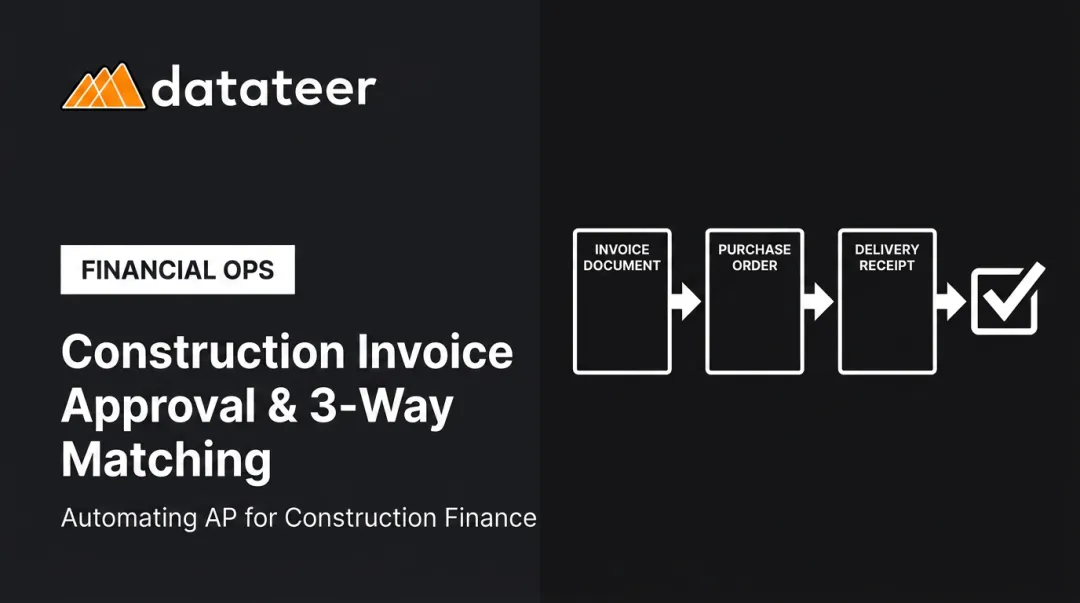
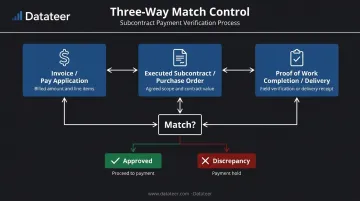
The three-way match compares:
- The submitted invoice or pay application
- The executed subcontract or purchase order
- Documented proof of work completion or material delivery (signed delivery receipts, field progress reports, inspection sign-offs)
Discrepancies here are the most common trigger for payment holds. A pay application billing 80% complete on a scope that field reports show at 65% gets held — as it should. Skipping this control under schedule pressure leads directly to overpayment and billing-for-uncompleted-work exposure.
Step 3: Cost Code Allocation
Verified invoices must be coded to the correct project, phase, and cost code in the firm's chart of accounts. This step directly feeds job costing accuracy, WIP reporting, and cost-to-complete forecasting.
Miscoding is a persistent problem — particularly on multi-phase projects or when subcontractors bill across multiple scopes in a single pay application. Firms running Procore alongside Sage often face reconciliation challenges here: project commit data in one system doesn't automatically align with invoice coding in the other.
Datateer's automated data cleaning engine handles this directly: it standardizes cost codes across ERPs and reconciles Procore project commits to Sage invoices automatically, so finance teams aren't manually VLOOKUPing their way through month-end close.
Step 4: Lien Waiver Collection
Before releasing payment, the AP team collects a conditional lien waiver from the payee. This waiver becomes effective upon payment clearing — protecting the firm from future lien claims on work already paid.
Many firms also require lower-tier lien waivers from sub-subcontractors and material suppliers before processing a subcontractor's payment. This is particularly important on larger projects where the GC has limited visibility into whether subs have paid their own supply chain.
Step 5: Approval Routing
Invoices are routed through the firm's approval hierarchy:
- Project manager approves work completion
- Project accountant validates coding and documentation
- CFO or controller approves payments above the dollar threshold
Manual routing via email is one of the most reliable sources of AP bottlenecks in construction. An invoice sitting in someone's inbox over a holiday weekend can push a payment past a prompt payment deadline.
ERP-based or automated routing creates an audit trail and compresses cycle time. The difference between a 5-day approval and a 15-day one often comes down entirely to routing method.
Step 6: Payment Execution, Retainage Holdback, and GL Posting
The AP team issues payment via ACH, check, or wire transfer — after deducting any contractual retainage, typically 5–10% depending on contract terms and jurisdiction. New York, for example, capped retainage at 5% for covered private contracts entered on or after November 17, 2023.
Retainage isn't just deducted and forgotten. It creates a separate payable liability that must be:
- Tracked per vendor, per project
- Held until contractual release conditions are met
- Released according to the project's closeout schedule
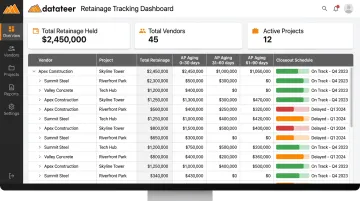
The payment transaction then posts to the general ledger, the project cost ledger, and the retainage ledger. Finance managers using Datateer's AP Health and Retainage Tracking dashboards can monitor AP aging (in 0–30, 31–60, and 61–90 day windows), retainage balances, and Days Payables Outstanding across all active projects — pulled directly from their ERP overnight — without manual spreadsheet reconciliation.
Key Factors That Affect the Construction AP Process
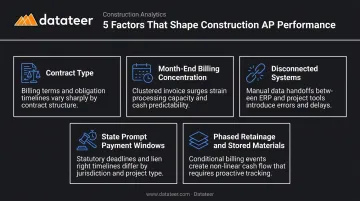
Several variables determine how smoothly (or badly) the six steps above execute in practice:
- Fixed-price, cost-plus, and T&M contracts each generate different invoice structures. Cost-plus contracts require supporting cost documentation at Step 2 that fixed-price pay applications don't — so your AP process has to flex with contract type, not assume a single workflow.
- Month-end billing concentrations compress approval queues all at once. When every subcontractor invoices simultaneously, disbursements stall and subcontractor relationships take the hit at the worst possible moment.
- Disconnected systems between project management, accounting, and payroll introduce duplicate entries, cost code misallocations, and data errors that are hard to trace after the fact. ERP-integrated analytics platforms (including Datateer's direct syncs with Sage, Viewpoint Vista, CMiC, and others) exist specifically to close these hand-off gaps.
- State prompt payment windows range from 7 to 25 days. Missing them triggers penalty interest — and in some states, licensing risk — making compliance a finance-level concern, not just a legal one.
- Phased retainage and stored materials billing force AP systems to maintain multiple sub-ledgers per vendor per project — adding real reconciliation weight at closeout that catch many teams off guard.
Common Issues and Misconceptions in Construction AP
"Construction AP Is Just Slower Standard AP"
The delays in construction AP aren't caused by slow processors — they're structural. Each of these adds time independently:
- Document incompleteness at submission
- Cost code errors requiring rerouting
- Missing lien waivers holding payment release
- Multi-tier approval requirements across field and office
Firms that treat construction AP like generic invoice processing end up with systematic payment errors, compliance exposure, and cost data they can't trust. The workflow isn't slower because people work slower. It's different because the document requirements, legal obligations, and project-based tracking demands are different.
Paying Before Collecting Lien Waivers
Under schedule pressure, many firms release payment before securing the conditional waiver — leaving them exposed to lien claims on already-paid work. It's one of the most operationally damaging breakdowns in construction AP.
The misconception driving this is that a strong vendor relationship eliminates lien risk. It doesn't. A subcontractor who genuinely intends to pay their own suppliers can still fail to do so. Without a conditional waiver, the GC has no legal protection against a lower-tier lien claim on work the GC already paid for. Lien waiver collection isn't a formality — it's a financial control.
"Our ERP Reports Are Current"
They often aren't. The lag between field progress, invoice submission, AP processing, and GL posting can push cost-to-complete and cash flow data weeks behind actual project status. Finance teams are making decisions on data that reflects conditions from three weeks ago.
This makes AP not just a payment function but a data integrity function. Double L Management found that pulling project data through Datateer's analytics dashboard replaced two weeks of manual reporting work with a single click. Datateer's overnight ERP sync means finance teams start each day with prior-day actuals — so the gap between "current" and actual closes to less than 24 hours.
Frequently Asked Questions
What is the best payment method for contractors?
ACH bank transfers are the most efficient method for construction payables — lower fees on large transactions, automatic audit trails, and faster clearing than checks. The right method also depends on subcontract terms, retainage timing, and whether lien waiver exchange can be tied to payment confirmation.
What is the difference between a construction invoice and a payment application?
A standard invoice is a simple payment request. A construction payment application is a formal document package that includes a schedule of values, percentage completion per line item, stored materials, prior payment history, and supporting lien waivers — making it significantly more complex to process and verify through AP.
How does retainage affect the accounts payable process in construction?
Retainage creates a split payable: the AP team processes the full approved amount but withholds a contractual percentage (typically 5–10%) as a separate liability. That liability must be tracked per vendor per project and released only when contractual completion and closeout conditions are met.
What documents are required before a construction invoice can be approved?
At minimum: a signed subcontract or purchase order, evidence of work completion or delivery, and a conditional lien waiver from the payee. Public projects typically also require certified payroll documentation, with additional requirements varying by contract type and jurisdiction.
How long does the construction AP cycle typically take?
Billd's 2024 survey found an average of 57 days from pay application submission to payment across 696 US construction professionals. Firms using manual approval routing consistently take longer than those with ERP-integrated workflows — the approval and documentation stages are where most of the variation occurs.
What is a three-way match in construction AP, and why does it matter?
A three-way match compares the submitted invoice or pay application against the executed subcontract or PO, and against verified proof of work or delivery. It's the primary control preventing overpayment, billing for uncompleted work, and duplicate payments. Skipping it under schedule pressure reliably creates AP problems that surface months later at project closeout.