Unlike invoicing in most industries, construction billing is not a simple "send an invoice, get paid" transaction. Projects span months or years, involve dozens of subcontractors, require architect or owner approval before payment releases, and carry retainage obligations that lock up working capital until closeout. One delayed payment application can cascade into a subcontractor cash crisis within weeks.
This guide is written for construction finance managers, CFOs, controllers, and CPA firms serving contractors — the people responsible for making sure billing is accurate, timely, and defensible when owners push back.
Key Takeaways
- Construction billing methods include T&M, lump sum, unit price, cost-plus, and AIA progress billing, each suited to different contract types
- Retainage, change order management, and WIP reporting are construction-specific billing factors not found in standard commercial invoicing
- Billing errors and delays directly damage cash flow, project profitability, and owner relationships
- Accurate billing requires real-time alignment between field activity, cost codes, subcontractor invoices, and your accounting system
What Is Project Billing in Construction?
Construction project billing is the process of generating, submitting, and collecting payment for work performed — covering labor, materials, equipment, and subcontracted work — in alignment with the terms of the contract.
The goal is straightforward: maintain steady cash flow throughout the project lifecycle rather than waiting for a single payment at completion. On a 14-month commercial build, that distinction determines whether you make payroll in month six.
How Construction Billing Differs from Standard Invoicing
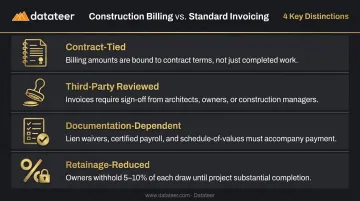
Standard commercial invoicing ties a payment to a delivered product or completed service. Construction billing operates under a different set of rules — structured around contracts, third-party oversight, and documentation requirements that don't exist in most industries:
- Contract-tied: Every invoice references a contract structure, a Schedule of Values, and specific progress milestones
- Third-party reviewed: Payment applications typically require architect or owner certification before funds release
- Documentation-dependent: Lien waivers, certified payroll, and inspection records aren't optional attachments — they're required components of a complete pay app submission
- Retainage-reduced: Typically 5–10% of each payment is withheld until substantial completion — revenue earned on paper that won't hit your bank account for months
This structure protects owners from front-loaded billing and project abandonment. The trade-off: contractors routinely carry weeks or months of unbilled labor and materials on their own balance sheet before a dollar clears.
Why Construction Billing Is More Complex Than Other Industries
The Multi-Party Billing Chain
General contractors occupy a financially awkward position: they must bill owners while simultaneously receiving and validating invoices from dozens of subcontractors and suppliers, each on different billing schedules and contract terms. A GC running 20 active subs in a given month manages 20 separate invoice validations against 20 separate progress assessments — all while preparing their own application to the owner.
Retainage Creates a Persistent Cash Gap
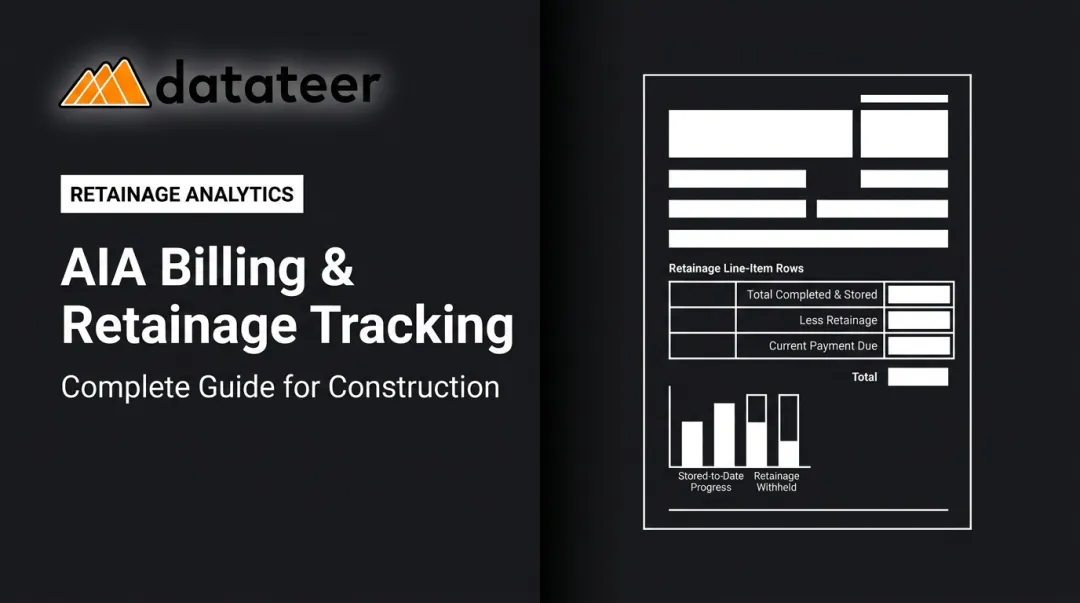
Retainage — typically 5–10% withheld from each progress payment — is one of the most financially significant features of construction billing. It exists in almost no other industry. On a $10M project with 10% retainage, a contractor could have $1M in earned revenue sitting uncollected until closeout.
That retained amount directly compresses working capital throughout the project. State laws vary considerably: California caps public contract retainage at 5%, Texas DOT does not withhold retainage at all on its contracts, while federal fixed-price construction contracts allow up to 10% retention when satisfactory progress has not been made.
Change Orders Disrupt the Billing Baseline
Every approved change order alters the contract value, the Schedule of Values, and the invoicing baseline. According to the Construction Industry Institute, scope modification is the most frequent source of project changes — with poor scope definition as the leading factor driving cost overruns.
The billing risk is specific: contractors who perform extra work under verbal direction and delay formal documentation create a growing gap between work done and work billed. That gap only widens until someone finally tries to invoice for it retroactively.
Regulatory and Documentation Overhead
Construction billing carries administrative requirements that other industries rarely face:
- Lien waivers (conditional and unconditional, progress and final)
- Certified payroll on prevailing wage projects
- AIA standard forms (G702/G703) for commercial work
- Sworn statements in some jurisdictions
- Pay-when-paid clauses that cascade payment delays downstream to subs
Each requirement adds processing time — and missing any one of them can trigger payment holds, lien disputes, or compliance exposure that outlasts the project itself.
Construction Project Billing Methods Explained
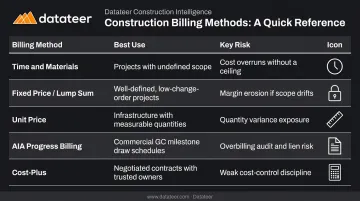
Contractors may use different billing methods on different projects depending on contract type, project complexity, and owner requirements.
Time and Materials (T&M)
T&M billing charges the owner for actual labor hours, equipment usage, and material costs plus an agreed markup or fee. It works best when scope is uncertain, including:
- Renovation projects with concealed conditions
- Emergency repairs with unknown extent
- Design-build work in early phases before scope solidifies
The key risk for owners: without a "not-to-exceed" cap, there is no ceiling on final cost. Many owners require a GMP or NTE clause before agreeing to T&M terms.
Fixed Price / Lump Sum
The contractor commits to a total price regardless of actual costs. It works well when scope is fully defined, material prices are stable, and the estimating team has deep experience with similar work.
Budget risk shifts entirely to the contractor. Margin protection depends on how tightly actual costs are tracked against the original estimate. That discipline requires accurate, timely cost data throughout construction, not just at closeout.
Unit Price Billing
Unit price contracts bill per measurable unit of work: cubic yards of excavation, linear feet of pipe, tons of asphalt placed. The final contract total depends on actual quantities installed.
This is the standard approach in heavy civil and infrastructure work, where quantities cannot be precisely determined at bid time but unit costs are well-established. When disputes arise, they tend to center on measurement methodology rather than scope.
AIA Progress Billing (Schedule of Values)
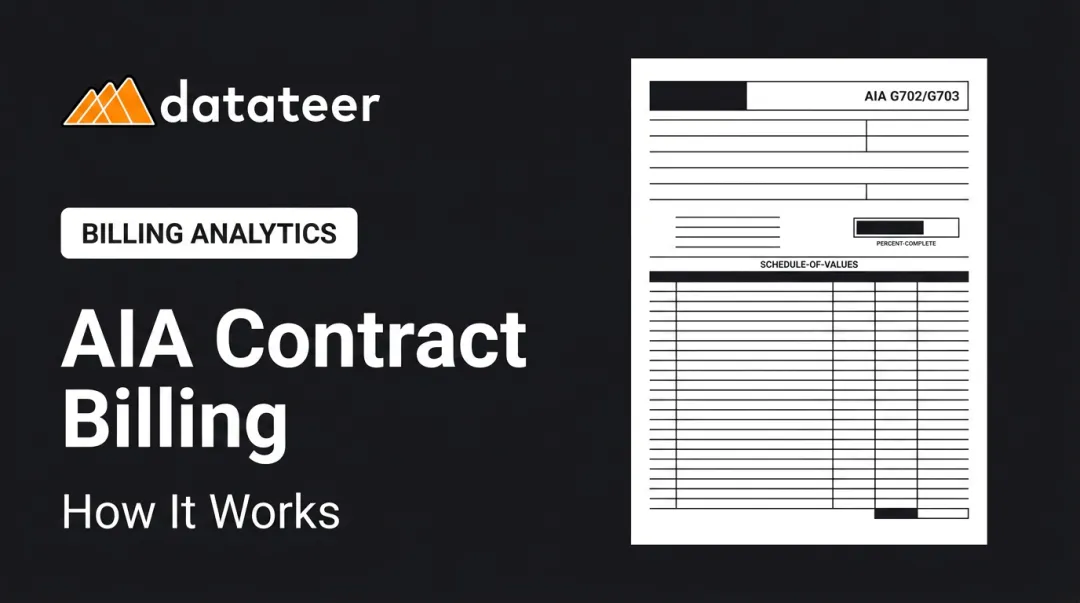
AIA progress billing — structured around the G702 Application for Payment and G703 Continuation Sheet — is the most widely used billing format for commercial and institutional construction. These AIA Contract Documents forms have been the industry standard for over 135 years.
The Schedule of Values breaks the contract into line items tied to project phases or CSI divisions. Each payment application submits a percentage complete per line item, forming the basis for architect review and owner payment certification. The G702 summarizes totals; the G703 provides the line-item detail.
Cost-Plus Billing
Cost-plus contracts reimburse all allowable project costs plus an agreed fee — either a fixed dollar amount or a percentage of cost. This method is common in design-build and fast-track projects where final scope is not defined upfront.
The tradeoff is documentation burden. Owners typically hold audit rights, and disputes over reimbursable cost definitions are common. Every charge must be categorized as allowable under the contract terms — which means cost tracking needs to be airtight from day one.
How the Construction Project Billing Process Works
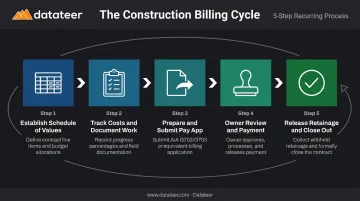
Construction billing is a recurring cycle that runs from contract execution through project closeout. Each billing period requires cost documentation, internal review, and formal submission to the owner or owner's representative before payment releases.
Step 1: Establish the Schedule of Values and Billing Terms
Before work begins, the contractor negotiates the Schedule of Values with the owner — breaking the contract sum into components by phase, trade, or cost code. This document becomes the billing baseline for the entire project.
Billing terms are also documented here: net payment days, retainage percentage, billing cutoff dates, and any lender or third-party approval requirements. Getting these terms right at the start prevents disputes that are much harder to resolve mid-project.
Step 2: Track Costs and Document Work Completed
Throughout each billing period, field teams and project managers must:
- Record labor hours by cost code
- Log material deliveries against purchase orders
- Track equipment usage and rental charges
- Capture subcontractor progress against their own SOVs
Missing time entries or undocumented deliveries reduce billings directly. The accuracy of the payment application is only as good as the field data feeding it.
Step 3: Prepare and Submit the Payment Application
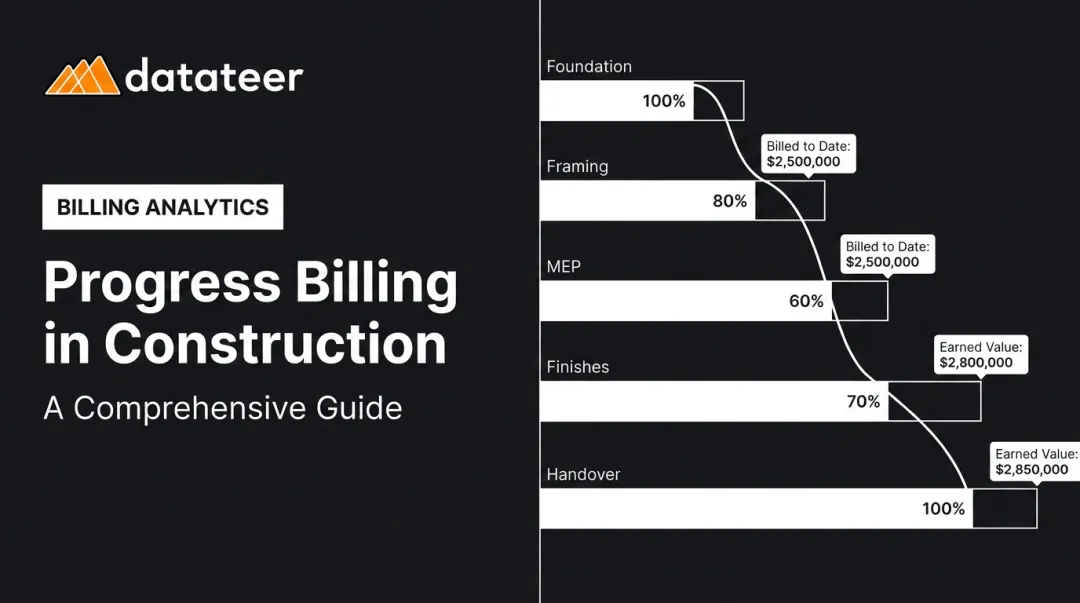
That field data feeds directly into the payment application: calculating percent complete per SOV line item, applying retainage, incorporating approved change orders, and assembling supporting documentation. For commercial work, the AIA G702/G703 format is the submission standard.
Timing matters here. According to Levelset's National Construction Payments Report, construction companies wait an average of 83 days to receive payment, and 49% of invoices are not paid on time per original contract terms. Late or incomplete submissions push those numbers further.
Step 4: Owner Review, Approval, and Payment
The owner — and often their architect or lender — reviews the application against observed project progress. They may certify a different amount than submitted. Disputed line items create payment delays, and under pay-when-paid clauses, those delays cascade directly to subcontractors.
CFMA's 2022 Construction Financial Benchmarker reported that days to collect accounts receivable increased from 53 days in 2020 to 58 days in 2021. That upward trend reflects structural billing friction across the industry, not isolated project issues.
Step 5: Release Retainage and Close Out Billing
Retainage releases at substantial completion or per contract milestones. Required documentation typically includes:
- Final conditional and unconditional lien waivers from all subs and suppliers
- Punch list completion confirmation
- Closeout submittals (O&M manuals, as-builts, warranties)
- Certificate of substantial completion
Retainage disputes are one of the most common sources of payment delays in construction. Sixty percent of contractors identify retainage withholding as a significant issue, and 66% wait more than 30 days to collect withheld funds after project completion.
Key Factors That Affect Construction Project Billing
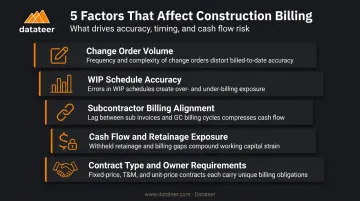
Five variables determine whether a billing cycle runs cleanly or compounds into disputes, cash shortfalls, and margin fade. Understanding each one is the starting point for tightening your billing process.
Change order volume and approval speed: Unapproved or stalled change orders create a gap between work performed and billings submitted. HKA's CRUX analysis — covering more than 1,400 projects representing over $2 trillion in capital expenditure — consistently identifies scope change and contract management failures as the leading drivers of construction disputes.
WIP schedule accuracy: Overbilling creates owner disputes at closeout. Underbilling starves the project of cash and masks margin fade until it's too late to correct. The typical 10–20 day reporting lag means finance teams are making decisions on stale data — Datateer's WIP dashboards replace that lag with automated overnight calculations pulling directly from ERPs including Sage, Vista, Acumatica, and CMiC.
Subcontractor billing alignment: When sub billing cycles don't match the GC's application cutoff, downstream cash flow risk accumulates fast. Reconciling Procore project commits against Sage invoices manually is where most misalignments go undetected longest.
Cash flow timing and retainage exposure: Net 30–45 day payment terms combined with retainage withholding mean contractors routinely finance a significant portion of their own projects. Tracking both A/R retainage (held by owners) and A/P retainage (held on subs) — and flagging overdue releases — gives finance teams the visibility to act before liquidity tightens.
Contract type and owner requirements: Public agency projects carry more compliance overhead than private owner work. GMP contracts require more rigorous cost tracking than lump sum. The billing system must match the contract structure, or administrative friction compounds every cycle.
Common Mistakes in Construction Billing
Construction billing errors rarely come from bad intentions — they come from structural gaps in how teams communicate, track, and document. These three mistakes show up repeatedly across firms of every size.
Treating Billing as a Back-Office Function
Accurate billing requires continuous coordination between field superintendents (who know actual progress), project managers (who manage change orders and owner relationships), and accounting (who prepare and submit applications). When those three groups operate independently, payment applications reflect assumptions rather than facts.
Applying "Bill What We Always Bill" Estimates
Applying standard percentage-of-completion estimates without verifying field progress creates two distinct failure modes:
- Systematic overbilling early in a project triggers owner disputes at closeout — often when the contractor can least afford the friction
- Chronic underbilling starves the project of cash and disguises margin erosion until there's nothing left to recover
Both patterns are avoidable when billing is tied to verified field data rather than historical habit.
Delayed Change Order Documentation
Many contractors perform extra work under verbal direction, then attempt to bill retroactively after the work is buried in the project timeline — creating both a cash flow shortfall and a contract dispute risk. Formal change order tracking, with aging visibility that surfaces how long each CO has been pending, prevents billing gaps before they compound into disputes.
Conclusion
Construction project billing is not simply about sending invoices. It is a structured, documentation-heavy process tied directly to cash flow, margin protection, and owner trust. The method chosen must match the contract type, project complexity, and the contractor's capacity to track and document work accurately.
The most common billing failures — missed change orders, WIP inaccuracies, retainage miscalculations — are symptoms of a data gap between the field and the finance office. When labor hours, cost codes, and subcontractor invoices don't flow into the accounting system accurately and quickly, payment applications reflect the best guess rather than the actual state of the project.
Closing that gap requires real-time financial data connected directly to the systems where billing decisions are made. Construction firms that get this right are better positioned to protect margins, accelerate cash collection, and avoid the closeout disputes that drain profit from otherwise successful projects.
Datateer's construction finance dashboards connect directly to 12+ ERPs — including Sage, Vista, Acumatica, CMiC, and NetSuite — to automate WIP reporting, retainage tracking, and billing intelligence so finance teams work from live data instead of end-of-month reconciliations.
Frequently Asked Questions
How does NetSuite handle project billing for construction?
NetSuite supports construction project billing through its Project Accounting module, with billing types including Time and Materials, Fixed Bid Interval, Fixed Bid Milestone, and Charge-Based billing tied to project records. Construction-specific features like AIA form generation and retainage tracking may require configuration or third-party SuiteApps to work properly.
Does NetSuite have a construction module?
NetSuite has no dedicated construction module, but its SuiteProjects and job costing tools can be configured for construction workflows. Partners like Caravel Partners, ScaleNorth, and BlueCollar Cloud offer SuiteApps that add AIA billing, subcontract management, and certified payroll.
Can NetSuite be used for construction project management?
NetSuite handles budgeting, cost tracking, resource management, and billing well for mid-market firms with standard workflows. More complex operations typically pair NetSuite with Procore for field management and a purpose-built analytics layer like Datateer to close the reporting gap between the two systems.
What is retainage in construction billing?
Retainage is a percentage, typically 5–10%, of each progress payment that the owner withholds until substantial completion to ensure the contractor finishes the project. It ties up a significant share of contractor working capital throughout the project and is released upon satisfactory closeout.
What is AIA billing in construction?
AIA billing refers to the payment application process using the American Institute of Architects standard forms: G702 (Application and Certificate for Payment) and G703 (Continuation Sheet). These forms document the Schedule of Values, percent complete per line item, retainage held, and net payment due, and are the most widely accepted billing format in commercial construction.
How does WIP reporting relate to project billing in construction?
The Work-in-Progress report reconciles contract value, billings to date, and costs incurred to determine whether each project is overbilled or underbilled. It is the primary tool finance managers use to verify that billing submissions accurately reflect field progress and to catch revenue distortions like margin fade before they compound into closeout losses.