Introduction
A construction company can carry a full backlog of signed contracts and still run out of cash mid-project. This isn't a failure of the business — it's a structural feature of how construction works. Money goes out months before it comes back in, and the gap between those two events can quietly end a firm.
According to CFMA's 2025 Construction Financial Benchmarker, the industry-wide average Days Sales Outstanding sits at 55.2 days — and that's just the average. For subcontractors and specialty trades, waits of 60 days or more are common.
Managing cash flow in construction means tracking the timing of every dollar coming in and going out, forecasting that timing weeks in advance, and having the data to act before a shortfall becomes a crisis.
Here's what this guide covers: the definition of construction cash flow, why it's uniquely difficult to manage, how to build a reliable forecast, proven strategies to improve it, and what real-time data visibility actually changes.
Key Takeaways
- Profitable construction firms can face cash crises — profit and cash flow measure different things
- The average contractor waits 55.2 days to get paid; subcontractors often wait longer
- Front-loaded costs, retainage, and change orders create structural cash gaps on every project
- Reliable forecasts require project-level cost curves, not flat spend assumptions
- Real-time WIP and cash data lets finance teams catch shortfalls early — before they become emergencies
What Is Construction Cash Flow?
Construction cash flow is the net movement of money into and out of a construction business over a defined period. The definition is straightforward. Managing it in practice is where most firms run into serious trouble.
Inflows and Outflows
Cash inflows include:
- Progress payments from owners
- Retainage releases at project completion
- Proceeds from equipment sales
- Working capital credit draws and bank loans
Cash outflows include:
- Labor and payroll
- Material and supplier payments
- Subcontractor payments
- Overhead, insurance, and bonding costs
- Front money spent before the first payment arrives
The Three Cash Flow Statement Categories
A formal cash flow statement organizes these movements into three categories — each tells a different story about where cash is coming from and where it's going:
| Category | What It Captures | Construction Example |
|---|---|---|
| CFO – Cash Flow from Operations | Day-to-day project revenues and costs | Progress billings received, subcontractor payments made |
| CFI – Cash Flow from Investing | Equipment and asset purchases or disposals | Buying a new excavator, selling old fleet equipment |
| CFF – Cash Flow from Financing | Loans, equity, and debt repayment | Drawing on a line of credit, repaying a construction loan |
Why Profit Doesn't Equal Cash
Those three categories track cash movement — but your income statement tracks something different. Under accrual accounting, you recognize revenue when it's earned, not when the check clears. A firm can post a strong project margin while waiting 60 days for the corresponding payment to arrive.
As Construction Executive notes, a contractor can earn a healthy profit but still be unable to pay bills — because profit measures what you earned minus what you spent, while cash flow tracks what actually hit your bank account. That gap is why forecasting cash separately from profitability isn't optional — it's the difference between a solvent business and one that's profitable on paper and struggling to make payroll.
Why Construction Cash Flow Is Harder to Manage Than It Looks
The timing mismatch between spending and receiving is baked into every construction project. Several structural forces compound the problem.
Front-Loaded Costs
Every project starts with cash going out before any comes in. Mobilization, site setup, early material purchases, and the first weeks of labor hit the books before the first progress payment is submitted — let alone received. This creates a structural cash deficit in the opening phase of every job, regardless of how well-priced it is.
A Payment Chain That Favors the Top
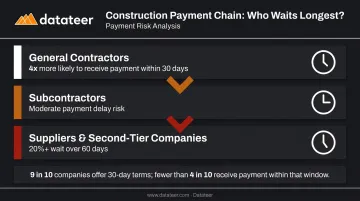
Position in the payment chain determines how long a firm waits. A 2021 survey of 764 construction professionals found that general contractors were four times more likely than other tiers to receive payment within 30 days — and 20% of subcontractors, suppliers, and second-tier companies waited more than 60 days for payment.
Levelset's 2022 survey of 519 US construction professionals confirmed the gap: nearly nine in ten companies offered 30-day payment terms, but fewer than four in ten reported actually receiving payment within that window.
Retainage: Earned Revenue That Isn't Collectible Yet
Owners typically withhold 5–10% of each progress payment as retainage until project completion. Levelset's research found that at least 5% was withheld on 46% of projects, and 66% of respondents waited more than 30 days to collect retainage after completing work.
On a multi-project portfolio, retainage compounds. A firm billing $5 million per month across ten projects could have $2–5 million in earned revenue sitting in retainage holds at any given time — available on paper, inaccessible in practice.
Change Orders Disrupt Timing Without Warning
Field crews start work associated with a change order before the owner approves it. Cash leaves the business — labor, materials, equipment — with no corresponding inflow. If approval takes weeks or months, that gap compounds across every unapproved change order in the portfolio:
- Labor costs post immediately; billing rights are pending approval
- Material purchases are sunk costs before the change order is signed
- Approval delays of 30–90 days are common on commercial projects
The Data Lag Problem
Finance teams relying on manually assembled spreadsheet-based WIP reports are often working with data that is 10–20 days old by the time it reaches leadership. By then, the margin fade has already happened and the cash drain is already in progress. Cash flow management becomes forensic accounting — reconstructing what went wrong — rather than the proactive financial control that prevents it.
How to Build a Construction Cash Flow Forecast
A reliable forecast starts at the project level and builds up. Get the inputs wrong at the job level, and the firm-wide view will be wrong too.
Start with Cost to Complete
The foundation of any cash flow projection is knowing how much money is left to spend on each active job:
Total Budget − Job Costs to Date = Projected Cost to Complete
That figure, spread across the remaining schedule, becomes the outflow side of the project forecast. Layer in the billing schedule — when progress payments are expected — and the inflow side takes shape.
Cost Curves: Spending Doesn't Happen Evenly
One of the most common forecasting errors is assuming a flat spend rate across a project's life. Construction spending follows recognizable patterns, and your forecast should match the shape of the actual work.
| Curve Type | Spend Pattern | Typical Use Case |
|---|---|---|
| Bell curve | Slow start, peak in middle, taper at end | Standard building construction |
| Linear | Equal spend each period | Simple, repetitive work packages |
| Front-loaded | Heavy early spend, lighter later | Projects with large material deposits (elevators, curtain wall) |
| Back-loaded | Light early spend, heavy later | Specialty finishes, commissioning-heavy projects |
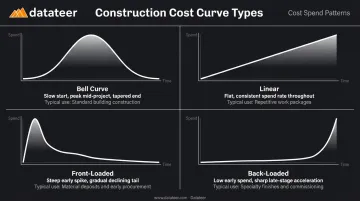
Choosing the wrong curve means your forecast will show money available when you don't have it — or show a shortage that isn't real.
Layer Forecasts from Project to Portfolio
Individual project forecasts are the building blocks. Stack them to see the consolidated picture:
- Project level — cost curve applied to each active job's remaining budget
- Portfolio level — all active projects aggregated to reveal peak cash demand weeks
- Firm level — portfolio cash position plus overhead, debt service, and corporate outflows
This layered view lets finance leaders identify firm-wide liquidity gaps weeks before they materialize — not days after they hit.
Track Forecast Variance
Variance tracking — comparing projected cash position against actuals — is what turns a forecast into a management tool. Without it, estimation errors compound silently until they surface as a shortfall.
If labor is consistently running 15% ahead of budget across multiple projects, variance analysis exposes that pattern early. Catching it at week three of a phase leaves room to act. By closeout, the damage is already done.
Strategies to Improve Construction Cash Flow
Cash flow rarely fails for one reason — and it rarely improves from one change. The firms that sustain healthy liquidity combine discipline across billing, collections, payment timing, and reserves.
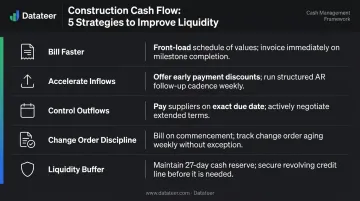
Bill Faster and More Frequently
- Front-load the schedule of values where defensible: assign a larger portion of the contract value to early work items to accelerate initial billings
- Invoice immediately at the end of each billing period rather than waiting days or weeks
- Switch milestone-based contracts to progress billing where possible, eliminating lump-sum end-of-project payment risk
Accelerate Inflows
- Offer early payment discounts — Construction Executive cites "2/10 net 30" (2% discount for payment within 10 days) as a workable example. Levelset data shows three-quarters of construction companies offer no early payment discount, so offering one creates a genuine differentiator for accelerating collections
- Accept multiple payment methods, including ACH and electronic options
- Implement a formal AR follow-up cadence with defined escalation triggers for overdue invoices
- Assign clear ownership for collections follow-up — unenforced cadences collapse without accountability
Control Outflow Timing
- Pay AP invoices on their due date — not before
- Negotiate extended credit terms with key material suppliers
- Use "pay-when-paid" clauses with subcontractors to align outflows with incoming owner payments (noting that enforceability varies by state and contract type)
Create Change Order Discipline
- Bill for change order work immediately upon commencement — don't wait for approval to invoice
- Track all pending change orders as a separate line item in the cash flow forecast so their expected impact is visible before approval arrives
- Monitor aging on pending COs — a change order outstanding for 45 days is an active cash flow risk that needs immediate follow-up
Build and Protect a Liquidity Buffer
- Maintain an operating cash reserve — CFMA's 2025 benchmarks show the industry average at 27 days of cash on hand (30 days for industrial/nonresidential, 33 days for heavy construction)
- Secure a revolving line of credit before it's needed — not during a cash crunch, when terms will be worse and approval slower
- Use the credit facility to bridge temporary timing gaps between outflows and inflows, not to fund structural deficits
From Spreadsheets to Real-Time Cash Flow Visibility
The Manual Data Problem
Construction finance teams know the cycle well. Pull CSVs from the ERP. Paste into Excel. Run VLOOKUPs to reconcile Procore commits against Sage invoices. Fix the broken formulas. Standardize the cost codes. Rebuild the WIP schedule. By the time the report reaches leadership, the underlying data is 10–20 days old.
That lag makes cash flow management reactive by design. Finance teams are reconstructing what happened rather than seeing what's happening. Margin fade goes undetected. Retainage sits overdue without a flag. Change orders age without accountability. The result is what Datateer calls "autopsy reporting" — making decisions on month-old data and perpetually explaining problems that could have been caught earlier.
Double L Management captured the pre-automation reality precisely: their business analyst reported that "one click replaced two weeks worth of prior work" after moving to automated dashboards. That two-week manual assembly process is the norm, not the exception.
What Changes with Real-Time ERP Integration
When ERP data flows directly into live dashboards, the finance team's role shifts from data gatherer to financial decision-maker:
- Job cost actuals update against budget continuously — no manual reconciliation required
- WIP position reflects current earned revenue versus billed revenue across all active projects
- Retainage exposure is visible by project, owner, and subcontractor — including overdue releases locking up working capital
- Pending change orders are tracked with aging and quantified margin impact — before approval, not after
- Cash position is projected weeks forward based on real burn rates and retainage schedules
Finance leaders can identify margin fade and liquidity risks while there is still time to act. That's a fundamentally different operating posture.
How Datateer Delivers This for Construction Firms
Datateer is the platform that makes that posture operational. Built from the ground up for construction — not a generic BI tool retrofitted from another industry — it syncs directly with 12+ major construction ERPs including Procore, Sage, Viewpoint Vista, Acumatica, Foundation, CMiC, and Jonas. Data pulls automatically through an overnight sync, populating purpose-built dashboards with zero manual extraction.
Key capabilities relevant to cash flow management:
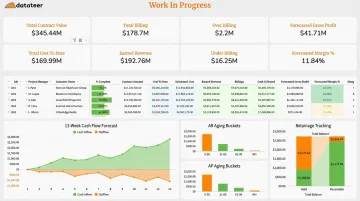
- 13-Week Cash Flow Forecasting built on real-time project burn rates and retainage schedules
- AR & AP Health dashboard with aging buckets (0–30, 31–60, 61–90 days) across the full portfolio
- WIP & Financial Truth — automated over/under-billings calculations per job, surfacing earned-but-not-billed exposure
- Job-Level Cash Flow — identifying which projects are generating cash versus which ones are consuming it
- Retainage Tracking — A/R and A/P retainage tracked separately, with release schedules integrated into the forecast
- Change Order Impact & Aging — pending change orders tracked from submission with days-outstanding aging and margin impact quantified
Setup takes 2–4 weeks, includes automated data cleaning and cost code standardization, and covers all dashboards from day one at flat annual pricing starting at $10,000 per year per data source — with unlimited users and no per-seat fees.
Frequently Asked Questions
What is construction cash flow?
Construction cash flow is the movement of money into and out of a construction business during a specific period. Tracking it reveals whether a firm has the liquidity to cover project costs, payroll, and overhead as they come due — even when the business looks profitable on paper.
How do you manage construction cash flow?
Strong cash management comes down to a few consistent habits:
- Build forecasts at the project and portfolio level
- Invoice promptly at each billing period
- Time AP payments to due dates — don't pay early
- Maintain a credit line for gap coverage
- Use real-time financial data to catch shortfalls before they compound
Firms that manage cash well treat it as a weekly discipline, not a monthly report.
What are CFO, CFI, and CFF?
These are the three sections of a formal cash flow statement. CFO (Cash Flow from Operations) covers project revenues and costs. CFI (Cash Flow from Investing) covers equipment purchases and asset disposals. CFF (Cash Flow from Financing) covers loans, equity draws, and debt repayment.
What is a construction cash flow forecast?
A cash flow forecast is a forward-looking projection of expected inflows and outflows over a future period. In construction, it's built from the project budget, schedule of values, cost curves, and retainage schedules — used to identify funding gaps before they occur rather than after.
What causes negative cash flow in construction?
The most common causes: front-loaded project costs before the first payment arrives, slow-paying owners, delayed invoicing, retainage withholdings, unmanaged change orders where work is performed before approval, and paying bills ahead of their due dates.
How do WIP reports affect cash flow forecasting?
WIP reports reveal how much revenue has been earned versus billed on each project. Under-billings represent cash that exists on paper but hasn't been collected; over-billings distort true liquidity. Stale or inaccurate WIP data flows directly into unreliable forecasts — making current WIP visibility essential before any cash planning begins.