Introduction
Budget overruns in construction aren't anomalies — they're the industry norm. A KPMG global construction survey found that only 31% of projects came within 10% of their original budget over a three-year period. That means roughly seven out of ten projects drift beyond their cost targets.
Budget tracking breaks down long before the numbers do. Labor costs shift week to week. Subcontractors bill ahead of schedule. Material prices move. Change orders get approved verbally and logged weeks later. By the time a finance team compiles the figures, the project has already moved on.
This article covers what every construction budget needs to track, which practices protect margins, and how the right reporting infrastructure turns budget data from a lagging report into an active management tool.
Key Takeaways
- Track budgets at the cost-code level, not just project totals — aggregate numbers hide variances until they compound
- Every change order is both a scope and a budget event; document and adjust immediately
- WIP reports catch margin fade before it becomes unrecoverable — run them more than once a month
- Manual reporting lags create a window where cost overruns go from correctable to locked in
- Post-project reviews sharpen your estimates — and protect margin on every job that follows
Why Construction Budget Tracking Is So Difficult
The Complexity Is Structural
Construction projects carry costs across dozens of cost codes, multiple subcontractors, fluctuating material prices, and labor that varies by week and crew. That structural complexity is inherent to the work itself.
Any gap in how costs are captured or categorized creates a distorted picture of where the project actually stands.
According to Autodesk and FMI research, bad data cost the global construction industry $1.84 trillion in 2020, with poor data tied to 14% of rework and one in three poor project decisions. The root cause isn't a technology gap. It's a data discipline gap.
The Reporting Lag Problem
In many construction firms, budget data gets compiled manually: ERP exports pulled into spreadsheets, formatted, reviewed, and distributed over 10–20 days. By the time a finance manager flags an overrun, the work driving it is already complete. The opportunity to intervene has passed.
Datateer describes this as "autopsy reporting": looking backward at problems that could have been caught mid-project. The 10-20 day reporting lag is one of the most consistent pain points among construction finance teams operating on manual workflows.
The Real Root Causes
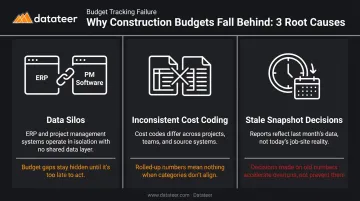
Poor budget tracking typically comes down to one of three root causes:
- Data silos — project management systems and finance systems don't communicate, so reconciliation happens manually and late
- Inconsistent cost coding — when the same work is coded differently across projects, comparisons become meaningless
- Decisions made on stale snapshots — if the numbers are two weeks old, they're not a management tool; they're a history lesson
Key Components of a Construction Project Budget to Track
Direct and Indirect Costs
Direct costs — labor, materials, equipment, and subcontractor fees — carry the most financial risk because they're the most variable. Tracking them requires consistent cost code mapping so actuals can be compared against estimates at the task level, not just the project total. A project can look fine in aggregate while a specific trade runs 15% over.
Indirect costs — overhead, permits, insurance, administrative expenses, and site-related costs — accumulate steadily. They're often underestimated during pre-construction and rarely monitored with the same discipline as direct costs. Left uncategorized, they distort profitability without appearing in any obvious line item.
Contingency Funds
Standard practice allocates 5–10% of total project cost as contingency for budget-phase estimates, though that range shifts based on drawing completeness and project risk. RSMeans notes that final drawings may require only 2–3%, while alteration and repair work can warrant 20%.
Governance matters more than the exact percentage. Contingency should be a reserved line item with a defined approval process — not a general buffer that gets spent on routine overruns. When contingency gets treated as slack, it's gone before the real risks arrive.
Change Orders
Every change order is two events simultaneously: a scope event and a budget event. Tracking change orders separately from the original contract value is the only way to understand true project cost versus estimated cost.
Research from Ibbs found that cumulative productivity losses can exceed 30% for mechanical and electrical contractors when changes are frequent, and productivity rarely recovers once change exceeds 20% of the original contract value. That's the financial case for managing change orders formally — not as an administrative preference, but as a margin protection measure.
Work-in-Progress (WIP) Reports
WIP reporting measures how much revenue has been earned relative to costs incurred at any point during a project. It surfaces over-billings, under-billings, and early signs of margin fade before they become unrecoverable.
The AICPA-CIMA describes WIP schedules as tools for overseeing budgets, understanding completed work, and recognizing what remains. EisnerAmper notes a less obvious dimension: WIP reporting affects bonding capacity. That makes it a financial credibility signal to sureties and lenders, not just an internal management tool.
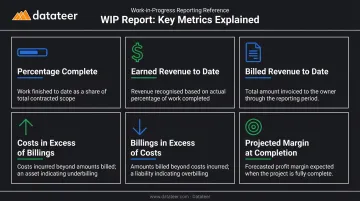
Key metrics a WIP report should capture:
- Percentage complete (by cost or units)
- Earned revenue to date
- Billed revenue to date
- Costs in excess of billings (under-billings)
- Billings in excess of costs (over-billings)
- Projected margin at completion
Best Practices for Tracking Construction Project Budgets
Develop a Detailed Pre-Construction Budget
A budget built from vague line items produces untrackable overruns. A budget built from historical job cost data, detailed scope breakdowns, and realistic labor and material estimates gives finance teams something they can actually measure against.
Before finalizing a new project budget, review actuals from comparable completed jobs. If your last three similar projects ran labor 8% over estimate on a specific trade, that's a data point that should change the next estimate.
Implement a Consistent Cost Code Structure
Cost codes are what make budget tracking meaningful across a portfolio. When labor hours, materials, and subcontractor costs are assigned to the same standardized codes on every project, finance managers can:
- Identify which activities are trending over budget
- Compare performance across jobs of similar scope
- Build more accurate estimates from actual historical cost data
Inconsistent coding is deceptive: reports can look clean while masking real variances. Retroactive code reassignment is particularly dangerous because it can restate historical data in ways that obscure trend patterns.
Datateer's automated data cleaning engine standardizes cost codes across ERP systems — including reconciling Procore project commits to Sage invoices — so cross-project benchmarking reflects actual comparisons, not apples-to-oranges artifacts.
Conduct Regular Budget Reviews with Variance Analysis
Budget reviews shouldn't wait for month-end close. On active projects, comparing actual-to-budget by cost code on a weekly or bi-weekly cadence catches variances while corrective action is still available.
The key is variance thresholds. When a cost code reaches a defined percentage of its budget, that should trigger a review. Two questions matter:
- Does the variance reflect a legitimate scope change?
- Or does it reflect an execution problem?
Those require different responses, and conflating them delays the right fix.
Manage Change Orders Through a Formal Process
A sound change order process has three requirements:
- Written documentation of the scope change before work proceeds
- Client approval confirmed before additional costs are incurred
- Immediate budget adjustment to reflect the updated contract value
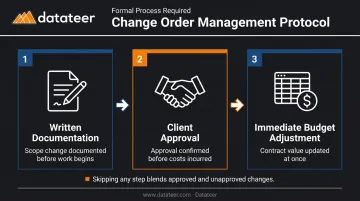
Without this discipline, approved and unapproved changes blend together. The project financials show a number, but no one can confidently explain whether it reflects the current contract or the original estimate with some drift added.
Use WIP Reports to Monitor Financial Health Throughout the Project
WIP reports should be generated regularly, not just at month-end. The most valuable use of WIP data is catching margin fade while work is still in progress.
When finance managers have current WIP data, they can escalate underperforming jobs before the damage is locked in. Working from month-old numbers means documenting what already happened — too late to change the outcome.
CFMA notes that contractors need to monitor KPIs including margin fade and job borrow daily or weekly on active projects, not quarterly.
Conduct a Post-Project Financial Review
After project closeout, compare estimated versus actual costs by category and investigate the root causes of variances — both over-runs and under-runs. This review does two things:
- Surfaces systemic issues (labor consistently running over on a specific trade, for example) that can be corrected operationally
- Feeds more accurate estimates for future projects
Firms that consistently hit their estimates build that discipline by feeding post-project actuals directly back into the estimating process.
How Real-Time Reporting Transforms Construction Budget Control
From Forensic Accounting to Active Management
The shift matters more than it sounds. When budget data is refreshed automatically from the ERP rather than compiled manually on a two-week lag, finance managers stop reporting what happened and start influencing what's about to happen. Labor slippage, cost code overruns, and cash flow risks become visible while corrective action is still possible.
The traditional manual workflow looks like this:
| Step | Traditional Process | Automated Process |
|---|---|---|
| Data extraction | Manual CSV exports from ERP | Automatic overnight ERP sync |
| Reconciliation | VLOOKUP marathons across systems | Automated cost code standardization |
| Report building | Pivot tables, cell formatting, version conflicts | Pre-built dashboards, no formatting required |
| Distribution | Email attachments, 10–20 day lag | Shared dashboards, updated overnight |
| Analysis time | Minimal — consumed by data assembly | Substantial — data is already clean |
One Datateer client from Double L Management described the change directly: "That one click replaced two weeks worth of prior work."
Portfolio-Level Visibility
That same efficiency gain scales beyond individual projects. Instead of reviewing jobs one at a time, construction leadership can see budget performance, WIP status, and liquidity metrics across the entire active portfolio in a single view.
Datateer connects to 12+ construction ERPs — including Procore, Sage, Viewpoint, Acumatica, Foundation Software, CMiC, and QuickBooks — and delivers that portfolio view through four dashboard suites available on day one:
- Executive Strategy & Solvency — enterprise health, liquidity, and solvency signals
- Financial Operations & Cash Management — AR/AP aging, cash flow forecasting, billing health
- Project Excellence & Field Operations — job costing, cost-to-complete, field productivity
- Resource Productivity — labor, equipment, and subcontractor performance
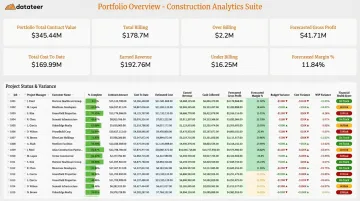
The practical result: finance managers spend time on analysis and escalation instead of data assembly. Problem jobs surface before margin damage becomes permanent.
Common Mistakes That Derail Construction Budget Tracking
Tracking at Too High a Level
Project-level budget totals give a false sense of control. A project can look on-budget in aggregate while specific trades or activities are significantly over — until those variances compound and show up in the final numbers. Cost-code-level tracking is what catches problems early.
Treating the Budget as a Static Document
A budget that doesn't reflect approved change orders, revised material costs, or schedule adjustments stops being a control tool. It becomes a historical artifact. The working budget should always reflect the current contract, not the original estimate.
Relying on the Monthly Close Cycle for Active Project Decisions
By the time month-end reports are compiled and distributed, the data is already 2–4 weeks old. On an active project, a margin problem that was recoverable at week two may be locked in by week six. The frequency of budget review needs to match the pace of construction activity. Monthly reporting cycles rarely keep up.
Frequently Asked Questions
What is the best way to track a construction project budget?
The most effective approach combines a cost-code-structured budget built from historical actuals, weekly variance reviews on active projects, a formal change order process that updates the budget immediately, and regular WIP reporting to monitor earned revenue versus costs incurred.
What are the key principles of construction project budgeting?
Four principles drive effective construction budgeting:
- Build budgets from detailed historical data at the cost-code level
- Allocate contingency as a governed reserve, not a catch-all buffer
- Update the budget whenever scope changes
- Review actuals against estimates frequently enough to act on variances before the project closes
How often should construction project budgets be reviewed?
Active projects benefit from weekly or bi-weekly cost reviews at the cost-code level. A more comprehensive financial review — including WIP — should happen at minimum monthly.
What are the most common causes of budget overruns in construction?
The most consistent culprits are scope creep without formal change orders, inaccurate initial estimates, labor productivity shortfalls, and delayed reporting that obscures early overruns. KPMG also identifies material cost escalation and skilled labor shortages as ongoing structural challenges for roughly one in three construction firms.
What is a WIP report and why does it matter for budget tracking?
A Work-in-Progress report measures earned revenue versus costs incurred on active projects, tracking over-billings, under-billings, and projected margin at completion. It's one of the few tools that can catch margin fade while there's still time to course-correct — before a project closes at a loss.
How can construction firms track budgets across multiple projects at once?
Portfolio-level budget tracking requires systems that pull cost data consistently from the ERP across all active jobs, standardize cost code structures, and surface underperforming projects in a unified view. Reviewing each project individually doesn't scale. Firms with effective portfolio oversight use dashboards that show exceptions and variances across the full job list in a single view.