AGC reported aluminum mill shapes up 30.5%, steel mill products up 17%, and copper up 11.8% — all in a single year. Tariffs on steel and aluminum reached 50% in June 2025, followed by a 50% copper tariff effective August 2025. These aren't tail-risk scenarios anymore. They're the baseline.
This guide gives construction CFOs and finance managers a complete, practical understanding of how price escalation clauses work — from definitions and clause types to the specific drafting elements that determine whether a claim gets paid or disputed. The goal is margin protection before contract execution, not damage control after the loss.
Key Takeaways
- Escalation clauses share price volatility risk between contractor and owner — they aren't cost-plus workarounds
- Standard AIA contract forms don't include escalation language; it must be negotiated into every contract
- Index-based clauses tied to BLS PPI series are the most defensible for commercial projects
- Six elements make a clause enforceable: covered materials list, base index reference, trigger threshold, bilateral adjustment formula, adjustment cap, and notice requirements
- Finance teams — not just estimators — must own escalation clause strategy across the full project portfolio
What Is a Price Escalation Clause in Construction?
A price escalation clause is a contractual provision that allows the agreed contract price to adjust — up or down — when the cost of specified materials or labor changes beyond a defined threshold between contract signing and actual purchase or performance.
Under a standard lump-sum or GMP contract, the contractor absorbs 100% of material price volatility. An escalation clause shifts that arrangement: when prices move beyond the agreed threshold, the adjustment is shared equitably. A well-drafted clause works in both directions — owners benefit when prices fall, which is exactly why bilateral language is easier to negotiate than one-directional clauses.
Standard AIA contract forms do not include price escalation clauses. The A101 (stipulated sum), A102 (cost plus with GMP), and A133 (CMc cost plus with GMP) are all silent on escalation. Provisions must be negotiated and inserted through supplementary conditions, amendments, or addenda.
ConsensusDocs fills this gap with a dedicated instrument: ConsensusDocs 200.1 Time and Price Impacted Materials, which provides a structured escalation framework with listed materials and an objective index-based adjustment mechanism. Contractors and owners relying on unmodified standard forms have no adjustment mechanism at all.
Why Price Escalation Clauses Are Essential in 2026
The Numbers Behind the Risk
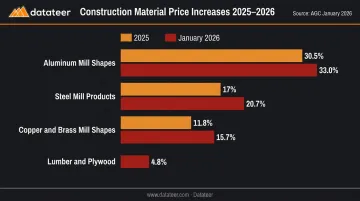
The 2026 cost environment is structurally volatile — not a temporary disruption that bids can simply absorb. AGC's January 2026 data shows the scale of exposure:
- Aluminum mill shapes: up 30.5% year-over-year (33.0% by January 2026)
- Steel mill products: up 17% in 2025, 20.7% by January 2026
- Copper and brass mill shapes: up 11.8% in 2025, 15.7% by January 2026
- Lumber and plywood: up 4.8% from August 2024 to August 2025
Tariff policy is driving a significant share of this volatility. Steel and aluminum tariffs escalated from 25% in March 2025 to 50% in June 2025. A 50% copper tariff followed in August 2025. Construction Dive reported an estimated $22 million cost increase on a single $375 million healthcare development — a 5.9% budget impact on one project from tariff-driven material costs alone.
The Timeline Exposure Gap
Projects don't get built the day bids are submitted. U.S. Census Bureau data shows private nonresidential projects averaging 12.5 months from start to completion overall — and 21.4 months for projects over $10 million. Office buildings average 15.8 months; educational projects, 15.4 months.
That duration creates a substantial exposure window between the bid-date pricing assumptions and actual material purchases. How large can that window be? Construction Dive documented rebar rising from approximately $750 to nearly $900 per short ton — a 20% increase in just over a month — adding an estimated $200,000 to a single concrete job. A 60-to-90-day bid-to-buy lag is enough to wipe out the margin on a material-heavy phase entirely.
Which Projects Carry the Highest Risk
Not every project carries equal escalation exposure. Finance teams should flag:
- Material-heavy trade packages: structural steel, concrete framing, copper wiring, aluminum cladding, asphalt paving
- Long-duration projects over $5 million where suppliers cannot hold pricing for the full duration
- Public sector work with extended procurement timelines and formal change order approval chains
- Projects with multiple simultaneous material-intensive phases that compress purchasing into a narrow window
The Finance Team's Role
Once high-risk projects are identified, the next step is quantifying what they collectively mean for the firm. Escalation clause strategy is ultimately a financial risk management decision — and it requires portfolio-level visibility, not just job-level awareness.
CFOs and finance managers need to know:
- What percentage of total committed revenue sits in lump-sum contracts without escalation coverage
- How much of that exposure is concentrated in materials categories with the sharpest price movement
- Whether multiple long-duration projects are purchasing material in overlapping windows
Firms running five or ten simultaneous long-duration projects face compounding exposure that doesn't surface in any single job's WIP report until margins are already gone.
Types of Price Escalation Clauses
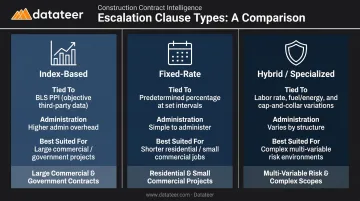
Index-Based Escalation
Index-based clauses tie price adjustments to a published, third-party data source, most commonly the Bureau of Labor Statistics (BLS) Producer Price Index (PPI). The base index value is recorded at contract signing; if the index moves beyond the agreed threshold at the time of material purchase, the contract price adjusts proportionally.
Standard adjustment formula:
Adjustment = (Current Index − Base Index) / Base Index × Material Line Item Value
The BLS publishes commodity-specific series for construction materials:
| Material | BLS PPI Series ID |
|---|---|
| Steel mill products | WPU1017 |
| Fabricated structural metal | WPU1074 |
| Aluminum mill shapes | WPU102501 |
| Copper wire and cable | WPU102603 |
| Softwood lumber | WPU0811 |
| Ready-mix concrete | WPU133301 |
| Asphalt paving mixtures | WPU139401 |
The primary advantage is objectivity: neither party controls BLS data, which eliminates the most common source of escalation disputes. This works best for larger commercial projects, government work, and contracts where material purchases are substantial enough to justify monthly index tracking.
The tradeoff is administrative overhead — someone must pull index values, run calculations, and maintain the audit trail.
Fixed-Rate Escalation
Instead of tracking market data, both parties agree upfront to a predetermined percentage increase applied at set intervals — for example, 4% per six-month period. This is simpler to administer, easy for both parties to budget around, and well-suited for residential remodels and smaller commercial jobs with shorter timelines.
The key trade-off: fixed-rate clauses may over-compensate if markets stay flat or under-compensate during sharp price spikes, leaving the contractor still exposed. A hybrid approach handles this gap:
- Default to fixed-rate for simplicity and predictability
- Switch to index-based if any single material category spikes beyond a defined threshold (for example, 15% in a rolling 90-day period)
Other Clause Variations
Three additional structures appear in specialized contexts:
- Labor rate clauses — important for public works projects subject to prevailing wage changes or union agreement renegotiations; ENR reported skilled labor costs rose 5.7% by end of 2025
- Fuel and energy clauses — relevant for heavy civil and transportation-intensive projects where diesel and energy are major budget components
- Cap-and-collar structures — impose both a maximum (cap) and minimum (collar) on adjustments, protecting both parties from extreme market swings in either direction
Key Elements of an Enforceable Escalation Clause
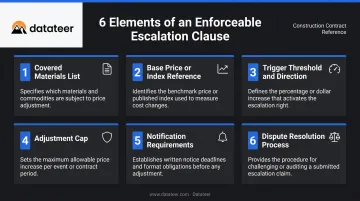
A well-intentioned escalation clause that lacks any of these six elements will either fail in a dispute or be rejected during negotiations.
1. Covered materials List exact categories — "structural steel, dimensional lumber, ready-mix concrete, copper wiring" — not vague language like "all materials." If a material isn't named, it isn't covered.
2. Base price or index reference State the exact index value or supplier price at contract signing, including the source, date, and specific BLS series ID. "Current market pricing" as a baseline is unenforceable in a dispute.
3. Trigger threshold and direction Specify the percentage change required to activate adjustment — state DOT specifications commonly use 5% and 10% thresholds for cement and steel. Bilateral language covering both increases and decreases makes the clause easier for owners to accept.
4. Adjustment cap Most well-drafted clauses cap total adjustments at a defined percentage of the original material budget. Without a cap, owners and their lenders frequently reject escalation provisions because their maximum exposure is undefined. A cap converts unlimited exposure into a defined line item owners and lenders can underwrite.
5. Notification requirements Specify written notice, required documentation (index printouts, supplier invoices, calculations), and the notice period — 14 days is common. Missing or vague notice requirements are the most frequent reason legitimate escalation claims fail.
6. Dispute resolution process Define what happens if the owner contests the calculation — arbitration, mediation, or the contract's standard dispute mechanism. Without it, a contested adjustment has no defined path to resolution and can stall a project.
How to Administer and Monitor Escalation Clauses Effectively
Step 1: Document the Baseline at Signing
On the day of contract execution, the finance team must:
- Record every material cost assumption from the estimate
- Save dated supplier quotes for all covered categories
- Log the specific BLS PPI series values for each covered material (with the publication date)
- Store all documentation in a project file that survives personnel changes
This baseline is the foundation of every future adjustment calculation. Without it, the clause cannot be enforced regardless of how well it was drafted.
Step 2: Monitor Monthly
Set a recurring monthly process to pull current index values for covered materials and compare them against the baseline. Key practices:
- Track the delta between current index and baseline for each covered category
- Flag when any material approaches the trigger threshold — not after it crosses
- Prepare the change order package before the threshold is exceeded and before purchase orders are placed
Datateer's Material Price Escalation module tracks actual purchased cost per unit against bid-estimate prices and live indices — including the BLS PPI and ENR Material Cost Index — with overnight syncing from ERPs including Procore, Sage, Viewpoint Vista, and Acumatica. For CFOs running multiple long-duration projects simultaneously, the portfolio-level view catches compounding margin exposure before it surfaces on the WIP schedule.
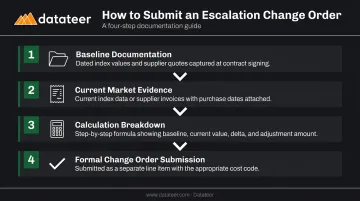
Step 3: Submit Change Orders Professionally
Once monitoring confirms a threshold has been crossed, move immediately to a formal written change order. Include:
- The baseline documentation (dated index values or supplier quotes from signing)
- Current index data or supplier invoices with purchase dates
- A step-by-step calculation showing exactly how the adjustment amount was derived
- The adjustment as a separate line item with its own cost code
Owners and GCs approve change orders that show their work. A clear calculation trail — baseline, current value, delta, formula — removes the ambiguity that stalls payment and triggers disputes.
Common Mistakes That Weaken Escalation Clauses
Drafting Mistakes
These contract errors make clauses either unenforceable or impossible for owners to accept:
- Vague trigger language ("if costs increase materially") with no defined threshold percentage
- No base index or dated price reference — leaves the baseline open to dispute
- Missing adjustment cap — owners and lenders routinely reject open-ended escalation provisions
- One-directional language that only allows upward adjustments, signaling bad faith and hardening negotiation
Administrative Mistakes
The clause can be perfectly drafted and still fail due to poor execution:
- Not documenting the baseline at signing — the most common and most costly error
- Failing to monitor indexes during the project until after a threshold is crossed
- Submitting change orders weeks or months after the threshold triggers — late submissions erode your negotiating position
- Treating escalation clauses as a substitute for accurate estimating rather than protection against unforeseeable market moves
Legal Review
Even a well-executed clause can fail at the courthouse if the language doesn't hold up in your jurisdiction. Duane Morris notes that price escalations and economic hardship rarely qualify as force majeure, and courts narrowly construe force majeure language. Smith Currie confirms that traditional fixed-price contracts leave material cost-increase risk with the contractor unless the contract explicitly shifts it.
Have an attorney review your escalation clause template before deploying it across all contracts — specifically to verify trigger language, index references, and cap provisions hold up under your state's contract law.
Frequently Asked Questions
What is a price escalation clause in a construction contract?
A price escalation clause is a contractual provision that allows the contract price to adjust — up or down — when specified material or labor costs change beyond a defined threshold. Unlike a cost-plus arrangement, it's a risk-sharing mechanism with formula-driven adjustments bounded by the clause's terms.
What are the key elements required in a price escalation clause?
A defensible clause needs six elements: a specific covered materials list, a dated base price or index reference (with BLS series ID if using PPI), a defined trigger threshold percentage, a bilateral adjustment formula, an adjustment cap, and written notification and documentation requirements.
Do standard AIA construction contracts include price escalation clauses?
No. Standard AIA forms — including A101, A102, and A133 — do not include escalation provisions. These must be specifically negotiated and added via supplementary conditions or amendment. ConsensusDocs 200.1 offers a dedicated escalation instrument as an alternative starting point.
What materials are most commonly covered by construction escalation clauses?
The highest-volatility categories in 2025–2026 are structural steel, aluminum, copper, dimensional lumber, ready-mix concrete, asphalt, and petroleum-based products. The specific list for any contract should reflect the materials making up the largest share of that project's direct cost budget.
What happens if a construction contract has no escalation clause?
Under a lump-sum or GMP contract, the contractor absorbs the full cost of price increases. Fallback doctrines — force majeure, commercial impracticability under UCC 2-615, or mutual mistake of fact — exist in theory, but courts consistently find them difficult to invoke for price increases alone. A properly drafted escalation clause is far more reliable.
What is a cap and collar in an escalation clause?
A cap sets the maximum upward adjustment allowed, protecting the owner from unlimited cost exposure. A collar sets a minimum threshold below which no adjustment is triggered, filtering out normal market noise. Together, they give both parties a predictable, negotiable range of outcomes.