Introduction
Revenue recognition under ASC 606 is a GAAP framework requiring companies to recognize revenue in an amount that reflects the consideration they expect to receive in exchange for transferring goods or services to customers. Apply that definition to a $50 million design-build project with four active change orders, 10% retainage, and a disputed delay claim, and the complexity becomes clear fast.
For construction CFOs, controllers, and CPAs serving contractors, ASC 606 carries real consequences. The standard replaced more than 100 pieces of industry-specific US GAAP guidance with a single principle-based framework, which demands significantly more judgment than the rules-based approach it replaced.
Long-duration contracts, variable pricing, and progress-based billing mean that nearly every step of the model requires deliberate analysis. Mechanical application won't hold up under audit.
This article walks through the five-step ASC 606 model as it applies specifically to construction contracts, with detailed coverage of the compliance factors that matter most, the misconceptions that trigger audit adjustments, and the data management failures that put contractors at risk.
Key Takeaways
- ASC 606 replaces legacy percentage-of-completion rules with a five-step principle-based framework covering virtually all construction contracts
- Most construction contracts qualify for over-time recognition because the customer controls the asset as it is built, or the contractor holds an enforceable right to payment for work completed
- Change orders, claims, and variable consideration require documented constraint analysis before revenue inclusion
- The cost-to-cost input method remains the dominant measure of progress — and only works when cost data is accurate and current
- Retainage affects cash collection and balance sheet presentation only — not when revenue is recognized
What Is Revenue Recognition Under ASC 606?
FASB and IASB jointly issued ASU 2014-09, "Revenue from Contracts with Customers (Topic 606)," on May 28, 2014. Public companies adopted it for periods beginning after December 15, 2017 (calendar year 2018); private companies followed for periods beginning after December 15, 2018 (calendar year 2019).
The core principle, stated in ASC 606-10-10-2, is that an entity recognizes revenue "to depict the transfer of promised goods or services to customers in an amount that reflects the consideration to which the entity expects to be entitled in exchange for those goods or services." Revenue is earned when control transfers — not simply when cash is collected.
How ASC 606 Differs From Prior Standards
The previous regime — ASC 605 plus construction-specific standards — relied heavily on prescriptive rules and industry carve-outs. ASC 606 replaced that with a single principles-based framework — one that requires judgment at every step, for every contract.
The shift has real operational consequences for contractors:
- Under prior guidance, industry-specific rules often told contractors exactly how to handle specific scenarios
- ASC 606 requires analyzing each contract individually: what was promised, what will be received, and when it has been earned
- Disclosure requirements now mandate disaggregated revenue breakdowns, performance obligation details, and documentation of significant judgments
Contractors who carry over prior accounting practices without running the five-step analysis are non-compliant — regardless of whether the numbers look similar on the surface.
Why ASC 606 Presents Unique Challenges for Construction Contracts
Standard product sales involve a discrete deliverable, a known price, and a single transaction. Construction contracts break almost every one of those assumptions.
Sources of Complexity
- Variable consideration is common: Contracts include bonuses for early completion, liquidated damages for delays, unpriced change orders, and unresolved owner claims — all requiring estimation and constraint analysis
- Performance spans reporting periods: Revenue recognition decisions made in one period affect cumulative positions in every subsequent period
- Assets typically have no alternative use: When a contractor builds on customer-owned land, the asset cannot be redirected to another buyer. That restriction directly drives over-time recognition eligibility under ASC 606
What Goes Wrong Without Disciplined Application
EY's technical guidance on E&C entities identifies units of account, variable consideration, contract modifications, and progress measurement as the areas where construction firms most frequently make new or different judgments under ASC 606.
The consequences of getting these wrong are concrete. The SEC's 2023 enforcement action against Fluor Corporation found that the firm improperly accounted for cost estimates and unapproved changes on large construction projects. Net earnings were overstated by as much as 37% on individual projects, resulting in a $14.5 million civil penalty. The root cause: insufficient evaluation of enforceable rights and significant-reversal risk for unapproved change notices after ASC 606 adoption.
The Five-Step ASC 606 Revenue Recognition Process for Construction Contracts
The five steps are sequential. Errors in early steps compound in later ones — a misidentified performance obligation in Step 2 will distort revenue timing through Step 5 for the life of the project.
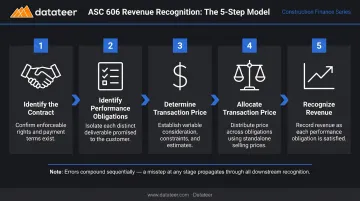
Step 1: Identify the Contract With a Customer
A construction contract qualifies under ASC 606 when:
- Both parties approve and commit to their obligations
- Each party's rights are identifiable
- Payment terms are identifiable
- The contract has commercial substance
- Collection of consideration is probable
Construction-specific complications arise frequently here. A contract may be formed through a purchase order, master agreement, or even verbal commitment. Contractors must also assess when combining contracts is required (when two or more contracts are entered with the same customer at or near the same time and are economically linked) and when segmenting contracts is appropriate.
Work performed before formal contract execution requires particular care — revenue on pre-contract work can only be recognized once the contract criteria are met.
Step 2: Identify Performance Obligations in the Contract
Most construction contracts contain a single performance obligation: constructing the defined asset. This is because the contractor provides a significant integration service — combining labor, materials, subcontractor work, and equipment into a combined output the customer could not otherwise obtain by purchasing the inputs separately.
Contracts that include distinct, separately deliverable components may contain multiple performance obligations. Common examples:
- Design-build contracts with a separable design deliverable that the owner could use independently
- Contracts covering both a building and unrelated equipment installation with independent value
- Phased projects where earlier phases are functionally complete and usable before later phases begin
Each distinct performance obligation requires independent revenue recognition — and each triggers its own timing analysis for the full contract term.
Step 3: Determine the Transaction Price
In construction, the transaction price is almost never just the base contract amount. It must include estimates of:
- Approved change orders already executed
- Unapproved change orders where scope has changed but price is not finalized
- Incentive payments for early completion or quality milestones
- Liquidated damages penalties for delays (which reduce the transaction price)
- Claims for additional compensation due to owner-caused delays or changed conditions
The constraint principle governs all of these. Under ASC 606-10-32-11, variable consideration is included only "to the extent that it is probable that a significant reversal in the amount of cumulative revenue recognized will not occur" when the uncertainty resolves. Both likelihood and magnitude of potential reversal factor into that assessment.
A $2 million claim with uncertain legal entitlement should not be included in the transaction price simply because the contractor believes it is likely to prevail. The constraint requires documented analysis and conservative estimation.
Step 4: Allocate the Transaction Price to Performance Obligations
When a contract has a single performance obligation — the most common construction scenario — the entire transaction price is allocated to that one obligation. No further analysis is needed.
For contracts with multiple distinct performance obligations, the transaction price must be allocated based on relative standalone selling prices. This is where construction creates a genuine practical challenge: bespoke construction scopes rarely have clear market comparables.
Estimation methods include the expected cost-plus-margin approach, where each obligation's standalone price is estimated by projecting its expected costs and applying a reasonable margin. The allocation then determines how much revenue is attributed to each obligation as it is satisfied.
Step 5: Recognize Revenue When (or As) Performance Obligations Are Satisfied
Under ASC 606-10-25-27, revenue is recognized over time if any one of three criteria is met:
- The customer simultaneously receives and consumes the benefits as performance occurs
- Performance creates or enhances an asset the customer controls as it is created
- Performance creates no asset with an alternative use to the contractor, and the contractor has an enforceable right to payment for performance completed to date
Most construction contracts satisfy criterion 2, criterion 3, or both — making over-time recognition the standard approach for the industry.
Measuring progress using the cost-to-cost input method:
Revenue recognized = (Costs incurred to date ÷ Total estimated contract costs) × Contract price
The formula is straightforward; executing it accurately is not. Reliable results require:
- Current, complete cost-to-date figures including labor, materials, equipment, and subcontractors
- Reliable revised estimates of total contract cost incorporating approved and pending changes
- Timely updates at each reporting date, with changes treated as changes in accounting estimate under ASC 250
The reliability of cost-to-cost calculations depends entirely on the quality and timeliness of the underlying cost data. Firms using manual month-end processes often work with cost data that is 10–20 days old by the time WIP schedules are finalized — meaning the percentage-of-completion figure driving recognized revenue reflects the project's position weeks ago, not today.
Datateer's WIP dashboard eliminates this lag by pulling cost and billing data directly from construction ERPs — including Procore, Sage, Viewpoint Vista, Acumatica, Foundation Software, and others — on an automated overnight cycle. Double L Management noted that "one click replaced two weeks worth of prior work."
Datateer's platform data puts a number on that difference: a 10–20 day manual lag versus a 2-minute refresh. When cost-to-complete projections and actual costs update continuously, the cost-to-cost calculation reflects reality rather than a snapshot from the prior month.
Construction-Specific Factors That Complicate ASC 606 Compliance
Change Orders and Contract Modifications
Change orders are frequent in construction and require immediate classification under ASC 606:
| Change Order Type | Treatment |
|---|---|
| Distinct scope at standalone price | Separate new contract |
| Adds distinct scope, price doesn't reflect standalone value | Prospective modification |
| Adds non-distinct scope (part of existing performance obligation) | Cumulative catch-up adjustment |
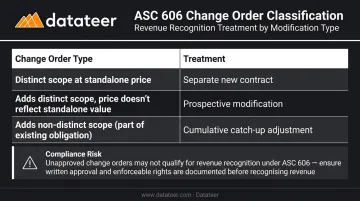
The most common compliance error: including unapproved change orders in revenue before they satisfy the variable consideration constraint. An oral or informal agreement does not constitute a contract modification under ASC 606, regardless of how confident both parties are that formal approval is coming.
Retainage
Retainage — typically 5% or 10% of billings withheld by the owner until project completion — does not change when revenue is recognized. Revenue recognition is driven by performance, not payment. Once the work underlying the retainage is performed, the revenue is earned.
The retainage amount is presented as a contract asset (unbilled receivable) on the balance sheet rather than accounts receivable, because the right to the payment may still be conditional on something beyond the passage of time. Cash collection is deferred; revenue recognition is not.
Measuring Progress Accurately
Errors in cost-to-date or total estimated cost projections flow directly into recognized revenue. When a revised cost estimate changes the measure of progress, the cumulative revenue recognized through that date is recalculated — the catch-up adjustment hits the current period.
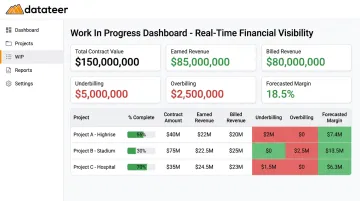
This is why accurate, timely job cost data is not merely an accounting convenience — it is a direct revenue recognition input. Datateer's Job Costing & Cost-to-Complete analytics break down costs by labor, materials, equipment, subcontractors, and overhead at the contract level — the same cost categories required for cost-to-cost percentage-of-completion — updated from ERP source data without manual intervention.
Over/Under Billings and the WIP Schedule
ASC 606 formalizes what construction finance teams have tracked informally for years:
- Contract assets (underbillings): Earned revenue exceeds amounts billed → costs and estimated earnings in excess of billings
- Contract liabilities (overbillings): Amounts billed exceed earned revenue → billings in excess of costs and estimated earnings
Real-time visibility into these positions matters because they signal margin fade before it becomes irreversible. Datateer's WIP dashboard has tracked portfolios with total contract values exceeding $345 million, reporting underbilling and overbilling positions per project — with individual job details including percentage completion, earned revenue, billed revenue, and forecasted margin — all simultaneously updated without manual assembly.
Common Misconceptions About ASC 606 in Construction
Three misconceptions consistently surface in construction finance — each one a genuine compliance risk if left uncorrected.
Myth: "ASC 606 is just percentage-of-completion with new branding."
The cost-to-cost input method remains valid under ASC 606. The difference is everything surrounding it. The standard adds:
- An explicit five-step framework for each contract
- Variable consideration constraint requirements
- Performance obligation identification and allocation
- Disclosure requirements that didn't exist under legacy guidance
Relabeling prior practices without running that analysis is non-compliant — regardless of how similar the math looks.
Myth: "We can recognize revenue on a change order once we and the owner informally agree it will be approved."
Oral or informal agreements don't constitute contract modifications under ASC 606. Variable consideration must be included only to the extent it's probable of not being reversed — and that determination must be documented. Skipping this step is one of the most common causes of revenue overstatement and audit adjustments in construction.
Myth: "Retainage being withheld means we haven't earned that revenue yet."
Under ASC 606, performance drives recognition — not payment. Once the work underlying the retainage is complete, the revenue is earned and must be recognized. Cash collection is deferred; the revenue itself is not. Treating withheld retainage as unearned consistently understates reported revenue during the project.
Conclusion
ASC 606 gives construction firms a structured, principle-based approach to revenue recognition that, when applied correctly, improves the accuracy of job cost reporting, WIP schedules, and financial statements. The five-step framework is not optional or advisory — it is the governing standard, and enforcement actions like the Fluor case demonstrate that regulators are watching how contractors handle cost estimates, unapproved change orders, and variable consideration.
The construction industry's complexity — long-duration contracts, variable consideration, change orders, and progress-based billing — makes consistent application of all five steps unavoidable. Teams that invest in accurate, timely contract data build the foundation for defensible financials. Automated analytics platforms that sync directly from construction ERPs can enforce that discipline continuously, so revenue figures are supportable before an auditor asks, not after.
Frequently Asked Questions
What is the ASC 606 five-step model?
ASC 606 requires five sequential steps: identify the contract, identify performance obligations, determine the transaction price, allocate that price across obligations, and recognize revenue when each obligation is satisfied. Errors in early steps compound downstream, so sequence and accuracy both matter.
What is Step 4 in the five-step model for revenue recognition?
Step 4 requires allocating the total transaction price across each distinct performance obligation based on relative standalone selling prices. This ensures that each obligation is recognized at the revenue specifically attributable to it — not just a proportionate share of the total contract amount.
How are construction change orders treated under ASC 606?
Approved change orders that add distinct scope at a standalone price are treated as new contracts. Otherwise, they are modifications to the existing contract — handled prospectively when remaining goods or services are distinct, or through a cumulative catch-up adjustment when they are not.
Does ASC 606 replace the percentage-of-completion method in construction?
ASC 606 does not eliminate over-time recognition. It replaces the legacy percentage-of-completion rules with a structured five-step framework. The cost-to-cost input method remains valid but must now be applied within that framework, including proper exclusions for costs that don't depict performance.
What is retainage and how is it recognized under ASC 606?
Retainage is a portion of the contract price (typically 5–10%) withheld by the owner until project completion. Under ASC 606, it is recognized as revenue when the underlying work is performed — not when collected — and appears as a contract asset on the balance sheet, not deferred revenue.
How does ASC 606 affect a construction company's WIP schedule?
ASC 606 standardizes the balance sheet treatment of WIP concepts: underbillings become contract assets and overbillings become contract liabilities. Accurate, timely WIP reporting is essential to ensuring revenue is recognized in the correct period and that margin fade is caught before it becomes material.