
Introduction
Construction contracts routinely run 50 to 100 pages. Most of that language is boilerplate — but buried within it are a handful of clauses that directly determine whether a project is profitable, whether cash flows on schedule, and who bears the financial consequences when things go wrong.
For construction CFOs, controllers, and project managers, understanding these clauses isn't a legal exercise. It's a financial one. A misread payment term creates a liquidity gap. An undocumented change order erases margin — and an overlooked retainage provision can tie up working capital for months without anyone noticing until it's too late.
This guide breaks down the key clauses in construction contracts — scope of work, payment terms, retainage, liquidated damages, escalation, insurance, force majeure, and dispute resolution — with a focus on what each clause means for your financial exposure, not just your legal position.
Key Takeaways
- Contract type — lump sum, cost-plus, or GMP — determines risk allocation before you review a single clause
- Scope vagueness is the single most common trigger for costly disputes — document every change in writing
- 82% of contractors experienced payment delays longer than 30 days, adding an estimated $280 billion to U.S. construction costs in 2024
- Retainage (typically 5–10%) creates real liquidity pressure — and state statutes may override your contract language
- Real-time monitoring of contract financial terms surfaces margin fade and payment gaps while there's still time to act
Common Types of Construction Contracts
The contract structure you sign shapes every other clause in the document. Finance teams need to understand the type before analyzing individual provisions.
| Contract Type | How It Works | Best For |
|---|---|---|
| Lump Sum / Fixed Price | Single fixed price for defined scope | Well-defined projects; owner wants budget certainty |
| Cost-Plus | Owner pays actual costs plus contractor fee | Uncertain or evolving scope |
| Time & Materials (T&M) | Billed by labor hour and material unit | Undefined scope, early-phase services |
| Unit Price | Set price per repeatable unit of work | Infrastructure with measurable quantities |
| GMP (Guaranteed Maximum Price) | Cost-plus with an owner cost ceiling; risk above the cap shifts to the GC | Large commercial projects balancing flexibility and cost control |
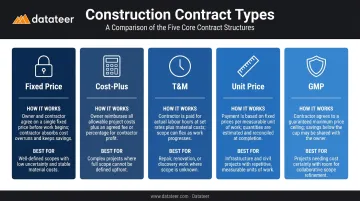
According to AIA, GMP is structured as a cost-plus-fee arrangement (see AIA A102-2017) with an owner payment ceiling subject to authorized contract adjustments.
Large commercial projects often blend contract types across phases — GMP for construction, T&M for preconstruction services. This layering adds complexity to financial tracking and requires clearly defining which terms govern each phase.
Core Operational Clauses: Scope, Timeline, and Change Orders
Scope of Work
The Scope of Work (SOW) defines what will be built, to what standard, and by what means — including drawings, specifications, materials, and deliverables. A vague SOW is the most common root cause of scope creep, and scope creep inflates costs while disrupting financial forecasting.
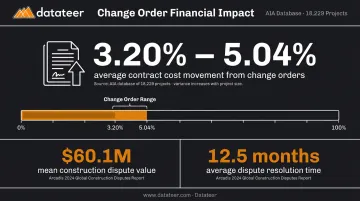
HKA's 2025 CRUX dataset, covering over 2,200 disputed or distressed projects globally, found that scope change affected 28% of projects completed after 2020. In Arcadis's 2024 North American disputes analysis, contract document errors, omissions, and owner-directed changes ranked among the leading dispute causes — with the mean dispute value rising to $60.1 million and average resolution time at 12.5 months.
Those numbers put a dollar figure on ambiguity: investing time in a precise SOW upfront is far cheaper than litigating a vague one later.
Project Timeline and Milestones
The schedule section establishes start and completion dates, interim milestones, and the conditions under which time extensions are granted. The distinction that matters financially:
- Excusable delays (weather, force majeure, owner-caused delays) — typically justify a time extension without penalty
- Non-excusable delays (contractor's failure to perform) — do not, and expose the contractor to liquidated damages
This distinction is the contractor's primary defense against LD exposure — and the same documentation discipline that protects against delay claims applies equally to change orders.
Change Orders and Constructive Changes
A change order clause establishes the formal process for modifying scope, price, or schedule after contract execution. Key elements:
- Who has authority to approve changes (owner, architect, project manager)
- How pricing is calculated — lump sum adjustment, T&M basis, or agreed unit prices
- Documentation requirements and notice deadlines
Undocumented verbal approvals are a leading cause of disputes. Contractors who perform additional work without a written change order frequently lose the right to compensation.
Constructive changes are a related — and frequently overlooked — risk. These occur when an owner or their representative indirectly forces additional work through design revisions, inspection requirements, or contradictory instructions, without issuing a formal change order.
Contractors who fail to document constructive changes in writing and assert them promptly typically forfeit their right to additional compensation.
AIA's U.S. database of 18,229 projects found average contract cost movement from change orders of 3.20% to 5.04%, depending on project size — a meaningful budget variance that finance teams should model as a baseline contingency.
Financial Clauses: Payment Terms, Retainage, Liquidated Damages, and Escalation
Payment Terms: Pay-When-Paid vs. Pay-If-Paid
Progress payment provisions typically follow either monthly billing cycles or milestone-based applications. Two critical variations:
- Pay-when-paid: Sets a reasonable timing condition : the GC pays subs within a defined period after receiving payment from the owner
- Pay-if-paid: Attempts to transfer owner nonpayment risk entirely to the subcontractor (if the owner doesn't pay the GC, the GC owes the sub nothing)
Pay-if-paid clauses are enforceable in many states but prohibited or materially restricted in at least 12 states, including California, New York, Virginia, North Carolina, and Wisconsin (per the 2025 American Subcontractors Association survey). Subcontractors working across multiple states should verify the applicable statute before signing.
Payment delays remain a pervasive problem. Rabbet's 2024 Construction Payments Report found 82% of contractors experienced delays longer than 30 days, adding an estimated $280 billion to U.S. construction costs through financing costs embedded in bids.
Retainage
Retainage is the percentage of each progress payment — typically 5% or 10% — withheld by the owner until substantial completion or final closeout. Its purpose is to ensure the contractor finishes the work and addresses deficiencies.
The cash flow math is significant: on a $20 million project with 10% retainage, a contractor may carry $2 million in tied-up working capital until the project closes out. For subcontractors, who often face retainage from the GC while simultaneously withholding retainage from their own subs, the compounding effect can create serious liquidity strain.
Key considerations:
- Several states cap retainage by statute — Washington state, for instance, limits private-work retainage to 5% of contract price under RCW 60.30.010
- Federal construction retainage is capped at 10% under FAR 32.103
- State prompt payment laws may set mandatory release timelines that supersede contract language
Datateer's Retainage Tracking module surfaces A/R retainage (owner-held), A/P retainage (owed to subs), release schedules, and overdue positions. That data feeds directly into the 13-week cash flow forecast, so overdue retainage doesn't catch a liquidity plan off guard.
Liquidated Damages
Liquidated damages (LD) clauses pre-establish the daily financial penalty a contractor owes for missing the contractual completion date, eliminating the owner's need to prove actual loss.
For LD clauses to be enforceable, Restatement (Second) of Contracts § 356 requires the amount to be a reasonable estimate of anticipated harm at the time of contracting — not a punitive figure. Courts routinely void LD provisions that look more like penalties than genuine pre-estimates.
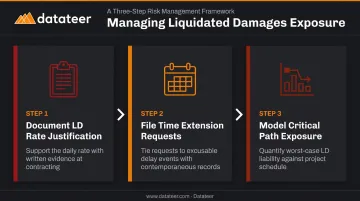
Three practical implications follow from that standard:
- LD rates must be documented with supporting justification at the time of contracting
- The contractor's primary protection against LD exposure is well-documented time extension requests tied to excusable delay events
- Finance teams should model the LD daily rate against the project schedule's critical path to quantify worst-case exposure
Escalation Clauses
Escalation provisions allow contract prices to adjust for significant post-execution increases in material or labor costs, typically indexed to an objective benchmark such as the Producer Price Index (PPI) or the ENR Material Cost Index.
The stakes are concrete. AGC reported that construction material and service input prices rose 20% between January 2021 and January 2022, while contractors' bid prices rose only 12.3%. That 7.7-point gap compressed margins on every fixed-price project with no escalation relief.
ConsensusDocs 200.1 provides a standard time-and-price impact amendment framework for escalation. These clauses are most appropriate for:
- Projects with duration exceeding 12 months
- Cost-plus and unit price contracts
- Contracts signed during periods of material cost volatility
Datateer's Material Price Escalation module tracks actual purchased costs per unit against bid-estimate unit prices, benchmarked against PPI and ENR data. Finance teams get the documentation they need to substantiate escalation claims or renegotiate pricing thresholds before margin erosion becomes irreversible.
Risk and Protection Clauses: Insurance, Warranties, Force Majeure, and Disputes
Insurance and Indemnification
Standard construction contract insurance requirements, per AIA A101-2017 Exhibit A:
- Commercial General Liability (CGL): Maintained by the contractor; project-specific limits are set in the contract schedule
- Workers' Compensation: Contractor maintains statutory workers' comp and employers' liability
- Builder's Risk / Property Insurance: Generally maintained by the owner on a completed-value basis
Two provisions that directly affect claims exposure:
- Additional insured status: Confirms which parties can make claims under a policy
- Waiver of subrogation: Prevents an insurer from pursuing recovery against another party on the insured's behalf
Indemnification clauses (AIA A201-2017, Section 3.18) define financial responsibility for third-party claims. Under AIA's standard form, contractor indemnification is proportional — it covers claims to the extent caused by the contractor's or its subcontractors' negligent acts. Broad-form indemnification (covering the indemnitee's own negligence) is prohibited in many states.
Warranties and the Defects Liability Period
Two warranty types matter in construction contracts:
- Express warranties: Specific written commitments on workmanship and materials. AIA A201 (Section 3.5) warrants new, good-quality, defect-free work. Section 12.2.2 creates a one-year correction period after substantial completion.
- Implied warranty of plans and specs: The owner's implied representation that their design documents are accurate and buildable — known as the Spearin doctrine.
The one-year correction period is a contractual remedy period, not a limitation on all warranty obligations. Defects discovered after that period may still give rise to claims under applicable statutes of repose.
Force Majeure
Force majeure clauses excuse performance delays caused by extraordinary events outside the parties' control — natural disasters, pandemics, government orders, labor strikes, or war.
Critical financial points:
- Most force majeure provisions entitle the contractor to a time extension only — not additional compensation
- The contractor must demonstrate the event actually impacted critical path activities, not just peripheral work
- Notice requirements are typically strict — late notice can forfeit the protection entirely
COVID-19 established important precedent: AIA's guidance confirmed that pandemic-related delays could qualify under A201 Section 8.3.1 for time relief, but compensation required a separate contractual basis. Before the next project kicks off, verify which events your current contracts cover — and whether those provisions extend to compensation, not just schedule relief.
Dispute Resolution and Termination
Most construction contracts follow a three-tier dispute resolution structure:
- Mandatory negotiation and notice periods — direct negotiation between the parties
- Mediation or a Dispute Review Board — structured facilitation before formal proceedings
- Arbitration or litigation — binding resolution
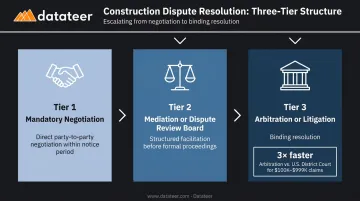
AAA data confirms that arbitration for claims in the $100,000–$999,000 range runs 3x faster than median U.S. District Court trial time. Large-dollar awards resolve approximately 1.7x faster as well — though arbitration limits appeal rights and can carry significant arbitrator fees.
On termination, contracts typically include two distinct provisions:
- Termination for cause: Triggered by material breach — repeated failures to provide labor or materials, nonpayment of subcontractors, or substantial contract violations. Under AIA A201 (Section 14.2), the owner must provide seven days' notice following architect certification.
- Termination for convenience: The owner's right to end the contract without fault. Under Section 14.4, the contractor is entitled to recover costs for properly executed work, lower-tier termination costs, and any agreed termination fee.
How Contract Terms Drive Financial Performance
Understanding contract clauses on paper is only half the equation. The financial risk materializes when project actuals diverge from contract commitments — and no one catches it in time.
Common scenarios where this happens:
- Retainage accumulates beyond forecast, straining near-term working capital
- Change orders are performed in the field but sit unapproved for 60+ days, eroding margin without corresponding revenue recognition
- Payment delays compound across multiple projects simultaneously, creating a portfolio-level liquidity problem
- Material cost increases exceed contracted escalation thresholds, but no claim is filed because the documentation doesn't exist
Construction finance teams that monitor these variables continuously (rather than waiting on end-of-month spreadsheet reconciliations) are able to intervene while options still exist.
That kind of continuous monitoring requires more than a spreadsheet refresh. Datateer's construction finance dashboards sync directly with 12+ construction ERPs — Procore, Sage, Viewpoint Vista, Acumatica, CMiC, Foundation, and others — giving CFOs and finance managers real-time visibility into retainage positions, change order aging, budget-to-actual variances, and 13-week cash flow forecasts. The Change Order Impact & Aging module tracks change orders across all four status stages (pending, approved, denied, executed), aging by days since submission, and margin impact, so stalled change orders surface before they become disputes.
A practical recommendation: create a contract financial summary document for each project that maps key contract terms — payment milestones, LD daily rate, retainage percentage, GMP ceiling — to corresponding financial line items. This ensures that contract exposure is always visible alongside project cost data, not buried in a separate binder.
Frequently Asked Questions
What are the key terms of a construction contract?
The core categories are scope of work, payment terms and schedule, project timeline and milestones, change order procedures, risk allocation (insurance and indemnification), warranties, force majeure, dispute resolution, and termination provisions. Each clause shapes how financial risk and legal responsibility are distributed between owner and contractor.
What are the 7 rules of a contract?
A legally enforceable contract requires offer, acceptance, consideration, mutual assent, capacity, legality, and — for construction contracts in most U.S. states — a written agreement under the Statute of Frauds. Offer and acceptance are the two components that establish mutual assent.
What is retainage in a construction contract?
Retainage is the percentage of each progress payment — typically 5% or 10% — that the owner withholds until project completion or final closeout. It protects the owner against incomplete or defective work, but creates significant cash flow pressure for contractors and subcontractors who must finance that withheld amount throughout the project.
What are liquidated damages in a construction contract?
Liquidated damages are a pre-agreed daily penalty the contractor owes for late delivery, compensating the owner without requiring proof of actual loss. To be enforceable, the daily rate must reflect a reasonable estimate of anticipated harm at signing — courts void LD clauses that function as punitive penalties rather than genuine pre-estimates.
What is a change order and why does it matter financially?
A change order is a formal written amendment that modifies the contract's scope, price, or schedule. Without a documented process, contractors risk performing additional work without compensation while owners face cost increases that were never formally approved.