Introduction
Refineries, power plants, and processing facilities represent some of the largest capital investments in construction. They also fail at a rate that should concern every owner, EPC contractor, and finance leader involved — according to KPMG's Global Construction Survey, only 25% of projects came within 10% of their original budget.
Most organizations believe they have project controls in place. What they actually have is reporting. Reporting tells you what already happened. Controls tell you what is about to happen — while there's still time to act.
The gap shows up in predictable ways:
- Budget variances that surface too late to address
- Cost and schedule data living in separate systems
- Finance teams buried in spreadsheet reconciliation instead of providing strategic guidance
- Project leadership making decisions on information that's already weeks old
This guide covers project controls in industrial construction — what they are, how they differ from project management and PMO functions, their core components, why projects fail without them, and how financial data quality determines whether your controls system actually works.
Key Takeaways
- Project controls measure performance against the plan — distinct from project management, which focuses on execution
- The five core components are planning and scheduling, cost management, risk management, change control, and performance measurement
- Unvalidated baselines, data silos, and late financial reporting are the leading causes of project failure
- Effective controls require a single source of truth connecting field data, cost commitments, and schedule performance
- Real-time data shifts finance teams from forensic accounting to strategic project partners
What Are Project Controls in Industrial Construction?
Project controls are the integrated system of people, processes, and tools used to plan, measure, analyze, and forecast project performance across cost, schedule, scope, and risk. The explicit purpose: enabling decisions while those decisions can still change outcomes.
As AACE International's Total Cost Management Framework defines it, project control is "the quantitative resource-control subset of the project management process." That quantitative distinction matters. Project controls isn't a communication function or a governance layer — it's an analytical discipline.
What Makes Industrial Construction Different
Industrial projects operate in a fundamentally higher-stakes environment than commercial or residential construction:
- EPC contract structures that distribute risk across owners, EPCs, and subcontractors with complex interdependencies
- Multi-year timelines where small early variances compound into large late-stage problems
- Massive capital exposure across project types from utility-scale power plants to petrochemical processing facilities
- Multi-stakeholder environments involving regulators, lenders, and multiple tiers of contractors — each with different data systems
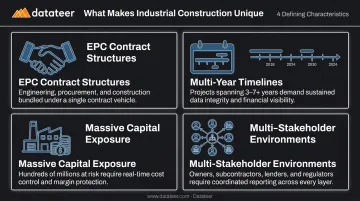
Every control failure in this environment carries consequences that commercial construction simply doesn't face at the same scale.
Controls vs. Reporting
A status report tells stakeholders where the project stood at month-end. A controls system surfaces whether the current trajectory is pointing toward on-time, on-budget delivery — and does so early enough to intervene.
It determines whether your organization catches a 2% variance or discovers a 10% overrun.
Origins in EVM — And Beyond
Project controls trace their origins to Earned Value Management, which the DoD formalized in 1967 through DoDI 7000.2. Modern practice has expanded well beyond EVM to integrate schedule analytics, risk quantification, and real-time cost tracking across the full project lifecycle.
Project controls is not a software category. Per AACE Recommended Practice 60R-10, it's a structured framework that runs parallel to the construction project from day one. The right software accelerates that framework — but the framework has to exist first.
Key Components of Project Controls in Industrial Construction
Planning and Scheduling
Planning establishes the CPM (Critical Path Method) baseline — the network of sequenced activities that determines the earliest possible completion date and calculates float for every non-critical task.
A baseline that hasn't been validated for logic density, float distribution, and constraint usage is not a controls instrument. It creates direct exposure. AACE Recommended Practice 78R-13 addresses this directly, providing evaluation criteria for original baseline CPM schedules on EPC projects specifically.
The schedule connects every other control discipline:
- Cost exposure is only visible relative to schedule progress
- Risk probability is assessed against available float reserves
- Change impacts are only defensible against a reliable baseline
A schedule that hasn't been formally reviewed before execution begins isn't a starting point for controls — it's a starting point for future disputes.
Cost Management
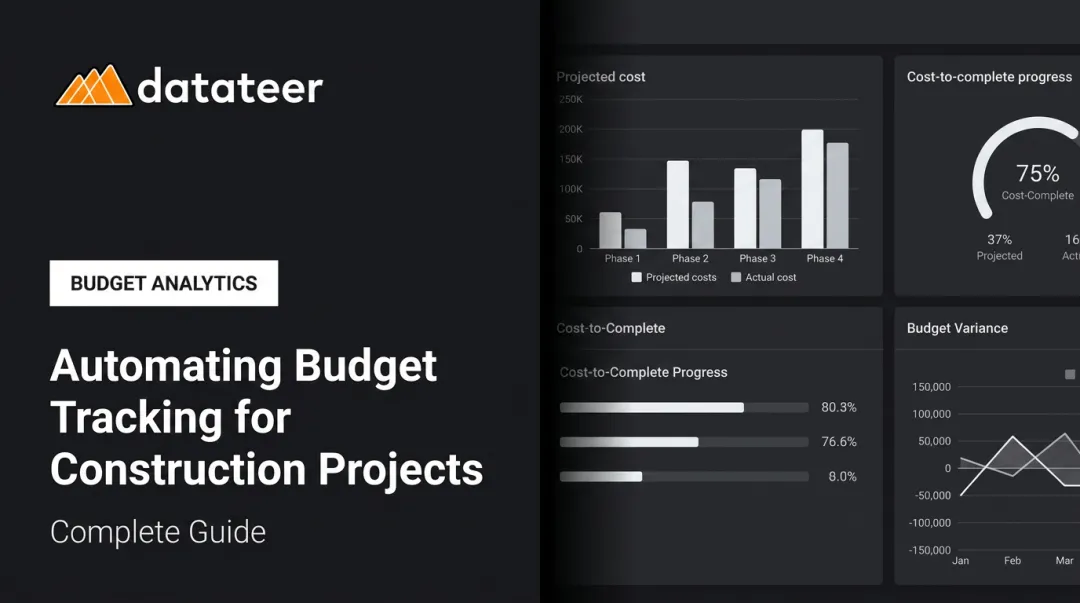
Cost management tracks actual expenditures against budget, generates cost-to-complete (CTC) projections, and performs variance analysis. On industrial projects, this must account for procurement commitments, subcontractor pay applications, material escalation, and multi-year cash flow curves — not just labor and direct costs.
Key metrics used in industrial construction cost management:
| Metric | What It Measures |
|---|---|
| Cost Performance Index (CPI) | Earned value per dollar spent |
| Budget at Completion (BAC) | Total authorized budget |
| Estimate at Completion (EAC) | Forecasted final cost |
| Cost Variance (CV) | Difference between earned and actual cost |
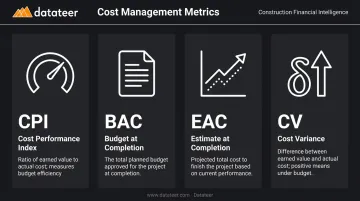
These metrics are only as reliable as the data feeding them. Stale or manually assembled cost data produces misleading signals — and bad decisions follow directly from those signals.
Risk Management
Risk management in project controls goes beyond maintaining a register. It involves quantifying the schedule and cost exposure of identified risks against current float levels and budget contingency, then executing mitigation before those risks materialize.
The stakes are clear: McKinsey's analysis of 300+ $1B-plus megaprojects found average cost overruns of approximately 80% and schedule delays of about 50%. Risk that isn't quantified and tracked against the baseline isn't managed — it accumulates until the damage is irreversible.
AACE's estimate classification system (18R-97) makes the risk-definition link explicit: a Class 5 estimate at 0–2% project definition carries accuracy ranges of -20% to -50% on the low side and +30% to +100% on the high side. Better-defined projects carry dramatically narrower ranges. Early investment in risk quantification directly narrows cost uncertainty.
Change Control
Change control is the formal process for evaluating proposed scope modifications before they're executed — assessing time and cost impact, obtaining approvals, and updating the baseline.
Scope creep is rarely dramatic. It accumulates through dozens of small, unapproved adjustments that individually seem manageable. Together, they erode schedule float and budget contingency before anyone has reviewed the cumulative impact.
An effective change control system tracks:
- Pending, approved, denied, and executed changes
- Aging by days since submission
- Revenue and margin impact tied to specific cost codes
- Work performed but not yet approved — the highest-risk exposure category
Stalled change orders eat margin silently. Datateer's Change Order Impact & Aging analytics surface stalled approvals across the full approval chain by connecting Procore and ERP data — so pending items don't disappear between systems.
Performance Measurement and Reporting
Performance measurement synthesizes data from all other disciplines into the KPIs that guide decisions: SPI (Schedule Performance Index), CPI, earned value, and cost variance trending.
The difference between measurement and analysis: knowing the numbers versus understanding what the trajectory demands.
Reporting frequency matters. Monthly updates create a 30-day window during which problems compound undetected. DOE requires contractors to submit project performance data monthly at minimum — and that's the floor, not the ceiling. For industrial construction projects with tight liquidated damages clauses, monthly is often not frequent enough.
Why Industrial Construction Projects Fail Without Effective Project Controls
The data on project failure is not a warning about edge cases. It describes the default outcome.
Oxford's analysis of 3,022 projects found that only 2.8% were on budget and on time. Just 0.2% met cost, schedule, and benefits targets. McKinsey's Flyvbjerg-database analysis puts the share of projects meeting cost and schedule at 8.5%.
The Typical Failure Pattern
Projects don't fail suddenly. They fail through a predictable sequence:
- Execution begins against an unvalidated baseline — logic gaps are invisible because no one has measured them objectively
- Early performance looks normal — float absorption and minor overruns don't trigger alarms
- Three to six months in, the schedule slips and costs trend over simultaneously
- By the time leadership is informed, the forensic record is fragmented and recovery options are expensive
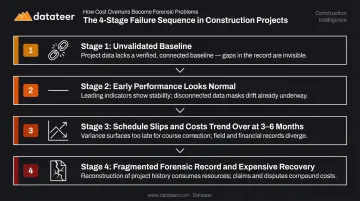
The breakdown starts with an unvalidated baseline and compounds through data silos and delayed reporting. Neither is inevitable — but both require deliberate systems to catch early.
The Cost of Late Detection
Problems identified early cost a fraction of what they cost after they've compounded. When variances go undetected, both direct and indirect costs pile up fast:
- Extended general conditions from prolonged schedules
- Acceleration premiums to recover lost time
- Lost productivity across trades and subcontractors
- Subcontractor claims that turn overruns into disputes
On industrial projects with liquidated damages clauses, late detection doesn't just hurt margins — it can turn a manageable overrun into a contract dispute.
The Financial Data Lag Problem
There's a specific failure mode that gets less attention than baseline quality: the financial data infrastructure problem.
When WIP reports take 10–20 days to generate manually — a common reality for industrial construction finance teams working across multiple ERPs and cost code systems — the cost data informing project controls decisions is already weeks old. A variance that could have been caught at 2% deviation becomes a 10% overrun by the time it surfaces.
That's not a scheduling problem. It's a financial data infrastructure problem — and closing that lag is precisely where project controls either hold or break down.
Project Controls vs. Project Management vs. PMO
These three functions are frequently conflated, and the confusion creates real blind spots in how industrial projects get measured and managed.
Project Management vs. Project Controls
Project management is responsible for execution: coordinating resources, managing subcontractors, communicating with stakeholders, and driving daily progress.
Project controls is the analytical measurement layer that evaluates whether execution is happening as planned and forecasts where it's headed.
The two roles are complementary but structurally separate. When the person making execution decisions is also responsible for objectively measuring those decisions, the controls function loses its integrity — and problems go unreported until they're expensive.
This structural risk is common in mid-market industrial construction firms that understaff the controls function — treating it as an add-on to the PM role rather than a separate analytical discipline.
PMO vs. Project Controls
A PMO (Project Management Office) sets governance standards and portfolio-level oversight across multiple projects. It defines the standards that controls teams follow.
Project controls is the operational data discipline applied at the individual project level — executing those standards on live job data.
On large industrial programs, both functions exist. Conflating them produces a firm with excellent governance documentation and no one actually running the numbers at the job level.
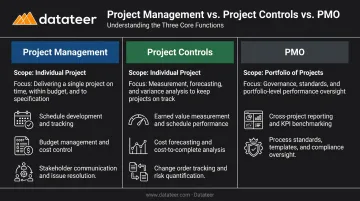
Here's a quick-reference summary of how the three functions differ:
| Function | Scope | Primary Focus |
|---|---|---|
| Project Management | Individual project | Execution — resources, schedule, stakeholders |
| Project Controls | Individual project | Measurement — cost, schedule, forecast accuracy |
| PMO | Portfolio / organization | Governance — standards, process, oversight |
Best Practices for Implementing Project Controls on Industrial Projects
Validate the Baseline Before Execution Begins
Define scope, cost, and schedule benchmarks early — and subject the CPM schedule to a formal quality review before it becomes the controls instrument. Per AACE 78R-13, that review should check for:
- Logic gaps and missing activity connections
- Float inflation from missing constraints
- Broken critical sequences that would produce false float readings
- Activity density relative to the complexity of the work package
A baseline that hasn't been validated is a starting point for a future dispute, not a controls foundation.
Standardize Data Workflows and Reporting Cadence
Change orders, pay applications, procurement commitments, and field progress entries should follow consistent, defined paths with role-based accountability at each step. Establish update intervals contractually where possible.
Inconsistent cadence — skipped updates, delayed submissions, informal approvals — erodes the controls system faster than any single project event. The DOE's PARS reporting requirements mandate that performance data be due no later than the last workday of every month. When that cadence slips, variance detection lags — and by the time finance teams see the problem, the correction window has often closed.
Connect Field-to-Office Data in a Single Integrated Environment
Eliminate the gap between what's happening on site and what finance and project leadership are seeing. When field logs, cost commitments, and schedule updates feed into the same system used by project managers and finance teams, variances surface as they develop — not weeks after month-end close.
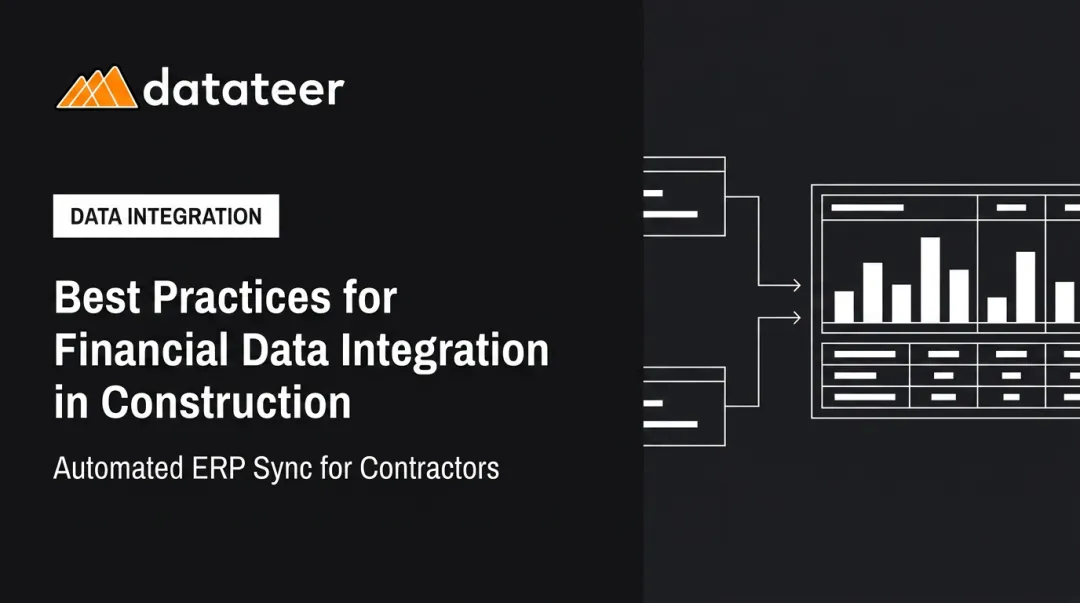
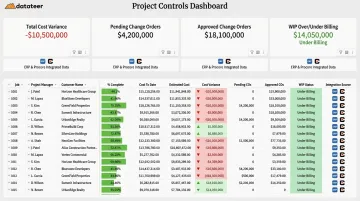
Datateer is built specifically for this integration problem. It connects to Procore for field and project management data and syncs directly with construction ERPs — Viewpoint Vista, CMiC, Sage, Acumatica, and others — to give project managers and finance teams a shared view of project performance. Practically, that means:
- Commits reconciled to invoices automatically, without manual matching
- Cost codes standardized across projects at the data layer
- Variances visible to both field and finance as they develop, not after month-end close
How Real-Time Financial Data Strengthens Project Controls
The Data Lag Problem in Practice
In many industrial construction firms, generating a WIP report requires 10–20 days of manual data gathering, spreadsheet reconciliation across multiple ERPs and cost codes, and error-prone formatting work. By the time the report reaches the project controls team, the data is already history.
The controls function is making forward-looking decisions with backward-looking information. Variances compound during that gap. A 2% cost overrun that would have triggered a corrective action becomes a 10% problem by the time it's visible.
What Real-Time Visibility Changes
When cost data is current, finance managers can identify labor slippage, budget overruns, and liquidity risks as they develop — not after month-end close. This shifts the finance team's role from explaining what happened to shaping what happens next — from forensic accounting to active project controls partnership.
On industrial projects where margin is thin and capital exposure is large, catching a variance early versus late is often the difference between a recoverable situation and a dispute.
The specific modules that matter most for project controls — Job Costing & Cost-to-Complete, Cost Variance, WIP Reporting, and Change Order Impact & Aging — surface CPI, SPI, EAC, and cost variance trending continuously, not just at month-end.
From Manual Grind to Real-Time Control
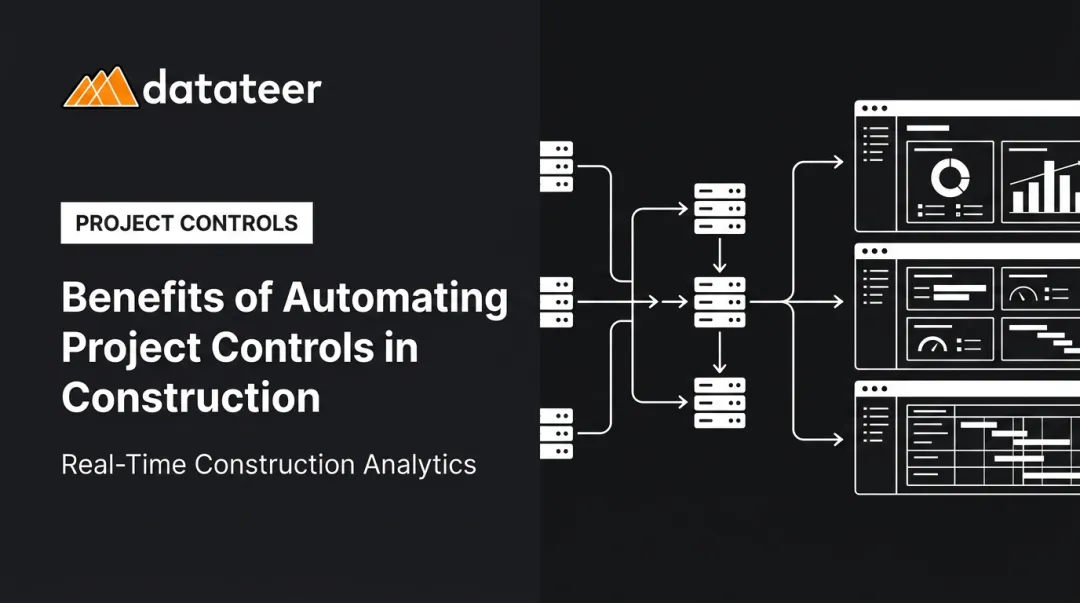
Datateer automates financial data flow directly from construction ERPs — including CMiC, Viewpoint Vista, Acumatica, and Sage — to executive dashboards, delivering a 2-minute real-time refresh that replaces the traditional 10–20 day WIP reporting cycle. Cost code standardization happens automatically during extraction — including Procore-to-Sage reconciliation that previously consumed days before every board meeting.
Finance teams get out of the data-gathering role and into actual project controls work. One client, Double L Management, reported that the first time their team accessed data through Datateer's dashboards, "that one click replaced two weeks worth of prior work."
"That one click replaced two weeks worth of prior work." — Double L Management
When your team can intervene days earlier, the financial outcome on a thin-margin industrial project is categorically different. That's the operational shift real-time visibility enables.
Frequently Asked Questions
What do project controls do in construction?
Project controls integrate cost, schedule, scope, and risk data to continuously measure performance against the baseline plan. The goal is surfacing variances early enough to act while outcomes can still be influenced — not documenting what went wrong after the fact.
What is the difference between PMO and project controls?
A PMO establishes governance standards, processes, and portfolio-level oversight across an organization's projects. Project controls is the analytical discipline applied at the individual project level to measure performance, forecast outcomes, and manage cost, schedule, scope, and risk.
What are the 7 stages of project management?
Most frameworks reference five stages: initiation, planning, execution, monitoring and controlling, and closeout. Some expand this to seven by separating feasibility, design, and procurement into distinct phases. Project controls operate across all stages, not just monitoring.
What is the difference between project controls and project management?
Project management focuses on leading execution — coordinating teams, managing contracts, driving progress. Project controls focuses on analytical measurement: asking whether execution is happening as planned and forecasting where it's headed.
What are the key components of project controls in construction?
The five core components are planning and scheduling, cost management, risk management, change control, and performance measurement. These disciplines are interconnected — the schedule serves as the connective tissue that all other components measure against.
How does financial data quality affect project controls?
Project controls are only as reliable as the data feeding them. When cost data is weeks old due to manual WIP reporting, the system makes forward-looking decisions on stale inputs. Automated ERP data sync eliminates that lag, surfacing variances while there's still time to course-correct.