According to a 2021 IDC survey commissioned by Procore, 75% of construction owners and developers went over their planned budgets, with projects averaging a 15% increase in total cost after budget and schedule changes. Change orders sit at the center of that cost growth — not because they're inherently problematic, but because they routinely go untracked, get processed weeks after the work is done, or never make it into the financial records at all.
The deeper problem is perception. Most firms treat change order tracking as back-office paperwork — something to clean up at project close. That framing is where margin fade begins and where payment disputes are born. This article makes the case for treating change order tracking as a financial control discipline, and explains the specific operational and financial advantages that come with doing it consistently.
Key Takeaways
- Untracked change orders corrupt WIP schedules and distort budgets — often weeks before the billing gap surfaces
- Without a written record, verbal approvals become payment disputes that are nearly impossible to win
- Delayed billing on change orders creates cash flow gaps that contractors fund out of pocket
- Scope creep is invisible without a log — the contract price stays fixed while the work silently expands
- Firms that track consistently close projects cleaner and carry fewer disputes into the next job
What Is Change Order Tracking?
Change order tracking is the systematic process of documenting, monitoring, and managing every modification to the original construction contract — from scope changes and cost adjustments to schedule impacts — from initiation through final approval.
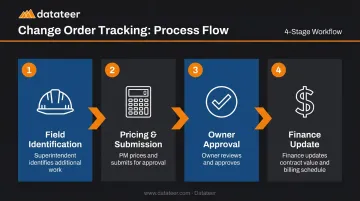
It operates at every stage of project execution:
- A field superintendent identifies additional work
- The project manager prices it and submits for approval
- The owner reviews and approves the change
- Finance updates the contract value and billing schedule
Change order tracking is the thread connecting all of those steps into a coherent, auditable record.
Change order tracking functions as a financial control mechanism, not a documentation task. Every deviation from the original contract must be captured, priced, approved, and reflected in the project's financial picture before it affects cash flow or triggers a dispute.
Without that control, scope expands while the contract stays flat. Costs are incurred but never billed. That gap between what was done and what was documented is precisely where margin disappears.
Key Advantages of Tracking Change Orders in Construction
The advantages below are grounded in outcomes construction firms actually measure: cost control, legal standing, cash flow, and risk exposure. They compound over time, too. Firms with consistent tracking protect margins project by project. Firms without it accumulate exposure that often can't be quantified until a job has already closed.
Advantage 1: Budget Accuracy and Financial Visibility
Systematic change order tracking keeps the project's financial baseline current. Every approved change gets reflected in the revised contract value, which means cost overruns can't quietly erode margins over weeks while no one is watching.
In practice: when each change order is logged with its cost breakdown and approval status, project managers and finance teams can see cumulative budget impact in real time — not after month-end close.
Why this matters for WIP integrity:
Untracked change orders directly distort WIP (Work-in-Progress) schedules. When approved scope additions aren't reflected in the revised contract value, the WIP report produces false overbillings or underbillings. Leadership makes decisions based on those numbers. Lenders and bonding agents review them.
A WIP schedule built on an understated contract value carries real financial and legal exposure — not just reporting inaccuracy.
The financial visibility advantage also changes the timing of interventions. With accurate, real-time budget data, finance managers can catch margin fade while there's still time to act. Without it, cost overrun investigations happen after the job closes, when the only option is after-the-fact cost reconstruction.
KPIs this affects:
- Budget variance
- Cost-to-complete accuracy
- WIP overbilling/underbilling
- Gross margin by project
- Contract value reconciliation
When it matters most: Multi-phase projects with high change order volume, where cumulative cost drift is nearly invisible without a structured system behind it.
Advantage 2: Legal Protection and Dispute Prevention
Every tracked and approved change order is a signed, documented record of what was agreed. That paper trail is the primary defense when disputes arise over scope, payment, or schedule.
A well-maintained change order log provides a chronological, auditable history of every contract modification. It's difficult for any party to claim ignorance of a scope change or cost adjustment when there's a signed record in front of them.
Why the legal stakes are high:
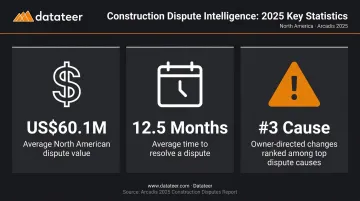
According to Arcadis's 2025 North America Construction Disputes Report, the average construction dispute in North America carries a value of US$60.1M and takes 12.5 months to resolve. Owner-directed changes ranked among the top three dispute causes. That's more than a year of organizational bandwidth and legal expense — for a single dispute.
The case law reinforces the point. In Ryan Cos. US, Inc. v. FDP WTC, LLC (Iowa Ct. App. 2022), the court concluded that Ryan's failure to obtain contractually required written change orders precluded payment for that extra work. The work was done. The documentation wasn't. That was enough.
Consistent documentation also speeds up payment. Clients and GCs have less basis to dispute invoices when every line item ties back to an approved change order.
KPIs this affects:
- Number of disputed change orders
- Claim frequency
- Days to payment on change order invoices
- Litigation or arbitration costs
When it matters most: Projects with multiple subcontractors, owner-initiated design changes mid-project, or contracts with strict notice windows — where the margin for undocumented work is essentially zero.
Advantage 3: Cash Flow and Billing Accuracy
Untracked change orders are, functionally, unbilled revenue. Work has been performed. It just hasn't been formally captured, priced, and submitted for payment.
Why scope changes become cash flow problems:
HKA's 2025 CRUX Insight Report, covering over 2,200 projects across 114 countries, found that change in scope was the most frequent cause of conflict, affecting just over 28% of post-2020 projects. Much of that conflict traces back to extra work that was performed but not formally documented before billing.
When change orders are documented promptly and linked to billing milestones, the gap between work performed and invoice submitted compresses significantly. Cash position on active projects improves.
Delayed billing — common when tracking is informal or paper-based — forces contractors to fund work they haven't been paid for. That gap compounds across multiple active projects simultaneously. A specialty contractor missing even a small percentage of change order billings per job faces meaningful revenue leakage at the portfolio level.
KPIs this affects:
- Days outstanding on change order billing
- Accounts receivable aging
- Billing cycle time
- Cash flow from operations per project
When it matters most: Specialty contractors and subcontractors performing frequent scope additions across many active jobs, where unbilled change orders accumulate quickly and the impact hits cash position before anyone runs a report.
What Happens When Change Orders Go Untracked
These aren't edge cases. Skipping change order tracking produces predictable, compounding failures — and they compound fast.
- Scope creep goes undetected. The project scope expands while the contract price stays fixed, so the contractor absorbs costs they were never paid for.
- WIP reports become unreliable. Unrecorded change orders corrupt the revised contract value — which throws off over/under billing calculations and blinds leadership to actual project profitability.
- Billing disputes escalate. Without documentation, owners and GCs dispute extra work invoices, withhold payment, or claim the work was in the original scope all along.
- Legal exposure compounds. Contractors relying on verbal agreements have no recourse when payment is disputed — and the longer the project runs undocumented, the more expensive that gap becomes to close.
- Finance teams go reactive. Instead of delivering proactive project intelligence, they spend cycles resolving disputes and reconstructing documentation that should have existed from day one.
How to Get the Most Value from Change Order Tracking
Tracking delivers its full value when applied consistently from the first scope modification — not retrospectively at project close.
The core behaviors:
- Submit change orders promptly — ideally within 7–14 days of the triggering event, consistent with notice requirements in most standard contract forms (AIA A201 uses a 21-day concept; ConsensusDocs commonly requires 14 days)
- Maintain a centralized log of all open, pending, approved, and denied items
- Review cumulative contract value impact at every billing cycle, not just month-end
Process discipline only goes so far. Change order records need to feed directly into financial reports — job cost summaries, WIP schedules, cost-to-complete calculations — so every approved modification is reflected in the numbers leadership relies on.
Construction finance teams using Datateer can connect change order data from ERPs like Procore, Sage, Vista, Spectrum, and Acumatica directly to executive dashboards. The platform's Change Order Impact & Aging Analytics tracks the full lifecycle (pending, approved, denied, executed), with aging by days since submission and revenue and margin impact tied to specific cost codes and project phases.
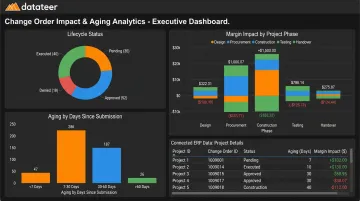
That turns what was once a manual reconciliation exercise into a real-time view of revised contract value, billing status, and margin exposure across all active projects.
The firms that extract the most value treat change order tracking as a shared responsibility across field, project management, and finance, not a task that lives in a single inbox. Consistent process, regular review cadence, and direct integration with financial reporting are what separate firms that control their margins from those who discover problems after the damage is done.
Conclusion
Change order tracking matters because construction margins are thin, timelines are tight, and the gap between undocumented work and paid work is where profitability erodes — often before anyone notices it's happening. Firms that track consistently close projects cleaner, maintain more accurate WIP schedules, and give their finance teams data to act on rather than reconstruct.
The firms that don't track change orders don't just lose money on individual invoices. Dispute exposure accumulates, financial reports become unreliable, and project close-out turns into forensic reconstruction work — effort that consistent documentation would have made unnecessary.
Change order tracking is one of the most direct financial controls available to a construction firm — and it pays for itself the first time it prevents a disputed invoice or catches a cost overrun before the margin window closes. Platforms like Datateer's Change Order Impact & Aging analytics make that visibility automatic, pulling directly from your ERP so nothing slips through between the field and the invoice.
Frequently Asked Questions
Why do change orders need to be tracked?
Untracked change orders distort project budgets, corrupt WIP reports, delay billing, and leave contractors without documentation when payment disputes arise. Tracking converts informal scope changes into an auditable, billable, legally defensible record that protects both cash flow and margin.
Are change orders good or bad?
Change orders are neutral — they're a normal, expected part of construction. The issue isn't that they exist, but whether they're managed well. Properly tracked change orders protect both parties; unmanaged ones are where disputes and cost overruns originate.
Who is responsible for keeping track of change orders?
Responsibility is typically shared: project managers initiate and document scope changes, owners or GCs approve them, and finance teams ensure approved changes are reflected in billing and financial reports. Breakdowns usually happen when no single person owns the full change order log.
Can a contractor decline a change order?
Yes — a contractor can decline to perform work under a proposed change order if the price or terms aren't agreed upon. However, contracts with "change directive" clauses may allow the owner to direct work to proceed before full agreement. Contractors should check their contract terms and respond in writing either way.
What happens if a change order is not approved before work begins?
Performing work without prior written approval is a common source of non-payment disputes. Without documented authorization, contractors often find it difficult to collect for extra work — especially if the owner claims it was within the original scope. Most contracts require written approval before additional work proceeds.
How do untracked change orders affect WIP reports?
WIP reports depend on an accurate revised contract value. When approved change orders go unrecorded, the contract value stays understated — causing false overbillings or misleading cost-to-complete figures that make the project appear healthier or worse than it actually is.