Introduction
Construction finance teams are caught in a frustrating loop: leadership wants accurate material cost forecasts, but the cost data needed to build them is weeks old by the time it arrives.
The issue isn't forecasting methodology. Most construction CFOs and controllers understand rolling forecasts, earned value, and escalation assumptions well enough. The problem is infrastructure.
When WIP reports and job cost data take weeks to compile after period close, every forecast is built on numbers that no longer reflect project reality. Material prices have shifted, deliveries have landed, and invoices have posted — none of it visible until the report finally shows up. By then, the overrun is already baked in.
This article covers what material cost forecasting actually requires, why manual reporting undermines it at the foundation, a practical forecasting process, and how automated reporting connects field costs directly to financial decisions.
Key Takeaways
- Material cost forecasting requires current job cost data — spreadsheet-based reporting can't reliably provide it
- The ENR 20-city average steel price rose 11.9% in 2025 — price assumptions from six months ago may already be wrong
- Without standardized cost codes and rolling forecast models, real-time budget visibility is impossible to sustain
- Overnight ERP-to-dashboard sync eliminates weeks of manual reporting work — data flows without anyone touching a spreadsheet
- Tracking CPI, Estimate to Complete, and cost code variance gives finance teams early warning before overruns become unrecoverable
What Is Construction Cost Forecasting — and Why Does Reporting Matter?
Construction cost forecasting is the ongoing process of predicting total project costs — materials, labor, and equipment — throughout a project's lifecycle to protect budget integrity and maintain margins. Unlike a one-time bid estimate, it's a continuously updated financial model that evolves as actuals come in, schedules shift, and market conditions change.
Why Material Costs Are the Hardest Variable to Control
Material costs are uniquely volatile. Steel, lumber, concrete, and copper prices shift with global supply chains, inflation, tariffs, and regional demand fluctuations. A price assumption baked into a bid can be significantly off by the time procurement actually happens.
The scale of these shifts is clear:
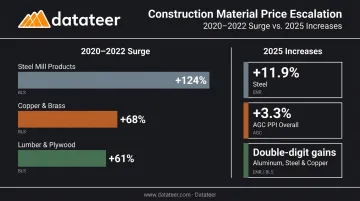
- ENR reported its 20-city average steel price rose 11.9% in 2025
- The AGC's Producer Price Index for construction materials and services rose 3.3% from December 2024 to December 2025, with double-digit increases in aluminum, steel, and copper
- During 2020–2022, steel mill products rose 124%, copper and brass 68%, and lumber and plywood 61% from April 2020 to June 2022
For multi-phase projects especially, static price assumptions built at bid time are a major source of forecast error.
The Reporting Quality Problem
Those material price swings only matter if the cost data feeding your forecast is current and accurate. Even a well-designed forecasting model breaks down when the underlying data is two weeks old, manually entered, or mapped to the wrong cost codes.
The quality of a material cost forecast is a direct function of reporting speed and accuracy. Common data quality failure modes include:
- Stale actuals — cost data updated weekly or monthly instead of daily
- Manual entry errors — transcription mistakes when moving data between systems
- Cost code mismatches — materials booked to the wrong codes, distorting variance reports
- Missing procurement data — committed costs not reflected until invoices post
When any of these gaps exist, the forecast isn't tracking reality — it's just a number with false precision.
The Hidden Cost of Manual Reporting on Material Cost Forecasts
Manual reporting doesn't just slow things down. It actively distorts the financial picture that forecasts are built on.
The Data Lag Problem
Manual WIP and job cost reports require significant time to compile after period close. During that window, material purchases are still being processed, field costs are unreconciled, and finance is forecasting with last month's reality. By the time the report lands, the overrun is already baked in — and the window to act has likely closed.
Double L Management's Business Analyst put it plainly after implementing Datateer: "That one click replaced two weeks worth of prior work."
The Error Propagation Problem
Manual cost code entry, copy-paste from procurement systems, and spreadsheet formula dependencies mean that a single miscoded vendor invoice distorts budget variance reports across multiple jobs.
A misclassified concrete delivery shows up as a variance in the wrong cost code. Finance investigates the wrong line. The actual exposure goes unnoticed. Forecasts built on misclassified costs lead to misinformed go/no-go decisions on future work.
The Siloed Data Problem
Field teams capture material usage in one system. Procurement logs POs in another. Finance works from a third. Manual reconciliation between these systems consumes hours and creates version control issues — multiple versions of "the current forecast" circulating at once, each slightly different.
The Business Risk: Margin Fade
These operational failures don't stay in the back office — they compound into real margin exposure. According to KPMG's 2023 Global Construction Survey, 37% of respondents missed budget or schedule targets by 20% or more due to ineffective risk management — and 83% identified improving estimating accuracy of materials and equipment as their single biggest priority.
When material cost overruns go undetected for weeks, the window to renegotiate supplier pricing, substitute materials, or reallocate budget has often passed. At that point, the conversation shifts from course-correction to damage control — a significantly more expensive place to be.
How to Forecast Material Costs in Construction
Establishing Your Baseline
Accurate material cost forecasting starts with historical job cost data organized by material category — concrete, steel, lumber, MEP components — and mapped to standardized cost codes across all projects.
Without cost code standardization, comparing actuals to estimates or one project to another is impossible. This is the prerequisite everything else depends on.
From there, quantity takeoff anchors the forecast to actual project scope. Itemizing every material by phase and work package ensures the forecast reflects actual project requirements rather than rough lump-sum estimates.
This is where ERP-connected analytics earn their place. Datateer's Construction Material Price Tracking & Escalation Analytics module pulls historical actual purchased cost per unit directly from your ERP, trends it over time, and compares it against bid-estimate unit prices — without manual compilation.
Incorporating Market Conditions and Escalation
Static price assumptions are a leading source of forecast error on multi-phase projects. Layering in current market conditions requires:
- BLS Producer Price Index series (steel mill products: WPU1017, softwood lumber: WPU0811, ready-mix concrete: WPU13330101) and ENR's Construction Cost Index and Materials Cost Index
- Active supplier quotes — index data sets the trend, but current quotes reflect what you'll actually pay
- Escalation assumptions by material category for any project with future procurement phases
A tri-scenario approach — optimistic, most-likely, and worst-case material cost projections — helps finance teams communicate risk proportionally and set contingency budgets tied to actual exposure rather than arbitrary percentages.
Using Rolling Forecasts Instead of Static Budgets
Rolling forecasts — updated monthly as actuals come in, market data shifts, and project schedules are revised — outperform static annual budgets in construction. As materials are consumed phase by phase, the forecast should sharpen the estimate-to-complete, not stay frozen at bid-time assumptions.
Key principles for rolling forecast design:
- Pull actual spend from the ERP monthly — not manually compiled summaries that lag by weeks
- Map material spend to schedule milestones so cash timing is visible, not just the aggregate total
- Tighten the estimate-to-complete with each update — the further into a project, the narrower the range should get
- Recalibrate escalation assumptions to current PPI and ENR index data at each update cycle, not the original bid
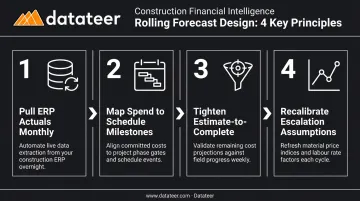
The model only works if the underlying actuals are current. ERP data that syncs overnight gives the forecast something real to update against — which is why automated data pipelines matter more here than in almost any other reporting context.
Automating Construction Reporting for Real-Time Material Cost Visibility
What Automated Construction Reporting Actually Means
Automated construction reporting is a direct integration between the construction ERP and a reporting layer that automatically extracts, cleans, and standardizes cost data — eliminating the manual export-reformat-distribute cycle entirely.
In operational terms: the platform syncs overnight from the ERP. Each morning, finance has updated job cost data reflecting the previous day's transactions — no manual exports, no spreadsheet reformatting, no waiting for IT.
The traditional reporting cycle delivers a monthly retrospective two weeks after the fact. Automated reporting replaces that lag with daily operational visibility.
How It Changes the Forecasting Dynamic
When actual material costs are visible daily rather than bi-weekly:
- Finance can compare actuals to the rolling forecast continuously
- Cost code anomalies get caught when they happen, not at month-end
- Budget reviews can be triggered before a trending overrun becomes a confirmed loss
- The forecast becomes a forward-looking tool, not a backward-looking autopsy
That shift — from reactive to proactive — only holds if the underlying data is reliable. Which brings everything back to the ERP integration layer.
The ERP Integration Layer
The reliability of automated reporting depends entirely on clean, consistent data flowing directly from source — procurement, accounts payable, job costing — without manual intervention.
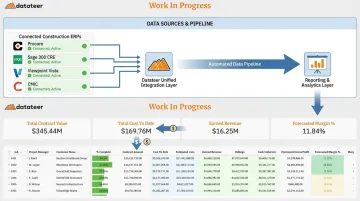
Datateer connects directly to 12 construction ERPs out of the box, with custom integrations available for other systems:
- Procore
- Sage 100 / 300 / Intacct
- Viewpoint Vista & Spectrum
- Acumatica Construction
- Foundation Software
- CMiC
- Jonas Construction
- QuickBooks & NetSuite
The automated data cleaning engine standardizes cost codes across systems, catches malformed entries, and reconciles Procore project commits to Sage invoices automatically — eliminating the manual VLOOKUP work that consumes hours before every board meeting. Flat annual pricing starts at $10,000/year per data source, with unlimited users and a 2–4 week implementation timeline.
Closing the Field-to-Office Gap
Automated reporting doesn't just benefit the finance team. When field data from Procore and office data from Sage flow into the same live dashboard, everyone is working from the same numbers.
Project managers and finance teams stop arguing about which spreadsheet is current. The forecast becomes a shared financial tool — not a back-office deliverable that arrives after the fact.
Key Metrics to Monitor in Automated Material Cost Reports
Cost Performance Index (CPI) by Material Category
CPI = Earned Value ÷ Actual Cost. A CPI below 1.0 in a specific material category — say, concrete on a foundation phase — signals overspend relative to progress and should trigger a forecast review before that phase is complete.
Tracking CPI at the material category level (not just the job level) tells you where the cost efficiency is breaking down, not just that it is.
Estimate to Complete (ETC) vs. Original Material Budget
ETC is the estimated cost of completing remaining work. Automated reports surface a running ETC for material costs at job and phase level — giving finance a forward-looking view of total material exposure at current spend rates, not just a backward-looking actual-to-date figure.
For finance teams, that forward view is what enables proactive budget adjustments — not post-mortems after the overage has already landed.
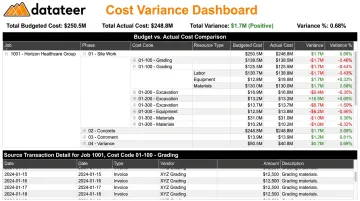
Budget Variance by Cost Code
Granular budget variance tracking — actual vs. budgeted cost by specific cost code, not just by job — allows finance to pinpoint:
- Which materials are trending over budget and by how much
- Whether the cause is a quantity overrun, unit price increase, or cost code misclassification
- What corrective action fits — each cause requires a different response
Datateer's Cost Variance dashboard presents this at job, phase, cost code, and resource type levels. Finance teams can drill down to source transactions in the ERP to investigate variances directly from the dashboard — no exporting to spreadsheets required.
Frequently Asked Questions
What is cost forecasting in construction?
Construction cost forecasting predicts and continuously updates total project costs — materials, labor, and equipment — throughout a project's lifecycle. The goal is to protect profit margins by catching variances while there's still time to act.
How do you forecast material costs in construction?
Establish a historical baseline by material category using standardized cost codes. Layer in current market pricing from sources like the BLS PPI and ENR indexes and run rolling forecasts updated monthly as actuals come in. Accurate forecasting requires current ERP data, not reports compiled weeks after period close.
How do you track construction costs with automated reporting?
Automated cost tracking uses a direct ERP integration to pull actual job costs into a live reporting layer, eliminating manual data entry. Finance gets real-time visibility into actuals vs. budget by cost code, job, and phase — refreshed overnight instead of compiled manually over weeks.
What are the key KPIs for material cost forecasting in construction?
The three most important metrics are:
- Cost Performance Index (CPI) — measures spending efficiency by material category
- Estimate to Complete (ETC) — projects remaining material cost exposure
- Budget variance by cost code — identifies which materials are driving overruns and why
What data sources feed into automated material cost forecasting?
Primary data sources are the construction ERP (job cost ledger, AP transactions, purchase orders), procurement systems, and field reporting tools like Procore. Forecast accuracy depends on these sources being integrated and synced automatically, because manual reconciliation between them introduces both lag and error.