
Introduction
Every construction project generates a constant stream of data — costs incurred, work completed, risks flagged, and schedules shifting day by day. Construction project management reports translate that raw data into the visibility leaders need to keep projects profitable and on schedule.
The challenge is that "construction report" covers everything from daily field logs to financial WIP statements. Many firms either over-report without acting on insights, or under-report until a problem becomes a crisis.
According to a 2021 Autodesk/FMI study, bad data cost the global construction industry $1.85 trillion in 2020 — and roughly 30% of construction professionals said poor data drove bad decisions more than half the time.
This article walks through the main types of construction project management reports, what each one tracks, who uses them, and the best practices that make reporting accurate, timely, and genuinely decision-useful.
Key Takeaways
- Construction PM reports divide into four categories: financial/cost, progress/schedule, risk/safety, and executive/portfolio
- Each category targets a different audience (site supervisors through CFOs) and runs on a different reporting frequency
- Delayed WIP and job cost reports are among the leading causes of undetected margin erosion
- Reliable reporting starts with standardized cost codes and direct ERP integration
- Reporting only creates value when paired with a structured review cadence
What Are Construction Project Management Reports?
Construction project management reports are structured documents that track and communicate key project data — costs, schedule, resources, risk, and safety — so every stakeholder can make informed decisions.
These reports exist at multiple levels:
- Field-level reports (daily logs, safety reports) drive operational decisions by site supervisors
- Financial-level reports (WIP, job cost, budget variance) serve the finance function
- Executive-level reports (portfolio status, feasibility) inform business leadership
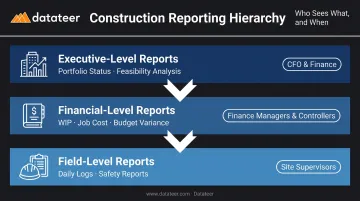
Not every report is meant for every audience. A daily construction report is irrelevant to a CFO reviewing period-end close; a WIP schedule is irrelevant to a site foreman tracking crew counts.
From Static to Dynamic Reporting
Traditional reports were manual spreadsheets compiled weekly or monthly, creating data lags that hid cost overruns and schedule slippage until it was too late to act. By the time the numbers landed on a finance manager's desk, the project had already moved on.
That lag is a solvable problem. Platforms like Datateer connect directly to construction ERPs — including Procore, Sage 100/300/Intacct, Viewpoint Vista, Acumatica, Foundation Software, CMiC, and others — and sync financial data overnight automatically. Reports that once took weeks to assemble are ready each morning without anyone touching a spreadsheet.
Why Construction Project Management Reports Matter
Decisions made without current data cost money — and in construction, that gap between what's happening on the job and what leadership sees on a report is where margin disappears.
FMI's 2025 Project Management Study found that only 2.5% of construction firms say their projects consistently finish on time and on budget. That figure isn't a technology problem — it's largely a visibility problem.
The Compounding Cost of Poor Visibility
Without consistent reporting, specific failure modes become routine:
- Crews trending over budget while the cost code report sits a month behind
- Work performed but not yet approved or billed, steadily eroding margin
- Critical path slippage discovered weeks after it was correctable
- Pay applications drifting out of sync with actual percent complete
The PlanGrid/FMI Construction Disconnected report estimated that poor project data and miscommunication caused $280 billion in rework globally in a single year, representing 52% of all rework costs.
The Stakeholder Alignment Function
Structured reports serve as a shared single source of truth that bridges the field and the office. When every stakeholder works from the same data, disputes shrink — and the ones that do surface get resolved faster.
Consistent reporting delivers alignment across the project team in several concrete ways:
- Reduces billing disputes by giving owners and PMs a shared reference point
- Resolves subcontractor disagreements against an authoritative record, not competing spreadsheets
- Keeps finance, field, and executive leadership synchronized on cost and schedule status
- Eliminates the version-control problem that makes monthly reviews unreliable
Types of Construction Project Management Reports
Construction project management reports divide into distinct categories based on purpose, audience, and reporting frequency. Using the right report for the right decision is as important as using any report at all.
Financial and Cost Reports
What they track: Where project money is going versus where it was planned to go, broken down by labor, materials, subcontractors, equipment, and overhead — organized by cost code.
Key report types:
- Work-in-Progress (WIP) report
- Job cost report
- Budget variance report
- Job profitability report
Best suited for: Construction CFOs, finance managers, controllers, and CPA advisors managing construction clients. These reports are most critical before pay applications, at period-end close, and whenever change orders are being evaluated.
The WIP report deserves special attention. AICPA-CIMA describes WIP schedules as the primary tool for revenue recognition and for measuring construction financial performance during active contracts — tracking contract price, estimated total project cost, costs incurred to date, and total billings to date. CFMA goes further, calling it the most important part of construction financial statements.
The core limitation: Financial reports are only useful if the underlying data is current. When WIP and job cost reports are assembled manually from spreadsheet exports, finance teams are always looking backward. Datateer addresses this directly — its platform eliminates the typical 10–20 day WIP reporting lag by syncing overnight from the ERP, giving finance managers current billing position without the manual assembly. The practical result: a company like Double L Management reported that "that one click replaced two weeks worth of prior work."
The Change Order Impact & Aging module extends financial visibility further by tracking pending, approved, denied, and executed change orders with aging by days since submission — surfacing stalled change orders that are eroding margin undetected while the approval process drags on.
Progress and Schedule Reports
What they track: Physical completion of work against the planned timeline — percent complete by trade or activity, milestone achievement, schedule variance, crew utilization, and upcoming activities.
Key report types:
- Daily construction report (DCR)
- Weekly progress report
- Monthly status report
Best suited for: General contractors, project managers, subcontractors, and owners who need ongoing visibility into whether the project is moving as planned. Daily reports are generated by site supervisors and capture weather conditions, workforce counts, deliveries, and incidents. Weekly and monthly reports roll this data up for leadership review.
The core limitation: Progress reports are only as accurate as the field data feeding them. According to a 2023 Dodge Construction Network report, nearly half of general contractors still rely on manual methods to gather site data, and fewer than one-third have frequent access to current site data for analysis. When field updates are delayed or inconsistent, schedule reports become unreliable — and the gap between reported completion and actual status widens without anyone noticing until a milestone is missed.

Risk, Safety, and Compliance Reports
What they track: Potential hazards, adherence to safety protocols, and any events that have already occurred on site — covering risk assessments, safety inspection reports, incident reports, and environmental compliance documentation.
Best suited for: Site supervisors, safety officers, compliance teams, and general contractors who bear liability exposure from site incidents. Project owners, lenders, and regulatory authorities also review these reports as evidence of compliance.
Unlike financial or progress reports, risk and safety documents carry legal and regulatory weight. OSHA mandates specific reporting windows:
- Recordable injuries logged within 7 calendar days
- Fatalities reported within 8 hours
- In-patient hospitalizations or amputations reported within 24 hours
Serious violations carry penalties up to $16,131 per violation; willful or repeated violations reach $161,323. The construction industry recorded 1,034 fatal occupational injuries in 2024 according to the Bureau of Labor Statistics, with falls, slips, and trips accounting for the largest share. Consistent safety documentation is a legal obligation with direct financial and human consequences.
The core limitation: The value of risk and safety reports depends entirely on consistent field documentation. Irregular reporting creates blind spots that typically surface only during audits, insurance reviews, or after a reportable incident.
Executive and Portfolio Reports
What they track: High-level financial and operational performance across multiple projects — portfolio status, cross-project cash flow, resource allocation, backlog analysis, and overall business health.
Key report types:
- Project portfolio report
- Feasibility report
- Final project closeout report
Best suited for: Construction company owners, CFOs managing multi-project portfolios, and investors or lenders who need a company-wide financial picture.
KPMG's 2023 Global Construction Survey reported that 87% of owners said large capital projects were facing increased scrutiny — and that data fragmentation across siloed systems was the primary reason executive-level reporting remained unreliable. Integrating risk reporting at the enterprise level rose in priority, with 36% of respondents emphasizing accurate risk reporting compared to 25% in 2021.
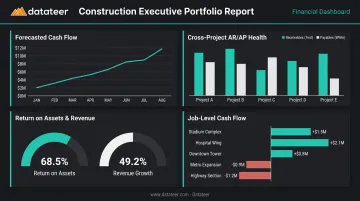
Datateer's Strategic Health and Cash Operations dashboard suites are designed specifically for this audience. Coverage includes:
- Forecasted liquidity and 13-week cash flow
- Return on assets, equity, and revenue
- Cross-project AR and AP health
- Job-level cash flow that identifies which projects generate cash versus consume it
The core limitation: Portfolio reports are only as reliable as the project-level data feeding them. Fragmented data across multiple ERPs and inconsistent cost coding across projects are the most common reasons executive reporting remains infrequent or unreliable.
Best Practices for Construction Project Management Reports
Match Frequency to the Decision Being Made
Reporting cadence should be driven by decision cycles, not default calendars:
| Report Type | Recommended Frequency |
|---|---|
| Daily construction report | Every working day |
| Progress / schedule report | Weekly or bi-weekly |
| WIP and job cost report | Monthly, aligned to billing cycle |
| Safety and incident reports | As events occur; weekly summary |
| Portfolio / executive report | Monthly to quarterly |
A WIP report produced quarterly on an active project guarantees decisions will be made with outdated information. Mismatched cadence is itself a risk.
Standardize Cost Codes and Templates Before the Project Begins
Inconsistent cost codes, varying report formats, and non-standard naming conventions across projects make it impossible to compare performance or aggregate data reliably. Treating this as a reporting problem misses the point. It's a data architecture decision that must be made during project setup and enforced at the ERP level.
Datateer's implementation process addresses this directly: its data cleaning engine standardizes cost codes across systems, catches malformed entries, and maps each firm's data logic into a unified structure. Procore project commits reconcile against Sage invoices without manual VLOOKUP work.
Integrate Reports Directly with ERP Systems
Manual report compilation — assembling WIP and job cost reports from CSV exports, email threads, and disconnected spreadsheets — is where reporting errors, delays, and version control failures originate in construction finance.
Automating the data flow from ERP to dashboard eliminates rekeying errors and the reporting lag that makes financial data stale by the time it reaches a decision-maker. Finance managers stop spending their week assembling data and start interpreting what the numbers mean.
Train Stakeholders to Interpret Reports and Act on What They Signal
Reports are only valuable if the person reading them understands the threshold that requires action. A WIP report showing overbilling, a job cost report with labor trending over budget, or a schedule showing critical path slippage each demand a specific response — and that response has to be learned.
Brief training on a handful of key metrics — cost-to-complete, percent billed versus percent complete, schedule performance index, margin variance — is as important as distributing the reports themselves. Without it, the data gets distributed but not acted on.
Build Structured Report Review Meetings into the Project Rhythm
Reporting without a dedicated review cadence creates data that is collected but not used. A practical structure that works across most construction firms:
- Weekly field-and-office sync — review progress reports, open risks, and any safety incidents from the prior week
- Monthly financial review — WIP, job cost, and billing reconciliation with the PM and finance team before pay applications go out
- Quarterly portfolio review — executive leadership reviews cross-project performance, backlog, liquidity, and resource allocation
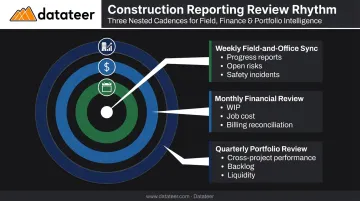
Consistent review cadence shifts a team from reactive problem-solving to proactive project control. Problems that would have compounded for months get caught in the weekly cycle, when there's still time to correct course.
Conclusion
Construction project management reports are not administrative overhead. They are the operational and financial intelligence system of a well-run project. Financial reports protect margins, progress reports track delivery, and risk reports provide legal and operational cover — each serving a distinct function that manual processes routinely leave gaps in.
ERP integration, automated dashboards, and real-time data access have moved from competitive advantage to table stakes. Firms building this infrastructure now — standardized cost codes, connected data pipelines, consistent review cadences — are the ones catching margin fade early and closing books without a two-week scramble. Platforms like Datateer exist specifically to make that infrastructure accessible to construction firms without a six-month implementation or a data engineering team.
Frequently Asked Questions
How do you write a construction project management report?
Start with a clear objective (financial, operational, or compliance) and use a standardized template aligned to your ERP data and cost codes. Include the metrics relevant to that report type, assign a consistent author and review process, and distribute to the right audience on a fixed schedule. Consistency and data accuracy matter more than format.
What are the 7 stages of a construction project?
The typical stages are conception and feasibility, design, pre-construction, procurement, construction, commissioning and handover, and closeout. Each stage carries distinct reporting needs: feasibility reports early on, WIP and progress reports through active construction, and final closeout reports at completion.
What is the most important report in construction project management?
It depends on the audience. For construction finance managers and CFOs, the WIP report is typically most critical because it tracks billing accuracy, margin health, and cash flow across active jobs. For project managers and field teams, the daily or weekly progress report is the primary operational tool.
How often should construction project management reports be updated?
Daily construction reports go out each working day; progress reports run weekly or bi-weekly. Financial reports such as WIP and job cost should align with monthly billing cycles. Portfolio and executive reports typically run monthly to quarterly depending on the firm's decision-making cadence.
What should be included in a construction project management report?
A complete construction PM report includes a project status summary, cost-to-date versus budget, schedule progress versus plan, open risks and issues, upcoming milestones, and any change orders or billing updates. The specific elements vary by report type — a daily field report and a WIP schedule serve entirely different audiences and purposes.