Misclassify retainage on the balance sheet and you distort your financial statements. Fail to track both sides simultaneously and you obscure your true cash position. Handle the ASC 606 classification wrong and your bonding capacity takes the hit.
This guide covers the mechanics of retainage, proper journal entries, ASC 606 classification rules, cash flow impact, and best practices for staying in control across a full project portfolio.
Key Takeaways
- Retainage is earned revenue — recognize it as work is performed, not when cash is received
- Retainage receivable and retainage payable must be tracked separately; netting them masks real liquidity
- ASC 606 requires contract-by-contract classification: receivable if unconditional, contract asset if conditions remain
- Strong P&L numbers can coexist with negative operating cash flow when retainage is large and slow to release
- Proactive retainage aging management and contract negotiation are as important as correct journal entries
What Is Construction Retainage?
Retainage is the portion of each progress payment withheld by a project owner — typically 5% to 10% of the payment amount — as a financial guarantee that the contractor will complete the work to specification. According to ConsensusDocs, this range is standard across both public and private construction contracts, though many states have enacted statutory caps that limit how much can be withheld.
The withheld amount doesn't release until the project reaches substantial completion, a defined milestone, or owner approval. That timeline can stretch months or even years, leaving earned funds uncollected throughout.
The Tiered Flow of Retainage
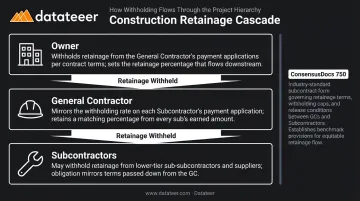
Retainage doesn't just flow between owners and general contractors. It cascades down the project chain:
- Owner withholds retainage from the general contractor on each pay application
- GC mirrors that withholding from each subcontractor on their portion of the work
- Subs may withhold from their own sub-tiers in the same fashion
ConsensusDocs 750 formalizes this structure: subcontract retainage equals the percentage the owner retains from the GC for that subcontract work. State law can impose the same requirement — California's Public Contract Code section 7201, for example, mandates this tiered withholding on public works contracts.
The practical result is a chain of withheld funds spanning the entire project duration, with the contractor in the middle: owed money from above while holding money owed to those below.
Retainage Receivable vs. Retainage Payable: The Two-Sided Picture
Construction contractors must account for retainage from both directions at once. Miss one side and your balance sheet tells a misleading story.
| Retainage Receivable | Retainage Payable | |
|---|---|---|
| What it is | Amounts owed to you, withheld by owner or GC | Amounts you owe subs, withheld pending completion |
| Balance sheet position | Asset (contract asset or receivable) | Liability |
| Release trigger | Substantial completion, owner approval, milestone | Project completion, sub's contractual conditions |
| Risk if mismanaged | Understated assets, obscured liquidity | Understated obligations, cash flow surprise |
Retainage Receivable
This is earned revenue the contractor has performed work for but cannot yet collect. It sits on the balance sheet as either a receivable or a contract asset: the distinction depends on whether any conditions beyond the passage of time remain before payment is due (more on ASC 606 classification below). Classifying it simply as "accounts receivable" without that analysis is a common error with real financial statement consequences.
Retainage Payable
This is the contractor's obligation to subcontractors for withheld amounts. It's a firm liability that must be tracked separately from standard accounts payable. Lumping retainage payable into the general AP balance understates your obligations and distorts working capital.
Both sides matter together. A contractor managing five projects simultaneously may carry $800,000 in retainage receivable while also holding $600,000 in retainage payable owed to subcontractors. Netting those figures informally, without project-level tracking, makes it nearly impossible to manage cash obligations as projects close out at different times.
How to Record Retainage in Construction Accounting: Journal Entries
The accounting treatment for retainage has one core principle: revenue is recognized when work is performed, not when cash is collected. Retainage only affects the timing of collection, not when revenue is earned.
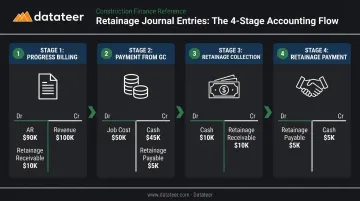
The four scenarios below cover the full retainage lifecycle: billing the owner, paying a subcontractor, collecting retainage, and releasing it downstream.
Progress Billing — Contractor Bills Owner
When a contractor submits a $100,000 progress billing with 10% retainage:
| Account | Debit | Credit |
|---|---|---|
| Accounts Receivable | $90,000 | |
| Retainage Receivable (or Contract Asset) | $10,000 | |
| Revenue | $100,000 |
The full $100,000 is recognized as revenue because the work has been performed. The $10,000 retainage goes to a separate balance sheet account — not into standard AR.
Progress Payment to Subcontractor — Withholding Retainage
When the GC pays a subcontractor their billing minus 10% retainage on a $50,000 invoice:
| Account | Debit | Credit |
|---|---|---|
| Job Cost (Subcontractor Expense) | $50,000 | |
| Cash | $45,000 | |
| Retainage Payable | $5,000 |
The full cost is recorded against the job. The withheld $5,000 becomes a liability tracked separately from standard AP.
Release Entries
When the owner pays retainage to the contractor:
| Account | Debit | Credit |
|---|---|---|
| Cash | $10,000 | |
| Retainage Receivable / Contract Asset | $10,000 |
When the contractor pays retainage to a subcontractor:
| Account | Debit | Credit |
|---|---|---|
| Retainage Payable | $5,000 | |
| Cash | $5,000 |
There's a deliberate timing gap here. Contractors typically collect retainage from the owner before releasing it to subcontractors, which means they briefly hold cash they technically owe. That window requires careful treasury management to avoid liquidity strain at project closeout.
ASC 606 and Retainage: Classification on the Balance Sheet
The April 2025 FASB Staff Educational Paper on retainage is the definitive current guidance. Every contractor preparing GAAP financial statements should understand its core requirements.
The Central Question
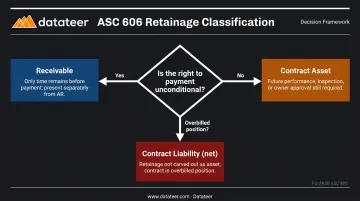
For every retainage balance, contractors must ask: Is the right to payment unconditional?
- Unconditional (only time required before payment): Classify as a Receivable
- Conditional (future performance, inspection, or owner approval still required): Classify as a Contract Asset
- Contract in overbilled position overall: Retainage is netted into the Contract Liability balance
Three Classification Outcomes
Getting this wrong affects how lenders and sureties read your balance sheet. They know the difference between a receivable and a contract asset — and so should you:
- Receivable: Contractor has fully performed the relevant scope; the only remaining condition is time. Present separately from accounts receivable in a labeled line item.
- Contract Asset: Right to payment still depends on completing future work, passing inspections, or obtaining owner sign-off. More common mid-project than at substantial completion.
- Contract Liability (net): If billings exceed earned revenue, the entire contract balance (including retainage) is presented as a contract liability. Retainage doesn't get carved out as an asset when the contract is in an overbilled position.
Contract-by-Contract Rule
FASB is clear: this determination is made at the individual contract level. A contractor cannot net a contract asset on Project A against a contract liability on Project B. Each contract stands alone on the balance sheet.
Voluntary Disclosures Now Encouraged
The FASB paper explicitly confirms that voluntary disclosures are permissible and encouraged, including parenthetical retainage amounts within contract asset line items and supplemental footnote schedules. For contractors seeking financing or working with sureties, these disclosures improve transparency and should be treated as standard practice.
How Retainage Affects Construction Cash Flow
Retainage creates a structural cash shortfall on every project, by design. Contractors fund 100% of their costs — labor, materials, equipment, subcontractors — while collecting only 90–95% of billed revenue until project closeout.
The Earnings-Cash Disconnect
Revenue is recognized on the income statement as work is performed. Cash doesn't arrive until retainage is released — which may be months or years later. A contractor can show strong profitability on paper while simultaneously burning through working capital.
That gap shows up directly on the cash flow statement: increases in retainage receivable reduce operating cash flow even when the income statement looks healthy. This is one of the most common disconnects finance teams must explain to leadership and lenders — a positive P&L does not guarantee positive operating cash flow when retainage is accumulating.
The Multi-Project Compounding Effect
The problem scales with portfolio size. A contractor running 10 concurrent projects, each with 10% retainage on $2M contracts, has $2M in earned-but-uncollected cash sitting in retainage — before accounting for any project delays or disputed releases. Multiply that across a full backlog and the working capital impact can constrain operations at every level of the organization.

What This Means for Financial Reporting
That compounding effect makes accurate financial reporting critical. Construction CFOs need to account for retainage at every layer:
- WIP schedules must separate retainage from billed AR — commingling them distorts over/underbilled positions
- Cash flow forecasts must model retainage releases as distinct inflows with their own timing, not just standard AR collections
- Bonding capacity depends on accurate balance sheet presentation — understated assets or overstated liquidity affect surety assessments directly
Best Practices for Managing Construction Retainage Accounting
Maintain a Dedicated Retainage Aging Schedule
Standard AR aging is not built for retainage. Build a separate schedule that tracks:
- Every open retainage balance by project
- Anticipated release date and conditions remaining
- Days outstanding since billing
- Lien deadline windows by jurisdiction
Untracked retainage doesn't just tie up cash. Mechanic's lien rights have statutory deadlines, and missing them can turn a collectible asset into a write-off.
Negotiate Retainage Terms Before Signing
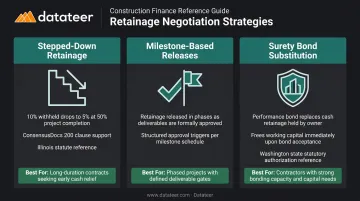
Most contractors accept standard retainage terms without pushing back. That's leaving cash on the table. Options worth pursuing in contract negotiations:
- Stepped-down retainage: 10% drops to 5% after 50% completion (ConsensusDocs 200 includes this structure; Illinois law mandates it for qualifying contracts)
- Milestone-based releases: Retainage released in phases as defined deliverables are approved
- Surety bond substitution: Washington state and many private contracts allow a performance bond to replace cash retainage — freeing working capital without reducing the owner's protection
Contractors with clean track records, strong bonding, and repeat owner relationships have more leverage in these negotiations than they typically exercise.
Use Construction-Specific Analytics to Replace Manual Tracking
Spreadsheet-based retainage tracking breaks down at scale. The problems compound quickly:
- Manual updates create data lag between what's in the ERP and what's on the report
- No automated aging or release-date flagging means overdue balances go unnoticed
- Retainage payable and receivable tracked in separate files makes portfolio-level visibility impossible
Datateer integrates directly with construction ERPs — Procore, Sage 100/300/Intacct, Viewpoint Vista, Viewpoint Spectrum, Acumatica Construction, Foundation Software, and others — to automatically pull retainage receivable and payable balances across all active projects.
Retainage aging, overdue release identification, and release schedule projections connect directly to 13-week cash flow forecasting — so treasury teams see exactly how held retainage affects liquidity without manual reconciliation. Unlimited users means the finance team and project managers work from the same retainage data simultaneously.
Frequently Asked Questions
How do you account for retainage in construction?
Contractors record retainage receivable as a contract asset (or receivable once unconditional) when issuing progress billings, recognizing revenue in full as work is performed. When payment arrives, the balance clears to cash. The mirror entry — retainage payable — captures amounts withheld from subcontractors until their work is complete and accepted.
How do you account for retainage in QuickBooks?
QuickBooks has no native retainage module. The standard workaround: create a "Retainage Receivable" account (Other Current Asset) and add a retainage line item on invoices to capture withheld amounts; mirror the setup with a retainage payable account for subcontractor withholdings. Contractors managing larger portfolios typically find construction-specific ERPs more reliable for retainage tracking than these manual workarounds.
Is retainage payable a current liability?
Yes — retainage payable is classified as a current liability, even when the construction operating cycle extends beyond 12 months. Contractors should apply and disclose a consistent accounting policy. The exact timing of when retainage payable becomes due depends on project completion terms and specific contract conditions.
What is the difference between retainage receivable and retainage payable?
Retainage receivable is the amount a contractor is owed but not yet paid by the project owner or GC, recorded as an asset. Retainage payable is the amount the contractor owes subcontractors but is withholding until project completion, recorded as a liability. Both must be tracked at the project level to understand true cash obligations and working capital position.
When is retainage released and how is it recorded?
Retainage releases when contract conditions are met: typically substantial completion, owner approval, or a defined milestone. The entry is: debit Cash, credit Retainage Receivable or Contract Asset. When the contractor subsequently releases retainage owed to a subcontractor, the entry reverses: debit Retainage Payable, credit Cash.
How does retainage affect the WIP schedule?
Retainage must be tracked separately from standard billed AR in WIP analysis. Under ASC 606, retainage is classified as a receivable or contract asset — not as a billing in the over/underbilled calculation. Mixing retainage into billed revenue on the WIP schedule distorts over/underbilled positions, which directly affects the bonding ratios and lender ratios derived from the WIP report.