The core formula is straightforward. But the inputs, allocation base, and timing all vary by firm size and project mix — meaning two firms with identical revenue can arrive at very different overhead rates, with very different consequences for bid profitability.
This article walks through exactly what overhead rate means, how to calculate it step by step, the key variables that shift the result, the most common mistakes construction finance managers make, and how to keep the number current.
Key Takeaways
- Overhead rate formula: Total Overhead Costs ÷ Allocation Base (Revenue or Direct Costs) × 100
- Two allocation bases apply — revenue-based for company benchmarking, direct-cost-based for bid-level pricing
- CFMA's 2023 data shows 13% of contractors reported losses — chronic overhead under-recovery is a structural contributor
- Stale or incomplete cost data — missing depreciation, software fees, or owner salary — distorts every bid that follows
- Recalculate quarterly against a rolling 12-month period to keep bids accurate as costs shift
What Is Construction Overhead Rate and Why It Matters
The overhead rate is the ratio of total indirect business costs to a chosen activity base — either total revenue or total direct costs — expressed as a percentage. It functions as the bridge between knowing your overhead exists and applying it correctly to every bid.
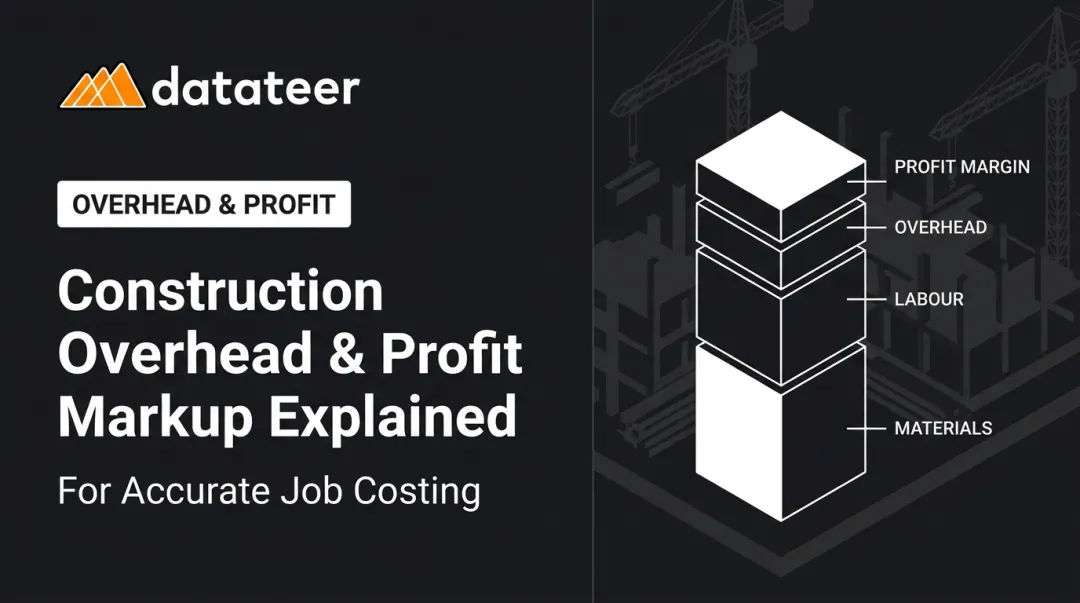
Overhead rate and profit margin are not the same thing. Overhead rate covers the cost of running the business. Profit is what remains after both direct costs and overhead are recovered. Contractors who treat overhead and profit as a single markup consistently underbid : they recover less than they spend and call what's left profit, when it isn't.
The financial stakes are real. According to CFMA's 2023 Financial Benchmarker, 13% of contractors reported losses in 2022 — nearly double the prior year's share. Chronic overhead under-recovery is a structural contributor: when the rate baked into bids doesn't reflect actual indirect costs, the shortfall comes directly out of margin on every job.
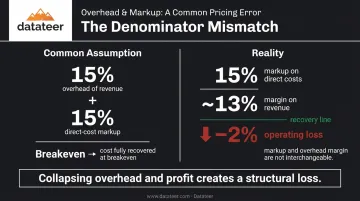
The math makes this concrete. A contractor with overhead equal to 15% of revenue who applies a 15% markup to direct costs doesn't break even. The denominator mismatch produces roughly a 13% margin on revenue and a 2% operating loss before a dollar of profit is taken.
How to Calculate Your Construction Overhead Rate: Step by Step
Accuracy hinges on two foundational decisions: defining what counts as overhead, and choosing the right allocation base. Get either wrong, and the percentage you calculate will be wrong — and every bid built on it will be wrong.
Step 1: Build Your Overhead Cost Pool
Pull all indirect costs from your ERP or accounting system for a trailing 12-month period. Common categories include:
- Administrative salaries and payroll taxes
- Office rent and utilities
- General liability, workers' comp, and commercial auto insurance
- Vehicle costs and fleet maintenance
- Equipment depreciation
- Marketing and business development
- Software subscriptions and technology
- Professional fees (legal, accounting, consulting)
- Licenses and dues
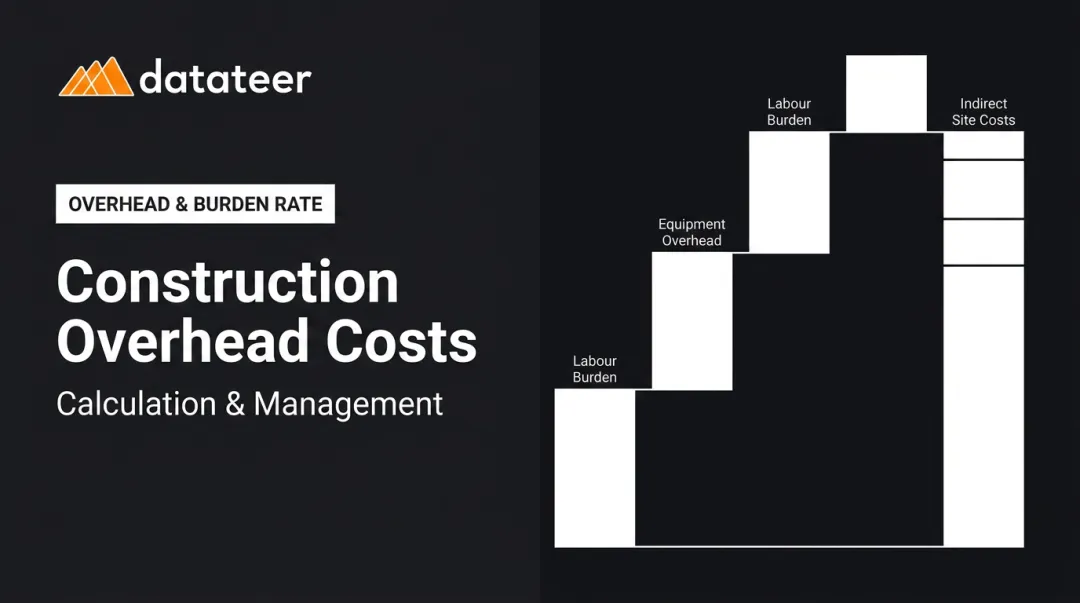
The boundary rule: a cost belongs in the overhead pool only if it cannot be assigned to a specific project. For costs that are partially project-related — a project manager splitting time between field supervision and estimating, for example — include only the non-project portion in the pool.
This judgment call is one of the leading sources of miscalculation. Including project-specific supervision wages in overhead inflates the rate and creates double-counting when those costs also appear in job cost reports.
Step 2: Select Your Allocation Base
The two most common bases are total revenue and total direct costs. The choice matters because the same dollar amount of overhead produces a different percentage under each.
| Allocation Base | Best Used For |
|---|---|
| Total Revenue | Company-level benchmarking; comparing against CFMA industry data |
| Total Direct Costs | Bid-stage markup; you know direct costs before you know final revenue |
Step 3: Apply the Overhead Rate Formula
Using a realistic example — a firm with $2M in revenue, $1.4M in direct costs, and $400K in annual overhead:
Formula A — Revenue-based:
$400,000 ÷ $2,000,000 × 100 = 20% overhead rate
Formula B — Direct-cost-based:
$400,000 ÷ $1,400,000 × 100 = 28.6% overhead rate
Same firm, same overhead, two very different numbers. Neither is wrong — they answer different questions. Use the revenue-based rate to compare your firm against CFMA benchmarks. Use the direct-cost-based rate when marking up a bid estimate.
Step 4: Translate the Rate Into a Bid Markup
Applying the overhead rate to an actual bid looks like this — for a project with $180,000 in estimated direct costs, using a 28.6% direct-cost overhead rate and a 12% target profit margin:
| Line Item | Calculation | Amount |
|---|---|---|
| Direct Costs | — | $180,000 |
| Overhead Recovery | $180,000 × 28.6% | $51,480 |
| Subtotal | — | $231,480 |
| Profit (12%) | $231,480 × 12% | $27,778 |
| Bid Total | — | $259,258 |
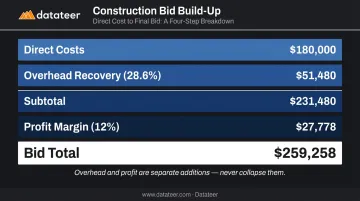
Overhead recovery and profit margin are two separate additions. Collapsing them into a single markup line typically understates the bid by 8–12%, leaving overhead unrecovered on every project that closes.
Key Variables That Affect Your Overhead Rate Accuracy
The formula is consistent. The inputs aren't. Four variables routinely cause overhead rates to drift from reality.
Cost Classification Consistency
Misclassifying direct costs as overhead — or overhead as direct costs — is the single biggest distortion factor. A clear chart-of-accounts policy with defined cost codes reduces this drift. Without it, the same expense gets coded differently depending on who's doing the entry.
Time Period and Revenue Seasonality
A firm running $500K/month during peak season but $200K/month in Q1 will calculate a very different overhead rate depending on the window used. A single slow quarter inflates the rate; a single strong quarter suppresses it. Rolling 12-month calculations smooth out this seasonality and should be the standard practice.
Fixed vs. Variable Overhead Mix
Firms with heavy fixed overhead — long-term leases, salaried administrative staff — face rate compression during slow periods. When revenue drops but rent and salaries don't, the overhead rate climbs. Firms with predominantly variable overhead have more flexibility.
Understanding the composition of your cost pool lets you stress-test the rate at different revenue levels and avoid bidding based on a rate that only holds at full capacity.
Company Growth Stage
Overhead rates tend to climb as firms scale. Adding office staff, upgrading ERPs, expanding insurance coverage, and layering in management infrastructure all increase the overhead pool faster than revenue growth catches up. CFMA's 2025 Financial Benchmarker reports SG&A at 7.3% of revenue for Industrial and Nonresidential contractors using 2024 data, and 11.8% for all respondents using 2023 data — with meaningful variation by segment. A rate calculated in a flat year can become outdated quickly in a growth year.
Common Mistakes When Calculating Construction Overhead Rate
Mistake 1 — Treating Overhead Rate and Profit Markup as One Number
Adding a single "20% markup" to direct costs to cover both overhead and profit is one of the most common and costly errors in construction bidding. If your overhead rate is 30% of direct costs and you apply a 20% markup, you're not covering overhead — let alone generating profit. You're losing money on every job while your P&L shows revenue.
Mistake 2 — Using Incomplete or Outdated Data
Firms often pull only the obvious line items — rent, insurance, administrative salaries — and miss costs that quietly drain the overhead pool:
- Vehicle depreciation
- Non-billable portion of owner's salary
- Software subscriptions
- Bank fees and professional services fees
Each omission understates overhead and inflates perceived job profitability. Relying on prior-year books compounds the problem — by mid-year, wages, insurance, or lease costs may have shifted materially. Construction labor wages alone increased 5.7% in 2025 according to ENR's Q1 2026 Cost Report.
Mistake 3 — Failing to Separate Billable and Non-Billable Labor
Project managers, estimators, and supervisors who split time between project work and general business operations create a specific accounting problem. Their non-project time is an overhead cost. Their project time is a direct cost. Firms without accurate labor allocation by cost code routinely understate the overhead pool, overstate job profitability, and underbid the next project using that flawed assumption.
Keeping Your Overhead Rate Accurate Over Time
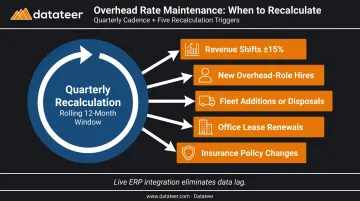
An overhead rate is not a set-and-forget number. A quarterly recalculation cadence using a rolling 12-month window is the appropriate baseline. A full reset should be triggered when:
- Revenue changes by more than 15% in either direction
- New overhead-role hires are added (admin staff, controllers, HR)
- Equipment fleet changes materially (additions, disposals, new lease agreements)
- Office leases renew at new rates
- Major insurance policy changes take effect
The practical problem for most firms is lag. A rate calculated in January, built on last year's costs and last year's revenue, is already outdated before the first bid goes out in February. Connecting overhead tracking directly to ERP data eliminates that lag.
Platforms like Datateer sync directly with Procore, Sage, Viewpoint Vista, Acumatica, Foundation Software, and 12+ other construction ERPs, surfacing overhead absorption as a live metric against actual cost data — not a static annual figure updated once at year-end.
The platform's Overhead & Burden Rate Analytics module calculates fully-burdened labor rates by craft and division, monitors overhead absorption per project, and flags under-allocated overhead before it erodes job margins. That's a different posture than pulling last year's financials in December and hoping the number holds through Q4 of next year.
Firms that embed a live overhead rate into every estimate stop discovering margin problems after the project closes — they catch them while there's still time to act.
Frequently Asked Questions
How to calculate overhead in construction?
Divide total indirect costs by your chosen allocation base (total revenue or total direct costs) and multiply by 100. Start by identifying every cost that cannot be directly assigned to a specific project — office rent, administrative salaries, insurance, software — then sum those before applying the formula.
What is a good percentage for overhead?
Published benchmarks vary by source and segment. CFMA's 2023 data shows SG&A at 11.8% of revenue for all contractors; a CPA-authored benchmark from JMCO sets a target range of 8–15% of revenue depending on firm size. Track your own rate over time and verify that your bid markup consistently recovers it — that's the number that actually protects your margins.
What is the difference between overhead rate and markup in construction?
Overhead rate measures the share of revenue or direct costs consumed by indirect expenses. Markup is the percentage added to direct costs in a bid to recover both overhead and profit. They are calculated separately — treating them as the same number is a systematic bidding error.
What costs should be included in the construction overhead pool?
Common categories include:
- Office rent and administrative salaries
- General liability and workers' comp insurance
- Vehicle costs and equipment depreciation
- Software subscriptions, marketing, and professional fees
The key rule: only costs that cannot be directly assigned to a specific project belong in the pool.
How often should construction firms recalculate their overhead rate?
Quarterly, using a rolling 12-month period, is the appropriate cadence. A full reset is warranted after significant revenue shifts, new overhead-role hires, fleet changes, or lease renewals.
What is the difference between job overhead and company overhead?
Job (project) overhead includes indirect costs tied to a specific site but not to a direct cost line item — site trailers, temporary utilities, project-specific safety equipment. Company (G&A) overhead covers firm-wide operating costs regardless of any single project: office rent, accounting staff, estimators, and company-wide insurance premiums.