Introduction
The project closes. You pull the final numbers. Margins came in three points lower than the bid — not because of one catastrophic mistake, but because costs drifted across a dozen line items for weeks before anyone had clear visibility into them. By the time the finance team saw the data, the window to intervene had closed.
Construction finance managers recognize that scenario immediately. The root cause is rarely a single bad decision — it's a tracking gap that compounds quietly until the damage is done.
According to McKinsey, 98% of megaprojects suffer cost overruns or delays, with average cost increases reaching 80% of original estimates. Delayed, fragmented financial data is the common thread.
This guide covers the full picture: what construction cost tracking is, which categories demand the closest attention, how tracking systems typically break down, and what a process that gives leadership accurate, timely data actually looks like.
Key Takeaways
- Track direct, indirect, and committed costs — including purchase orders and subcontracts, not just paid invoices
- Job costing, cost codes, and earned value management are the core methods — all three break down without clean, timely data
- The biggest failure points are data lag, spreadsheet processes, and the field-to-office disconnect
- Real-time dashboards shift finance teams from reactive reporting to proactive cost management
What Is Construction Cost Tracking?
Construction cost tracking is the ongoing process of recording, monitoring, and analyzing all project-related costs — labor, materials, equipment, subcontractors, and overhead — from preconstruction through closeout. It's a continuous, project-lifecycle discipline — not a month-end accounting task.
Beyond Basic Bookkeeping
Effective cost tracking goes further than recording what has been spent. It compares:
- Estimated costs (the original budget)
- Committed costs (POs, subcontracts, approved change orders)
- Actual costs (invoices paid and costs incurred)
- Cost-to-complete (projected spend remaining)
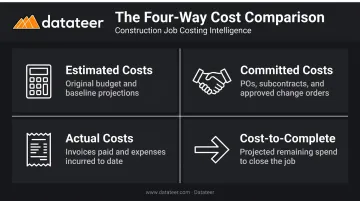
That four-way comparison is what separates cost management from basic bookkeeping — it gives finance teams the visibility to intervene before a budget problem becomes a margin problem.
Why It's a Strategic Finance Function
When that measurement discipline is consistent, it feeds three deliverables that go well beyond operational accounting:
- WIP schedules — which drive revenue recognition under ASC 606 and which sureties, banks, and CPAs review to assess a firm's financial health
- Job profitability analysis — actual margin performance versus the bid, broken down by cost code and phase
- Portfolio-level cash flow forecasting — aggregate working capital requirements across all active projects
These outputs directly affect banking relationships, bonding capacity, and executive decision-making. That makes cost tracking a strategic finance function, not a back-office task.
Types of Construction Costs You Need to Track
Direct Costs
Direct costs are expenses directly attributable to a specific project. Per AACE International's cost engineering terminology, these include installed equipment, materials, field labor, and supervision directly involved in physical construction of the permanent facility.
These are the primary inputs to job costing and are generally the most straightforward to assign. Every labor hour, material delivery, and piece of equipment deployed on-site falls into this category.
Indirect Costs
Indirect costs support overall operations rather than a single project — overhead, G&A, insurance, permits, and interest on construction loans. The National Academy of Construction notes that indirect field costs must be accurately reflected in initial bids — and when firms fail to update their indirect cost assumptions in estimating systems, bids are systematically underestimated.
Outdated burden rates are a common culprit. When firms carry stale overhead recovery assumptions in their ERP, every bid in the pipeline is distorted — and the error compounds silently across the entire job portfolio before anyone catches it.
Committed Costs
Committed costs are future financial obligations already incurred — approved purchase orders, executed subcontractor agreements, and approved change orders. The money hasn't left the bank, but it's no longer available in the budget.
Finance teams that track only paid invoices are working with an incomplete picture. The gap between "budget spent" and "budget available" is the committed cost balance — and missing it leads to overruns that only surface in the accounting system when it's too late to course-correct.
Tracking committed costs effectively means capturing:
- Approved purchase orders not yet invoiced
- Executed subcontractor agreements (full contract value, not just billed-to-date)
- Approved change orders pending billing
Datateer's Job Costing & Cost-to-Complete module surfaces committed costs alongside actuals at the job, phase, and cost-code level — pulled directly from your ERP so the data reflects current commitments, not last week's export.
Construction Cost Tracking Methods
No single method covers every situation. Most construction firms use several in combination, and the right mix depends on project type, contract structure, and the level of financial granularity required.
Job Costing
Job costing assigns all project costs — labor, materials, equipment, subcontractors — to a specific job code so actual expenditures can be compared against the budget throughout the project lifecycle.
It's the foundation of WIP schedule preparation. The AICPA provides a clear example: if $250,000 has been spent against a $1 million budget, the project is 25% complete, and 25% of revenue and gross profit are recognized.
That percentage-of-completion calculation depends entirely on accurate job cost data flowing into the WIP on time.
Cost Code Systems
Cost codes are the classification structure that makes job costing comparable across projects and over time. Many firms follow CSI MasterFormat divisions (Concrete, Masonry, Electrical, etc.), though company-specific breakdowns are common.
The hidden risk: inconsistent cost code assignment. When the same type of work gets coded differently across jobs or project managers, cross-project comparison becomes unreliable and historical productivity benchmarking produces misleading results.
This is why data standardization matters before any reporting layer is built. During implementation, Datateer's automated data cleaning engine standardizes cost codes across systems and maps each firm's unique data logic, so the classification structure is consistent before any dashboard is populated.
Earned Value Management
EVM integrates scope, schedule, and cost data to assess project performance and predict final outcomes. The three core inputs:
- Planned Value (PV) — budgeted cost for scheduled work
- Actual Cost (AC) — costs incurred for work performed
- Earned Value (EV) — budgeted cost for work actually completed
The Cost Performance Index (CPI = EV ÷ AC) signals whether a project is running over or under budget relative to work completed. A CPI below 1.0 means the project is spending more than planned per unit of completed work — a leading indicator of overrun, not a lagging confirmation.
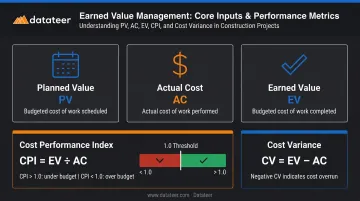
EVM is particularly powerful for finance teams managing large or multi-phase projects because it shifts reporting from historical to predictive. Datateer surfaces CPI, Cost Variance, and Schedule Variance within its Job Costing & Cost-to-Complete module.
Time & Material Tracking
T&M tracking applies to variable-scope or change-order-heavy projects where labor hours and material quantities are billed at agreed rates plus markup. Accurate documentation is critical for two reasons: it protects billing, and it validates internal cost performance data used for future bidding.
At minimum, that means:
- Verified labor time records tied to specific work performed
- Material receipts matched to the job and activity
- Markup rates documented and consistently applied
Activity-Based Costing
Activity-based costing allocates costs to specific work activities (formwork, concrete placement, electrical rough-in) rather than broad categories. This granularity reveals which activities consume disproportionate time and cost — information that directly improves bid accuracy on future projects with similar work content.
Common Challenges That Derail Construction Cost Tracking
The Data Lag Problem
Most construction firms produce WIP schedules and cost reports on a monthly cycle. KPMG's Global Construction Survey found that only 8% of firms had real-time, push-button project reporting — and a 2021 update showed only 16% had fully integrated systems. The practical result: financial data is often 10 to 20 days behind real project conditions by the time it reaches the finance team.
By then, the overrun has already happened. The question is whether there's still time to do something about it.
Datateer's customers describe this as the "Excel Autopsy" problem — discovering issues only after they've compounded. The platform replaces that 10-to-20-day lag with overnight automated refresh, so finance teams review current data rather than last month's.
The Manual Spreadsheet Trap
Finance teams that spend hours each week manually exporting ERP data, reformatting it in Excel, and reconciling discrepancies aren't dealing with a minor inefficiency. It's a data quality problem baked into the process itself.
Every manual step introduces formula errors, version control failures, and constant rework. When reports are built on fragile spreadsheet logic, they're unreliable before they're even shared. One Datateer client put it plainly: "That one click replaced two weeks worth of prior work."
The Field-to-Office Gap
Cost data generated in the field (labor hours, materials consumed, subcontractor progress, change events) frequently doesn't reach the accounting system for days. This creates a direct disconnect between what the project team believes is happening financially and what finance is reporting.
The practical fallout includes:
- Over/under billing errors in WIP schedules
- Disputes between PMs and finance over whose numbers are correct
- Margin calls that surface weeks after the project has moved on
Datateer's automated reconciliation of Procore project commits against Sage invoices — and equivalent integrations across 20+ platforms — eliminates this gap by creating a single source of truth both teams work from.
Margin Fade
Margin fade is the gradual, often invisible erosion of project profitability. Small cost overruns accumulate across multiple cost codes or projects, none large enough to trigger an alert on their own.
It's almost always discovered at project closeout, when recovery is no longer possible. In most cases, the root cause isn't a single large mistake — it's inadequate real-time visibility across the job. Datateer's Margin Protection module monitors original estimated margin versus current projected margin per job continuously, flagging the specific cost codes and phases driving deterioration while there's still time to act.
Best Practices for Construction Finance Teams
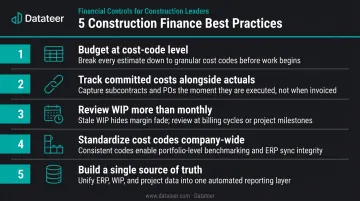
Construction finance teams that track costs accurately share a handful of common habits. These aren't aspirational — they're the operational disciplines that separate firms with reliable numbers from those flying blind.
- Build budgets at the cost-code level before work begins. Lump-sum budgets make variance analysis meaningless. A detailed baseline is what gives you something to measure individual work activities against.
- Track committed costs alongside actuals. Finance teams that only track paid invoices consistently underestimate project exposure. Open POs, executed subcontracts, and approved change orders are part of the real financial picture.
- Review WIP more frequently than monthly. Weekly or bi-weekly reviews catch over/under-billing trends early, flag at-risk projects before they become problems, and keep percentage-of-completion calculations tied to actual field progress — not administrative assumptions.
- Standardize cost codes and enforce them company-wide. Apply a consistent structure across all jobs in the ERP. Without that discipline, cross-project comparison and historical benchmarking are impossible. Finance teams should own cost code governance, not leave it to individual PMs.
- Build and protect a single source of truth. When cost data lives in disconnected places — ERP, Excel, field reports, project management tools — financial reporting becomes unreliable at scale. A unified data environment is the foundation for trustworthy analysis.
How Technology Transforms Construction Cost Tracking
Modern construction cost tracking technology should eliminate the manual steps that create data lag — not just automate them faster. The meaningful capabilities:
- Direct ERP integration with systems like Procore, Sage, Vista, and Acumatica
- Overnight automated data refresh that eliminates the 10-to-20-day reporting cycle
- Automated WIP report generation replacing manual CSV exports and VLOOKUP marathons
- Portfolio-level dashboards aggregating financial data across all active projects
- Role-based views so executives, project managers, and finance staff each see what they need
The strategic shift matters as much as the operational one. When finance teams stop spending hours gathering and formatting data, they gain capacity to analyze variances, identify margin risks, and advise on project decisions while there's still time to act. That's the difference between catching a margin problem at month-end closeout and catching it while the project is still on-site.
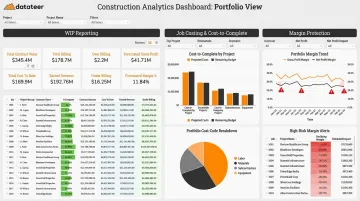
Datateer is built specifically for this shift. It integrates directly with 20+ construction ERPs and delivers 12 pre-built dashboards across four suites — all available from day one, with setup completing in 2-4 weeks. Core modules include:
- WIP Reporting: Replaces the manual reporting cycle with overnight-refreshed schedules
- Job Costing & Cost-to-Complete: Tracks actuals, committed costs, and pending change orders at the cost-code level
- Margin Protection: Flags deterioration as it happens, not at closeout
Flat annual pricing starts at $10,000/year per data source with unlimited users. No per-seat licensing, no per-dashboard fees.
Frequently Asked Questions
How do you track construction costs?
Establish a cost-code-level budget before work begins, then implement job costing to compare actuals against that budget in real time — not at month-end. Cost data should flow from the ERP into financial reports without manual intervention, so finance teams are always working from current numbers.
What is job costing in construction?
Job costing assigns all project costs to a specific job code so actual expenditures can be measured against the budget throughout the project lifecycle. It underlies WIP preparation and profitability analysis, and it only works when cost data is timely and accurately coded at entry.
What are the most common construction cost tracking challenges?
Four failure points show up consistently: data lag from monthly reporting cycles, manual spreadsheet processes that introduce errors and version control problems, field-to-office gaps that cause WIP inaccuracies and over/under billing errors, and margin fade that goes undetected until project closeout.
How do construction companies track costs across multiple projects?
Multi-project tracking requires a standardized cost code structure applied consistently across all jobs, a centralized ERP as the system of record, and portfolio-level dashboards that aggregate financial data across all active projects into a single view. Without consistent coding and a reliable system of record, portfolio dashboards surface misleading numbers — making them worse than no dashboard at all.
What KPIs should construction finance managers track for cost control?
Track Cost Performance Index (CPI), budget vs. actual variance by cost code, over/under billing position on the WIP schedule, cost-to-complete vs. budget remaining, and gross margin by project. Each of these is only as reliable as the underlying cost data — current, consistently coded, and pulled directly from the ERP.