Introduction
Picture this: a project owner calls Wednesday morning asking for a budget update. The finance team is still reconciling last month's numbers — pulling CSVs from Sage, running VLOOKUPs, and manually formatting a WIP report that's already three weeks stale. Meanwhile, the field superintendent is tracking labor slippage that nobody in the office has seen yet.
Datateer calls this the "Awkward Wednesday Meeting," and it plays out on construction sites across the country every week.
The core problem is that teams are communicating from different versions of the truth. According to a PlanGrid/FMI study of 599 construction leaders, 48% of rework in U.S. construction traces back to poor data and miscommunication — costing the industry an estimated $31.3 billion annually. Poor communication alone accounts for $17 billion of that figure.
This article covers who construction stakeholders are, where communication breaks down, best practices for fixing it, and the tools that make data-driven stakeholder communication actually work.
TLDR
- Poor stakeholder communication costs U.S. construction $17 billion annually — the root cause is stale, siloed data
- Different stakeholder groups need different information at different frequencies — one format doesn't work for all
- A single source of truth eliminates the "which spreadsheet is right?" problem that derails financial reporting
- Manual WIP reporting creates a 10–20 day lag that leaves owners and lenders working from outdated data
- Construction-specific platforms automate financial reporting, replacing weeks of manual work with overnight data refreshes
What Is Stakeholder Communication in Construction?
Stakeholder communication in construction is the structured exchange of project-relevant information — schedules, budgets, scope changes, safety updates, and financial performance — between all parties with a stake in a project's outcome.
What separates construction stakeholder communication from general project communication is who's on the receiving end — and what they do with the data. These aren't passive observers. They're decision-makers acting on the numbers you send them:
- Lenders approve or withhold draw requests based on your financial reporting
- Sureties extend or limit bonding capacity based on WIP accuracy and cash position
- Owners approve change orders — or escalate disputes — based on what you show them
When that data is inaccurate, incomplete, or delayed, those decisions go wrong.
Accurate, timely financial and operational data protects project funding, bonding capacity, and approval timelines. That's the real stakes of getting stakeholder communication right.
Who Are the Key Stakeholders in a Construction Project?
Internal Stakeholders
Internal stakeholders need granular, real-time data to manage day-to-day execution:
- Project managers — need current budget-to-actual, schedule performance, and change order status
- Field superintendents — need scope clarity, resource allocation, and daily production tracking
- Estimators — need historical cost data and margin performance by job type to bid accurately
- Construction CFOs and finance managers — need WIP schedules, over/under-billing positions, cash flow forecasts, and margin trends
Beyond the internal team, the parties outside your organization carry just as much weight — and often have higher stakes in specific outcomes.
External Stakeholders
External stakeholders have less visibility into daily operations but carry significant influence over project continuity:
- Project owners and developers — want budget-to-actual performance, contingency status, and schedule adherence
- Lenders — need WIP reports, draw request documentation, and cash flow projections to manage loan exposure
- Surety providers — per Surety Information Office guidance, sureties may request interim financial statements every 3 or 6 months and require a quarterly WIP schedule covering contract price, billings, cost to complete, and estimated final gross profit
- Subcontractors and suppliers — need scope clarity, RFI responses, and payment timelines
- Regulatory and permitting bodies — need compliance documentation and inspection records
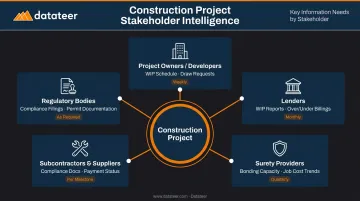
Each group has distinct communication needs, preferred formats, and update cadences. Sending everyone the same monthly report creates confusion, erodes trust, and signals you haven't thought through who actually needs what.
Why Stakeholder Communication Breaks Down in Construction
The Field-to-Office Data Gap
Field crews capture production data in one system — or on paper — while the finance team is working from an ERP that only updates during monthly close. The result is a 2–3 week window where no one has an accurate picture of cost-to-complete or margin performance.
By the time that information reaches the people who need it, it's already historical. As one Double L Management analyst put it after implementing automated reporting: "that one click replaced two weeks worth of prior work."
Siloed Data and Version Conflicts
When different stakeholders pull numbers from different spreadsheets, different software exports, or different cost code mappings, the data can't be reconciled. The conversation shifts from "what do we do about this problem?" to "whose numbers are right?" That's a waste of everyone's time.
FMI research from 2023 found that construction data volume increased 200% between 2019 and 2021, yet roughly 96% of generated data goes unused — and only 55% of construction firms have a formal data plan.
Manual Reporting Lag
Manual WIP compilation — CSV exports, VLOOKUP formulas, Procore-to-Sage reconciliation — routinely creates a 10–20 day reporting lag. By the time financial stakeholders receive a WIP report, margin fade may already be baked in.
The FMI study cited an MEP contractor that experienced 17% margin fade over four years, with equipment costs exceeding budgets by 55% on average and an $8M net loss to show for it. That kind of deterioration stays invisible when you're reading last month's numbers.
Misaligned Expectations
When the field team is tracking labor slippage that the finance team hasn't seen yet, and the owner expects on-budget delivery, no one is working from the same reality. This information asymmetry creates conflict and erodes trust in ways that outlast individual projects.
No Defined Escalation Path
Without a structured process for flagging budget overruns or schedule delays to the right people quickly, small problems compound. A cost overrun that's addressable in week three becomes a project-level crisis by month two if no one escalates it.
Best Practices for Stakeholder Communication in Construction
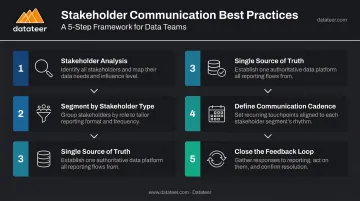
Best Practice 1: Conduct Stakeholder Analysis Before Kickoff
Map every stakeholder by influence and interest before the project starts. The PMI power-interest grid (a 2×2 matrix that classifies stakeholders by power and interest) is the most practical tool for this. CMAA applies the same framework to large construction programs, recommending that high-influence, high-interest stakeholders be managed comprehensively and continuously.
This exercise prevents two common failures:
- Over-communication — flooding stakeholders with detail they don't need and won't read
- Under-communication — executives blindsided by issues that field teams have known about for weeks
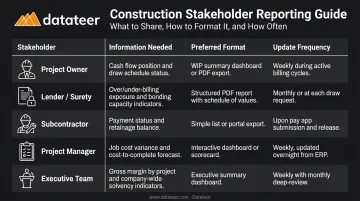
Best Practice 2: Segment Communication by Stakeholder Type
The information a project owner needs looks nothing like what a subcontractor needs — and treating them the same wastes time for everyone.
| Stakeholder | Information Needed | Typical Format |
|---|---|---|
| Project owner | Budget-to-actual, contingency status, schedule variance | Monthly/bi-weekly summary report |
| Lender / surety | WIP schedule, over/under-billing, cash flow projection | Monthly formal report |
| Subcontractor | Scope clarity, RFI status, payment schedule | Weekly updates, meeting minutes |
| Project manager | Job cost detail, change order status, daily production | Daily/weekly dashboard |
| Executive team | Margin trends, liquidity, portfolio performance | Real-time executive dashboard |
Best Practice 3: Establish a Single Source of Truth
The most effective construction teams operate from a centralized, current data set. When everyone, from the field superintendent to the CFO to the project owner, references the same numbers, the conversation shifts from debating data to solving problems.
This is the foundation for consistent financial reporting — and the most difficult goal to reach when data lives in disconnected spreadsheets, separate software exports, and individual project folders.
Best Practice 4: Define a Communication Cadence and Stick to It
Predictability builds trust — even when the news isn't good. A practical starting cadence:
- Daily — field logs and production data for site teams
- Weekly — schedule updates and change order status for project managers
- Bi-weekly — budget-to-actual and cost-to-complete for project owners
- Monthly — formal WIP report and financial performance for lenders and sureties (quarterly at minimum per surety requirements)
Stakeholders who receive consistent, reliable updates in a predictable format are far less likely to panic when a problem surfaces.
Best Practice 5: Close the Feedback Loop
Communication in construction has to be two-way. Stakeholders who raise concerns need to know those concerns were received and acted on. This means:
- Issue tracking with assigned owners and due dates
- Meeting minutes that document decisions and action items
- Defined response SLAs for critical escalations (for example: cost overruns exceeding 5% must be escalated to the owner within 48 hours)
Tools for Stakeholder Communication in Construction
Project Management and Field Collaboration Platforms
Purpose-built construction PM platforms — Procore being the most widely adopted — connect field activity, RFIs, submittals, and daily reports to give the office real-time visibility into schedule and scope. A 2025 Dodge Construction Network study of 1,100+ owners and contractors found that highly skilled PM software adopters reported 77% saw increased profit margins, with a median improvement of 4 percentage points.
BIM and Visual Communication Tools
Building Information Modeling gives owners and design stakeholders a way to engage with project progress without needing to interpret cost codes. 360° progress photos, 3D models, and clash detection reports communicate design intent and construction status in formats accessible to non-technical stakeholders — particularly useful in owner communication for complex or public projects.
Internal Collaboration Platforms
Microsoft Teams, Slack, and similar tools handle day-to-day internal communication effectively. The key discipline: keep project-critical decisions documented and searchable. Decisions buried in a Slack thread or email chain are functionally invisible to anyone who wasn't in that conversation — and in a dispute, they're unenforceable.
Financial Reporting and ERP-Integrated Dashboards
For financial stakeholders — CFOs, owners, lenders, and sureties — the most critical communication tool is accurate, current financial data. This is where traditional workflows break down most visibly.
ERP data typically sits locked in systems that require manual extraction and Excel formatting before it can be shared. That process creates the 10–20 day WIP reporting lag that leaves financial stakeholders working from stale numbers. By the time margin fade shows up in a manually compiled report, it's often too late to course-correct.
Datateer addresses this directly. The platform integrates with 12+ construction ERPs — Procore, Sage 100/300/Intacct, Viewpoint Vista, Viewpoint Spectrum, Acumatica Construction, Foundation Software, CMiC, Jonas Construction, QuickBooks, and NetSuite — to automate WIP reports, over/under-billing positions, cash flow projections, and executive dashboards. Data refreshes overnight by default, meaning financial stakeholders start each day with current, ERP-sourced numbers rather than a spreadsheet compiled two weeks prior.
Key dashboards available on day one include:
- WIP Reporting: Calculates percentage complete, earned revenue, billed revenue, billings in excess, costs in excess, and projected margin per job — flagging margin fade in real time
- Executive Strategy & Solvency: Gives CFOs and owners a forward-looking view of liquidity, cash conversion, and return on assets without a four-hour prep session before every board meeting
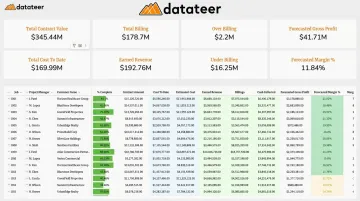
For construction firms spending 40+ hours per month on manual reporting, the math is stark: two staff members at average salary rates spending that time on spreadsheet work costs roughly $43,800 per year. Flat annual pricing starting at $10,000 per year per data source, with unlimited users and no per-seat fees, inverts that equation.
How to Build a Stakeholder Communication Plan for Construction
Step 1: Identify and Map Your Stakeholders
List every individual and organization connected to the project, then sort them into four groups:
- Financial — owners, lenders, sureties
- Field — subcontractors, suppliers, crews
- Regulatory — permitting authorities, inspectors
- Internal — project managers, executives, finance
Document what each group needs, how often, and in what format. Use a stakeholder register within your project management platform to keep this record current.
Step 2: Build the Communication Matrix
For each stakeholder group, define:
- Information type — WIP report, daily log, change order summary, permit status
- Format — dashboard, formal report, email, meeting
- Frequency — daily, weekly, bi-weekly, monthly
- Responsible party — who owns producing and delivering this communication
- Escalation path — what triggers escalation, to whom, and within what timeframe
Review this matrix at every major project milestone. Stakeholder needs shift as projects move from preconstruction through execution and closeout.
Step 3: Assign Ownership and Set Escalation Protocols
Assign specific individuals to each communication type — unnamed responsibilities get skipped. Define what triggers an escalation: for example, a cost overrun exceeding 5% of contract value, a schedule delay beyond 10 working days, or a liquidity position falling below a defined threshold.
Build in a quarterly review of the plan itself. A communication framework written at project kickoff rarely reflects conditions at month nine — revisiting it keeps ownership and escalation paths accurate as the project evolves.
Frequently Asked Questions
What is construction stakeholder communication?
It's the structured exchange of project-relevant information (schedules, budgets, scope changes, safety updates, and financial performance) between all parties with a stake in a project's outcome. This includes owners, lenders, sureties, field crews, subcontractors, and executive leadership, each receiving the data they need in a format and frequency appropriate to their role.
Which tool is commonly used for stakeholder analysis?
The power-interest grid (also called a power-interest matrix) is the most widely used tool. It plots stakeholders on a 2×2 matrix by their level of influence and interest in the project, helping teams tailor communication strategies for each group. Most project management platforms include a stakeholder register for documenting and tracking this analysis.
What are the 4 C's of stakeholder management?
The 4 C's are Communication, Consultation, Coordination, and Control. Together they cover how information flows, how input is gathered, how actions align across parties, and how the engagement strategy adjusts as the project evolves.
What are the most common stakeholder communication challenges in construction?
The most persistent challenges are: siloed data between field and office systems, stale financial reporting due to manual WIP compilation, misaligned expectations between owners and project teams, and no defined escalation path when budgets or schedules slip. All four typically share a common root : fragmented data that different stakeholders can't reconcile.
How do you create a stakeholder communication plan for a construction project?
Identify and map all stakeholders, define what each group needs and how often, then build a communication matrix that assigns ownership and escalation triggers for every stakeholder group. Review the plan at each major project milestone to keep it current.
How often should financial stakeholders be updated on a construction project?
Sureties typically require quarterly WIP schedules and may request interim financials every 3 to 6 months; owners generally expect bi-weekly or monthly budget-to-actual updates. Frequency matters less than accuracy — a monthly report built on automated, ERP-sourced data outperforms a weekly report compiled from stale spreadsheet exports.