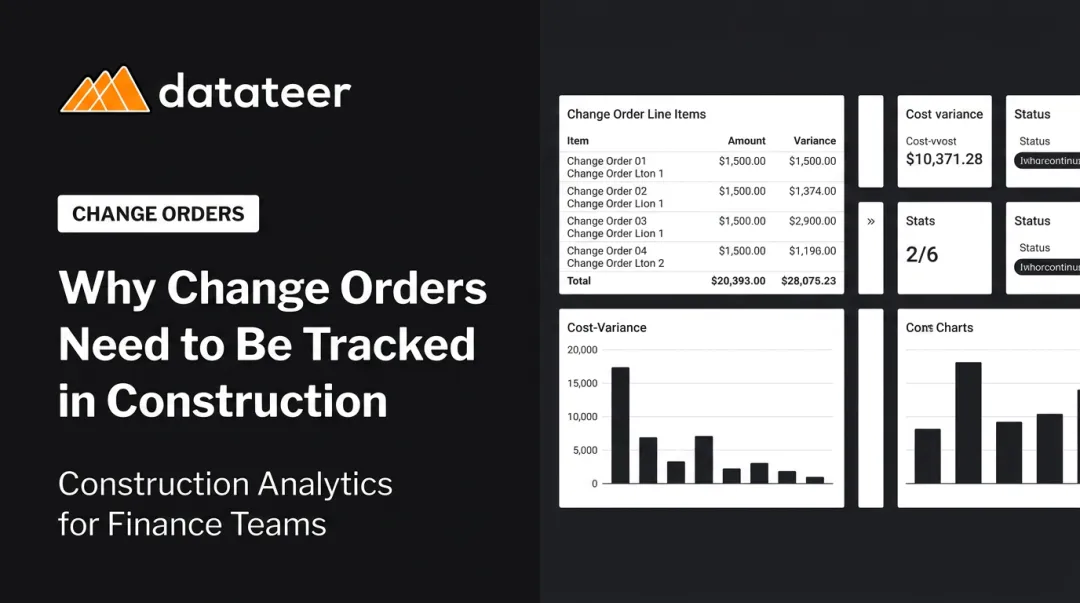

According to AIA Contract Documents analysis of 18,229 completed projects, the average number of change orders scales from 1.70 on projects under $500K to 11.29 on projects over $50M — with average cost changes ranging from 3.20% to 5.04% of the original contract value. Change orders aren't the exception; they're the norm on virtually every project of meaningful size.
This article covers what a change order is, what triggers one, the three types, how the process works, and why the financial stakes of mismanaging them are higher than most teams realize.
Key Takeaways
- A change order is a formal, legally binding document modifying a construction contract's scope, cost, or schedule. All parties must sign before work proceeds.
- Change orders most often arise from unforeseen site conditions, owner-directed changes, and design gaps — not contractor errors.
- The three types are additive, deductive, and partial termination — each shifts the contract value in a different direction.
- Work should never begin on changed scope before all required signatures are obtained.
- Cumulative change orders are a primary driver of margin fade, quietly eroding project profitability one approval delay at a time.
What Is a Change Order in Construction?
Scope changes are inevitable on nearly every job. The question is whether they're documented properly — or left to become disputes.
Under AIA A201-2017 §7.2.1, a change order is a written instrument prepared by the architect and signed by the owner, contractor, and architect — stating mutual agreement on the change in work, any adjustment to the contract sum, and any adjustment to contract time. The AGC defines it similarly: an official change in the original scope of work or contract terms, agreed to by the owner, contractor, and project designer.
Two words in those definitions matter most: agreed to. A change order is a consensus document. All terms are settled before it becomes binding, making it a legal amendment to the original contract — not a unilateral instruction.
Change Orders vs. Construction Change Directives
Not every scope change reaches that "agreed to" state immediately. That's where the Construction Change Directive (CCD) comes in, defined under AIA A201-2017 §7.3.1–7.3.2. A CCD is used when the owner and contractor haven't yet reached full agreement on change terms. The owner can direct the work to proceed while pricing is still being negotiated. Once both parties agree, the CCD converts into a formal change order.
What Does a Change Order Include?
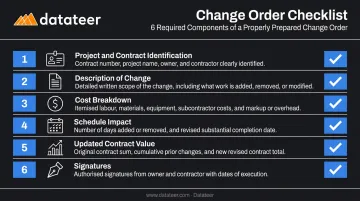
Every properly prepared change order should contain:
- Project and contract identification — project name, contract number, change order number, and contact information
- Description of the change — clearly written against the original scope, specific enough for someone unfamiliar with the project to understand
- Cost breakdown — labor, materials, overhead, profit, insurance, and applicable tax adjustments
- Schedule impact — days added or removed from the contract time
- Updated contract value — original contract amount, all prior change orders, and the new adjusted total
- Signatures — from all required parties (architect, contractor, owner)
Always attach supporting documentation — photos, drawings, field notes, RFIs. If the change order is reviewed by an arbitrator or attorney months later, that person has no site context. Every attachment strengthens the record: a drawing reference or dated field note can resolve a dispute that would otherwise take weeks to untangle.
Common Causes of Construction Change Orders
A persistent misconception is that change orders signal mistakes. Most don't. No contract, however thorough, can anticipate every condition a project will encounter — and change orders exist precisely to handle what the original scope couldn't foresee.
That said, all modifications — regardless of cause — must be documented in a change order. Verbal agreements and informal approvals are where disputes originate.
Unforeseen Site Conditions
The most common trigger. Excavation reveals unstable soil, buried utilities not shown on any survey, underground obstructions, or hazardous materials. The original plan cannot proceed without modification, and the contractor has no obligation to absorb those costs.
Owner-Directed Changes
Unlike site conditions, owner-directed changes originate from the client side — different finishes, adjusted floor plans, relocated building elements. Each revision requires a formal change order to protect both parties and keep the contract current.
Other Common Triggers
- Scope creep — gradual expansion of requirements without formal documentation
- Design errors or omissions — gaps in the architect's drawings requiring field resolution (Arcadis identified errors and omissions in contract documents as the leading cause of North America construction disputes in 2024)
- Code changes — regulatory updates enacted after bidding that require design adjustments
- Material substitutions — supply chain disruptions forcing specification changes
- Force majeure events — weather or other circumstances outside any party's control
The Three Types of Construction Change Orders
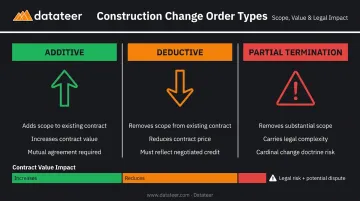
Additive Change Orders
The most common type, additive change orders occur when the owner requests work beyond the original contract scope, increasing the contract value. Clear documentation of exactly what is being added — and at what price — is critical. Vague descriptions create disputes later.
Deductive Change Orders
Removes a specified portion of work, reducing the total contract price. That reduction isn't always straightforward to negotiate: the contractor may have already mobilized crews, ordered materials, or committed subcontractors. Contract terms governing deductive change orders should be agreed upon before work begins, not after.
Partial Termination
Used when an owner wants to remove a substantial portion of project scope — not just a single line item. This carries legal complexity.
The cardinal change doctrine (established in construction contract law and noted by Smith Currie) prohibits owner-directed changes that fundamentally alter the nature of the original contract. Using deductive change orders to gut the project's scope can potentially void the original agreement entirely — a meaningful distinction from full contract termination.
How the Change Order Process Works
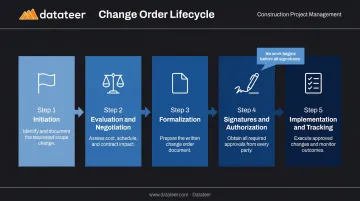
Step 1 — Initiation
Either party can initiate a change order. The initiating party documents the proposed modification — its description, cause, estimated cost impact, and schedule impact. Common initiating documents include:
- Proposal Request (PR) — from the architect
- Request for Information (RFI) — seeking clarification that may require a scope change
- Architect's Supplemental Instruction (ASI) — for minor clarifications without cost impact
- Change Order Request (COR) — submitted by the contractor
Step 2 — Evaluation and Negotiation
The receiving party assesses cost, schedule, and scope impact. The contractor typically provides a detailed breakdown referencing the original estimate. RSMeans/Gordian estimating guidance cites 10% profit and general conditions typically in the 5%–15% range as reference points for overhead and profit markups — though the exact figures depend on contract terms and project type.
The architect, where involved, reviews whether the proposed costs are reasonable and advises the owner accordingly.
Step 3 — Formalization
Once both parties agree, the change order is drafted. The description must be clear and complete enough for a third party — an arbitrator, attorney, or bonding company — to understand the modification and its implications. Anyone reading it should grasp the financial and schedule impact without contacting anyone on the project.
Step 4 — Signatures and Authorization
Signature order under AIA contracts: architect first, then contractor, then owner. Work on the changed scope should not begin until all required signatures are obtained. This is the single most violated best practice in construction. Starting work under verbal approval or an assumed future sign-off reliably leads to payment disputes — and they're rarely easy to resolve after the fact.
Step 5 — Implementation and Tracking
Once authorized, the contractor proceeds and the change order becomes part of the permanent contract record.
Maintain a change order log — a running register that tracks every change order through its full lifecycle. At minimum, each entry should capture:
- Change order number and description
- Current approval status
- Cost impact (approved and pending)
- Schedule impact in days
For project managers and finance teams, this log is the only reliable way to see how cumulative changes are affecting the contract before the project closes out.
The Financial and Legal Impact of Change Orders
The Legal Stakes
A properly executed change order is the official record of what was agreed. Without one, scope disputes become credibility contests.
According to Arcadis' 2025 North America Construction Disputes Report, the average dispute value in 2024 was $42.8 million, with an average resolution time of 12.5 months. That's the financial exposure sitting behind poorly documented change orders.
The Margin Fade Problem
Individual change orders often look manageable in isolation — the danger is cumulative, and it connects directly to the legal exposure above. According to KPMG's 2023 Global Construction Survey, 37% of respondents reported projects that significantly missed budget or schedule targets by 20% or more due to ineffective risk management — and unmanaged scope changes are among the top contributors.
For construction finance managers and CFOs, the real threat is margin fade: a series of under-priced, delayed, or denied change orders steadily eroding project profitability across multiple jobs simultaneously. The damage is rarely visible in any single change order — it accumulates across the log.
Why Real-Time Visibility Matters
The challenge for construction finance teams isn't understanding that change orders affect margins. It's knowing when and by how much across every active project at once.
Datateer integrates directly with construction ERPs (Procore, Sage, Vista, Spectrum, Acumatica) to pull change order data automatically. The Change Order Impact & Aging module tracks:
- Every CO by lifecycle status: pending, approved, denied, executed
- Aging by days since submission
- Revenue and margin impact tied to specific cost codes
- Denial flagged explicitly as a negative variance driver, alongside labor overruns and material escalation
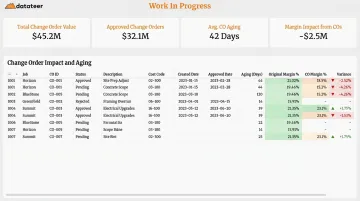
When a change order sits pending for 45 days, with costs already incurred in the field, that distortion shows up in the WIP position immediately, not at month-end. Finance teams see the exposure while the project is still in progress — when course correction is still possible.
Frequently Asked Questions
What is a construction change order?
A change order is a formal, written document that modifies an original construction contract's scope, cost, or schedule. It requires mutual agreement and signatures from all required parties — typically the owner, contractor, and architect — before it becomes legally binding.
What is the purpose of a construction change order?
Change orders create an official record of all modifications, protect all parties from scope disputes, and ensure contractors are compensated for work outside the original contract.
How does a construction change order work?
Either party identifies and documents the change, then submits a proposal covering cost and schedule impacts. Both parties negotiate, formalize the document, and sign it — work on the change begins only after all signatures are in place.
What's the difference between an RFI and a change order?
An RFI (Request for Information) is a question submitted to resolve ambiguities in the contract documents — it doesn't modify the contract. A change order is the formal amendment that results when resolving an RFI (or any other trigger) requires a change to scope, cost, or schedule.
What is an example of a construction change order?
During foundation excavation, the crew encounters unexpected rock that requires specialized drilling equipment not included in the original scope. The contractor submits a change order covering the additional equipment, labor costs, and the schedule extension needed to complete the work.