
For construction CFOs, finance managers, and CPAs advising construction clients, getting this right has direct consequences: financial statement accuracy, tax liability, bonding capacity, and auditor confidence all hinge on the method chosen and how consistently it is applied. This article explains the primary revenue recognition methods used in construction, how ASC 606 governs them, how to choose the right approach, and where finance teams most commonly go wrong.
Key Takeaways
- Construction firms primarily use four methods: percentage of completion, cost-to-cost, completed contract, and milestone.
- ASC 606 requires recognizing revenue either over time or at a point in time, depending on when control transfers to the customer.
- Most long-term construction contracts qualify for over-time recognition — method selection is the key implementation decision.
- The completed contract method does not comply with ASC 606 for most construction scenarios; it applies for tax purposes only under specific IRS rules.
- Stale WIP data is the leading operational cause of revenue recognition errors.
What Is Revenue Recognition in Construction?
Construction firms don't recognize revenue the way most businesses do — and the rules governing how they should are more nuanced than many finance teams realize. Revenue recognition is governed by ASC 606, FASB's Revenue from Contracts with Customers, which replaced the fragmented industry-specific rules that previously applied under the old ASC 605-35 framework.
ASC 606's core principle: recognize revenue to depict the transfer of promised goods or services to customers in an amount that reflects the consideration to which the entity expects to be entitled.
Why Construction Is Different
Most industries recognize revenue at a clear moment — goods ship, services are delivered. Construction doesn't work that way. Several factors complicate the timing and amount of revenue recorded:
- Project duration: Contracts span months or years, with revenue earned gradually rather than at a discrete point
- Multiple performance obligations: A single contract may bundle distinct deliverables — electrical systems, site lighting, structural work — each requiring separate accounting treatment
- Variable consideration: Change orders, bonuses, liquidated damages, and claims all affect the final contract price — but each carries its own uncertainty about whether and when it will be recognized
- Ongoing cost estimation: Total estimated costs must be revised continuously as scope evolves — and those revisions flow directly into how much revenue gets recorded each period
The Two Overarching Categories
Under ASC 606, all construction revenue recognition falls into one of two categories:
- Over time — revenue recorded as work progresses, based on a measurable method (cost-to-cost, units delivered, or milestones)
- At a point in time — revenue recorded when control of the completed asset transfers to the customer
Which category applies to a given contract determines which recognition method a contractor can use — and getting that determination wrong creates compliance exposure. The sections below break down each method and when it applies.
The Four Revenue Recognition Methods for Construction
Construction firms choose methods based on contract type, project duration, cost predictability, and internal accounting capabilities. Each method produces different financial results across the life of a project.
Percentage of Completion Method
The most widely used approach for long-term construction contracts. Revenue is recorded in each reporting period based on how far along the project is — not at the end.
Completion can be measured three ways:
- Costs incurred to date as a percentage of total estimated costs (the cost-to-cost approach)
- Labor hours expended relative to total budgeted hours
- Engineering or project milestones achieved
The method requires two things to work correctly: reliable cost estimates and consistent progress tracking throughout the project.
Cost-to-Cost Method
Technically a measurement technique within the percentage of completion framework — not a standalone method, though it's often treated as one in practice. The formula:
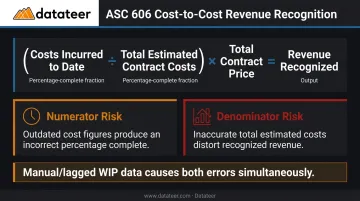
Revenue recognized = (Costs incurred to date ÷ Total estimated contract costs) × Total contract price
Under ASC 606, this is an input method — permitted when it faithfully depicts the transfer of control to the customer. Labor and material costs need to closely track actual project progress for this method to hold up under scrutiny.
The accuracy of this method depends entirely on two data quality conditions:
- Inaccurate total estimated costs distort the denominator and misstate recognized revenue
- Outdated cost figures in the numerator produce a percentage complete that doesn't reflect actual project status
When WIP data is assembled manually from spreadsheets or runs 10–20 days behind the close cycle, both conditions can fail simultaneously — and the revenue distortion compounds period over period.
Completed Contract Method
Under this method, all revenue and expenses are deferred until the project is fully complete. Simple to apply, but problematic for financial reporting transparency.
Critical compliance point: The completed contract method does not align with ASC 606 for most construction scenarios. ASC 606 requires recognizing revenue as performance obligations are satisfied — which for most construction contracts means over time, not only at project completion.
Where it still appears:
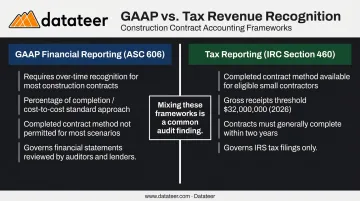
- Tax accounting: Eligible small contractors may use the completed contract method under IRC Section 460. As of IRS Rev. Proc. 2025-32, the gross receipts threshold for the Section 448(c) test is $32,000,000 for taxable years beginning in 2026. Qualifying contracts must also generally be expected to complete within two years.
- Point-in-time scenarios: If none of ASC 606's over-time criteria are met, revenue is recognized at a point in time — which looks like completed contract treatment in practice, but is driven by the ASC 606 analysis, not legacy method choice.
- Short-duration contracts: Very short projects where deferral until completion doesn't materially misstate period financials may still use this approach in limited circumstances.
GAAP financial statements must follow ASC 606, not legacy tax methods. Conflating the two is a common error with audit consequences.
Milestone Method
Revenue is recognized when specific, pre-defined project milestones are achieved — foundation completion, structural framing, substantial completion, or formal owner acceptance at each phase.
Under ASC 606, this qualifies as an output method, permitted when it faithfully depicts control transferring to the customer. Phased infrastructure projects are the natural fit — each milestone needs to represent a genuine transfer of value, not just a billing trigger.
Key limitation: Milestone definitions must be defensible. Per PwC and Deloitte guidance, a milestone approach is inappropriate when significant performance occurs between milestones or when milestone payments don't correspond to actual value transferred. Milestones tied to payment schedules rather than performance create recognition errors.
How ASC 606's Five-Step Framework Applies to Construction
ASC 606 replaced patchwork industry guidance with a universal five-step model. For construction contractors, this framework governs not just when revenue is recorded, but how contract modifications, variable consideration, and multi-obligation contracts are handled.
Step 1: Identify the Contract
A valid contract under ASC 606 requires approval and commitment by both parties, identifiable rights and payment terms, commercial substance, and probable collection.
Construction-specific issue: Verbal agreements, letters of intent, and unsigned change orders create ambiguity about when a contract legally exists — which directly determines when revenue recognition can begin.
Step 2: Identify Performance Obligations
A performance obligation is a distinct promise to transfer goods or services. In construction, a single contract may contain multiple obligations: a building's electrical systems and the site lighting for an adjacent facility, for example. Each distinct obligation must be tracked and recognized separately.
In practice, many construction contracts involve significant integration services, coordinating multiple subcontractors and tasks into one combined deliverable. EY notes this often results in a single performance obligation rather than multiple distinct ones. That determination directly affects how revenue is allocated across the contract.
Step 3: Determine the Transaction Price
The transaction price includes more than the base contract amount. Construction-specific variable consideration includes:
- Unpriced or unapproved change orders
- Incentive bonuses and performance awards
- Liquidated damage clauses
- Claims against the owner
Under ASC 606, contractors must estimate variable consideration using either the expected value or most likely amount method and include it in the transaction price only to the extent a significant revenue reversal is unlikely when uncertainty resolves. That constraint requires contemporaneous documentation: probability assessments, historical data, and project-specific factors supporting the estimate.
Step 4: Allocate the Transaction Price
When a contract has multiple performance obligations, the total transaction price is allocated to each based on standalone selling prices. In construction, this requires judgment. When obligations are bundled and individual prices were never separately negotiated, contractors typically use one of three estimation approaches: the adjusted market assessment method (what the market would pay for the obligation independently), the expected cost-plus-margin method (estimated costs plus a reasonable margin), or the residual approach (transaction price minus the sum of observable standalone prices for other obligations). The residual approach is only permitted when standalone prices are highly variable or uncertain. Whichever method is used, the allocation basis should be documented and applied consistently across similar contracts.
Step 5: Recognize Revenue as Obligations Are Satisfied
The core question: does the obligation qualify for over-time recognition, or point-in-time?
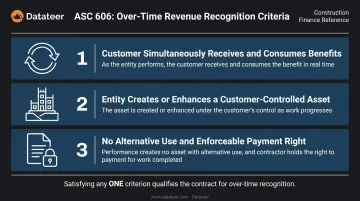
ASC 606's three over-time criteria (any one is sufficient):
- The customer simultaneously receives and consumes the benefits as work progresses
- The entity creates or enhances an asset that the customer controls as it's built
- The entity's performance creates no asset with alternative use to the contractor, and the contractor has an enforceable right to payment for work completed to date
Most long-term construction contracts satisfy at least one criterion — typically criterion 2 for projects built on customer-owned land, or criterion 3 for custom builds where the contractor holds enforceable payment rights. Once over-time recognition is established, the measurement method (cost-to-cost, milestones, or labor hours) should align with how the work actually progresses — and that choice carries real implications for how WIP schedules are prepared and reviewed.
Choosing the Right Revenue Recognition Method
Method selection should be driven by four factors:
| Factor | Implication |
|---|---|
| Project duration and complexity | Multi-year contracts → percentage of completion / cost-to-cost |
| Cost estimate reliability | Cost-to-cost requires confident total cost projections |
| Contract structure | Milestone method requires clear, defensible value transfer points |
| Internal accounting capabilities | Cost-to-cost demands timely, accurate WIP data — not a monthly snapshot |
The Operational Dependency Teams Often Overlook
The cost-to-cost and percentage of completion methods are only as accurate as the WIP data feeding them. Specifically, both costs incurred to date and total estimated contract costs must be current, complete, and sourced from actual project accounting records.
When this data is assembled manually from spreadsheets, the typical lag runs 10–20 days behind actual project conditions. By the time a period-end WIP schedule is finalized, the cost figures driving revenue calculations may already be weeks out of date. That gap quietly distorts recognized revenue — and rarely surfaces until an audit or restatement forces the correction.
Automated WIP platforms that sync directly to your ERP — such as Datateer, which pulls from 12+ construction ERPs on an overnight cycle — surface costs incurred to date and projected final costs as separate line items at the job, phase, and cost-code level. That eliminates the manual assembly step where most lag and error enters the revenue calculation.
Tax vs. GAAP: Don't Mix the Two Up
Data lag isn't the only source of recognition errors — method confusion is just as common. Some contractors apply different methods for income tax purposes versus GAAP financial reporting. Under IRC Section 460, eligible small contractors may use the completed contract method for tax; GAAP financial statements must follow ASC 606 regardless.
Treating tax method elections as GAAP guidance is a consistent audit finding and a costly error to unwind.
Consistency Matters
Beyond getting the method right, keeping it consistent matters just as much. The chosen method must be applied consistently across similar contracts and disclosed in financial statements. Switching methods between periods — even with defensible reasoning — raises audit flags and undermines period-to-period comparability.
Common Issues in Construction Revenue Recognition
Billing Is Not Revenue
The most frequent misconception: invoicing milestones or retainage schedules drive revenue recognition. They don't.
Under ASC 606, billing and revenue are independent:
- Overbilling (billed more than earned) = contract liability — billings in excess of costs
- Underbilling (earned more than billed) = contract asset — costs in excess of billings
Per CFMA guidance, these are determined on a net basis at the individual contract level. They reflect real financial obligations and receivables — not optional accounting entries — and directly affect the balance sheet.
Datateer's WIP dashboard surfaces both as distinct line items: overbillings and underbillings calculated separately at the job level, refreshed nightly from ERP source data.
Cost-to-Cost Misapplications
Three specific errors produce systematically distorted revenue under the cost-to-cost method:
- Using committed costs (purchase orders) in the numerator: POs not yet incurred inflate the percentage complete. Committed costs belong in the forward-looking cost picture, not the "costs incurred to date" figure
- Failing to revise total estimated costs when scope changes: Changes to scope without corresponding updates to the denominator produce a completion percentage that doesn't reflect actual project status
- Using blended cost rates across dissimilar work types: A single rate applied across high-cost and low-cost work categories introduces systematic error into percentage complete calculations
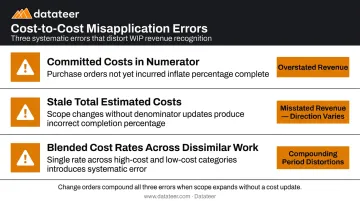
The change order problem compounds each of these errors when scope expands without a matching cost update.
The Change Order Problem
Unapproved or unpriced change orders are a persistent source of revenue recognition error. Under ASC 606, revenue from a change order can only be recognized if it is probable that doing so won't cause a significant reversal when the uncertainty resolves. That determination requires documentation and discipline — not just optimism about eventual approval.
Datateer's Change Order Impact & Aging module tracks change orders across their full lifecycle — pending, approved, denied, and executed. It flags aging by days since submission and identifies stalled change orders where costs are already accumulating against unapproved scope. That visibility directly supports the variable consideration constraint analysis required under ASC 606.
Frequently Asked Questions
What are the two methods for recognizing revenue on a long-term construction contract?
Under ASC 606, the two primary approaches are recognizing revenue over time (using measures like cost-to-cost or milestones as work progresses) and recognizing revenue at a point in time (when control of the completed asset transfers to the customer). Most long-term construction contracts satisfy at least one of ASC 606's over-time criteria, making over-time recognition the standard approach.
What is the journal entry for a construction company recognizing revenue over time?
Debit Accounts Receivable (or Contract Asset / Costs in Excess of Billings) and credit Revenue for the amount earned in the period; separately, debit Cost of Revenue and credit the relevant cost accounts. The WIP schedule drives the amounts recorded each period, with percentage complete and earned revenue calculations determining the entries.
What is the difference between the cost-to-cost method and the percentage of completion method?
Percentage of completion is the overarching framework: revenue is recognized as a project progresses. Cost-to-cost is one specific measure of that progress, comparing costs incurred to total estimated contract costs. Labor hours and engineering milestones are equally valid measures under ASC 606.
Does the completed contract method comply with ASC 606?
Generally, no. ASC 606 requires recognizing revenue as performance obligations are satisfied, which for most construction contracts means over time — not only at completion. The completed contract method remains available for income tax purposes under IRC Section 460 for eligible small contractors, but it does not satisfy GAAP financial reporting requirements under ASC 606 for most firms.
How do change orders affect revenue recognition in construction?
Change orders modify contract scope and price. Approved, priced change orders increase the transaction price and are recognized as performance obligations are satisfied. Unapproved or unpriced change orders require judgment under ASC 606's variable consideration constraint: revenue is included only when a significant reversal is not probable.
When should a construction company recognize revenue at a point in time?
Point-in-time recognition applies when none of ASC 606's three over-time criteria are met. This is most common with prefabricated components or contracts where the contractor retains the right to redirect the asset and has no enforceable payment right until delivery. Key indicators: legal title transfer, physical possession, and formal customer acceptance.
Revenue recognition in construction depends on contract structure, project duration, cost predictability, and the quality of underlying financial data. For construction finance managers and CFOs, knowing the rules matters less than having the data infrastructure to apply them accurately, every period.
If your firm is still assembling WIP schedules manually, a free 15-Minute Workflow Audit with Datateer's team is worth scheduling: no slides, no pitch — just a direct look at how automated ERP-connected reporting would work with your actual data.