Introduction
Contract type selection is one of the most consequential financial decisions a construction firm makes — yet many firms treat it as the legal team's problem. The accounting team finds out later, usually when the billing cycle doesn't match the revenue recognition method or the WIP schedule doesn't reconcile cleanly.
According to the AIA, every construction contract includes a compensation method that determines both how the contractor gets paid and how much financial risk they carry. That structural choice directly shapes WIP accounting complexity, billing cycle timing, and the documentation burden behind every payment application.
This guide is written for construction finance managers, CFOs, and advisors who need to understand contract types not just as legal structures, but as financial management frameworks. We cover the five most common contract types, what drives selection between them, and the specific reporting demands each one creates.
Key Takeaways
- Five primary contract types — lump sum, cost-plus, time and materials, unit price, and design-build — each allocates risk and payment structure differently
- Lump sum locks in contractor exposure; any cost growth without a signed change order comes directly out of margin
- Cost-plus and T&M shift risk to the owner but require detailed expense documentation from the contractor
- Scope certainty is the primary decision driver — unclear scope and fixed prices are a dangerous combination
- Contract type directly shapes WIP accounting complexity, billing cadence, and cash flow forecasting
What Is a Construction Contract?
A construction contract is a legally binding agreement between an owner and contractor that defines scope of work, payment terms, project schedule, change order procedures, and each party's rights and responsibilities. As Smith Debnam outlines, any well-structured construction agreement rests on five core elements:
- Scope of work — what is being built and to what standard
- Timeline — milestones, completion dates, and schedule requirements
- Payment structure — how and when money moves through the project
- Change order procedures — how scope changes are documented and priced
- Dispute resolution — the mechanism for resolving disagreements
The contract's deeper function is risk allocation. The payment structure determines who absorbs cost overruns, who captures savings, and how money moves throughout the project lifecycle — which is why contract type matters to finance teams, not just legal counsel.
One distinction worth clarifying upfront: contract type refers to the payment and risk structure (lump sum vs. cost-plus), while contract terms refers to the specific clauses built into that structure. Two lump sum contracts can have very different terms around differing site conditions, liquidated damages, or audit rights — but both still carry the same fundamental risk allocation logic.
The 5 Most Common Construction Contract Types Explained
Lump Sum (Fixed Price) Contract
A lump sum contract sets a single fixed price for the entire project scope. The contractor delivers the work for that price regardless of what it actually costs — cost overruns belong to the contractor, and so do the savings.
AIA describes lump sum contracts as best suited to clearly defined scopes with predictable schedules. When drawings are complete and site conditions are well understood, fixed pricing is achievable. When they're not, the contractor is pricing against uncertainty — and that uncertainty has a cost.
Risk profile for contractors:
- Must estimate accurately before work begins
- Absorbs all cost growth unless a formal change order is executed
- Retains all savings if work comes in under budget
- Typically builds in a contingency allowance to protect margin
Lump sum is the most common contract structure for commercial construction projects with well-defined scopes. It offers owners cost certainty and straightforward administration, but it places the financial burden of accurate pre-construction estimating squarely on the GC.
Cost-Plus Contract
Under a cost-plus contract, the owner reimburses all allowable project costs — labor, materials, equipment, subcontractors, overhead — plus a predetermined fee representing the contractor's profit. AIA notes that cost-plus is commonly used when scope isn't fully defined or when construction must begin before design is complete.
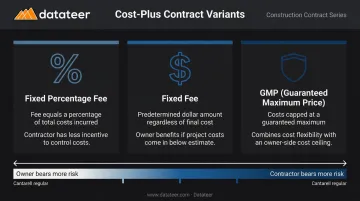
Three main variants:
| Variant | How the Fee Works | Key Characteristic |
|---|---|---|
| Cost-plus fixed percentage | Fee = % of total costs incurred | Contractor has less incentive to control costs |
| Cost-plus fixed fee | Fee is a predetermined dollar amount | Owner benefits if costs come in low |
| Cost-plus with GMP | Same as above, but costs capped at a maximum | Combines flexibility with an owner-side cost ceiling |
The Guaranteed Maximum Price (GMP) variant deserves special attention. AIA defines a GMP contract as an agreement that caps the total amount an owner pays, regardless of actual costs above that ceiling. Costs over the GMP are the contractor's responsibility, giving owners cost-reimbursable flexibility up to a defined limit.
GMP contracts typically require detailed expense documentation and give the owner audit rights over all billable costs. Contractors need to be prepared to back up every line item.
Time and Materials (T&M) Contract
T&M contracts pay the contractor for actual labor hours at agreed rates, plus materials at cost with a markup. There's no fixed price — the final cost depends entirely on how much time and material the work requires.
Most T&M contracts include a not-to-exceed (NTE) cap to give owners some cost predictability. Without a cap, the owner carries essentially unlimited cost exposure.
When T&M is the right structure:
- Maintenance and repair work with unpredictable scope
- Emergency response situations
- Early-phase work before full design is available
- Small projects where estimating upfront would cost more than it saves
The documentation burden on T&M contracts is substantial. Every labor hour and material purchase needs to be tracked, verified, and supported for billing. For contractors, this creates a direct link between field data discipline and cash flow.
Unit Price Contract
Unit price contracts set a fixed price per measurable unit of work — cubic yards of earthwork, linear feet of pipe, tons of asphalt. The total contract value isn't known at signing; it's calculated by multiplying agreed unit rates by actual quantities once work is complete.
This structure is common in civil, infrastructure, and heavy construction where quantities can't be precisely determined at bid time. The federal highway system operates largely on this model — FHWA contract procedures describe payment estimates based on agreed unit prices and quantities determined during construction.
The core financial risk: a miscalculated unit rate compounds across every unit performed. A small pricing error on a low-volume item may be immaterial. That same error across 500,000 cubic yards of earthwork is a serious margin problem.
Design-Build Contract
Design-build consolidates design and construction responsibility under a single entity. Rather than completing design before soliciting construction bids, the owner contracts with one team that handles both — allowing design and construction to overlap and compress the overall schedule.
DBIA/FMI research projects design-build will account for 47% of construction spending by 2026, with design-build projects delivered 102% faster than traditional design-bid-build from design through completion.
Unlike traditional delivery, design-build projects are typically awarded through negotiation or best-value selection rather than competitive bidding. Progressive Design-Build is now standard on complex projects where scope can't be locked down at contract execution. Design and price are developed collaboratively in phases, rather than fixed upfront.
Owner benefit: Single point of accountability. One contract, one entity responsible for both design quality and construction performance.
How to Choose the Right Construction Contract Type
Scope certainty is the primary decision driver — every other factor follows from it.
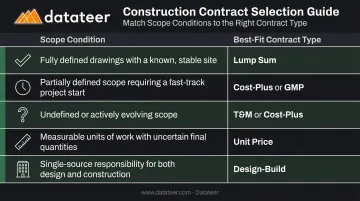
Scope-to-Contract Framework
Use this framework to match your project's scope conditions to the right contract structure:
| Scope Condition | Best-Fit Contract Type |
|---|---|
| Fully defined drawings, known site | Lump sum |
| Partially defined, fast-track start | Cost-plus or cost-plus with GMP |
| Undefined or evolving scope | T&M or cost-plus |
| Measurable units, uncertain quantities | Unit price |
| Single-source design + construction | Design-build |
Beyond scope, two other factors shape the decision:
Risk tolerance. Lump sum and design-build transfer more financial risk to the contractor. Cost-plus and T&M keep more risk with the owner. The right allocation depends on who is better positioned to manage project uncertainty. An owner with a seasoned in-house construction team may be comfortable with cost-plus exposure. An owner with no construction expertise usually isn't.
Schedule and owner involvement. Design-build and cost-plus both allow construction to begin before design is complete — critical on fast-track or phased projects. Hands-off owners tend to prefer lump sum or design-build, where they hand off risk and accountability to a single party. Owners who want cost transparency and active involvement are better suited to cost-plus or T&M, where every dollar spent is visible.
How Contract Type Shapes Your Financial Reporting Burden
Contract type is the single biggest driver of financial reporting complexity in construction. Each structure creates distinct data management demands for finance teams.
WIP Reporting by Contract Type
- Lump sum: Requires percent-complete calculations, earned revenue vs. billed revenue analysis, and over/underbilling detection. Margin fade is invisible until it hits the WIP schedule — by which point recovery options are limited
- Cost-plus: Requires matching actual costs to allowable categories defined in the contract, supporting every billable line item, and managing potential audit exposure
- T&M: Requires labor hour verification, materials reconciliation, and documentation sufficient to support each payment application
- Unit price: Requires quantity verification and unit rate reconciliation across potentially thousands of pay items
The manual approach to all of this — CSV exports from the ERP, VLOOKUP-heavy Excel models, Procore-to-Sage reconciliation cycles — creates a 10–20 day reporting lag that leaves finance teams making decisions on month-old data.
The Cash Flow Timing Problem
Contract type also drives when money moves:
- Lump sum: Typically allows scheduled progress billing tied to milestones or percent complete, giving contractors a predictable billing rhythm
- Cost-plus and T&M: Billing is triggered by documented costs, which means there's often a gap between when costs are incurred and when an invoice can be submitted and paid — creating working capital pressure that doesn't show up in project profitability metrics
Managing Multiple Contract Types Simultaneously
Construction firms managing a mixed portfolio — some lump sum, some cost-plus, a few T&M — face compounded reporting complexity. Each project's financial data needs to roll into a single portfolio view while maintaining the contract-type-specific reporting logic each structure demands.
Datateer's automated WIP dashboards address this by syncing overnight with 12+ construction ERPs (Procore, Sage, Viewpoint Vista, Acumatica, Foundation Software, and others). Earned revenue, over/underbilling positions, projected margins, and cash flow data all land in a single consolidated view. Double L Management's business analyst described the impact: "The very first time we accessed our data through a Datateer analytics dashboard, that one click replaced two weeks worth of prior work."
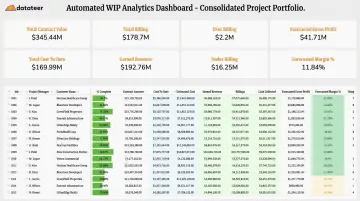
For finance teams rebuilding WIP schedules from scratch each month-end, that 2-minute real-time refresh closes a reporting cycle that used to consume weeks — freeing controllers to analyze the numbers instead of assembling them.
Common Misconceptions About Construction Contracts
"Lump sum protects the contractor from financial risk"
Not quite. A lump sum contract shifts price risk to the contractor when the scope and site assumptions hold. When they don't — incomplete drawings, undisclosed site conditions, scope creep without documented change orders — that protection disappears. AIA notes that incomplete documents frequently lead to change orders, pricing disputes, and schedule delays. A fixed price only stays fixed if scope stays fixed.
"Cost-plus means the owner pays whatever it costs"
Cost-plus does not mean unlimited reimbursement. Allowable costs must be defined in the contract, GMP clauses cap total exposure, and audit rights give owners the ability to review books, records, and supporting documentation to verify every billed cost. The flexibility of cost-plus comes with real accountability requirements for both parties.
"Contract type is a one-time decision"
Different phases of the same project often operate under different structures. Early-phase investigation work might run on T&M while the scope is undefined; core construction might shift to lump sum once drawings are complete. Finance teams should track the reporting requirements of each phase separately, since the accounting treatment and documentation burden change with the contract structure, not just the project phase.
Frequently Asked Questions
What are the 5 types of construction contracts?
The five main types are: lump sum (fixed price for the full scope), cost-plus (owner reimburses actual costs plus a fee), time and materials (contractor billed at agreed labor rates plus materials), unit price (fixed rate per measurable unit of work), and design-build (single entity responsible for both design and construction).
What is the most common type of construction contract?
Lump sum (fixed price) is the most widely used structure — it offers owners cost certainty and straightforward administration. It works best when scope and drawings are complete upfront, so the contractor can price the work accurately before starting.
What is the difference between a lump sum and a cost-plus contract?
In a lump sum contract, the contractor delivers the project for a fixed price regardless of actual costs — cost overruns reduce the contractor's margin. In a cost-plus contract, the owner reimburses actual costs and pays an additional fee, shifting financial risk from contractor to owner.
What is a Guaranteed Maximum Price (GMP) contract?
A GMP is a cost-plus variant that caps the owner's total payment obligation. The owner reimburses actual costs up to the guaranteed maximum; any costs above that ceiling fall to the contractor — giving both sides a degree of cost certainty.
How does contract type affect cash flow in construction?
Lump sum contracts support scheduled progress billing tied to milestones or percent complete. Cost-plus and T&M contracts tie billing to documented costs, which can create a gap between when costs are incurred and when payment arrives — so active cash flow tracking matters most on those contract types.
What contract type is best for a project with an undefined scope?
Cost-plus or time and materials contracts are better suited to undefined or evolving scope. Both allow work to begin before full design is complete and reimburse actual costs rather than requiring an upfront fixed estimate that may bear little resemblance to what the work actually requires.