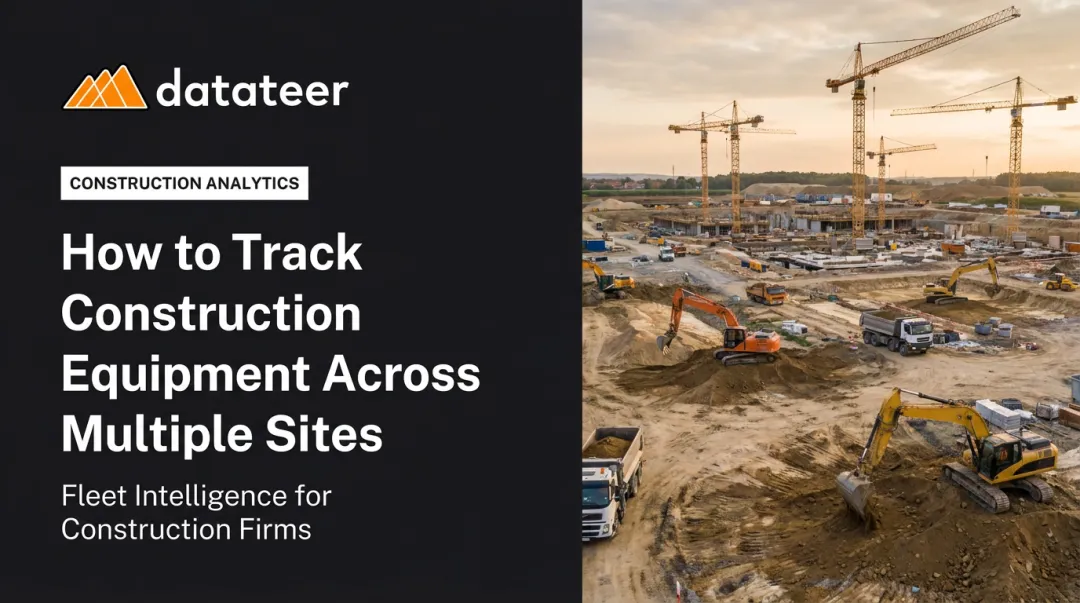
Telematics closes that gap. By capturing, transmitting, and surfacing real-time equipment data, it turns raw sensor output into decisions — better maintenance scheduling, lower fuel spend, fewer surprise breakdowns, and tighter fleet control across every active site.
This article covers what construction telematics is, how it works, the key benefits, top use cases, and what to look for when evaluating solutions.
Key Takeaways
- Construction telematics combines GPS, onboard diagnostics, and wireless data transmission to monitor equipment in real time
- Key data captured: location, engine hours, fuel consumption, idle time, operator behavior, and fault codes
- Core benefits include reduced fuel waste, predictive maintenance, optimized fleet utilization, and improved site safety
- Telematics data only delivers financial visibility when your ERP and dashboards are built to act on it
- Look for construction-specific solutions with OEM integrations, mixed-fleet support, and ERP connectivity
What Is Telematics in Construction?
According to the Association of Equipment Manufacturers (AEM), machine telematics is a set of technologies used to remotely track, monitor, and optimize machinery assets. In construction, that means integrating GPS receivers, onboard diagnostics, CAN bus readers, and wireless communication into a system that monitors your entire fleet — in real time.
That's a critical distinction from basic GPS tracking. A GPS device tells you where a machine is. Telematics tells you where it is, how long it's been running, how much fuel it's consumed, whether the engine is throwing fault codes, and how the operator is handling it — all at once.
What Data Does Telematics Actually Capture?
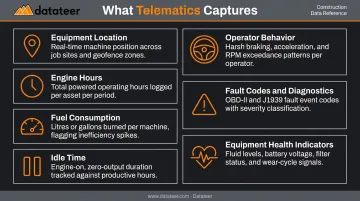
The breadth of data varies by system and hardware, but construction telematics platforms typically capture:
- Equipment location — GPS coordinates updated continuously across all sites
- Engine hours — the primary utilization metric for heavy equipment (not mileage)
- Fuel consumption — per machine, per shift, with running vs. idle time breakdowns
- Idle time — time the engine runs without productive output
- Operator behavior — harsh braking, over-revving, speeding, overloading
- Fault codes and diagnostics — engine health alerts pulled via CAN bus / J1939
- Equipment health indicators — fluid levels, temperature, abnormality alerts
Caterpillar's Product Link hardware, for example, captures fuel burn, fuel level, running vs. idling time, payload information, and fault codes. Komatsu's KOMTRAX platform tracks productive hours, idle time, load factors, travel times, economy vs. power modes, and automated abnormality alerts.
Construction Telematics vs. General Fleet Telematics
Standard fleet management tools are built for on-road vehicles tracked by mileage and driving hours. Construction fleets don't work that way. A 300-ton mining excavator is tracked by engine hours and CAN bus data, not odometer readings. Many construction fleets also include non-powered assets (trailers, attachments, generators) that require different tracking approaches.
Construction-specific telematics systems account for these distinctions. ISO/TS 15143-3:2020 formalizes mixed-fleet interoperability as the international standard for mobile machinery status data exchange across OEM telematics platforms.
Who Benefits Most?
The value of telematics cuts across every level of a construction organization:
- Fleet and equipment managers get utilization data, maintenance scheduling, and fault code alerts
- Project managers gain real-time location tracking, job-level hours, and cost visibility
- Site supervisors use operator behavior monitoring, geofencing, and safety oversight tools
- CFOs and finance leaders see equipment cost data, fuel spend, and rental vs. own analysis
How Construction Telematics Systems Work
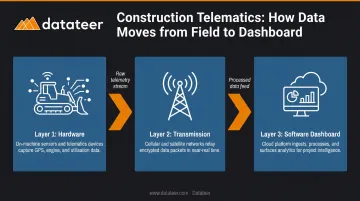
Telematics operates across three layers: hardware, transmission, and software, each doing a distinct job.
The Hardware Layer
GPS receivers, accelerometers, CAN bus readers, and engine diagnostic sensors mount directly on equipment and collect data continuously. Hardware may be OEM-embedded (factory-installed by Caterpillar, Komatsu, John Deere, Volvo) or added as aftermarket devices for older or mixed-brand fleets.
The CAN bus connection (using the SAE J1939 protocol standard in heavy equipment) is what enables telematics to go deeper than location. It's the vehicle network that carries engine diagnostics, fault codes, and performance data from the machine's ECU to the telematics device.
The Transmission Layer
Captured data travels via cellular, satellite, or hybrid networks to a cloud platform. Cat Product Link offers three hardware variants: 4G cellular, satellite-only, and a combined 4G-plus-satellite device for remote sites with limited cellular coverage. Komatsu supports cellular, Wi-Fi, and satellite transmission depending on site conditions.
This matters on remote jobsites. A satellite-capable device ensures data keeps flowing even when cellular coverage drops out.
The Software/Dashboard Layer
The cloud platform is where raw sensor data becomes operational intelligence. Aggregated data flows through dashboards, automated alerts, utilization reports, and maintenance scheduling tools. This is the layer that converts "the excavator ran for 8.4 hours today" into "this machine needs a service in 47 hours and was idle for 31% of its runtime."
Key Benefits of Telematics for Construction Firms
Reduced Fuel and Idle Costs
Idle time is a straightforward problem: the engine runs, fuel burns, and no work happens. It also shortens engine lifespan and inflates operating costs without any corresponding productivity.
Telematics makes idle time patterns visible across machines, operators, and shifts so managers can actually address them. AEM documented a case where better idle-time management helped one fleet save roughly 6,000 gallons of fuel per week, a 20% reduction. That's a case-specific result, not an industry average, but it illustrates what targeted intervention with real data can produce.
The mechanism is simple: when supervisors can see which machines idle most and when, they can set targets, coach operators, and track improvement over time.
Predictive and Preventive Maintenance
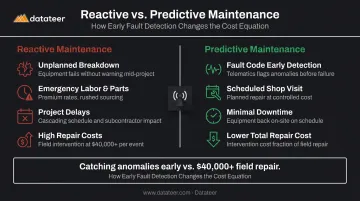
Reactive maintenance — fix it when it breaks — is expensive. Unplanned breakdowns halt production, require emergency labor and parts sourcing, and often trigger project delays. Telematics shifts the model toward predictive and preventive intervention.
Key capabilities here:
- Fault code detection — systems like Volvo ActiveCare Direct analyze telematics data and separate minor fault codes from critical issues requiring immediate attention
- Abnormality alerts — Komatsu sends automated alerts when equipment performance deviates from normal thresholds
- Maintenance threshold tracking — engine hours trigger service reminders automatically, so nothing slips through a spreadsheet
Catching a coolant temperature anomaly before it becomes a blown head gasket means a scheduled shop visit instead of a $40,000 field repair on a critical-path machine.
Optimized Equipment Utilization
Most construction fleets have underutilized assets — machines sitting on a yard or rental lot, accumulating cost with no productive output. Telematics utilization reports make that visible.
With actual hour-by-hour data, fleet managers can:
- Identify which assets are overworked and which are consistently underused
- Redeploy machines across sites based on real demand, not estimates
- Make rent-vs.-own decisions grounded in actual utilization rates
- Right-size the fleet over time to eliminate unnecessary rental and ownership costs
The AEMP's Heavy Equipment Comparator benchmarks 32 KPIs for construction companies specifically to support this kind of utilization analysis against industry peers.
Improved Jobsite Safety
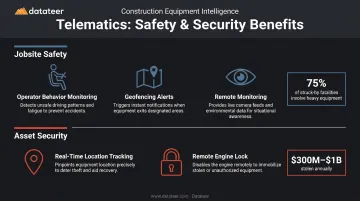
OSHA data shows that approximately 75% of struck-by fatalities in construction involve heavy equipment such as trucks or cranes. Telematics contributes to reducing that exposure through several mechanisms:
- Operator behavior monitoring — speeding, harsh braking, rapid acceleration, and overloading are recorded and available for coaching
- Geofencing — virtual perimeter alerts trigger instantly when equipment moves outside approved zones, catching both unauthorized use and operator error
- Remote monitoring — supervisors can track machine activity across sites without being physically present
On the asset security side, the National Equipment Register estimates that $300 million to $1 billion in heavy equipment is stolen annually. Real-time location tracking and remote engine lock capability — available on platforms like Komatsu KOMTRAX — are direct countermeasures.
Regulatory Compliance Support
For fleets operating diesel equipment in regulated jurisdictions, telematics provides data that supports compliance documentation. California's CARB In-Use Off-Road Diesel Regulation includes operational thresholds — such as a low-use designation for equipment operating fewer than 600 hours over three consecutive years — that engine-hour data from telematics platforms directly supports.
Telematics doesn't make a fleet automatically compliant. What it does is generate the engine-hour and operational records that compliance reporting requires — replacing manual logs with automated, auditable data.
From Field Data to Financial Intelligence
Telematics solves the operational data problem in the field. But construction finance teams face a parallel challenge that telematics alone can't fix: financial data from ERPs, job cost reports, and WIP schedules typically lags by 10–20 days, creating a disconnect between what's happening on the jobsite and what's visible to the CFO.
When telematics data flows into an ERP through integrations — populating actual fuel burn, equipment hours, and utilization metrics against job cost codes — that operational data becomes far more valuable. It can feed budget-vs.-actual analysis, cost-to-complete projections, and overhead rate calculations in real time.
The catch: that value only materializes if your financial dashboards can actually surface it.
This is where Datateer comes in. Datateer is a financial intelligence platform built specifically for construction firms, connecting directly to 12+ construction ERPs — including Procore, Sage 100/300/Intacct, Viewpoint Vista, Viewpoint Spectrum, Acumatica Construction, Foundation Software, CMiC, Jonas, QuickBooks, and NetSuite — to eliminate the manual reporting lag entirely.
Datateer closes the financial data gap that telematics can't reach. The platform delivers:
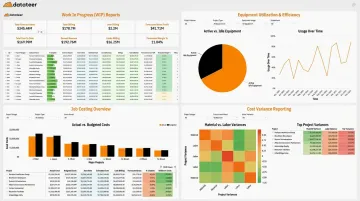
- Real-time WIP reports — replacing 10–20 days of spreadsheet work with automated overnight refresh
- Job Costing & Cost-to-Complete dashboards — actual costs, committed costs, projected final cost, and budget variance at job, phase, and cost-code level
- Equipment Utilization dashboards — part of the Resource Productivity suite, showing which machines are generating value and which are sitting idle
- Cost Variance reporting — real-time budget vs. actuals with drill-down to source transactions
Double L Management's Business Analyst described it plainly: "The very first time we accessed our data through a Datateer analytics dashboard, that one click replaced two weeks worth of prior work."
Together, telematics and Datateer give construction firms a complete picture — operational performance on the ground and the financial intelligence to act on it in the office.
What to Look for in a Construction Telematics Solution
Construction-Specific vs. Generic Fleet Tools
Generic fleet management platforms are built around on-road vehicles. Construction fleets require engine-hour tracking, CAN bus data from heavy equipment, and support for non-powered assets. A purpose-built construction telematics system handles all three without workarounds or custom configuration.
Integration Capabilities
Integration depth matters regardless of fleet size. Look for:
- Native OEM connections to Caterpillar VisionLink, Komatsu KOMTRAX, John Deere JDLink, Volvo ActiveCare Direct, and Hitachi
- ISO/TS 15143-3 / AEMP 2.0 compliance for consolidating data across multiple OEMs into one view
- Direct feeds into Procore, Sage, Viewpoint, and similar ERPs so equipment data flows into job cost tracking automatically
Practical Adoption Factors
The best integration stack means nothing if field teams ignore it. Before committing, evaluate:
- Mobile app functionality field supervisors can actually use on-site, not just a desktop portal
- Setup complexity — OEM-embedded hardware installs cleanly; aftermarket on mixed fleets takes more planning
- Ongoing support quality, particularly during the first 90 days when adoption habits form
- Scalability across sites, asset types, and fleet size without forcing a platform switch later
Frequently Asked Questions
What is telematics in construction?
Construction telematics combines GPS, onboard diagnostics, and wireless data transmission to monitor equipment location, usage, fuel consumption, and health in real time. It gives construction firms continuous visibility into fleet performance across every active jobsite.
What is telematics integration?
Telematics integration connects telematics hardware and software with other business systems — ERP platforms, OEM equipment portals, and project management tools. The goal is automatic data flow into operational and financial workflows, eliminating manual exports.
What data does construction telematics collect?
Core data categories include GPS location, engine hours, fuel consumption, idle time, operator behavior (speeding, harsh inputs, overloading), equipment fault codes, and diagnostic health indicators such as temperature and fluid levels.
How does telematics help reduce construction equipment costs?
Telematics targets four main cost levers:
- Cuts idle time and fuel waste through real-time visibility
- Enables predictive maintenance before breakdowns occur
- Reduces unnecessary rentals by optimizing fleet utilization
- Extends equipment lifespan by catching fault codes early
What is the difference between telematics and GPS tracking in construction?
GPS tracking provides location data only. Telematics captures a much broader set of operational data — engine diagnostics, fuel consumption, idle time, operator behavior, fault codes, and maintenance indicators — making it a comprehensive equipment and fleet management tool rather than just a location service.