ASC 606 gets referenced constantly in construction, but it's often reduced to "percentage-of-completion" with little understanding of what actually changed from the prior standard or what compliance requires operationally. That gap creates real risk.
Key Takeaways
- ASC 606 replaced ASC 605 with a five-step model built on "transfer of control," not completion percentage
- Most construction contractors recognize revenue over time under stricter criteria than the old percentage-of-completion method
- The cost-to-cost input method requires cost-to-complete estimates updated every reporting period
- Uninstalled materials and waste costs must be excluded from progress calculations — a step many contractors miss
- Over-time vs. point-in-time recognition is determined at contract inception, not at completion
What Is Revenue Recognition Under ASC 606?
ASC 606 — formally, Accounting Standards Codification Topic 606, "Revenue from Contracts with Customers" — is the current GAAP standard governing when and how revenue is recorded. Issued as FASB ASU 2014-09, it replaced ASC 605 and the industry-specific construction guidance under Subtopic 605-35, introducing a single, unified five-step framework that applies across industries.
The core principle (ASC 606-10-10-2): revenue should reflect the transfer of promised goods or services to customers in an amount the entity expects to receive. Revenue in any period should match what was actually delivered — not when cash arrived or an invoice went out.
How It Differs from the Old Standard
ASC 605 relied on "earning" revenue through percentage-of-completion or completed-contract methods. ASC 606 replaces that with a stricter question: has control of the promised good or service transferred to the customer?
That shift matters because it requires:
- Documentation of performance obligation identification at contract inception
- Specific criteria to qualify for over-time recognition — criteria that must be actively demonstrated, not assumed
- Required adjustments for uninstalled materials and waste costs
- Updated estimates at every reporting period, not just at year-end
Why Construction Contractors Must Understand ASC 606
Construction is uniquely exposed to revenue recognition complexity. Projects span multiple fiscal years, billing schedules routinely diverge from actual work progress, and contract values range from thousands to hundreds of millions. A firm carrying dozens of simultaneous contracts — each at a different stage with different billing terms — needs accurate period-by-period recognition to produce financials that mean something.
The stakes are concrete. According to the NASBP, sureties evaluate working capital, net worth, and work program when setting bonding capacity. An inaccurate WIP schedule creates an audit problem and directly limits how much work a contractor can bond. Surety underwriters have called the WIP schedule the heart of the surety file; UFG Surety notes that even a poorly documented schedule can shrink available bonding capacity.
The SEC's 2023 action against Fluor Corporation — which resulted in a $14.5 million civil penalty and disclosed earnings overstated by as much as 37% across affected years — illustrates what revenue estimate failures look like in practice for large construction firms. Informal, undocumented revenue recognition practices put any contractor on the same path, regardless of size.
When ASC 606 is applied improperly:
- Overbillings and underbillings become unreliable balance sheet figures
- WIP schedules mislead lenders and bonding companies
- Audit risk climbs sharply
- Management decisions rest on inaccurate data, compounding errors across every affected project
How ASC 606 Revenue Recognition Works in Construction
Under ASC 606, revenue is recognized when, or as, a performance obligation is satisfied by transferring control to the customer. In construction, this almost always happens over time rather than at a single point.
The Five-Step ASC 606 Model
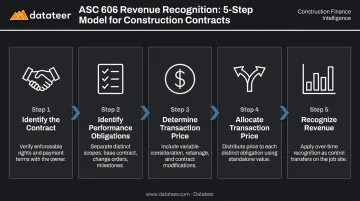
Applied to a construction contract, the five steps work as follows:
- Identify the contract — confirm it meets ASC 606 criteria (commercial substance, collectibility probable, rights and payment terms identifiable)
- Identify the performance obligation(s) — in construction, the entire project is typically treated as a single performance obligation, though separate phases or deliverables can qualify as distinct obligations
- Determine the transaction price — include the base contract price plus variable consideration such as approved and probable change orders, incentive payments, or liquidated damages
- Allocate the transaction price — necessary when multiple performance obligations exist; typically straightforward in single-obligation contracts
- Recognize revenue — as each performance obligation is satisfied, either over time or at a point in time
Over-Time Recognition: The Three Qualifying Criteria
Under ASC 606-10-25-27, a contractor recognizes revenue over time if any one of these three criteria is met:
- (a) Simultaneous benefit — the customer receives and consumes the benefits as the work is performed (common in service-type maintenance contracts)
- (b) Customer-controlled asset — the contractor's work creates or enhances an asset the customer controls as it is built — for example, construction on customer-owned land
- (c) No alternative use + enforceable payment right — the work has no alternative use to the contractor (a building designed specifically for one owner can't easily be redirected) AND the contractor has an enforceable right to payment for performance completed to date
Criteria (b) and (c) cover the vast majority of commercial construction contracts. One critical timing rule: the over-time classification must be established at contract inception, not reassessed at project completion. When none of the three criteria apply, a different recognition approach is required.
Point-in-Time Recognition: When It Applies
If none of the three criteria are met, revenue is recognized at a point in time — when control transfers to the customer. The clearest construction example: a speculative homebuilder constructing on their own land. Until closing, the builder controls the asset and has no enforceable right to payment. Revenue is recognized at the point of sale, analogous to the old completed-contract method.
Measuring Progress: Input vs. Output Methods
Once over-time recognition is established, the contractor selects a method to measure progress toward satisfying the performance obligation. That method must faithfully depict how control is transferring — not simply how costs are accumulating.
The Cost-to-Cost Input Method
The cost-to-cost method is the most common approach in construction:
Percentage complete = Costs incurred to date ÷ Total estimated costs
Revenue recognized to date = Percentage complete × Total contract price
The formula is simple — keeping the denominator current is not. Total estimated costs must be updated at every reporting period. Stale estimates cascade directly into inaccurate earned revenue, misstated WIP schedules, and unreliable over/underbilling balances.
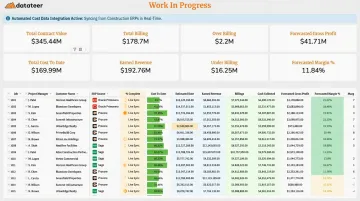
This is where construction finance teams gain or lose accuracy at scale. Keeping cost-to-complete data current across dozens of simultaneous contracts requires live cost data from the ERP — not a month-end spreadsheet update. Datateer handles this by syncing cost data automatically from construction ERPs (Procore, Sage, Vista, Acumatica, Foundation, CMiC, and others) overnight, so the inputs driving the percentage-complete calculation reflect actual project status rather than whatever was last manually entered.
Two required adjustments contractors frequently miss:
- Waste and rework exclusion — per ASC 606-10-55-21, costs from unexpected inefficiency or rework must be excluded; they inflate the numerator without reflecting value delivered to the customer
- Uninstalled materials carve-out — materials delivered to site but not yet installed are excluded from the percentage-complete calculation; revenue is recognized only at cost (zero margin) until installation occurs, sometimes called the "zero-profit carve-out method"
Output Methods and the Invoice Practical Expedient
Output methods measure progress based on direct evidence of value delivered — milestones reached, units installed, surveys of work completed. These are conceptually preferred under ASC 606 but rarely used in construction because reliable, objective output measures are difficult to obtain without significant cost.
One practical alternative: the invoice practical expedient under ASC 606-10-55-18 allows a contractor to recognize revenue equal to the amount it has the right to invoice — but only if that amount directly corresponds to the value transferred to the customer. This works in time-and-materials contracts with fixed unit pricing. It does not apply in lump-sum contracts where the billing schedule and actual performance diverge.
Over/Underbillings: The Balance Sheet Result
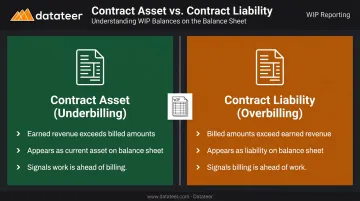
Both methods ultimately produce the same balance sheet result — a gap between revenue earned and amounts billed. That gap takes one of two forms:
- Contract asset (underbilling) — earned revenue exceeds amounts billed; appears as a current asset
- Contract liability (overbilling) — amounts billed exceed earned revenue; appears as a liability
These balances are direct outputs of the ASC 606 revenue recognition mechanics. A firm with unreliable cost-to-complete estimates will produce a WIP schedule that misleads every stakeholder who relies on it — lenders, bonding companies, and internal leadership alike.
Common Misconceptions About Revenue Recognition in Construction
These misconceptions trip up even experienced construction finance teams. Here's what the standard actually requires.
Misconception 1: ASC 606 Is Essentially the Same as Old Percentage-of-Completion
Over-time recognition works like PCM in broad terms, but ASC 606 adds documentation requirements, stricter over-time qualification criteria at contract inception, and specific adjustments — waste exclusions, uninstalled materials carve-outs — that contractors applying the old method informally have often never made.
Misconception 2: You Can Mix Measurement Methods Across Similar Contracts
ASC 606 requires one method per performance obligation and consistent application to similar obligations in similar circumstances. Applying different methods without documented rationale creates direct audit exposure. Common problem pairings include:
- Cost-to-cost on some contracts, milestone-based output on others
- Input methods applied selectively based on project profitability
- No written policy distinguishing why different obligations warrant different approaches
Misconception 3: Updating Cost-to-Complete Estimates Can Wait Until Year-End
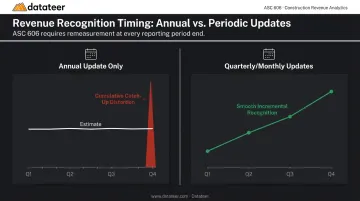
ASC 606 requires remeasurement at the end of each reporting period. Changes to total estimated costs are accounted for prospectively as changes in accounting estimate under ASC 250 — they are not restated. The cumulative catch-up effect can significantly distort a single reporting period's revenue if estimates are only updated annually rather than quarterly or monthly.
Frequently Asked Questions
What is the percentage of completion method?
The percentage of completion method (PCM) recognizes revenue and expenses incrementally as a long-term project progresses, proportional to work completed. ASC 606 preserves this concept through over-time recognition using input or output methods to measure progress.
What is the formula for percentage of completion?
Percentage complete = costs incurred to date ÷ total estimated costs. Revenue recognized = percentage complete × total contract price. The formula's accuracy depends entirely on keeping the total estimated cost figure current at each reporting period — a stale denominator produces unreliable results.
Does GAAP require the percentage of completion method?
GAAP under ASC 606 does not require or explicitly name PCM. It requires contractors to use an appropriate input or output method to measure progress when revenue is recognized over time. The IRS, under IRC Section 460, generally requires PCM for long-term contracts. A small contractor exception applies for firms averaging under $32 million in gross receipts for the prior three tax years (per Rev. Proc. 2025-32).
What is an example of percentage of completion?
A contractor on a $1,000,000 project with $800,000 in estimated total costs has incurred $400,000 — the project is 50% complete, so $500,000 of revenue is recognized. If total estimated costs are later revised to $900,000, the completion percentage recalculates and revenue adjusts prospectively.
What are overbillings and underbillings in construction?
Overbillings occur when a contractor has billed more than revenue recognized to date; they appear as a contract liability on the balance sheet. Underbillings occur when earned revenue exceeds amounts billed; they appear as a contract asset. Both are direct outputs of the ASC 606 process and the primary components of the WIP schedule.
What is the difference between input and output methods under ASC 606?
Input methods measure progress based on contractor efforts (costs incurred, labor hours, materials used) relative to total expected inputs; output methods measure based on direct evidence of value delivered, such as milestones or units installed. In construction, input methods — particularly cost-to-cost — dominate because reliable output measures are rarely available without significant cost or subjectivity.