According to a 2018 survey reported by Construction Executive, 19% of construction company owners said cash flow is a constant problem, 17% said it occurs monthly, and only 13% said they never experience it. The same survey found 25% say cash flow problems prevent business growth.
This guide covers why construction cash flow is structurally difficult, how the cash flow cycle works across project phases, common problems that drain working capital, how to build a meaningful projection, and concrete strategies to improve financial control.
Key Takeaways
- Construction cash flow problems stem from structural timing gaps, not just poor management
- Front-loaded costs, delayed billing, and retainage holds create predictable pressure points
- A 5-step projection process turns reactive firefighting into forward-looking planning
- Underbilling and stale WIP data quietly drain cash in ways most firms don't catch until month-end
- Daily-refreshed dashboards cut the 10–20 day reporting lag that forces reactive cash decisions
Why Construction Cash Flow Is Uniquely Challenging
Most industries invoice after delivering a product or service, then wait to get paid. Construction works differently. Contractors fund the work — labor, materials, equipment, subcontractors — weeks or months before milestone billing even triggers.
That gap is manageable on a single project. It becomes dangerous as the portfolio grows. Each new project requires its own "front money," and if the timing of inflows and outflows across five or ten simultaneous jobs doesn't align, working capital gets consumed faster than it's replenished.
The Compounding Effect Across the Portfolio
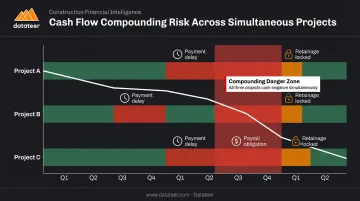
Negative cash flow at project start is normal. The problem is when it compounds:
- Project A hasn't paid out yet, so its cash is unavailable
- Project B starts and requires its own upfront funding
- Project C's retainage is locked until final acceptance
- Meanwhile, payroll, subs, and suppliers don't wait
Each gap individually is survivable. Overlapping gaps across multiple jobs can wipe out working capital before the quarter ends — and that's when the real business risk begins.
What This Means for Bonding and Lending
Those operational gaps don't stay contained to the job site — they follow contractors into the boardroom and the bonding office. Poor cash flow limits growth directly. Bonding companies and banks scrutinize working capital ratios and liquidity before approving new work. CFMA's 2025 Construction Financial Benchmarker reports 2024 national construction averages of a 1.7 current ratio and 1.4 quick ratio. Surety underwriters typically require a minimum current ratio of 1.15 to 1.20 just to qualify for bonding. A contractor who drains working capital in a bad cash flow quarter may find bonding capacity shrinking exactly when new work is on the table.
The Construction Cash Flow Cycle
Cash flow in construction follows a predictable arc tied to project phases. Knowing where the pressure points hit — and how deep they go — lets finance teams build reserves proactively instead of scrambling when the gap opens.
Preconstruction and Mobilization
This is the cash-negative phase by definition. Money flows out for:
- Design fees, permits, site surveys
- Initial material deposits and procurement
- Mobilization costs and site setup
The only inflows are client deposits or advance payments — which rarely cover the full exposure. The critical lever here is the Schedule of Values. A well-structured SOV front-loads overhead and profit recovery in early line items, reducing how deep the cash hole gets before progress payments begin.
Active Construction
Spending spikes sharply as labor, materials, equipment rentals, and subcontractor payments all peak simultaneously. Progress payments start flowing in, but a timing gap always exists between work completion and payment receipt. In practice, that lag commonly runs 30–60 days from work-in-place to cash in hand. The levers that compress it — accurate pay applications, fast owner review cycles, and tight lien waiver turnaround — deserve the same attention as field productivity.
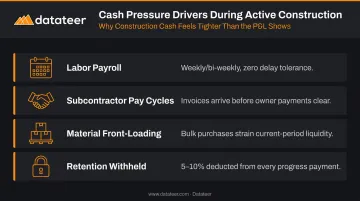
Key cash pressure drivers during active construction:
- Labor payroll: Weekly or bi-weekly with no delay tolerance
- Subcontractor pay cycles: Sub invoices often arrive before owner payments clear
- Material front-loading: Large purchases for upcoming phases strain current-period liquidity
- Retention withheld: Each progress payment is already reduced by 5–10% retainage
Closeout and Post-Construction
Major expenses wind down, but retainage — typically 5–10% of the contract value — stays locked until final acceptance. On a $5M project, that's $250,000–$500,000 in earned cash sitting idle. This phase rewards contractors who treat punch list completion as a financial priority, not an administrative one. Every week of delay in final acceptance is a week that money sits on the owner's balance sheet instead of yours.
Common Construction Cash Flow Problems
Delayed and Inaccurate Billing
Every day a progress billing is delayed pushes payment 30–60 days further out. That delay compounds month over month — a structural cash drain, not a rounding error.
Underbilling is equally damaging and often less visible. When a contractor bills less than the value of work completed, they leave earned revenue uncollected. NASBP notes that underbillings tie up cash in work not yet billed, reduce liquidity, may force short-term borrowing, and can become surety red flags — especially late in a project.
Slow Collections and Escalation Failures
Most contractors don't have a formal escalation process for overdue invoices. The result: passive follow-up, aging receivables, and a Days Sales Outstanding (DSO) that climbs unchecked.
Job borrow is the specific danger here. Cash collected on Project A gets consumed before Project A's payables are settled — effectively borrowing from one job to fund another. It masks the real shortfall until the timing gap can no longer be papered over.
Change Orders Disrupting Cash Flow
Change orders require immediate expenditure. Approval can take weeks or months — GAO data on federal construction showed most changes finalize within 60 days, but some took significantly longer, and at least one agency halt left $41M in unpaid subcontractor payments outstanding.
Without a disciplined change order billing process:
- Costs are incurred in the field without billing authorization
- Working capital absorbs the gap across multiple projects simultaneously
- Underbilling positions widen on the WIP schedule
- Margin fade accelerates before anyone sees it in a report
The Hopscotch Pattern
Some contractors front-load their Schedule of Values to offset early project costs — which is legitimate — but then forget to account for the resulting shortage at that project's end. They patch it with advances from a new project. That new project eventually has the same problem, requiring another new project to cover it.
This cascading dependency works until one project is delayed, underpaid, or disputed. Then the whole chain tightens at once.
The Data Lag Problem
What enables the hopscotch pattern — and most of the problems above — is a visibility gap. When WIP reports take 10–20 days to produce manually, every financial decision in the interim is made on stale data.
By the time a margin fade or underbilling issue appears in a month-end report, the project has moved on. Costs are already incurred, billing windows have closed, and the damage is done.
A business analyst at Double L Management described the shift after implementing automated dashboards: "That one click replaced two weeks worth of prior work." If you're not seeing your WIP and AR position until two weeks after close, you're making billing, staffing, and purchasing decisions without the information needed to make them well.
How to Calculate a Construction Cash Flow Projection
A cash flow projection is a forward-looking document. Unlike a cash flow statement, which is historical, a projection surfaces gaps early enough to act on them. Here's a five-step process:
Step 1: Map All Cash Inflows by Timing
List every source, then assign it to a specific month based on actual contract terms — not project averages:
- Progress payments tied to specific milestone triggers
- Client deposits and advance payments
- Retainage releases (by anticipated acceptance date)
- Equipment rental income or material resale
The goal is precision. A progress payment expected "sometime in Q3" is not useful. A payment tied to a specific billing submission date and a 30-day payment window is.
Step 2: Forecast All Cash Outflows
Cover every category:
- Subcontractor payments (match to sub billing cycles)
- Material purchases (flag large bulk orders early)
- Labor and payroll
- Equipment costs
- Permits, insurance, and overhead
Flag large one-time purchases in advance so reserves can be positioned before the outflow hits.
Step 3: Calculate Net Cash Flow and Identify Gaps
Net Cash Flow = Total Cash Inflows − Total Cash Outflows
Run this calculation month by month across the full project duration. Every negative month is a signal: this is when a line-of-credit draw or cash reserve deployment will be needed. The goal is to identify these gaps four to six weeks out, not the day they arrive.
Step 4: Apply Spending Curves to the Schedule of Values
Different scopes of work follow different spending patterns. Applying a flat distribution to every line item produces an inaccurate forecast.
| Curve Type | Pattern | Construction Example |
|---|---|---|
| S-Curve | Slow start, fast middle, slow close | General construction, most civil projects |
| Front-Loaded | Heavy early spend | Site work, foundations, early procurement |
| Back-Loaded | Heavy late spend | Commissioning, finishes, specialty systems |
| Linear | Consistent spend throughout | Ongoing labor-only scopes |
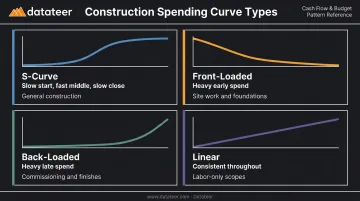
Match each trade or SOV line item to its likely curve. The result is a forecast that reflects how money actually moves through the project, not just how it's budgeted.
Step 5: Monitor Key Financial Ratios Regularly
These aren't just internal benchmarks — bonding companies and lenders require them:
- Current Ratio (Current Assets ÷ Current Liabilities): Target ≥ 1.5; surety minimum commonly 1.15–1.20
- Quick Ratio (Liquid Assets ÷ Current Liabilities): Target ≥ 1.2; 2024 industry average is 1.4
- Working Capital (Current Assets − Current Liabilities): Tracks absolute liquidity, drives bonding capacity
Set monthly exception reports that flag deviations from your thresholds before they become surety conversations.
Strategies to Improve Construction Cash Flow
Optimize the Schedule of Values from the Start
A strategically prepared SOV front-loads overhead and profit recovery into early-phase line items. Mobilization, permits, temporary facilities, general conditions — these are legitimate early-phase items that, when valued appropriately, reduce how long you're funding the project without recovering margin.
Require management review of every SOV before submission. Few pre-submission reviews return more value in project finance.
Streamline Billing and Enforce a Collections Process
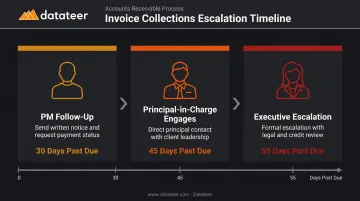
Set firm submission deadlines. Confirm documentation requirements with owners before the billing close date. Build a formal escalation policy:
- PM follows up at 30 days past due
- Principal-in-charge engages at 45 days
- Executive escalation at 55 days
Accurate, on-time billing removes the ambiguity that owners sometimes exploit to justify payment delays — and eliminates the most common pretexts for holding payment.
Manage Retainage Proactively
Most contractors treat retainage passively — they wait for the owner to release it. That's a mistake. Active strategies include:
- Negotiate reduced retainage rates as project milestones are met
- Track retainage balances across all active projects as a separate line item in cash forecasting
- Prioritize punch list completion specifically because it unlocks final payment
On large projects, retainage can represent hundreds of thousands of dollars. It deserves dedicated attention, not a footnote in the close-out checklist.
Negotiate Vendor and Subcontractor Payment Terms in Advance
Extending accounts payable from net 30 to net 45 or net 60 is a legitimate working capital source — but only if it's negotiated before cash pressure materializes. Suppliers who experience unilateral payment delays tighten terms and classify your firm as a credit risk.
The strategic balance: early payment discounts sometimes outweigh the cash conservation benefit of extended terms. Run the math per supplier.
Replace Manual Reporting with Daily-Refreshed Financial Dashboards
The highest-leverage change most contractors can make is eliminating the 10–20 day lag between financial activity and visibility.
Platforms like Datateer connect directly to construction ERPs — Procore, Sage 100/300/Intacct, Viewpoint Vista, Acumatica Construction, Foundation Software, and others — and refresh financial data automatically on an overnight cadence. Rather than waiting for a month-end WIP marathon, finance teams wake up to dashboards that already reflect the prior day's activity.
Specific capabilities relevant to cash flow management include:
- Job-Level Cash Flow dashboard — identifies which projects are generating positive cash flow and which are cannibalizing company liquidity
- WIP & Financial Truth dashboard — surfaces underbilling ($16.25M in the platform's demo example) and overbilling positions across the portfolio in real time
- AR & AP Health dashboard — replaces estimated checkbook views with actual aging data broken into 0–30, 31–60, and 61–90 day buckets
- Forecasted Liquidity dashboard — projects bank balance six months out, described internally as the "CFO's Early Warning System"
- 13-week cash flow forecasting — built from real-time project burn rates and retainage release schedules
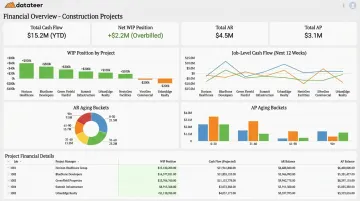
That next-morning visibility changes what's possible — finance teams can address a cash drag on one project before it erodes margin on another.
Maintain Access to Working Capital Before You Need It
Better data supports better borrowing — but only if the credit relationship exists before you need it. Establish a working capital line of credit when the business is financially strong, not in response to a cash crisis. Banks lend on confidence and track record. A contractor who approaches their bank at the start of a shortfall will pay more, get less, and signal distress.
Long-term relationships with lenders also increase flexibility during slow periods or unexpected project disruptions. CFMA advises negotiating adequate working-capital lines based on projected usage needs before every bid season, not just on collateral value.
Frequently Asked Questions
What are the three types of cash flow?
The three types are operating cash flow (day-to-day project revenues and expenses), investing cash flow (equipment purchases and asset sales), and financing cash flow (loans, credit lines, and equity funding). For contractors, operating cash flow is the most critical: it reflects the actual health of project-level financial activity.
What is a construction cash flow projection?
It's a forward-looking document that forecasts the timing and size of cash inflows and outflows over a set period. Unlike a cash flow statement, which is historical, a projection is used to anticipate funding gaps and plan payroll, purchases, and credit drawdowns before shortfalls occur.
What causes negative cash flow in a construction project?
The main causes include front-loaded expenses before progress payments begin, delayed billing cycles, slow-paying clients, and change order lags. Some negative cash flow at project start is expected. Persistent negative flow across the full project lifecycle points to a billing or management problem.
How does retainage affect construction cash flow?
Retainage (typically 5–10% of contract value) is withheld until substantial or final completion, locking up a significant cash balance contractors must plan around. Tracking open retainage balances closely and completing punch list items aggressively are the fastest ways to accelerate release.
What is the difference between underbilling and overbilling in construction?
Underbilling means billing less than the value of work completed, leaving earned revenue uncollected and straining working capital. Overbilling is the reverse: billing ahead of work performed creates a balance sheet liability. Regular WIP report review catches both and keeps cash flow projections accurate.
How does the Schedule of Values impact cash flow for contractors?
The SOV determines when and how much a contractor gets paid at each milestone. A strategically prepared SOV that front-loads overhead and profit recovery in early phases reduces the cash-negative period at project start and improves overall cash flow timing throughout the project lifecycle.