Introduction
Most construction finance teams understand what cost tracking and change order control are supposed to do. The problem is execution — specifically, the gap between knowing these processes exist and actually running them in a way that keeps project financials current.
Construction cost tracking monitors actual versus budgeted spend across a project's lifecycle. Change order control governs the documentation and approval of every scope modification that affects that budget. Both are distinct disciplines, yet financially inseparable.
This guide is written for construction CFOs, finance managers, and project accountants at firms ranging from $10M to $1B+ in revenue. If you've ever presented a WIP report built on stale data, discovered margin fade too late to act, or watched a change order backlog quietly become a dispute, this is for you.
What follows is a practical breakdown of both processes: how they work, where they break down, and what it takes to run them in a way that keeps your numbers current before it's too late to act on them.
Key Takeaways
- Cost tracking compares committed costs, actual expenditures, and budgeted amounts by cost code, giving finance teams a real-time view of where each project stands
- Change order control documents, prices, and logs every contract modification; without it, scope creep turns into uncompensated work
- Every approved change order must update the cost tracking system — otherwise the budget becomes fiction
- KPMG's 2023 Global Construction Survey: 37% of firms missed budget targets by 20%+ due to ineffective risk management
- Real-time integration between field cost data and financial systems separates proactive project management from constant firefighting
What Are Construction Cost Tracking and Change Order Control?
Construction cost tracking records, categorizes, and compares every project cost — labor, materials, subcontractor billings, equipment — against the original budget in real time. Costs are organized by cost code or work breakdown structure so variances surface at the right level of detail, not buried in a lump-sum total.
Change order control governs every formal amendment to a construction contract. When scope, schedule, or cost shifts, the change order process prices the impact, documents the negotiation, captures the approval, and updates the contract value — creating a defensible audit trail from first notice to final signature.
How They Differ from Adjacent Processes
These two functions are frequently conflated with adjacent workflows — and that confusion creates financial blind spots.
Cost tracking ≠ accounts payable or payroll
A/P processes invoices for payment; cost tracking compares those costs against the budget by job and cost code. Payroll cuts checks; cost tracking allocates labor hours to the right cost codes. Both AP and payroll can run without issues while cost tracking is silently broken — because they're measuring different things.
Change order control ≠ an RFI or verbal field directive
A Request for Information clarifies design intent but doesn't authorize scope changes. A verbal direction from a superintendent or owner's rep isn't a contract amendment. Only a signed, documented change order adjusts the contract value and authorized scope. Teams that treat field directives as de facto approvals accumulate unpriced work that never gets recovered.
Why These Processes Matter in Construction Finance
Construction projects bill incrementally against a moving baseline. Any drift between contracted scope and actual work performed immediately affects revenue recognition, WIP reporting accuracy, and cash flow — and usually all three at once.
KPMG's 2023 survey of nearly 300 construction executives found that 37% missed budget performance targets by 20% or more, with ineffective risk management cited as the primary cause. On the dispute side, Arcadis reported the average North American construction dispute reached $43 million in 2023 and took 14.4 months to resolve — most of those disputes trace back to unresolved scope changes.
What Breakdown Looks Like in Practice
When either process fails, the damage follows a predictable pattern:
- Delayed WIP reports give management stale data — decisions about labor deployment, billing, and subcontractor payments get made on information that's 15-20 days old
- Change order backlog compounds into disputed claims; work performed without written approval is the most common reason legitimate change requests get denied
- Margin fade appears invisible until project close, when over-billing and under-collection collide in the same period
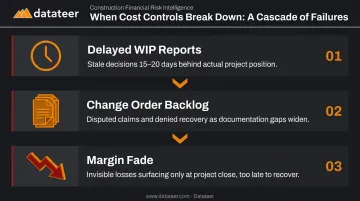
Each issue is manageable on its own. Combined, they quietly move a profitable job into a loss — often before the monthly close surfaces the damage.
How Construction Cost Tracking Works
Cost tracking has a defined end-to-end flow, and every gap in that flow corrupts the output downstream.
Establish the Budget Baseline
Before any cost can be tracked, the original estimate must convert into a detailed job budget organized by cost code. Each line item represents a controllable unit of scope — this becomes the baseline against which all actuals are measured. Skip this step and the entire comparison framework collapses.
Capture and Post Field Costs
Labor hours from timesheets, material deliveries, subcontractor progress billings, and equipment charges must be captured as close to real time as possible and posted to the correct cost codes in the ERP. Two failure modes are common here:
- Delays in posting — costs incurred in week one don't appear in reports until week three
- Miscoding — labor charges posted to the wrong cost code make the budget comparison meaningless, even when the dollar totals are correct
Cost code discipline is the unglamorous foundation that everything else depends on. Apply codes inconsistently across jobs and the budget-vs.-actual comparison produces noise, not insight.
Compare, Forecast, and Report
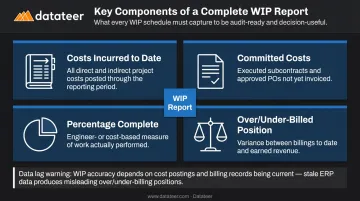
Finance teams run cost-to-complete forecasts by comparing actuals against budget and projecting what's needed to finish. The WIP (Work-in-Progress) report is the primary financial output of this process. It combines costs incurred, billings to date, and percentage completion to determine whether a job is over- or under-billed.
A complete WIP report captures:
- Costs incurred to date — actual charges posted by cost code
- Committed costs — open POs and subcontract values not yet billed
- Percentage complete — earned value relative to the original budget
- Over/under-billed position — whether billings are ahead of or behind earned revenue
A WIP report produced with a 10-20 day lag forces management to make decisions on last month's reality. By the time the report lands, the job has moved on. The window to adjust labor deployment, renegotiate material pricing, or compress a subcontractor schedule has already closed.
That lag is the core problem Datateer solves. By integrating directly with construction ERPs — Procore, Sage, Viewpoint Vista, Acumatica, Foundation Software, CMiC, and others — Datateer automates the flow from field cost data to executive-ready dashboards overnight. The Job Costing & Cost-to-Complete module tracks actual costs, committed costs (POs and subcontracts), pending change orders, and projected final cost at job, phase, and cost-code level.
Implementation takes 2-4 weeks, and pricing starts at $10,000/year per data source with unlimited users — replacing the month-end refresh cycle with continuous automated tracking.
How Change Order Control Works
Change order control is a financial process, not a project management formality. Every approved change order is a contract amendment that adjusts both the project's revenue ceiling and its cost budget simultaneously. Failing to close the loop on both sides creates phantom profit or hidden losses.
Common Triggers
The leading causes of change orders are consistent across the industry:
- Design errors, omissions, or late information (HKA's CRUX data found this affected 44.8% of projects in their claims dataset)
- Owner-requested scope additions
- Unforeseen site conditions (soil instability, hidden utilities, subsurface conflicts)
- Regulatory or code changes discovered during construction
The trigger matters because it determines who bears the cost and how quickly pricing resolves.
Change Order Types
| Type | What It Is | Financial Risk |
|---|---|---|
| Additive CO | Increases contract value and authorized scope | Low if priced before work begins |
| Deductive CO | Reduces scope and price | Moderate — credit disputes are common |
| Construction Change Directive (CCD) | Unilateral owner instruction to proceed before cost is agreed | High — contractor proceeds at financial risk until resolved |
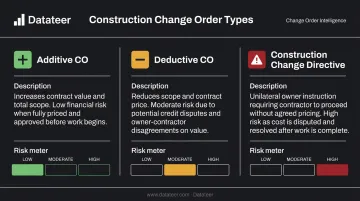
CCDs deserve particular attention. Per AIA G714-2017, a CCD directs a change in work when the parties haven't agreed on cost or time adjustments. The contractor must proceed, but pricing remains unresolved.
CFMA guidance notes that unpriced changes can appear as WIP underbillings, affect working capital, and draw scrutiny from banks and surety underwriters.
Step 1: Identify and Notify
As soon as a change condition is identified (by any party), formal written notification must be issued within the timeframe the contract specifies. Delayed notification is one of the most common reasons valid change order claims get denied. This isn't a paperwork formality; it's a contractual deadline.
Step 2: Scope, Price, and Evaluate
The contractor prepares a detailed cost estimate covering labor, materials, equipment, overhead, and profit, plus assesses schedule impact. The owner may develop an independent estimate. Pricing methods under AIA G714-2017 include:
- Lump sum — cost certainty for the owner, but requires accurate upfront estimating
- Unit price — pre-agreed rates applied to verified quantities
- Cost of work plus fee — closest to time-and-materials; shifts risk to owner but requires meticulous field documentation
The goal is always to price changes before work starts. T&M work performed before pricing is agreed creates documentation disputes that are difficult to resolve later.
Step 3: Document and Approve
A formal change order document must include:
- Description of the change
- Cost adjustment and revised contract value
- Schedule impact
- Authorized signatures from both parties
No work should proceed on changed scope without a signed document. The change order log (a running register of every change order by status, cost impact, and schedule impact) is the real-time financial scoreboard for how cumulative changes are shifting the original contract.
Step 4: Incorporate into Budget and WIP
Once signed, the approved change order must immediately update three financial records:
- Project budget — new or revised cost code line items
- Revised contract value — affects revenue recognition under ASC 606
- WIP schedule — percentage complete calculations change when both the revenue ceiling and cost budget shift
Skipping this step means WIP percentages, revenue recognition, and cost-to-complete figures are all wrong from the moment the change is approved — a direct path to margin misstatement and bonding exposure.
Datateer's Change Order Impact & Aging module tracks change orders through their full lifecycle (pending, approved, denied, executed) with aging measured by days since submission. It flags stalled change orders eating margin and creates accountability across the office-to-field-to-owner approval chain, pulling directly from Procore, Sage, Vista, Spectrum, and Acumatica change order modules.
Key Factors and Common Pitfalls
What Determines Whether These Processes Succeed
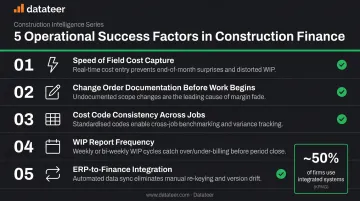
The operational factors that separate high-performing construction finance functions from struggling ones:
- Speed of field cost capture — costs posted days or weeks late corrupt the entire downstream comparison
- Change order documentation before work begins — the most common failure point, consistently
- Cost code consistency across jobs — without standardization, cross-job comparisons are meaningless
- WIP report frequency — monthly is often not enough; biweekly or weekly cadences catch problems earlier
- ERP-to-finance integration — KPMG found only about 50% of firms used integrated project management systems to track performance
Misconceptions That Derail Finance Teams
- Verbal approvals are sufficient. They aren't — and when a change order is later disputed, "we had a conversation about it" isn't a contract amendment.
- Change orders can be batched at month-end. Every week of delay increases dispute risk and creates cash flow gaps when billing cycles don't align with cost incurrence.
- The WIP report is accurate despite unresolved change order backlog. It isn't. An unresolved backlog distorts percentage complete, understates cost-to-complete, and can mask a job trending toward a loss.
The Cumulative Impact Problem
Individual change orders often look manageable in isolation. A $15,000 change here, a $22,000 deferred pricing negotiation there — none of it feels catastrophic until the backlog is finally reconciled and the job is $400,000 over budget.
That's how margin fade works. No single event looks significant, but the cumulative effect of unresolved or uncosted changes shifts a profitable job to a loss without triggering any obvious alarm. Datateer's Margin Protection dashboard tracks this continuously — reporting negative variance drivers across labor, materials, subcontractors, and change order denials in real time, so problems are visible while there's still time to act.
Double L Management, a Datateer client, reported that accessing their cost and WIP data through Datateer's dashboards "replaced two weeks worth of prior work" with a single click. That's time their finance team now spends managing forward, not reconstructing the past.
Conclusion
Construction cost tracking and change order control aren't separate administrative functions. They're two halves of the same financial control system. A breakdown in either produces the same result: a project whose true financial position is unknown until it's too late to act.
For construction finance leaders, the strategic implication is clear. Firms that automate the flow from ERP to cost reports and enforce structured change order documentation don't just reduce disputes — they shift their finance function from backward-looking autopsy work to proactive margin protection.
The difference between those two modes comes down to one thing: how fast your data moves from the field and ERP into the hands of the people who can act on it.
Datateer automates that data flow — pulling directly from your construction ERP overnight and delivering pre-built dashboards for job costing, change order aging, cost variance, and margin protection. If your team is still closing the books in spreadsheets before anyone can see where a project stands, the 15-Minute Workflow Audit is a practical starting point.
Frequently Asked Questions
What is cost tracking in construction?
Construction cost tracking is the process of recording and comparing actual project expenditures against the original budget by cost code, in real time. It enables finance teams to identify variances, forecast cost-to-complete, and produce accurate WIP reports — before jobs close rather than after.
How do you manage construction change orders?
Four core steps:
- Formally identify the change in writing before work begins
- Evaluate cost and schedule impact in detail
- Obtain signed documentation from both parties
- Incorporate the approved change into the project budget and WIP schedule immediately
The most common failure point: proceeding on verbal approvals without written sign-off.
What is a change order log in construction?
A change order log is a running register of every change order submitted on a project, tracking its status (pending, approved, disputed, rejected), cost impact, and schedule impact. It serves as the real-time financial scoreboard for how cumulative changes are affecting the original contract value.
What causes cost overruns in construction projects?
The leading causes:
- Design changes and scope creep that go unformalized as change orders
- Estimating errors not caught during cost tracking
- Delayed WIP reporting that hides over-billing or under-collection
- Change order backlog that distorts the project's true financial position
What is the difference between a change order and a change directive?
A change order is a mutually agreed-upon, signed contract modification — both parties consent before work proceeds. A Construction Change Directive (CCD) is a unilateral owner instruction to proceed when agreement on cost or schedule hasn't been reached, with pricing resolved after the fact — creating financial exposure for the contractor until it closes.
How do unresolved change orders affect project budgets?
Unresolved change orders create a gap between the work being performed and the budget on record. This distorts WIP calculations, inflates over-billing risk, understates cost-to-complete, and can mask a project trending toward a loss — often undetected until the backlog closes and loss recognition can no longer be deferred.