
Key Takeaways
- Design-bid-build (DBB) is a sequential delivery method where design is fully completed before contractors bid, with the winning bid forming the fixed-price lump sum contract
- According to DBIA/FMI data, DBB represented 23% of U.S. construction spending from 2016–2020, with design-build now capturing the larger share
- Fixed price contracts lock in scope, not total cost — change orders, allowances, and escalation clauses all introduce variability
- In DBB, the owner bears design error risk; change order corrections eat directly into GC margins
- CFMs running fixed price DBB portfolios need real-time WIP, cost-to-complete, and change order aging data — monthly close cycles leave too much hidden for too long
What Is Design-Bid-Build?
Design-bid-build (DBB) — also called "design-tender" or "hard bid" — is a project delivery method where the owner contracts separately with a designer and a general contractor. Design is fully completed before construction begins, and a contractor isn't engaged until the drawings are done.
The sequence follows three distinct phases:
- Design: The owner engages an architect or engineer to produce complete construction documents
- Bid: Contractors competitively bid on those finished drawings
- Build: The winning contractor executes the work under a fixed price agreement
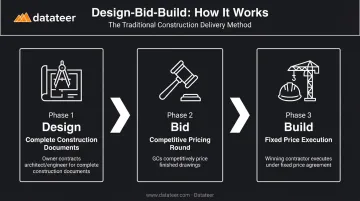
The relationship between DBB and fixed price contracting is important to understand clearly: DBB is a delivery method, and fixed price (lump sum or stipulated sum) is a contract type. In DBB, the GC bids on fully completed drawings, and the winning bid typically becomes a fixed price agreement — the contractor commits to deliver the specified scope for a set dollar amount.
DBB's market share has been declining: a DBIA/FMI 2021 spending study found DBB accounted for 23% of U.S. construction spending from 2016–2020, against design-build's 42% — with DBB forecast to fall further to 15% by 2025.
Despite the trend, DBB remains the mandated or default method across much of the public sector. Federal sealed bidding requirements under FAR 36.103 apply to most federal construction projects, and state agencies such as NCDOT require competitive award to the lowest responsible, responsive bidder. CMAA notes DBB is "often mandated by statute" in public procurement, though specific requirements vary by jurisdiction.
The Three Phases of Design-Bid-Build
Phase 1 — Design
The owner contracts an architect or engineer to develop complete construction drawings, specifications, and bid documents. This package defines scope, materials, and quality standards in enough detail for contractors to price accurately.
Design document quality has direct financial consequences. A 2025 U.S. DOT review of TxDOT's 2001–2015 data found that errors and omissions accounted for roughly one-quarter of all change orders and one-third of total change-order value. Incomplete or rushed drawings don't just cause rework — they transfer cost risk to the owner and create the change order exposure that defines fixed price DBB risk.
Phase 2 — Bid
The owner issues the completed bid package to GCs — either through open/public bidding or a selective short-list. GCs then solicit subcontractor bids for specialty trades (MEP, structural steel, HVAC, etc.) and submit a full price proposal by a set deadline.
Bid evaluation under DBB follows a clear hierarchy:
- Public projects: Award goes to the lowest responsible, responsive bidder — price is the governing criterion under federal sealed bidding rules (FAR 14.408-1) and most state procurement statutes
- Private projects: Owners may weigh contractor experience, past performance, and bonding capacity alongside price
- When all bids exceed budget: FAR permits cancellation after bid opening; owners can also pursue value engineering, redesign, or rebidding
Phase 3 — Build
The selected GC signs a contract (typically a fixed price agreement such as AIA A101-2017) and takes over day-to-day site management, subcontractor oversight, and schedule control.
Once signed, the design documents are frozen. Any change to scope, materials, or design requires a formal change order — and each one carries direct exposure to cost overruns, schedule delays, and margin erosion that GC finance teams must track from day one.
Fixed Price Contracts in DBB: What Actually Gets Locked In
A fixed price (lump sum or stipulated sum) contract sets a single all-in price covering labor, materials, equipment, overhead, and profit. Once signed, cost overruns within the defined scope are the GC's problem, not the owner's.
What "Fixed" Actually Means
The word "fixed" creates a false sense of cost certainty that CFMs need to correct. Four contract mechanisms preserve cost variability even within a lump sum agreement:
| Mechanism | What It Does |
|---|---|
| Change orders | Adjust contract sum when scope changes, owner requests modifications, or design errors surface during construction |
| Differing site conditions | FAR 52.236-2 requires equitable adjustment when subsurface or latent conditions materially differ from contract assumptions |
| Economic price adjustment clauses | FAR 16.203 permits fixed price contracts with escalation provisions when serious material price uncertainty exists |
| Allowance line items | Cover items not fully specified at award; actual selections can require contract sum adjustment per AIA A101-2017 |
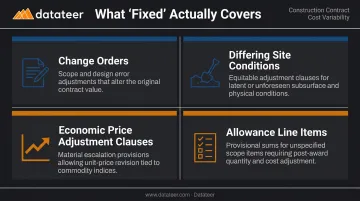
Change orders are the primary mechanism by which the "fixed" price breaks down. When the owner modifies scope, unforeseen site conditions arise, or design errors surface mid-construction, a change order adjusts the contract sum upward — typically at the owner's expense.
The margin risk lives in the gap: when GCs perform out-of-scope work before a change order is approved, or when scope disputes drag on, margin erosion follows quickly.
The Two-Contract Structure
In DBB, there are two separate prime contracts: one between the owner and the designer, and one between the owner and the GC. The owner sits in the middle, managing both relationships. The owner assumes coordination risk directly: when the designer's intent and the contractor's execution diverge, closing that gap falls on the owner — not on either contracted party.
That exposure has two practical consequences:
- Design errors mid-construction typically generate change orders at the owner's cost, not the GC's
- Contractor claims for defective specs route back to the owner, who must then pursue the designer separately
Design-build consolidates both contracts under one entity specifically to eliminate this gap.
DBB vs. Design-Build: Key Differences
Design-build (DB) consolidates design and construction under one entity that holds a single contract with the owner. For CFMs managing contract risk and cash flow, the structure has direct financial consequences.
Contract Structure and Accountability
- DBB: Owner holds two separate contracts (designer + GC), manages coordination between them, and bears risk when the two don't align
- DB: Single design-builder holds one contract, is accountable for both design accuracy and construction execution
Timeline
DBB is inherently sequential — construction can't start until design is 100% complete and a contractor is selected. DB allows design and construction to run concurrently.
DBIA's 2018 study of 212 projects (80 design-build, 53 DBB, completed 2008–2013) found design-build was 36% faster in construction and 102% faster in total delivery than DBB. These are study comparisons from a specific sample, not universal guarantees — a 2020 peer-reviewed ASCE study found no statistically significant cost-growth difference between DB and DBB. The evidence is real but context-dependent.
Risk Allocation
| Risk Type | Who Bears It in DBB | Who Bears It in DB |
|---|---|---|
| Design errors & omissions | Owner (pays via change orders) | Design-builder |
| Construction cost overruns | GC | Design-builder |
| Schedule coordination | Owner manages both contracts | Design-builder |
| Price competition | High — multiple GCs bid identical docs | Lower — fewer bidders |
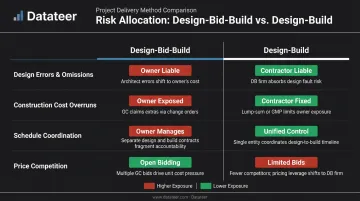
DBB's competitive bidding transparency — multiple contractors pricing identical drawings — is why it remains the default for publicly funded projects. DB gives up that price competition in exchange for schedule speed and a single point of accountability for risk.
Pros, Cons, and When to Use Design-Bid-Build
Advantages of DBB
- Competitive pricing: Multiple GCs bid on identical documents, producing transparent, market-tested prices
- Owner design control: The owner approves all design decisions before any contractor is engaged
- Clear accountability: Designer and contractor roles are separated — when something goes wrong, responsibility is easier to assign
- Procurement compliance: The open competitive bidding structure satisfies most public procurement statutes
Disadvantages of DBB
- Sequential timeline: No construction starts until design is complete, extending overall project duration
- No contractor input during design: GCs can't flag buildability issues or cost-saving alternatives until after they've won the bid
- Change order exposure: Design errors become expensive owner-funded corrections during construction
- Owner coordination burden: The owner must manage the interface between designer and GC
When DBB Is the Right Choice
DBB fits well when:
- Scope is well-defined and unlikely to change materially
- The project is publicly funded and subject to competitive bidding requirements
- The owner prioritizes price transparency over schedule speed
- Separating design and construction accountability is practical and preferable
Design-build is the stronger fit when scope is uncertain or the schedule can't absorb a sequential design-then-bid process. It also works better when the owner wants one contract, one throat to grab, rather than managing the boundary between designer and GC.
Managing Financial Risk on Fixed Price DBB Projects
On a fixed price DBB contract, the GC's profit is the gap between the bid price and actual job cost. Full stop. Any labor slippage, material cost escalation, or scope creep that isn't captured in an approved change order compresses or eliminates that margin — and problems discovered late are far more expensive to address than those caught early.
What CFMs Must Monitor
For fixed price work, these are the metrics that reveal margin fate before it becomes unrecoverable:
- Job cost-to-date vs. budgeted cost — is spending tracking to bid?
- Estimated cost at completion (EAC) — what will this job actually cost when finished?
- Cost-to-complete (CTC) — how much more needs to be spent, and does the remaining contract value cover it?
- Overbilling/underbilling status on WIP schedules — is the firm's billing position accurately reflecting work performed?
- Change order backlog by aging — which COs are stalled, and how much uncovered cost is accumulating while approvals lag?
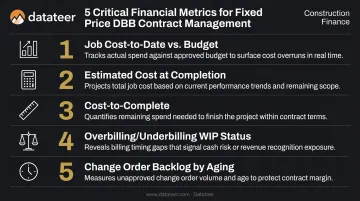
These indicators only protect margin if they're current enough to act on.
The Information Lag Problem
The traditional monthly close cycle — assembling WIP reports manually from ERP exports, reconciling Procore commits to Sage invoices via VLOOKUP, formatting everything for stakeholders — creates a 10–20 day information lag. On a fixed price contract, that means a CFM can go weeks without knowing that labor is tracking 15% over bid on a critical phase, or that $400K in change order costs have been absorbed without corresponding owner approvals.
Datateer eliminates this lag by syncing directly with the construction ERPs that GCs and CFMs use — Procore, Sage 100/300/Intacct, Viewpoint Vista, Acumatica Construction, Foundation Software, CMiC, and others — to deliver automated WIP and job cost dashboards without manual assembly. The modules most relevant to fixed price DBB risk include:
- WIP & Financial Truth Dashboard — automates percentage complete, earned revenue, overbillings, underbillings, and projected margin per job, updated overnight
- Job Costing & Cost-to-Complete — pulls actual costs, committed costs, and pending COs to produce EAC and CTC at the job, phase, and cost-code level (no manual forecast input)
- Change Order Impact & Aging — tracks CO status, aging by days since submission, and revenue/margin impact, pulling directly from Procore, Sage, Vista, and Acumatica
- Margin Protection Analytics — monitors original vs. current projected margin per job, with cost-code drill-down into labor overruns, material escalation, subcontractor increases, and denied COs
For construction firms managing a portfolio of fixed price contracts, these capabilities replace the monthly forensic accounting cycle with continuous oversight — catching margin fade while there's still time to intervene, not after the margin is gone. Flat annual pricing starts at $10,000/year per data source, with unlimited users and a 2–4 week setup timeline.
CFMs who want to assess their current information lag can take Datateer's free Construction Data Maturity Audit in 60 seconds, or book a free 15-Minute Workflow Audit to see the dashboards running on their own ERP data.
Frequently Asked Questions
What is a design-build contract?
A design-bid-build contract is the agreement that formalizes the build phase of the DBB delivery method — typically a fixed price (lump sum) agreement between the owner and the selected GC. It commits the contractor to complete the fully designed scope for a set sum, with cost overruns within that scope absorbed by the contractor.
How many contracts are needed in a design-bid-build delivery method?
DBB requires at least two prime contracts: one between the owner and the designer (architect/engineer) and one between the owner and the general contractor. The owner holds and manages both separately, assuming coordination risk between the two parties.
What are three key differences between DBB and design-build?
The three main differences: (1) DBB uses separate designer and GC contracts vs. a single design-build contract; (2) DBB is sequential while DB allows concurrent design and construction; and (3) in DBB the owner bears design error risk, while in DB the design-builder carries it.
What is a design-build contract?
A design-build contract is a single agreement between the owner and one entity (the design-builder) responsible for both designing and constructing the project. It consolidates design risk, schedule risk, and construction responsibility under one party — eliminating the coordination gap that exists between separate designer and GC contracts in DBB.
What is a fixed price contract in construction?
A fixed price (lump sum or stipulated sum) contract sets a single all-in price for a defined scope of work. The contractor is responsible for delivering that scope within the agreed price, absorbing cost overruns — unless scope changes are formally documented through approved change orders.