The problem is they weren't built for the same thing.
Sage Intacct is a finance-first financial management platform with exceptional accounting depth. Acumatica is a full cloud ERP suite with a purpose-built Construction Edition that manages the entire project lifecycle. Choosing between them based on feature lists and vendor demos misses the real question: which platform aligns with how your firm actually operates?
This guide covers both platforms head-to-head across financials, construction-specific capabilities, pricing mechanics, and deployment — so you can make a decision grounded in your actual workflows.
Key Takeaways
- Sage Intacct is the AICPA's only endorsed financial management platform — strongest on accounting depth, multi-entity consolidation, and financial reporting
- Acumatica Construction Edition covers the full project lifecycle natively — AIA billing, job costing, certified payroll, change orders, and subcontractor compliance
- Sage Intacct charges per named user; Acumatica uses consumption-based pricing with unlimited users — a significant cost advantage for firms with large field teams
- Neither platform fully eliminates the WIP reporting gap without an analytics layer on top
- The right choice depends on whether your priority is financial reporting sophistication or full field-to-finance operational management
Sage Intacct vs Acumatica: Quick Comparison
| Feature | Sage Intacct | Acumatica Construction Edition |
|---|---|---|
| Platform Type | Cloud financial management (finance-first) | Full cloud ERP suite |
| Deployment | True multi-tenant SaaS only — no on-premise option | SaaS, private cloud, or on-premise self-hosted |
| Licensing Model | Per named user (~$400–$800/user/month per ERP Research) | Unlimited users, consumption/resource-based pricing |
| Construction Edition | Construction-specific features marketed as built-in | Dedicated Construction Edition (native) |
| AIA Billing | Marketed as built-in per Sage's 2025 construction documentation | Native — AIA reports documented in official help |
| Job Costing Depth | Multi-dimensional GL with project dimensions | Cost codes, phase tracking, real-time cost analysis |
| Certified Payroll | Marketed as built-in per Sage's 2025 construction documentation | WH-347 certified payroll — documented natively |
| Multi-Entity Consolidation | Native — consolidate hundreds of entities across currencies | Available but less sophisticated out-of-the-box |
| AICPA Endorsement | Yes — only AICPA-endorsed financial management platform | No |
| Implementation Timeline | ~3–6 months (G2: 4 months average) | ~4–8 months (G2: 7 months average) |
| Typical TCO | $50K–$200K (ERP Research) | $75K–$350K (ERP Research) |
| Best-Fit Industry | Multi-entity organizations, real estate developers, finance-heavy operations | General contractors, specialty trades, field-to-finance workflows |
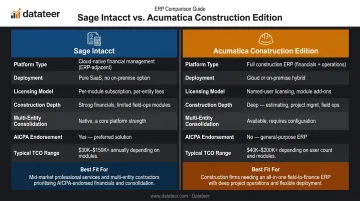
Both platforms use custom pricing requiring a direct sales conversation. Neither publishes a standard rate card. According to ERP Research, Sage Intacct's total cost of ownership typically runs $50K–$200K, while Acumatica's TCO range runs $75K–$350K. Actual costs vary widely based on module selection, user count, and your implementation partner's experience.
Understanding Both Platforms
What Is Sage Intacct?
Sage Intacct is a true cloud, finance-first financial management platform. It is not a full ERP — it was built to deliver deep accounting capabilities for mid-market businesses where financial reporting sophistication is the top priority.
Its most notable credential: Sage Intacct is the only financial management software endorsed by the AICPA. For construction accounting teams where audit-readiness, compliance, and multi-entity reporting matter, that distinction carries real weight.
Core strengths relevant to construction finance:
- Multi-dimensional GL with unlimited reporting dimensions
- Native multi-entity consolidation across hundreds of entities and currencies
- AP automation with vendor matching
- ASC 606 and IFRS 15 revenue recognition support
- Real-time dashboards and financial reporting
Sage's 2025 construction documentation also markets built-in AIA billing, retainage, certified payroll reporting, and subcontractor compliance tracking as part of the Sage Intacct Construction offering. Verify which modules are included in your license before finalizing scope during evaluation.
Best-fit construction profiles for Sage Intacct:
- Real estate developers with finance-management priorities over operational ERP
- Multi-entity construction holding companies needing sophisticated consolidation
- Construction CPA and advisory firms managing client finances
- Organizations where the CFO's primary need is financial reporting depth, not field-to-finance workflow management
What Is Acumatica Construction Edition?
Acumatica is a broad cloud ERP suite with a dedicated Construction Edition built for construction operations as a primary use case. The platform is designed to run the entire construction business in one system — contract execution, subcontractor management, field operations, and financial close — rather than serving as a financial management layer alone.
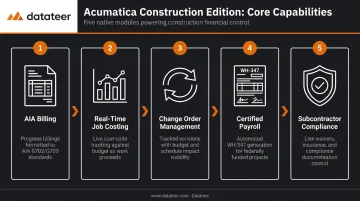
Native Construction Edition capabilities:
- AIA billing with G702/G703 report generation documented in official help
- Real-time job costing by phase and cost code
- Change order management flowing directly to billing and cost reporting
- Certified payroll with WH-347 reporting context
- Subcontractor compliance tracking — storing insurance and bond certificates electronically, with alerts when documents expire during invoice entry
Best-fit construction profiles for Acumatica:
- General contractors managing the full project lifecycle
- Specialty subcontractors needing field-to-finance integration
- Construction firms wanting a single system for financial and operational workflows without relying on third-party modules for core construction functions
Core Feature Differences: What Actually Matters
Financial Reporting and Accounting Depth
Sage Intacct leads on financial reporting depth. Its multi-dimensional GL, unlimited reporting dimensions, and native multi-entity consolidation are more sophisticated than Acumatica's out-of-the-box capabilities. Sage can consolidate hundreds of entities across currencies and geographies natively, without customization.
For construction holding companies managing multiple project entities, subsidiaries, or joint ventures where consolidated financial reporting is the primary driver, this is a genuine structural advantage.
Sage also carries the weight of its AICPA endorsement for firms where audit-readiness and accounting compliance are non-negotiable requirements.
Construction Operational Capabilities
Acumatica's Construction Edition leads here. AIA billing, certified payroll, change order management, and subcontractor compliance tracking are all natively documented in Acumatica's official product help and datasheets.
Sage Intacct Construction has expanded its native construction capabilities — its 2025 documentation claims built-in AIA billing, retainage, and certified payroll. But Acumatica's Construction Edition has a longer track record as a dedicated operational ERP for contractors, and its native integration of field-to-finance workflows is its core design purpose.
For general contractors and specialty trades, the difference isn't just about features — it's about how deeply those workflows are embedded in the platform's architecture.
Pricing Model: The Field Team Equation
This is one of the most practically significant differences in the comparison.
Sage Intacct uses per named user pricing — ERP Research estimates $400–$800/user/month. Costs scale predictably with headcount, but every user added increases licensing cost.
Acumatica uses consumption-based pricing with unlimited users — you pay for resources and transaction volume, not seats. Project managers, superintendents, field supervisors, and subcontractors can all have system access without increasing the licensing bill.
For construction firms where dozens of field users need occasional access — to log time, review job cost reports, or approve change orders — Acumatica's model is a structural cost advantage. Sage Intacct's per-user model becomes a friction point the moment you try to extend system access beyond the core finance team.
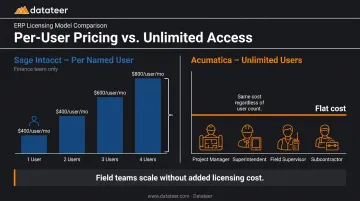
No published head-to-head cost model covers both platforms at scale — get direct quotes from both vendors before budgeting.
Deployment Options
Sage Intacct is true multi-tenant SaaS, with no on-premise option. For firms with remote job sites or strict data-residency requirements, that's a real constraint.
Acumatica supports SaaS, private cloud, and on-premise self-hosted deployment. That flexibility matters for firms operating in environments where a fully shared cloud infrastructure isn't viable.
Integration Philosophy
These two platforms take fundamentally different approaches:
- Sage Intacct is built as a best-in-class financial core that integrates outward — 300+ marketplace integrations, designed to connect with specialized tools around it. More integration decisions upfront, but more specialization in each component.
- Acumatica handles more internally across one platform, reducing reliance on third-party tools. Fewer integration decisions, but the tradeoff is that highly specialized workflows may require customization rather than a plug-in solution.
The practical question: are you building a best-in-class tech stack around a financial core, or do you want one platform that handles as much as possible natively?
Which Should Construction Companies Choose?
For most mid-market general contractors and specialty contractors — firms managing the full project lifecycle from contract to closeout — Acumatica's Construction Edition is the stronger out-of-the-box choice. Its construction workflows are native, its unlimited-user model fits the economics of field-heavy operations, and its track record as a purpose-built construction ERP is well-documented.
Choose Acumatica if:
- Your firm needs native AIA billing, certified payroll, and job costing by cost code
- You have field teams, foremen, or subcontractors who need system access without blowing up licensing costs
- You want one platform to manage both operational and financial workflows
- You're a general contractor or specialty trade that needs field-to-finance integration
Choose Sage Intacct if:
- Multi-entity consolidation across subsidiaries or joint ventures is your top accounting priority
- You're a real estate developer or construction holding company where financial management sophistication outweighs operational ERP depth
- Your team prioritizes AICPA-grade accounting compliance and audit-readiness
- You're comfortable building a best-in-class tech stack around a financial core and connecting specialized tools via integration
The Reporting Gap Neither Platform Solves Alone
Even after selecting the right ERP, construction CFOs on both Sage Intacct and Acumatica regularly find themselves manually assembling WIP reports in Excel. Double L Management's business analyst put it directly — before Datateer, that process consumed roughly two weeks of work per cycle. Their first session with Datateer's dashboards replaced that in a single click.
Datateer integrates directly with both Sage Intacct and Acumatica Construction Edition, pulling data via automated overnight sync into pre-built dashboards. The platform delivers 12 construction-specific reports on day one, with unlimited users and flat annual pricing starting at $10,000/year per data source. Day-one coverage includes:
- WIP reporting and over/under billings
- Job costing and cost-to-complete
- Cash flow forecasting
- Change order tracking and aging
- Retainage analytics
- Margin protection and cost variance
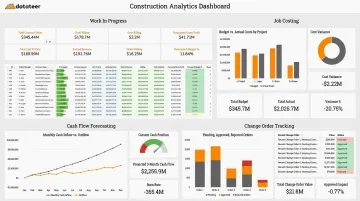
Whichever ERP your firm runs, your CFO's effectiveness comes down to one question: are they spending time pulling numbers together, or acting on them? If you want to see what your current reporting workflow is actually costing you, Datateer's 15-Minute Workflow Audit is a no-pitch way to find out.
Conclusion
Neither platform wins outright. Acumatica runs a construction operation from field to finance inside a single system. Sage Intacct delivers deeper financial reporting and fits cleanly into a best-in-class tech stack where specialized tools handle specialized functions. The right choice comes down to whether your highest priority is operational depth or financial reporting excellence.
What stays constant regardless of which platform you choose: you need real-time project visibility, accurate WIP reporting, and the financial intelligence to catch margin fade before closeout — not two weeks after. Which ERP you run determines where your data lives. The analytics layer sitting on top determines what your finance team can actually do with it. Datateer connects to both Acumatica Construction and Sage Intacct to automate WIP reports, job costing, over/under-billings, and cash flow dashboards — so your team spends time on decisions, not spreadsheet builds. If you want to see how your current ERP data maps to construction-ready dashboards, the 15-Minute Workflow Audit is a good place to start.
Frequently Asked Questions
What is the difference between Intacct and Acumatica?
Sage Intacct is a finance-first platform built around deep accounting — multi-entity consolidation, dimensional GL, and AICPA-endorsed compliance. Acumatica is a broader cloud ERP with a dedicated Construction Edition that covers both financial and operational workflows. Put simply, Intacct leads on accounting sophistication; Acumatica leads on operational breadth.
Is Acumatica a good ERP?
Acumatica earns a 4.4/5 from 2,002 reviews on G2 and holds a position in Gartner's Magic Quadrant for Cloud ERP for Product-Centric Enterprises. It's a strong fit for construction, manufacturing, and distribution companies that need unlimited user access and native operational workflows in a single platform.
Which is better for construction: Sage Intacct or Acumatica?
For general contractors and specialty trades needing native AIA billing, job costing, certified payroll, and subcontractor compliance, Acumatica's Construction Edition has a clear structural advantage. Sage Intacct is the stronger fit for real estate developers or multi-entity organizations where financial reporting depth and consolidation are the primary drivers.
How does Sage Intacct pricing compare to Acumatica?
Sage Intacct uses per named user pricing — ERP Research estimates $400–$800/user/month with total TCO typically $50K–$200K. Acumatica uses consumption-based pricing with unlimited users, with total TCO typically $75K–$350K. For construction firms with large field teams, Acumatica's unlimited-user model is often more cost-effective at scale.
Can Sage Intacct handle job costing and AIA billing for construction?
Sage Intacct Construction markets built-in AIA billing, retainage, and certified payroll reporting as of its 2025 documentation. Confirm module depth during your evaluation — these workflows are Acumatica's Construction Edition core design purpose, so the comparison matters.
How long does it take to implement Sage Intacct vs Acumatica?
Sage Intacct typically implements in 3–6 months (G2 average: 4 months). Acumatica typically takes 4–8 months (G2 average: 7 months). Both timelines depend heavily on module scope, data migration complexity, and the implementation partner's experience with construction deployments.