For most construction finance teams, CTC is also a source of persistent frustration. The calculation looks straightforward until you account for productivity slippage, unapproved change orders, material price movement, and indirect costs that somehow always get missed until close-out.
This article covers the exact inputs required, a step-by-step calculation process, the variables most likely to throw off your estimate, and the mistakes that cause CTC to fail in practice.
Key Takeaways
- CTC estimates remaining costs based on current project conditions, not the original budget assumptions
- Accurate CTC requires actual costs by cost code, updated labor productivity, current material pricing, and confirmed change orders — all current, not budgeted
- CTC feeds directly into EAC and the WIP report — stale CTC corrupts both
- Cost-code-level analysis is more reliable than a single blended percent complete
- The most common CTC failure is assuming future performance will correct for past overruns — it rarely does
How to Calculate Cost to Complete in Construction
CTC is not a one-time calculation. It should be updated monthly at minimum — and more frequently when schedule, scope, or cost conditions shift mid-project.
Step 1: Establish Your Cost Baseline
Start with two confirmed figures:
- Budget at Completion (BAC): The original contract value and agreed total cost — the benchmark against which all progress is measured
- Actual Costs to Date (AC): Total costs posted by cost code in your ERP or job cost ledger, confirmed and reconciled
The reconciliation step matters. AC pulled from a ledger that lags by two weeks will produce a CTC that's already wrong before you've done any math.
Step 2: Determine Percent Complete by Cost Code
Calculate percent complete separately for each major cost category: labor, materials, subcontractors, equipment, and overhead.
The cost-to-cost method: Percent Complete = Costs Incurred to Date ÷ Total Estimated Cost for that category
According to Meaden & Moore, most engineering and construction firms use the cost-to-cost method to measure percentage of completion — and it's supported under ASC 606 as an input method for progress measurement.
Costs that don't reflect actual transfer of work — stored materials, waste, abnormal costs — may need special treatment before entering the calculation.
Avoid blending all cost codes into a single percent complete. A project that's 55% complete on materials but 70% complete on labor has very different cost dynamics than the blended average suggests.
Step 3: Estimate the Remaining Work Scope
Review the project schedule and scope documentation to identify everything still to be done. Include:
- All remaining tasks by cost code
- Approved change orders not yet reflected in the original budget
- Pending change orders (flag these separately — more on this below)
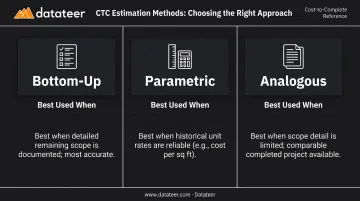
Then choose your estimation method:
| Method | Best Used When |
|---|---|
| Bottom-up | Detailed remaining scope is documented; most accurate |
| Parametric | Historical unit rates are reliable (e.g., cost per sq ft) |
| Analogous | Scope detail is limited; comparable completed project available |
Step 4: Apply the CTC Formula
Two approaches, both valid — and worth running both when accuracy matters:
Formula 1: CTC = EAC − AC (requires a reliable EAC forecast)
Formula 2 (direct build-up): CTC = Sum of all estimated costs for remaining work items
Example: A commercial project with a $2M BAC has spent $900K to date. Cost-to-cost percent complete across all codes averages 45%. That implies an EAC of $900K ÷ 0.45 = $2.0M — suggesting the project is tracking on budget.
But run the bottom-up: if remaining labor scope is re-estimated at $650K, remaining materials at $380K, and remaining subs/indirect at $190K, the direct CTC = $1.22M — meaning EAC = $900K + $1.22M = $2.12M, or $120K over budget.
When the two methods diverge, that gap typically points to a specific problem: labor productivity running below estimate, scope creep not yet captured in the budget, or material pricing that hasn't been updated since bid. Identify which cost codes are driving the difference before finalizing the forecast.
Step 5: Validate and Document the Estimate
Before finalizing, cross-check against:
- Field reports and superintendent logs
- Subcontractor schedules of values
- Outstanding purchase orders and committed costs
Then document your assumptions: labor productivity rates used, material pricing source, indirect cost allocation method. Without documentation, the estimate can't be consistently updated, and can't be explained to lenders, sureties, or project owners when questioned.
What You Need Before Calculating Cost to Complete
CTC accuracy is dependent on input quality. Teams that consistently produce unreliable estimates almost always trace the problem back to incomplete or outdated data — not formula errors.
Required Data Inputs
At minimum, you need:
- Actual costs to date by cost code (reconciled, not lagging)
- Remaining scope of work documentation
- Updated labor productivity figures (actual vs. estimated output per trade)
- Current material pricing — not bid-time rates
- Confirmed list of approved change orders, with pending COs flagged separately
Once you have those core inputs, check one more category that teams consistently omit: indirect costs. Extended general conditions, home office overhead, insurance escalations, and project management time all need to be included. Missing them produces a CTC that looks accurate until the last two months of the job.
System and Access Requirements
CTC calculations require a job cost system where costs are posted promptly. Before running any calculation, confirm your system meets these basics:
- Costs posted promptly — delayed entries distort every downstream figure
- Actuals fully reconciled — stale spreadsheet data produces a lagging report, not a forecast
- Cost codes aligned — field entries must map cleanly to the same codes used in the original budget
Key Variables That Affect CTC Accuracy
Even a methodologically sound CTC can produce an unreliable number if the following variables aren't controlled for.
Labor Productivity Rate
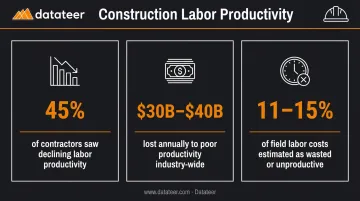
Labor is the most variable cost on most construction projects. FMI's 2023 Labor Productivity Study found that 45% of contractors saw declining labor productivity over the prior 12–18 months, and that $30B–$40B is lost annually to poor productivity across the industry. FMI also reported that contractors believe 11–15% of field labor costs are wasted or unproductive.
If the productivity rate assumed in your original estimate doesn't match what's happening in the field, your CTC will be off by a material amount. The only way to catch this early is tracking actual output per trade weekly — not waiting for month-end.
Datateer's Labor & Materials Productivity dashboard surfaces labor cost trends by cost code on an overnight sync cadence — so finance teams catch budget blowouts mid-week, not after payroll is cut.
Material Price Fluctuations
Bid-time pricing can drift significantly from current market rates on multi-year projects. AGC reported that nonresidential construction input costs rose 12.4% from March 2020 to March 2021, while bid prices rose only 1.7% — a gap that collapsed margins across thousands of projects.
CTC estimates should use current vendor quotes or updated pricing indexes (BLS PPI, ENR Material Cost Index) for major material categories. Datateer's Material Price Tracking module benchmarks actual purchased unit costs against both bid-estimate prices and live PPI/ENR index data, giving estimators a current reference when refreshing CTC assumptions.
Approved vs. Pending Change Orders
Change order status has a direct effect on CTC accuracy:
- Approved change orders must update both the BAC and remaining scope immediately
- Pending change orders should carry a probability-weighted cost adjustment — not be ignored
Ignoring pending changes creates a phantom budget surplus that disappears the moment approval comes through. Datateer's Change Order Impact & Aging module tracks the full lifecycle (pending, approved, denied, executed) and feeds that data directly into CTC analytics, so cost exposure is visible before it's confirmed.
Remaining Schedule Duration
Extended timelines add real indirect costs regardless of physical work progress. A project running two months over schedule carries additional superintendent time, site overhead, and equipment rental — costs that don't appear in the field cost estimate but hit the bottom line just as hard.
Quantify your general conditions burn rate per week or month and include it in every CTC update after a confirmed delay. AACE recommends treating time extensions and general conditions costs as a single combined impact — they aren't separable, and modeling them separately understates total exposure.
Common Mistakes When Estimating Cost to Complete
Anchoring to the Original Budget Instead of Actual Performance
The most common CTC failure: applying the remaining budget percentage from the original estimate without accounting for how actual costs have already diverged. This produces a CTC that assumes future performance will correct for past overruns. It rarely does. If labor is running 15% over productivity assumptions through the first half of a project, applying the original labor rate to the remaining half doesn't fix the overrun — it hides it.
Updating CTC Too Infrequently
Monthly updates become unreliable on fast-moving projects. By the time a CTC is issued, conditions may have already shifted. Manual WIP and CTC workflows carry a significant lag between cost events and financial reporting — the difference between "autopsy reporting" and actual forward-looking management. Platforms like Datateer address this by syncing overnight from the ERP, so mid-month course corrections are possible before margin fade compounds.
Ignoring Indirect and Overhead Costs
Project managers focus CTC estimates on direct field costs and forget the rest. Common omissions include:
- Project management time
- Insurance and bonding costs
- Extended general conditions
- Home office overhead allocations
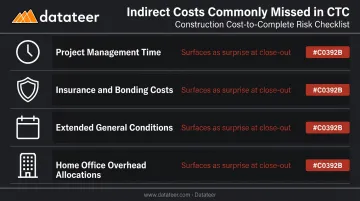
These gaps cause EAC to understate true project cost. Include them explicitly or they'll surface as surprises at close-out.
Failing to Account for Approved Scope Changes
Calculating CTC against the original contract scope while ignoring approved change orders creates a false picture of cost-to-go. If $150K in approved change orders haven't been incorporated into the remaining scope estimate, the CTC is understated by at least that amount — and the WIP report that flows from it will be wrong.
How CTC Connects to EAC, BAC, and WIP Reports
Three metrics define the financial picture of any active project:
- BAC (Budget at Completion): The original approved total project budget
- CTC (Cost to Complete): Estimated remaining costs from today forward
- EAC (Estimate at Completion): Total projected project cost = AC + CTC
An incorrect CTC produces an incorrect EAC. Once that EAC flows into the WIP report, it distorts percent complete, recognized revenue, and over/underbilling calculations across the entire project portfolio.
The WIP schedule's "estimated cost to complete" column is fed by CTC — and the direction of the error determines which financial problem surfaces:
- CTC inflated: Percent complete drops, underbilling increases
- CTC understated: Percent complete overstates, overbilling goes undetected until close-out
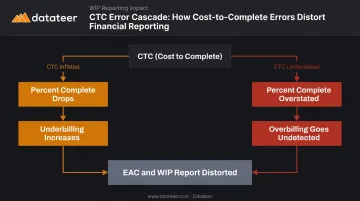
As AICPA-CIMA notes, WIP schedules enable revenue recognition calculations and help identify overbillings and underbillings — making CTC reliability a direct financial reporting issue, not just a project management one.
Construction CFOs reviewing WIP schedules should treat any CTC figure not updated within the current period as a red flag. Stale CTC data is one of the most consistent sources of margin fade that surprises firms at project close-out.
Datateer's WIP Reporting dashboard pulls estimated cost figures from the ERP automatically — no manual entries — and refreshes overnight on a set schedule. The estimated cost column feeding percent complete and earned revenue calculations stays current without a finance team member updating a spreadsheet before every month-end close.
Frequently Asked Questions
What is the cost to complete?
Cost to complete (CTC) is the estimated amount of money still required to finish the remaining work on a construction project, based on current progress and actual cost data. It is distinct from the original budget and from total project cost — it represents only the forward-looking remaining spend.
How often should cost to complete be updated in construction?
Most construction firms update CTC monthly, tied to their billing cycle and WIP report preparation. On complex or fast-moving projects, bi-weekly updates are advisable when conditions are shifting faster than monthly cycles can capture.
What is the difference between cost to complete and estimate at completion?
CTC covers only the costs from the present forward. EAC represents the total projected project cost — both what has already been spent and what remains: EAC = Actual Costs to Date + CTC. CTC is the input; EAC is the output.
What costs should be included in a CTC calculation?
Include all direct field costs (labor, materials, subcontractors, equipment) and indirect costs: general conditions, home office overhead, insurance, extended project management time, and approved change orders. Omitting indirect costs is the most common source of late-project cost surprises.
How does cost to complete affect the WIP report?
CTC is the primary input for the "estimated cost to complete" column in the WIP schedule. An inaccurate CTC shifts percent complete, recognized revenue, and over/underbilling positions. WIP report accuracy is entirely dependent on CTC reliability.
What is the difference between bottom-up and parametric cost-to-complete estimating?
Bottom-up builds the CTC task by task from remaining work items. It's the most accurate method, but also the most time-intensive. Parametric applies a cost-per-unit rate (such as cost per square foot) derived from historical data to the remaining quantity of work. It's faster and works best when detailed scope breakdowns aren't available or when historical unit rates are well-established.