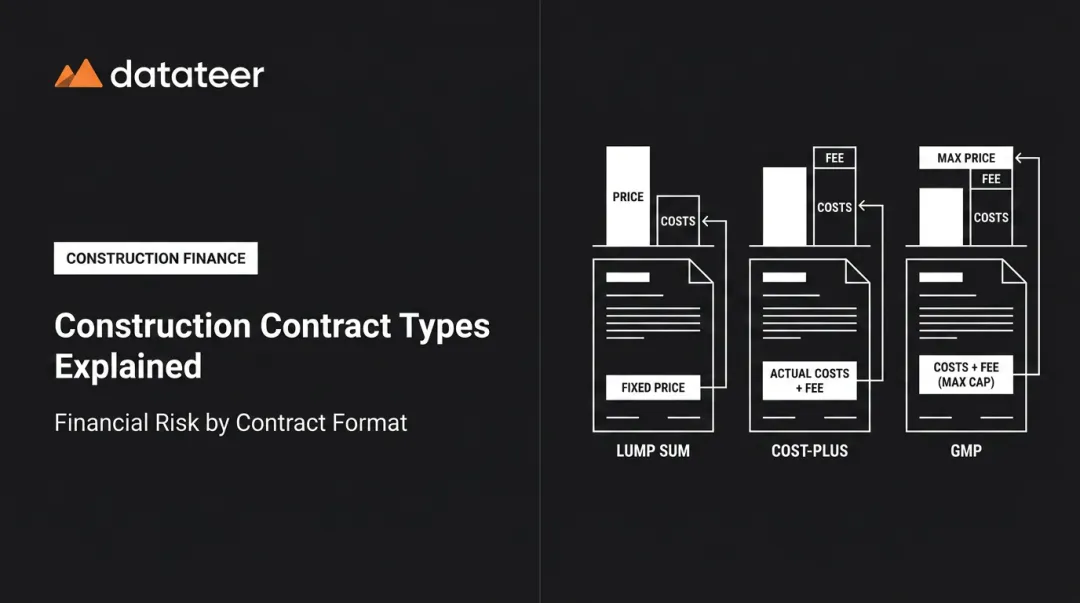
Lump sum, cost-plus, and GMP are the three most common contract structures in commercial construction. Each one creates a fundamentally different financial reporting reality for the CFM or CFO managing the job. Here's what you need to know.
Key Takeaways
- Lump sum offers price certainty but puts all cost overrun risk on the contractor
- Cost-plus reimburses actual costs plus a fee, but requires meticulous documentation to manage
- GMP sets a maximum price ceiling with open-book cost tracking and a shared savings incentive
- GMP is not the same as lump sum; each contract type structures financial accountability differently
- Contract type directly shapes your WIP schedule, billing complexity, and how fast you can detect overruns
What Is a Lump Sum Contract?
A lump sum (or stipulated sum) contract sets a single fixed price for the entire project scope before construction begins. That price doesn't move unless both parties execute a formal change order. As AIA defines it, the contractor completes all work for the agreed amount.
How Billing Works Under Lump Sum
Billing is straightforward. Smaller jobs may use a single payment at completion. Larger projects use progress billing tied to percentage of work completed—but critically, contractors don't submit itemized cost breakdowns to owners.
The owner sees a progress percentage and an invoice. What the contractor actually spent to reach that milestone stays internal.
The Risk Dynamic
FAR's firm-fixed-price framework puts it plainly: maximum cost responsibility and resulting profit or loss sits with the contractor. Finish under budget and you keep the difference; miss your estimate and the overrun comes out of your margin. Lump sum rewards disciplined estimating and tight cost control—and punishes scope ambiguity or volatile input prices.
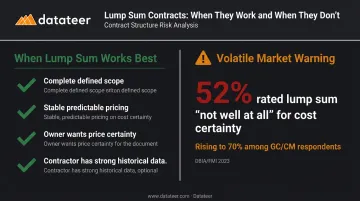
Lump sum works best when:
- Design is complete and scope is fully defined
- Pricing inputs are stable and predictable
- The owner prioritizes simplicity and price certainty
- The contractor has strong historical cost data for the work type
One important caveat: in volatile markets, lump sum's risk profile shifts dramatically. A 2023 DBIA/FMI survey found that 52% of respondents rated fixed price/lump sum "not well at all" for managing cost certainty in volatile conditions—a number that climbed to 70% among general contractors and CM respondents.
On lump sum jobs, the CFM tracks percent complete against a fixed contract value. Cost growth reduces estimated margin without changing the contract price, which makes accurate cost-to-complete estimates the central financial management task.
What Is a Cost-Plus Contract?
Under a cost-plus contract, the owner reimburses the contractor for all direct project costs—labor, materials, equipment, subcontractors, overhead—plus a predetermined profit. That profit is either a fixed fee or a percentage of total costs.
The Two Main Structures
- Cost-Plus Fixed Fee (CPFF): The contractor's fee is set at contract inception and doesn't change with actual costs—only with scope changes. This preserves some incentive to control spending.
- Cost-Plus Percentage of Cost (CPPC): The fee rises as actual costs rise. Federal procurement explicitly prohibits CPPC because it removes the contractor's incentive to contain costs. In private construction, it's legal but worth scrutinizing carefully before agreeing to it.
The Documentation Burden
Cost-plus contracts generate significant administrative work. Every invoice, receipt, and cost record must be submitted and verified to justify reimbursement. Missed documentation means missed revenue—it's that direct. A GSA audit of cost-reimbursement contracts identified more than $24.4 million in unallowable costs across audited claims, illustrating how documentation failures create real financial exposure.
Who Bears the Risk?
The owner absorbs virtually all cost uncertainty. There's no ceiling on what the final project cost could be under a pure cost-plus structure. That makes it well-suited for complex or fast-track projects where scope can't be fully defined upfront—but it demands that the owner maintain active oversight of cost accumulation throughout the project.
WIP reporting implication: That ownership of risk has a direct consequence for financial reporting. Costs are continuously accumulating and reimbursable, so a two-week lag in cost visibility means overruns go undetected long after the window to course-correct has closed. Real-time cost-to-date versus budget is the critical metric on cost-plus work—reviewed weekly, not monthly.
What Is a GMP Contract?
A Guaranteed Maximum Price contract is structured as cost reimbursement with a ceiling. The contractor commits to a maximum total project cost. Costs above the GMP come out of the contractor's pocket. Costs below the GMP are typically shared between contractor and owner per a negotiated split.
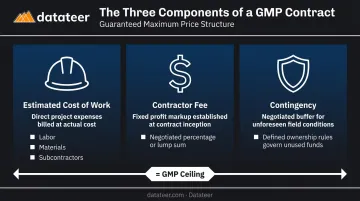
The Three Components of a GMP
- Estimated cost of work — labor, materials, subcontractors
- Contractor fee — the profit markup, fixed at contract inception
- Contingency — a buffer to absorb unforeseen conditions, with defined ownership and permitted uses negotiated between parties
Open-Book Cost Tracking
GMP contracts are transparent by design. Owners have the right to review subcontractor bids, invoices, and cost records throughout the project. That transparency builds trust—but it also creates substantially more administrative workload for the contractor's finance team than a lump sum arrangement.
The shared savings clause is what makes GMP genuinely incentivize cost control. If the contractor brings the project in under the ceiling, both parties benefit. Without that clause, the contractor has little reason to optimize beyond hitting the GMP exactly.
GMP Administration in Practice
The open-book requirement isn't optional—and when it's poorly administered, the consequences are significant. A 2024 GSA OIG audit found that 10 of 12 active GMP projects did not reconcile monthly payments to open-book cost records. Six of 18 projects reviewed saw GMP increases of more than 25%. A ceiling alone doesn't replace disciplined monthly cost verification.
WIP reporting implication: GMP finance management requires monitoring actual costs versus the GMP ceiling continuously, not monthly. Three data points need real-time visibility at all times:
- Contingency position — how much buffer remains and what's been consumed
- GMP adjustment approvals — pending and approved changes against the ceiling
- Projected cost-to-complete — whether the current trajectory stays under the cap
Finance tools that pull live cost data overnight from ERPs like Sage, Vista, or Acumatica let project teams track ceiling headroom before it disappears. Datateer's Job Costing & Cost-to-Complete and Cost Variance modules surface actual versus budget at the job, phase, and cost-code level on a daily basis — which is the cadence GMP administration actually requires.
Cost-Plus vs. Lump Sum vs. GMP: A Direct Comparison
| Dimension | Lump Sum | Pure Cost-Plus | GMP |
|---|---|---|---|
| Owner payment | Fixed stipulated price | Actual costs + fee | Actual costs + fee, capped at GMP |
| Cost overrun risk | Contractor | Owner | Owner below ceiling; contractor above |
| Cost transparency | Lowest | Highest | High, with ceiling and reconciliation |
| Savings below budget | Contractor keeps all | Accrues to owner | Shared per contract terms |
| Documentation burden | Minimal | Extensive | Extensive + open-book audit |
| Finance team focus | EAC accuracy, margin fade | Allowability, coding, fee calc | All cost-plus controls + contingency and ceiling tracking |
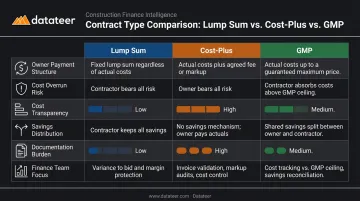
Sources: AIA, FAR Part 16, DBIA standard forms
The GMP vs. Lump Sum Confusion
GMP and lump sum look similar on the surface — both establish a ceiling — but the financial mechanics are opposite. Under lump sum, the price is fixed regardless of actual cost: the contractor keeps all savings or absorbs all overruns, and the owner never sees cost detail.
Under GMP, the owner pays actual costs up to the ceiling, can review all cost records, and typically shares in savings below the GMP. These are structurally different accountability frameworks — and conflating them leads to misaligned audit prep, wrong documentation requirements, and reporting gaps.
How Change Orders Work Differently
- Lump sum: Change orders are formal and often contentious—they modify a fixed price, so both parties have incentive to fight about scope boundaries
- Cost-plus: Changes absorb naturally since the owner pays actuals anyway; the financial impact is cost accumulation, not price negotiation
- GMP: Change orders must be tracked carefully against the established contingency—an approved change that exceeds contingency is a GMP adjustment, which carries its own approval process and financial reporting implications
Which Contract Type Is Right for Your Project?
The selection decision comes down to two variables: how well-defined is the scope, and how much cost uncertainty can each party tolerate?
| Project Condition | Best Fit |
|---|---|
| Complete design, stable pricing, defined scope | Lump sum |
| Evolving scope, fast-track start, high uncertainty | Cost-plus |
| Owner needs a budget ceiling but construction must start before design is complete | GMP |
| Weak cost-accounting or audit capacity | Avoid unmanaged cost-plus/GMP exposure |
The Mixed-Portfolio Problem
Most construction firms aren't running one contract type at a time. A $200M contractor might carry lump sum commercial work, a cost-plus industrial project, and a GMP hospital job simultaneously—each with different billing structures, WIP methodologies, and cost-tracking requirements. That combination creates real financial complexity.
Managing that mix across separate reports is where finance teams lose hours they don't have. Datateer connects directly to ERPs including Sage, Viewpoint Vista, Procore, Acumatica, and CMiC, pulling live cost data across the full job portfolio into one view. Finance teams can track WIP position, over/under-billings, and margin trajectory per job without waiting for month-end close.
The WIP & Financial Truth dashboard covers portfolio-level metrics — total contract value, cost-to-date, earned revenue, and forecasted margin — in a single refresh. What previously took 10–20 days of spreadsheet work runs in about two minutes.
Mismatched Contracts Create Lasting Damage
Picking the wrong contract type for the project conditions isn't easily fixed mid-job. Common mismatches follow predictable patterns:
- A lump sum bid on a poorly defined scope triggers scope creep disputes and change order battles that erode margins on both sides
- A cost-plus contract without a GMP cap on a budget-sensitive project invites owner payment disputes when final costs run over
- Premature conversion from cost-plus/GMP to fixed price before subcontracts are executed can shift significant profit to the contractor — one documented GSA case put that figure at nearly $25 million
The contract structure is a financial decision as much as a procurement one. Getting it wrong early sets the terms for every dispute that follows.
Frequently Asked Questions
Is GMP the same as lump sum?
No. Under lump sum, the price is fully fixed regardless of actual cost, and the contractor keeps all savings. Under GMP, the owner pays actual costs up to a ceiling and typically shares savings below it—making GMP an open-book, cost-reimbursable structure with a price cap.
What is the main difference between cost-plus and GMP?
Both reimburse actual costs, but GMP adds a contractual ceiling. Any costs beyond the GMP come out of the contractor's pocket. Pure cost-plus has no such ceiling—the owner bears unlimited cost risk, which makes documentation and oversight critical.
Which construction contract type carries the most risk for the contractor?
GMP contracts carry the highest contractor risk because the contractor guarantees a maximum price and absorbs any overruns. Lump sum also carries significant risk from estimation errors. Cost-plus carries the least contractor risk since all allowable costs are reimbursed.
When is a lump sum contract a bad idea?
When the project scope isn't fully defined at bid time. Incomplete design documents produce inaccurate estimates, which lead to scope creep disputes, excessive change orders, and margin erosion for the contractor—while destroying the price certainty the owner thought they were getting.
Can a cost-plus contract include a GMP?
Yes, and it's common. A GMP layered on a cost-plus or T&M structure as a "not-to-exceed" clause preserves the flexibility and transparency of cost reimbursement while protecting the owner from unlimited cost exposure.
How does contract type affect WIP reporting?
Lump sum WIP tracks percent complete against a fixed contract value—cost growth reduces margin without changing the price. Cost-plus and GMP WIP must also account for cost-to-complete accuracy, billing-versus-cost lag, and (for GMP) remaining contingency and ceiling headroom.