The pressure is compounding. With 69% of construction companies still making payments by paper check, according to a January 2025 AmEx/PYMNTS report, the industry's financial infrastructure is overdue for a structural upgrade.
AI platforms purpose-built for construction finance are now addressing this directly — not through generic automation, but through tools that understand cost codes, WIP schedules, retention, and job costing natively.
This guide focuses specifically on AI platforms built for construction finance management — not general project management tools. It's written for CFOs, CFMs, and CPA firms serving construction clients.
Key Takeaways
- AI platforms built for construction finance automate WIP reporting, cash flow forecasting, job cost tracking, and AP workflows — replacing days of manual spreadsheet work
- The strongest platforms connect directly to construction ERPs (Sage, Vista, Procore, Acumatica) and deliver live dashboards rather than static monthly exports
- Key selection criteria: ERP integration depth, data refresh speed, setup timeline, pricing model, and native construction reporting logic
- Platforms reviewed include Datateer, Briq, AvidXchange, CMiC, and Procore Financials — each covering a distinct slice of the construction finance workflow
Why 2026 Is a Turning Point for AI in Construction Finance
Construction finance management is not general business accounting. It involves WIP reporting tied to percentage-of-completion, job cost tracking across dozens of cost codes, and subcontractor AP with retention and lien waivers — all spanning multi-year project lifecycles. None of this maps cleanly to tools built for SaaS companies or retail businesses.
The financial stakes are significant. CFMA reports Days in Accounts Receivable of 55.2 against Days in Accounts Payable of 32.8 for 2024 — firms are structurally carrying working capital gaps as a normal cost of doing business.
That gap has consequences. 37% of KPMG engineering and construction respondents missed budget or schedule targets by 20% or more, with inadequate risk visibility cited as a primary driver.
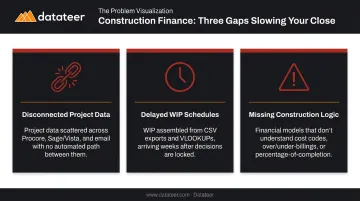
Those numbers explain why generic finance tools keep falling short. AI platforms purpose-built for construction are addressing three structural gaps that horizontal software has never solved:
- Project data scattered across Procore, Sage or Vista, and subcontractor email threads — with no automated path between them
- WIP schedules assembled from CSV exports and VLOOKUP marathons, arriving weeks late after decisions are already locked
- Financial models that don't understand cost codes, over/under-billings, retention schedules, or percentage-of-completion out of the box
The construction accounting software market was valued at $1.9 billion in 2024 and is projected to grow at a 6.9% CAGR through 2034, driven by demand for automation and real-time reporting.
Best AI Platforms for Construction Finance Management in 2026
Platforms below were evaluated on construction-specific functionality, ERP integration breadth, reporting capability, and real-world adoption by contractors. Each serves a different part of the construction finance workflow.
Datateer
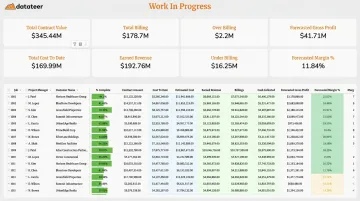
Datateer is a Financial Operating System purpose-built for construction — connecting directly to 12+ construction ERPs (Procore, Sage 100/300/Intacct, Viewpoint Vista, Viewpoint Spectrum, Acumatica, Foundation Software, CMiC, Jonas, QuickBooks, NetSuite) and automating the full financial data pipeline from ERP to executive-ready dashboards.
The platform ships 12 pre-built construction intelligence dashboards on day one across four suites: Executive Strategy & Solvency, Financial Operations & Cash Management, Project Excellence & Field Operations, and Resource Productivity. Core capabilities include:
- Automated WIP schedules and over/under-billing summaries
- ASC 606 revenue recognition and job-level cash flow analysis
- 13-week liquidity forecasting and PM scorecards
- All pre-mapped to construction ERP data models
Unlike generic BI tools, the construction logic is already built in. No 18-month implementation, no custom data modeling, no cost-code mapping from scratch. Clients at Double L Management put it plainly: "That one click replaced two weeks worth of prior work."
| Attribute | Details |
|---|---|
| Key Features | Automated WIP reporting, ASC 606 compliance, job cost tracking, 13-week cash flow forecasting, over/under-billing analytics, change order tracking, retainage analytics, labor slippage alerts, PM scorecards, direct ERP sync with 12+ platforms, 12 pre-built dashboards |
| Pricing Model | Flat annual pricing starting at $10,000/year per data source; unlimited users; no per-seat or per-module fees; annual fee starts only when data is flowing (2-4 week setup) |
| Best For | Construction CFOs and Finance Managers at firms from $10M to $1B+ in revenue who need a single source of financial truth without building a custom BI stack |
Briq
Briq is an AI orchestration platform for construction, deploying 20+ purpose-built AI agents and a fleet of digital workers that run financial workflows around the clock. These agents handle invoice processing, payroll management, budget variance analysis, and data movement across systems — without requiring manual oversight.
The platform's differentiator is breadth of financial automation. Rather than focusing on reporting and analytics, Briq embeds AI throughout the financial operations lifecycle — from AP and forecasting through to executive reporting and risk management. A documented case study shows Briq connecting CMiC to Procore bidirectionally for a contractor, eliminating duplicate data entry across systems.
| Attribute | Details |
|---|---|
| Key Features | AI-powered budgeting and forecasting, AP automation, invoice processing, cash flow management, risk assessment, executive reporting, 20+ AI agents |
| Pricing Model | Custom pricing; modular platform with demo-first onboarding |
| Best For | Mid-to-large construction firms wanting AI embedded throughout their financial back office, from AP to forecasting |
AvidXchange
AvidXchange is a dedicated AP automation platform with a construction-specific track — AvidSuite for Construction — that automates invoice capture, PO matching, and payment workflows across major ERPs including Sage 300 CRE, Sage Intacct, Viewpoint Vista, and Acumatica.
In April 2025, AvidXchange launched three AI-native tools: the AI Approval Agent (assesses invoice approval likelihood based on historical decision patterns), AI PO Matching Agent (automates line-item matching between invoices and POs), and AI-Enhanced Invoice Capture. For firms bottlenecked by AP volume and slow subcontractor payment cycles, these tools cut processing time and reduce manual touchpoints.
| Attribute | Details |
|---|---|
| Key Features | AI Invoice Capture, AI Approval Agent, AI PO Matching Agent, PO matching automation, lien waiver management, payment automation (ACH, check, virtual card) |
| Pricing Model | Custom pricing based on invoice volume and integrations; free demo available |
| Best For | Construction firms processing high invoice volumes who need to reduce AP processing time and improve subcontractor payment visibility |
CMiC
CMiC is a unified construction ERP where financials, project operations, and analytics run on a single database. All project, cost, and financial data lives in one system — so there's no reconciliation lag between what the field sees and what finance reports.
For finance teams, the single-database architecture matters most in forecasting and change order management. Job cost transactions post simultaneously to the general ledger and job costing, which eliminates the double-entry problem common in firms running separate accounting and PM systems. A Power BI Connector is available for teams that want to extend reporting beyond the native interface.
| Attribute | Details |
|---|---|
| Key Features | Job cost management, forecasting, change order tracking, earned value management, AP/AR/GL, resource scheduling, Power BI Connector |
| Pricing Model | Custom pricing upon request; free demo available |
| Best For | Mid-to-large construction firms that want a single system for both project operations and financial management |
Procore Financials
Procore Financials is the financial management layer within the Procore platform, providing live budget tracking, commitment management, change order workflows, and financial reporting tied directly to field activity. For firms already running Procore for project management, it closes the field-to-finance gap natively. A change order or RFI logged in the field shows up in the financial dashboard without a manual transfer.
In January 2026, Procore acquired Datagrid, an agentic AI platform that connects Procore with 100+ data sources and executes autonomous workflows. This acquisition materially expands Procore Financials' AI capabilities, enabling automated routing, budget deviation alerts, and deeper integration with external finance systems.
| Attribute | Details |
|---|---|
| Key Features | Live budget management, subcontract and commitment tracking, change order automation, AI-assisted workflows (Datagrid), invoice management, Forecast to Complete views |
| Pricing Model | Custom pricing upon request; unlimited users per license |
| Best For | Construction firms already using Procore for project management who want to unify financial data within the same platform |
How to Choose the Right Platform
The Four Factors That Actually Determine Platform Success
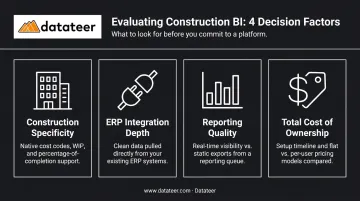
Most construction finance teams evaluate platforms on feature lists. The better approach is to evaluate on four factors that determine whether a platform eliminates manual work or just adds another tool to the stack:
- Construction specificity — does the platform natively understand cost codes, WIP schedules, retention, and percentage-of-completion, or does it require custom configuration to get there?
- ERP integration depth — can it pull clean, structured data from the specific ERPs your firm already runs?
- Reporting quality — are outputs real-time and actionable, or static exports that are already outdated when you open them?
- Total cost of ownership — what's the setup timeline, and does pricing scale with users or stay flat?
The Most Common Mistake Buyers Make
The single most costly selection error is choosing a general-purpose FP&A tool or horizontal BI platform — Microsoft Copilot, Power BI from scratch, or a generic forecasting tool. Teams spend months on custom configuration that still doesn't produce a compliant WIP schedule or a job-cost view by cost code.
Generic tools don't know what a cost code is. They don't understand the difference between overbilling and underbilling, and they have no concept of retention schedules or percentage-of-completion. Building that logic from scratch is a 12-18 month project that regularly costs $500,000+ and still delivers incomplete results.
Two Factors That Predict Success
ERP integration depth determines whether the platform can actually pull your data, or whether your team ends up doing manual exports anyway. A platform that lists 50 integrations but only does surface-level API calls will require more manual intervention than one with fewer but deeper connections.
Data refresh rate determines whether you're making decisions on live information or last month's numbers. For WIP reporting specifically, the difference between overnight refresh and a manual monthly process is the difference between proactive project management and forensic accounting once margin has already slipped.
Conclusion
The right AI platform for construction finance management connects to your ERP without a six-month integration project, understands construction-specific financial logic without custom configuration, and produces reports your finance team will actually rely on — not just tolerate.
Before selecting a platform, evaluate three things:
- How long your current WIP reporting process takes end-to-end
- Which ERPs you're running today and whether they're on the vendor's integration list
- Whether your team can maintain a custom data pipeline or needs something pre-built
Prioritize vendors with short setup timelines, proven construction-industry references, and pricing structures that don't penalize you for adding users.
For firms ready to move from monthly spreadsheet grind to real-time financial intelligence, Datateer offers a purpose-built Financial Operating System for construction. It connects directly to 12+ construction ERPs, delivers 12+ pre-built dashboards on day one, and goes live in 2–4 weeks — with no annual fees until data is flowing. Reach out at hello@datateer.com to get an ERP compatibility check before you commit.
Frequently Asked Questions
What is the best AI for managing finances?
For construction firms, the answer depends heavily on industry context. Platforms like Datateer or Briq that natively understand cost codes, WIP schedules, and job costing will outperform generic tools like Microsoft Copilot or standard FP&A software, which require significant custom configuration before they can produce construction-specific reports.
Which AI is best for construction management?
It depends on the problem being solved. General construction management tools (Procore, monday.com) handle project workflow and scheduling, while construction finance platforms (Datateer, Briq, AvidXchange) handle WIP reporting, job costing, cash flow, and AP. They address fundamentally different needs.
Can ChatGPT read construction plans?
ChatGPT can parse text from uploaded documents, but it cannot reliably interpret structured construction financial data — WIP schedules, cost code exports, ERP data structures — or produce audit-ready financial reports. Purpose-built platforms with direct ERP integration are required for construction finance use cases.
How does AI improve WIP reporting for construction firms?
AI platforms automate the extraction, standardization, and formatting of job cost data directly from the ERP, replacing the manual CSV export and VLOOKUP process that typically consumes 10-20 days each month. The result is a WIP schedule that refreshes automatically rather than one built by hand each reporting cycle.
What ERP integrations should a construction finance AI platform support?
The most commonly used construction ERPs include Sage 100/300/Intacct, Vista by Viewpoint, Viewpoint Spectrum, Acumatica Construction, Procore, Foundation Software, CMiC, Jonas Construction, QuickBooks, and NetSuite. A platform's practical value depends entirely on whether it connects cleanly to the specific ERP a firm is already running, not just to a broad list of supported systems.